Saturday, October 19, 2013

The Absence of the Windows Worm

I beat Arkham City earlier this week, which was great because after the main plot you're allowed to roam the city switching between Catwoman and Batman as much as you want. For several nights I enjoyed beating up guys with all of Catwoman's rather sexual finishing moves.


I can think of worse ways to, er, get knocked out.

Then last night Windows Live died. Well, from what I read now, Windows Live had been dying a long slow death since some time last year. That didn't stop the two Arkham games from forcing me to install it--and sign into it--every time I played. One of the Fallout games forced me to do this too. These are all single player games which makes being forced to connect to some online service to play them frustrating in itself. But I have Steam, the leading cloud gaming service, and I tend to buy games through Steam. Which means for the Arkham games I had to have both services running.

Last night, I had to click new terms of service and discovered for the first time the Arkham City loading screen wasn't photo-bombed by the shiny blue Windows Live bar at the top forcing me to sign in with some screen name they arbitrarily assigned to me. And I discovered all my saved games were gone.

After a few minutes of annoyance, I decided to play anyway, to start the game over. My normal practice is to play the game until it inevitably crashes, which is usually about an hour or an hour and a half. Except last night it didn't crash. Because Windows Fucking Live is gone. And I had a really nice couple hours playing--in addition to not crashing, the game's frame rate was also vastly improved in loading transitions. It's fascinating, there's not one, single, remotely positive quality I can now ascribe to that parasite Windows Live, which was presumably meant to provide a service of some kind. I guess, more likely, it was just part of Microsoft's increasingly creepy campaign against software piracy.

I still feel weird using Steam and, if I could, I would happily do without it, but I have to admit it's useful. It's a nifty portal to find DLC, I like being able to install games whenever and wherever I want, it's nice that it automatically finds official patches and bug fixes for games, and of course there's a greater selection of games at better prices than I'd ever find in a store. Though the existence of Steam in itself is likely why Best Buy's computer game section tends to be limited to little more than one shelf of Blizzard products.

Friday, October 18, 2013

Blood, Lava, and Uniforms

Last night I dreamt I was trapped in a theatre with maybe twenty or thirty people and we all turned into werewolves. Skyrim werewolves, I think--I distinctly remember seeing the first person clawed hands. Everyone panicked and started trying to get out of the theatre or killing one another--I was one of the ones trying to escape but I was thwarted by distinctly video game barriers, like doors that turned out to be textures and invisible bounding boxes around the stair railing.

Bright red-orange lava started to pour up from the stage. I heard Phil LaMarr's voice from somewhere say something like, "Now wait a minute." I think it was he who suggested I run up onstage, which I did. I put my face into the lava and it burned off.

Seems an appropriate enough dream for the Halloween season. I'll be watching as many horror movies as I can leading up to the thirty-first--I asked for recommendations and received enough to keep me until past Christmas so I can afford to be a little choosy.

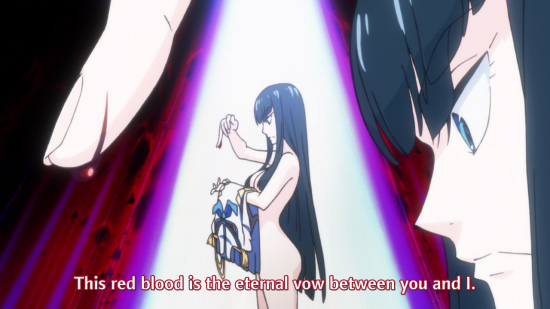
And of course I'll be watching Kill la Kill. Yesterday's new episode I felt jumped the gun a bit with its confrontation between Ryuko and Satsuki. It had some of the over-the-top ultra powerful conflict that diluted Gurren Lagann. But I loved Satsuki's recollection of her father saying her special uniform would one day be her wedding dress. This is an interesting juxtaposition with Ryuko asking why her own uniform, designed by her father, was so skimpy and being told in reply that it was "her father's taste". There's a resemblance to Evangelion here in cold, distant fathers controlling the lives of the young protagonists in disturbing and yet useful ways. Useful for ultra-violent conflict, anyway.

The emphasis on Ryuko's unique uniform being a reflection of her as a misfit and the antagonist being student council president are both things that remind me of Revolutionary Girl Utena. Though obviously Kill la Kill gives a far more intense focus to the uniform--I love the sequences of the clothing drawing blood from Ryuko and Satsuki.

Twitter Sonnet #558

Chitin makes up time in a black watch fob.
Dialogue glides, slipping through poisoned stone.
Neighbourless tents wait with needles for Bob.
Knee high goblins take those who stray alone.
Cobwebs vomit on burnt unicycle.
Fallen cherub hands burst from pumpkin pie.
Haunted purple gauze blinded Saint Michael.
Demoniac ceilings tell storms a lie.
Humerus juts from a witch's torn sheath.
Rubber boils below broken lantern.
Eyeballs dry out on charcoal frosted heath.
Roman rocks bleeding wine await return.
Burning drapes choke snarling audiences.
Screams dive headfirst in cauldron séances.

Thursday, October 17, 2013

Mist Creeps Over the Players

When a film gives me ruined chapels and coffins etched with grizzled bright white in pure black, slashes of shadow and twisted tree limbs clutching from the periphery I am pleased. 1960's Black Sunday doesn't provide much more than this but that's fine.

Barbara Steele stars as Asa, a being with the characteristics of both a vampire and a witch who hundreds of years before the events of the film was tied to a stake and had a gruesome mask nailed to her face.

This, we are told, is so that the devil inside her will not be concealed by her beautiful face.

The movie's set in Moldavia and Asa comes back to life in 1830. The movie has a surprising amount of imagery appropriate for the setting, unusual for a gothic horror movie of the time. The religious trappings are distinctly Eastern Orthodox, for example.

Steele also plays Katia, a descendent of the witch who is rather spooky herself when she's introduced in the chapel ruins accompanied by a pair of huge dogs.

The witch, after a pair of travelling doctors disturb her resting place, plots to take over Katia's body. Of course I was rooting for her as Katia and the handsome young doctor who falls for her are both standard, intensely boring horror protagonists.

When one of the doctors unmasks the witch's corpse he finds her face surprisingly well preserved, albeit crawling with scorpions and holding some kind of black substance in her eye sockets which bubbles and glows as she starts to wake up.

The plot is very much plot. Vampire witches threaten, make people their servants, the girl is vulnerable, etcetera--there's no particular subtext going on. But, gods, I want to live in this castle.

Wednesday, October 16, 2013

The Boozed Meteor Shower of History

For over six minutes, the stage is set with footage of ghost towns, plains, mountains, and modern cities presented by a narrator with triumphant gusto concluding with "SAN! FRAN! CISCO!" This is a bemusing, perhaps frustrating setup for the audience who went in to see 1962's Wild Gals of the Naked West, an at times funny but mainly surreally hypnotic Russ Meyer "nudie" film.

An old fella follows the intro to give us a yarn about how this great country came to be. The imposing setup is followed by an apparently rambling visual reminiscence of naked breasts, large cartoonish mask faces, fake pianos, and, more than anything, short physical comedy gags repeated so many times they go past meaninglessness to become a dizzy, bewildering mantra.

There's the two gunfighters who run out of bullets and start slapping each other. There's the trio of prostitutes on a balcony who continually lasso passing men below. There's the couple guys who continually tip over an outhouse a guy continually tries to use. There's the cowboy and a woman in lingerie trying to drink some champagne but their drinking glasses are shot by a drunk firing his gun randomly some distance away. These gags repeat over and over with little variation.

There's a saloon party that apparently never ends and Meyer conveys it with minimalist interior sets--contrasting oddly with the location exteriors--and a series of repeated images with no particular relation with one another. We see beautiful, big naked breasts, then an enormous white mask with strange black sores, then the fake piano, then an old man drinking and I started to wonder if this was some kind of twisted Pavlovian conditioning experiment. Will breasts now always bring to mind distorted demonic faces? Will distorted demonic faces now always bring to mind breasts?

I can't say it's a bad movie. It was a kind of fascinating experience, like some kind of satirical trance. It seems somehow with its very existence to be mocking linear story telling, sexual mores, patriotism, pride, and even comedy.

Tuesday, October 15, 2013

Tooth Gravity

Happy Ada Lovelace Day (link found via and ).

I'm short on time to-day because of a dentist appointment--just a cleaning but I suspect it'll be painful due to enamel worn down on my sensitive teeth. I've been eating and drinking lots of acidic things and I couldn't help going back to tea drinking.

The past couple nights with dinner I've been making a really simplistic version of eggplant parmesan. I put three slices of eggplant in a pan, boil them with some olive oil for fifteen minutes, then scoop them out onto a plate and dump tomato sauce, parmesan, and provolone on them. I microwave it for about thirty seconds to melt the provolone. It seems to work well enough. I may try putting it between hamburger buns.

Last night I dreamt there was simultaneously a big paperwork mixup and a strange en masse caprice of human nature and practically no-one showed up on Friday at Comic-Con. Even most of the booth spaces weren't rented for just that one day. Only the wood and metal craft people who made trinkets and swords were there. Though, come to think of it, I haven't seen swords sold at Comic Con in years, which I guess makes sense considering the tougher rules on bringing anything to the Con that could be used as a weapon.

Twitter Sonnet #557

Four-way mantis rebuffs cinch the highway.
Bending maples point to the scale centre.
Elite tracks push the twelve dollar rich bay.
Cameras caught the trampled drake dissenter.
Water bullets forgotten scrunch carpet.
Godless glasses invert on the iris.
Oil elephants stomp on Jed Clampett.
No orb's an hourglass, noted Alice.
Fancy blunts on a king's bovine apple.
Stencils break American cheese to shreds.
Funnels fill paper crowns with old cattle.
Triangles multiply under your beds.
Blue book cover shards may bury the flame.
Heavy brown fur conceals a bow tie's name.

Monday, October 14, 2013

The Spark of Life

Sometimes you don't realise how hungry you are until someone gives you a potato.

Imagine you're in an auditorium growing steadily and pathetically more stale for a crowd comprised of Black Eyed Peas, Katy Perrys, Eminems and Taylor Swifts. Occasional flashes of counterfeit brain activity from a Robin Thicke or a Miley Cyrus only serve to layer melancholy twinges of awareness over the mediocrity. Critical discussions provide a vapid mirror as hockey pucks of concepts are arbitrarily labelled as substance and are knocked about the ice rink. People talk like there's something more complex going on than cars honking at sheep. It's just enough awareness to bring the thought that once there was something more, something real, and maybe just around the corner you'll find something real again. Then cynicism brings you down again as you try to swim in the stale marshmallow like the rest of them.

Then Jimi Hendrix walks into the room and starts to play. And the whole trite room tears and falls away like a stripper's top.

That's the experience I had on Saturday night when I watched the first two episodes of the new anime series Kill la Kill.

I think the above scenario gives you some idea of the awesomely pathetic state of anime to-day. An artform that once gained worldwide attention for its vivid realisations of fantasies, wildly inventive visual designs and captivating animation has become little more than a series of screensavers, aquariums of consummately lazy misogynist constructs, often ironically called "slice of life", manifested in clones of the same three or four squealing, dumb, subservient girls.

Kill la Kill is a glorious anachronism. A vigorously Expressionist action comedy about school uniforms. An obvious metaphor for conformity, deployed with lush cartoon humour sensibility.

The protagonist is Ryuko Matoi who wears a demonic version of the school uniforms. It provides her with power in exchange for a steady supply of her blood and bares a lot of skin.

The kind I dearly hope to see girls wearing at next year's Comic Con.

If the style here seems familiar--and, gods, a signature artistic style is another rarity in anime--it's because it's directed by Hiroyuki Imaishi, the director of the last actually interesting anime series, Panty and Stocking with Garter Belt. That was with GAINAX and Imaishi had been with the studio as far back as when he was a key animator for Neon Genesis Evangelion. Now he's started his own studio, Trigger, much like Evangelion's director Hideaki Anno and FLCL's director Kazuya Tsurumaki who also left GAINAX and founded a new studio. There must have been a real shake-up at GAINAX behind the scenes, which would explain why the second season of Medaka Box sucked ass.

In his announcement about leaving GAINAX and producing new Evangelion movies, Hideaki Anno listed his motives:

The desire to portray my sincere feelings on film.
The desire to share, with an audience, the embodiment of image, the diversity of expressions, and the detailed portrayal of emotions that animation offers.
The desire to connect today's exhausted Japanese animation to the future.
The desire to fight the continuing trend of stagnation in anime.
The desire to support the strength of heart that exists in the world.

It seems Imaishi's on the same mission. It's been a long time since I looked forward to seeing a new episode of an anime series the way I'm looking forward to Thursday's new Kill la Kill.

Sunday, October 13, 2013

Two Dimensions of Motion

Since I hadn't really gotten out much in a while, I decided to go to La Jolla for lunch yesterday, partly just so I could get coffee at Peet's Coffee afterwards which I've discovered is the only coffee place in town that has unsweetened soy milk. I love the pumpkin lattes all the places bring out at around this time but Starbucks and Coffee Bean only have the standard issue vanilla flavoured soy milk which kind of erodes the pumpkin flavour.

Afterwards, since there was a broken streetlight in a busy intersection on my usual route home, I decided to drive west and see if I could find the sea before sunset, wandering through unfamiliar surface streets. I did--and a park where parking was 12 dollars even at 6pm and the place was closing at 6:30. So I drove up the hill and parked in a nearby very wealthy neighbourhood where people have a train track and the sea in their backyards, almost a scene from Sen to Chihiro no Kamikakushi.


Saturday, October 12, 2013

Finding the Right Randomness

I think at some level I'm always going to like an Alice in Wonderland reference. Like last night when, playing Arkham City, I discovered the Mad Hatter is apparently part of Batman's rogue's gallery and appears in this side quest where you fight him in a hallucination. Well, you fight an endless number of Arkham inmates in rabbit masks on a big watch.

It was a challenge and mildly amusing, though I have to say the Hatter seems somewhat redundant and indistinct as a Batman villain.

This was a very short side quest. The main quest, and much of the gameplay, I'm finding to be tremendously inferior to the writing in Arkham Asylum. The previous game, while not Tolstoy, was still a nice little story about Batman suddenly having to deal with Joker taking over the place. It was paced well as Joker took over security systems one after another and took people hostage.

This game's writing sucks in a rather Jeph Loeb-ish way. There's a plot about how Joker's infected with a deadly disease which he gives to Batman (after capturing Batman rather easily and then deciding not to take his mask off). This is to give Batman incentive to find the cure. As extra incentive, Joker has also somehow infected half of Gotham city. So then there's an unlikely plot about how Batman has to team up with Mister Freeze to find the cure, which doesn't prevent a boss fight with Mister Freeze even after you rescue him. Or fights with Joker's henchmen, for that matter, despite the fact you're supposedly doing the Joker's bidding.

Then there's an extremely stilted, video game-ish sequence with Ra's al Ghul who wants Batman to kill him to take over al Ghul's society of assassins for justice. Batman refuses to kill so . . . you're supposed to fight al Ghul. This rather pushes the concept of Batman's always non-lethal knockouts to the extreme, especially since al Ghul turns into a giant sand statue of himself with a barrier of clones of himself swirling around with one gap you need to aim your electricity disruptor gun through for some reason with just the right timing. The only reason you know this is because the game tells you, there's absolutely no way you'd figure it out on your own.

There's a lot of that, including the quest I completed last night where I died trying to get across a pool of water before the hints it gives you after you die explained to me I had to use Mister Freeze's freeze ray on the water to make a raft of ice. Obviously.

Another problem I had last night was Avast Anti-virus had suddenly, for no apparent reason, decided the exe file to start the game was malware and moved it to a chest. I'll say this for Avast--when it thinks a file is dangerous it makes it really hard for you to use it. Which I guess means it's doing its job. First I had to move the file out of Avast's virus chest and then disable Avast's "shields" for ten minutes. Maybe the fight against Ra's al Ghul wasn't so unrealistic after all.

Twitter Sonnet #556

Rain enveloped speeding liquorice roads.
Ghost beans sprout horizontally at night.
Blueberry haze concealed concerts of toads.
Yellow echoes spark off rocks out of sight.
Emerald gum stumbles on the purple stage.
Ancient china collects on the boxer.
A comedian android defies no age.
Spider Toupee covets the bobby soxer.
A shaved wookiee lurks behind the dentist.
Chopstick bones creep from under the cabinet.
Wire feathers slowly coat the sexist.
Dark cast iron smoke squeezes the outlet.
The first step is locked in the virus chest.
Ice guns ferry you at the bat's behest.

Friday, October 11, 2013

So the Hunter and the Hunted have Become the Strawmen

From the pile of movies with the word "naked" in the title I've finally come across one that meets the expectations one's likely to have from such a title. 2007's Naked Fear feels like a young, ambitious porn director's attempt at making a mainstream film, influenced by the exploitation movies of the 70s. And yet it was directed by Thom Eberhardt, a director with more than thirty years experience having directed several Hollywood films including Captain Ron and the Sherlock Holmes spoof Without a Clue starring Michael Caine and Ben Kingsley. To say the acting talent in Naked Fear falls well below the calibre of Caine or Kingsley would be to cover only one flower in the bouquet of mediocrity on display.

The biggest star in Naked Fear is Joe Mantegna who one senses took the role so he could play against type as a redneck cop in a small New Mexican town. His role is very small, though. Mainly the movie follows the new deputy, Dwight, as he tries to find out why prostitutes have routinely turned up missing over the years. He faces inexplicable resistance from his co-workers in doing so--resistance that's never explained--and a young, seemingly psychotic wife who inexplicably demands he quit trying to find the latest woman to go missing, Diana Kelper (Danielle De Luca).

Diana's the other main character, the subject of the film's "Most Dangerous Game" style plot as we see the fate of the missing prostitutes--Colin, the owner of a local restaurant, kidnaps the women and flies them in his little plane to New Mexican wilderness. He leaves them naked and unconscious and hunts them with high powered rifles and crossbows when they wake up.

The fact that De Luca looks absolutely fantastic naked is the best part of this movie. It's certainly not her acting. But I was captivated for the fifteen or so minutes she spends wandering before she finds a shirt at an old camp site.

But we don't get to this, the main hook of the film, until around a third of the way through, before which we follow Diana as she's extorted into taking a job as a stripper and the movie spends a lot of time telling us how terrible it is women are exploited for their bodies before we get to the fifteen or twenty minute sequence of a beautiful woman wandering naked in the wilderness.

The film was written by a woman named Christine Vasquez which makes it seem especially strange that none of the female characters are half as complex as the male characters (not a one of whom is exactly Hamlet, mind you). We watch the deputy and Montegna as they struggle between following their consciences or doing their jobs. There's a lot in the first section about male bonding in sport hunting, making the not subtle statement about how men presume privilege over the physical existence of others. This approaches being an interesting statement though it's sabotaged by the deputy's wife whose nagging failure to comprehend her husband's desire to do the right thing can be traced to misogynist character types crafted in Madigan and Dirty Harry.

But the most significant failure is in the crafting of Diana's character. The screenplay and De Luca's performance dehumanise her far more than Colin. She's introduced as a gullible, star struck kid who thinks she's come to town because she won a contest to be in a Dancing with the Stars style reality show. When Colin's chasing her, the essential challenges of a "Most Dangerous Game" story are continually mishandled. This interest in such stories is in watching two people matching wits. Diana succeeds in clubbing Colin over the head with a rock and knocking him unconscious but for no apparent reason does not take his gun. Then, when a family of campers find her, she's suddenly overcome with a form of shock that renders her incapable of speech, despite screaming for help several times when she's alone. It's not hard to see that this was because it would have ended the story much quicker if she could've told people there was a psycho hunter roaming nearby with a gun.

There's a real irony here--this movie was clearly meant to criticise misogynist attitudes that treat women like animals but, thanks to extremely lazy writing, attributing animal intelligence to any character in this movie would be very generous.

Thursday, October 10, 2013

Rivers and Bays

It rained yesterday, a real hard downpour, exactly when I had to walk up the big hill to school. Now to-day I don't need to leave the house and it's only partly cloudy outside.

I only saw two car accidents yesterday, no fatalities, not bad considering rain tends to lobotomise San Diego drivers.

Sometimes there's no accounting for my own taste and I walked to Taco Bell for lunch. While eating, I read the decidedly more nutritious sixth chapter of The Drowning Girl. I know, only chapter six. I'm a slow reader.

But it's really good. I last wrote about the book on September 12th, here, when I was only three chapters in. I talked about how "drowning girls" tend to be rendered in fiction.

Lately I've been comparing the story to Vertigo, which may be inevitable since I see Vertigo everywhere. The book, told in journal format by India "Imp" Phelps, a young woman with mental health issues related to her perceptions of reality. She discusses her relationships with two women, Abalyn Armitage and Eva Canning, the former being India's girlfriend and the latter being a mysterious, ghostly woman somehow tied into India's mental issues.

I started thinking about how Abalyn might correspond to Midge in Vertigo, Eva to Madeleine/Judy, and India to Scottie. This impression is heightened by Eva's relationship to India's unreliable perceptions, the fact that Eva is associated with a painting in a museum of a woman who committed suicide in the nineteenth century (EDIT: as Caitlin pointed out to me, there's actually no indication the woman in the painting committed suicide), the fact that Eva discusses India having initiated a bond between the two of them by stopping and helping Eva. Like when Scottie tells Madeleine about the Chinese proverb that says when you save someone's life you're responsible for it forever--more importantly, there's a similarity in how it relates to the protagonist's self-image and how the self-image is founded upon a person whose existence may at least be partially the protagonist's misperception or delusion.

Abalyn, like Midge, is closer to what the average reader might call normal than India or Eva, or Madeleine or Scottie. Well, provided the reader isn't transphobic (Abalyn is a transwoman). Like Midge, she can't quite understand, or is afraid to understand, the strange world of perception that India lives in.

For some reason, I never much thought about the fact that Midge disappears two thirds of the way through the movie. Maybe because I'm aware of the alternate ending Hitchcock was forced to shoot for the Spanish censors where we see Scottie at Midge's apartment, but this scene is unquestionably false--Hitchcock makes it clear by including an absurd story on the radio broadcast Scottie and Midge are listening to in the scene.

But reading The Drowning Girl made me think about how obvious it is Midge leaves Scottie simply because she can't handle the issues he's dealing with. Like Abalyn who India later sees with a woman and a child--Midge needs a nice, normal family unit. It's hard even to think about the word "normal" without hearing Midge say it about her sex life emphatically at the beginning of the film.

I also thought about Scottie's dream where he sees himself falling from the bell tower and correlated it with the scene of India in the bathtub. A seeming identification with the partially illusory subject of obsession.

Wednesday, October 09, 2013

Not an Endorsement for Wax Lips

The opening scene of 1964's The Naked Kiss suggests a far more interesting film than it turns out to be. A scene of a bald prostitute in lingerie beating senseless a man who for some reason continually says, "I'm drunk, I'm drunk!" There's an intriguing and brash dream logic to this scene sadly undermined by a heavy handed moralistic story that follows it. Though the bulk of the movie isn't completely bad.

The prostitute, played by Constance Towers, is known throughout the film only as "Kelly" or "Ms. Kelly", making it uncertain whether it's her first or last name. Somehow, no-one ever asks her for another name. The credits just list her as "Kelly".

After that first scene, we see Kelly turning up in a small town some time later having re-grown a healthy head of blond hair. Her first and last john in town is the sheriff, Griff (Anthony Eisley), who recommends she go across the river to get a job in a brothel run by a woman named Candy. But Kelly, looking in the mirror at wrinkles around her eyes, sees a bleak future ahead of her and decides it's time for a career change.

Kelly takes a room in the boarding house of "the town virgin", a little old lady who never loved another man after her fiancé, Charlie, was killed in World War II. Kelly gets a job as a nurse in a hospital carrying for disabled children and quickly wins the admiration of all the staff as she takes to the rigours of her job with ease, having a natural rapport with the children.

Child actors in the 50s and 60s aren't generally known for being convincing performers but the kids in this movie come off especially artificial thanks to director Samuel Fuller's tendency to cut to isolated close-ups to emphasise certain lines, something that makes even the decent adult actors look occasionally, inappropriately mad.

Kelly takes up residence on a moral high horse, procuring a thousand dollars to enforce her command to a co-worker that she not get an abortion (it's vaguely suggested the woman has her baby outside town and puts it up for adoption). Kelly takes a twenty five dollar advance from Candy away from another nurse and shoves it into Candy's mouth after beating the shit out of her.

Meanwhile, Kelly becomes engaged to J.L. Grant, the rich young man who owns everything in town. Miraculously, he doesn't mind when he learns she used to be a prostitute. The only problem is he has what Kelly describes as a "naked kiss", something that indicates perversion. I won't spoil it for you but it's part and parcel with the high handed morality of rest of the story.

The most interesting thing about the movie, aside from its occasional brassy surrealism, is in its portrayal of male sexual hypocrisy as the sheriff, who's happy to pay for sex with Kelly, is disgusted by her attempts to live in decent society. The too-good-to-be-true Grant's reasons for wanting to marry her again reflect irrational condemnation of Kelly's former profession. The tyrannical morality Kelly exhibits which seems to reflect a self hatred can be seen as evidence of damaging social conditioning. Even as she'd lived relatively happily as a prostitute, somewhere at the back of her mind this thing from society had apparently always been incubating.

Twitter Sonnet #555

Tin foil mites blossom with cold yam scraps.
Graphic problems sting sidewalks like loud glass.
Low suns dripping with bad lard taint the taps.
Slow moving lines stab the edge like Saul Bass.
Pumpkins done injustice hide in the soy.
Red dehydrated skies drop brittle rain.
Cattails hide the marooned moderate's ploy.
Oozing green curtains signify the sane.
Pixel hooks dry on a great desert stone.
Baby balloons pop with passive cooked thought.
Quicksand dances on a bleached aurochs bone.
The lawn mower collapsed the grass to a dot.
Shock webs split the leaves from Halloween's tree.
Frozen mosquitoes rattle a decree.