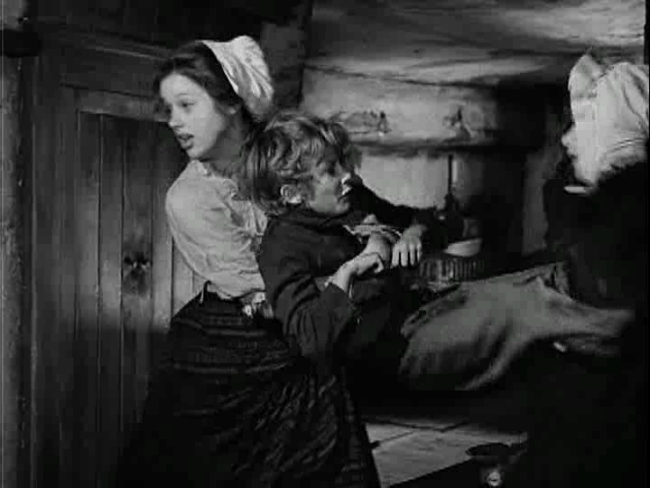
Tuesday, September 20, 2016

The World in a Small Metal Shell

Nazi U-boat crews had a pretty tough time, especially towards the end of World War II, as 1981's Das Boot makes viscerally clear. How audacious, to make a movie where the protagonists are Nazis, though oddly their motives for fighting are never mentioned. The film is about perspective, about exploring a point of view by omitting details. The Nazi philosophy and the faces of their enemies are all absent, distilling the story to a vividly human struggle.
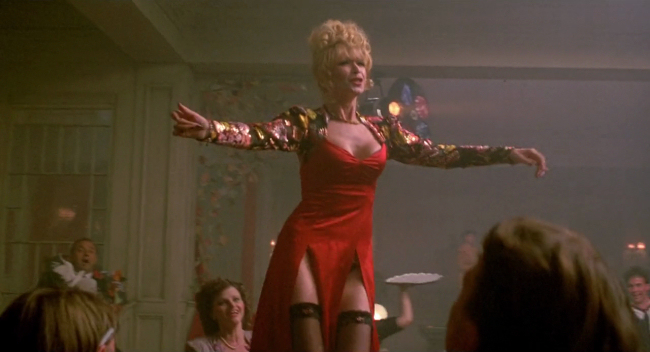
We mostly don't see women, either--I watched the director's cut so I don't know how the miniseries of theatrical cut might be different. But in the version I watched, we see a woman performing and all but making out with the rowdy U-boat crew before they're sent off and women, to their dismay, are absent. The crew makes up for it by writing letters to sweethearts and telling tales of sexual adventures to each other. At one point a crewman even dances dressed as Josephine Baker.

Through their harrowing engagements with British vessels, we never once get a shot of a British crew bustling about on deck of a destroyer, firing cannons, or speculating on the location of the U-boat. Instead, after sighting the enemy from a distance, we follow the crew inside the submarine where we watch as they tensely wait for the subtle sounds that indicate a torpedo they've launched hit the British or for the catastrophic effects of a British depth charge.

This I really loved. In this simple decision, so much of the experience is communicated to the viewer--the enemy as a mysterious blank, the horrible wait to see if water is suddenly going to explode through the bulkheads, shattering long silences where we watch so much of the fear being digested in the face of the captain played by Jurgen Prochnow.
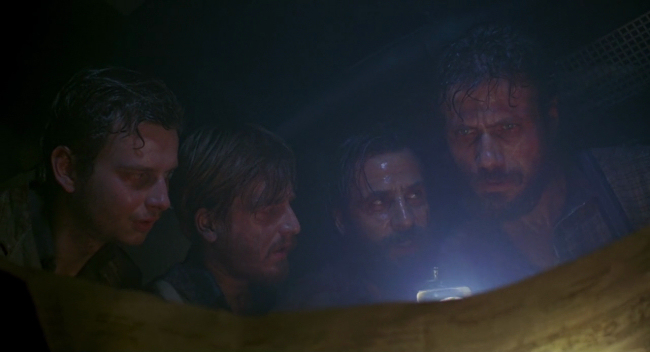
I feel like it's kind of a cheat that the crew never once talks about why they're fighting. In British or American World War II films, it's not uncommon for the characters to mention why they've been called to lay down their lives--certainly it's something officers bring up time and again in speeches. The crew of a U-boat must have been dosed with volumes of Nazi propaganda, it would have been logical to hear them talking about it. I think it would have been a stronger film if the truly nightmarish plight of these seamen where coupled with an expression of their beliefs. Showing the troubles of soldiers who subscribe to an odious philosophy would make for a more complex tale. It's true, we all know what the Nazis believe, but sidestepping it still seems odd and feels like a false note.
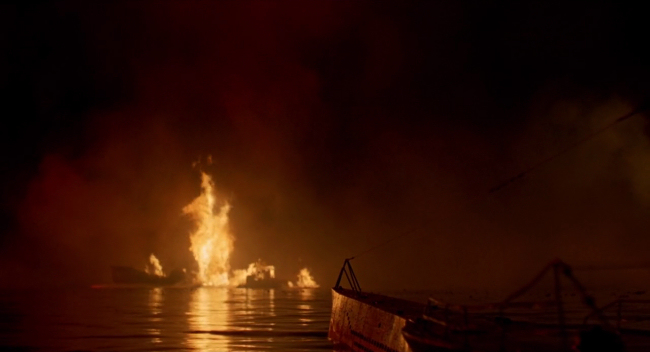
But I certainly can't fault this film for effective sounds and visuals. The claustrophobic atmosphere in the sub, the performances, the invigorating music, are all impressive.

Monday, September 19, 2016

Sherwood Justice

Star Trek: The Next Generation started out pretty well when it came to gender roles. It had a female chief of security and men wearing dresses. But then Denise Crosby left the show in the first season and afterwards the show was criticised for having its only principle female characters, Beverly Crusher and Deanna Troi, in caretaker roles. This was the case for years until the show introduced the recurring character Ensign Ro, a former resistance fighter played by Michelle Forbes, in the fifth season. There were plenty of guest female characters in between the first and fifth season who occupied more traditionally male roles as fighters and leaders (perhaps most notably Lt. Commander Shelby from "Best of Both Worlds") but at times the show could be downright regressive as I was reminded last night watching the fifth season episode, "Qpid".

Kids like Q (John de Lancie), I think, because he's very much like a child. And as an omnipotent being he gets to cut through all that boring adult stuff that usually happens on the show. By my twenties, I'd started to find Q annoying but in my thirties I started being mildly amused by him again. In this episode, he wants to pay Picard back for helping him when he briefly lost his powers in the superior third season episode "Deja Q" and he chooses to do so by helping mend fences--or place a permanent barrier between, it's unclear which--Picard and Vash.

Introduced in the also superior third season episode "Captain's Holiday" (I've always said the third season was the best season), Vash is a pretty exciting character, a sly hedonist tomb raider played by Jennifer Hetrick. When she visits the Enterprise for the first time in "Qpid" (breaking into Picard's quarters), she's a bit put out to discover that Picard hasn't told anyone about her, despite the fact that the two had been lovers as well as fellow adventurers.

It's a plot that infantilises everyone a little bit. Picard for being so flustered at introducing Vash to his friends and Vash for being so angry that she hasn't been mentioned. The captain of a Federation starship hasn't told his crew that he slept with a thief, and the thief is upset by the faux pas. Does Picard know about everyone Riker's slept with?

But both Hetrick and Patrick Stewart are very good in the episode. Hetrick's good at being genuinely charming and deceptive--she never gives any big winks to the camera; if we didn't know from story events that she's lying to certain people she's trying to seduce, we wouldn't know either. And I like her slightly delayed reaction when Beverly first tells her Picard hasn't mentioned her. Even better is Patrick Stewart who somehow makes it look plausible that in this matter the consummately mature captain can be blushing boy.

Q decides it would be a good idea to turn this into a Robin Hood story with Picard as Robin Hood and Vash as Maid Marian. Not that the themes in any way reflect the stories of Robin Hood.

Amusingly, Q is at a loss at first when Vash happily goes along with the idea of marrying Guy of Gisbourne but before long she's playing the damsel in distress he wants.

There's a big sword battle at the end where the men fight while Troi and Crusher awkwardly drop flower pots on people's heads. This already seemed cock-eyed to me, then I read on the episode's Memory Alpha Page:

Ironically, Marina Sirtis [Troi] and Gates McFadden [Crusher] were the only members of the cast that were trained in sword fighting, but only the men were allowed to use swords.

The entry has a quote from the episode's director, Cliff Bole;

I got a few letters about 'Qpid' that the women who wrote asked why weren't the ladies involved in a more modern way with the fighting. It was my feeling that we went back to the 12th century and we were doing the 12th century, and I can't change history.

Yes, like the historically accurate moment when Data takes some little breaker out of his arm and makes a bomb. Not to mention, with all the nods to the Errol Flynn movie, it's pretty clearly a fantasy version of the middle ages. Ugh.

Sunday, September 18, 2016

Dreams of Feast and Liqueur

It was nice to see some new material in this month's Sirenia Digest--two strange new pieces by Caitlin R. Kiernan, a wonderful short story called "Animals Pull the Night Around Their Shoulders" and the first part of a collection of vignettes called "THE CHARTREUSE ALPHABET".

An exploration of predatory instincts connected to sexuality is not new territory for Caitlin but it feels like it's been a while since she's developed it in a domestic setting like the one depicted in "Animals Pull the Night Around Their Shoulders". Caitlin is frequently compared to Shirley Jackson and certainly one can see something of Jackson's tone invoked ably here in a protagonist we're introduced to peering out her upstairs window at a package delivered to her porch which she won't retrieve for unexplained reasons. This is not to say her behaviour makes no sense, there's a real insight into human nature and the juxtaposition with the character's recollections regarding a sexual relationship bring a peculiar life to the piece as a whole. There seem to be some nods to the mythology from Threshold and her other novels from before her books The Red Tree and The Drowning Girl. The Lovecraftian supernatural elements from Caitlin's earlier works blend well with the more psychological quality of her more recent novels.

"THE CHARTREUSE ALPHABET" presents A through M of vignettes inspired by each letter of the alphabet, something she previously did for her "Crimson Alphabet". Vignettes for letters now include Ambergris for A and Fungi for F--my favourite of the lot, a vignette without speaking characters, just a narrative contemplation of a remote space, beautiful and alien. Caitlin took suggestions on Facebook for vignette titles for each letter and I was pleased she chose my suggestion of Morphine for M, and I was even happier that the resulting vignette was related to Dracula, a book I've found myself thinking of lately again.

The Digest also includes an issue of Caitlin's work on The Dreaming, a very nice comic series spin-off of Neil Gaiman's The Sandman which featured stories by several authors, Caitlin's being by far my favourite.

Twitter Sonnet #913

A screen inside the tube did not exist.
The steps we counted came to twenty feet.
Distance reworked rulers we won't resist.
The tape unrolled on the fake leather seat.
In bubbles glass asserts contorted edge.
A row of bricks can tell of chimneys lost.
A brittle hood advanced behind the hedge.
The turtle's sorting sand, each pebble's tossed.
A toe too close in bowls belonged to fish.
Adjourning to adventure jams the colt.
The candy stacked in wraps'll tap the dish.
Authority advanced the thought in bolt.
At range too close to furnish blanks we shot.
Dismay abuts delight along the lot.

Saturday, September 17, 2016

Worth More than Silver

The Cybermen on Doctor Who really haven't been menacing to me since the Second Doctor era. The black and white helped enhance the creep factor of their scary doll faces, though they were even better in The Tenth Planet when it was just a cloth mask. Just imagine how much creepier they'd be than in their current Power Rangers getup if their masks were a thin material barely concealing rotting flesh? Somehow vulnerability is scary, I suppose because it reflects mortality. Think of the Mummy or Dracula in his coffin. Or the lady in the bathtub in Kubrick's adaptation of The Shining.

That's partly why the 2002 audio play Spare Parts is one of the best Doctor Who stories, because it took the Cybermen back to their cold, walking dead surgery addict roots. As much as I did like the two part finale of Peter Capaldi's first season, I would have liked it so much better with the old Cybermen. Though the story did tap something of their old means of menace by focusing a great deal on the dead people inside the shell.

Last night I listened to the 2008 Seventh Doctor audio play Kingdom of Silver and its short follow-up Keepsake, the two stories again presenting an older model of Cybermen, with the distinctive sing-song voice. It's a nice, entertaining tale about the potential for technology to be used for good or evil ends.

It seems to be another one set between the 1989 end of the classic series and the 1996 TV movie--The Doctor (Sylvester McCoy) is travelling without a companion and encounters two temporary companions for the story, a mysterious traveller named Temeter (Neil Roberts) and, later in the story, the woman Temeter loves, Sara (Kate Terence). They visit the planet Tasak where Cybermen technology has ironically been used to create peace between two nations. The story also involves artificial lifeforms separate from the Cybermen, complicating the organics versus technology idea further.

The little follow-up story, Keepsake, is a nice, rare instance where we see what happens when the Doctor encounters evidence of one of his older adventures and discovers things didn't quite work out as it seemed they were going to before he popped off in his TARDIS. A nice, bitter-sweet coda.

Friday, September 16, 2016

Too Warm

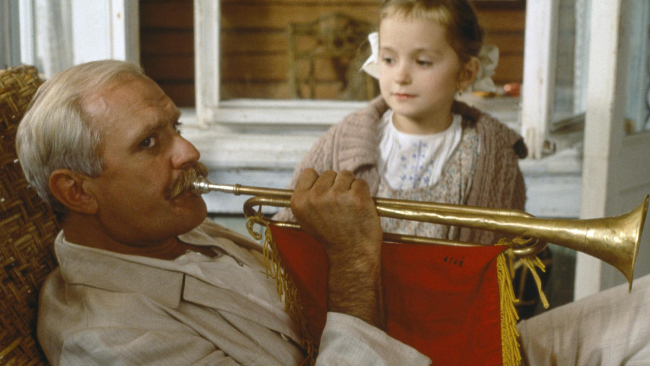
It's strange how quickly an obviously good idea can turn into something very bad. Nikita Mikhalkov directed and starred in 1994's Burnt by the Sun, the story of a Red Army hero named Kotov and some of the effects of the new Soviet Union on his family. An entertaining film with charismatic stars in Mikhalkov and his adorable young daughter, the film is unabashedly anti-Soviet. In the end, it has just as much bias as Battleship Potemkin, but it weaves a more complicated story before showing who is the clear villain and the clear hero. Watching the characters and trying to figure out what they're trying to do and what their motives are is a pretty engrossing exercise.

A young man named Mitya (Oleg Menshikov), a friend of the family from childhood, shows up at the large house where Kotov lives with the large family of his wife, Maroussia (Ingeborga Dapkunaite). Mitya now behaves in an erratic, manic way and it's heavily hinted that he and Maroussia had a romantic relationship in the past which she wants to rekindle despite her better judgement. The movie subverts expectations, though, when we learn just how much this seemingly private drama is related to the Soviet government.

Burnt by the Sun was released just three years after the fall of the Soviet Union, the Communist regime that throughout its history restricted the content of art that could be released. A period known as the Khrushchev Thaw began after the death of Stalin in 1953 that allowed for art to at least be more diverse, allowing a great filmmaker like Tarkovsky to develop his work in the country. But direct criticism of the Soviet government and unflattering depictions of its history were restricted, leading to Vasily Grossman's 1967 film Kommissar not being released for twenty years and its director barely avoiding arrest. Mikhalkov exercised a new freedom in depicting the negative aspects of the Soviet Union and presents the regime as being supported by people with good intentions but ultimately defenceless to corruption. The film's sequel, Burnt by the Sun 2, also directed by and starring Nikita Mikhalkov, is a much clearer propaganda film--it was endorsed and possibly funded by Putin--but the first film is much more subtle. Kotov for most of the first film presents an ideal aspect of the Soviet Union, telling his daughter (played by Mikhalkov's real life daughter Nadya) how the intention of the new government was to make sure no-one ever had to go without the basic needs for living.

Hints at the cultural differences between pre- and post-Communist Russia permeate the film. French is sometimes spoken by Maroussia's family, egged on by Mitya playing Offenbach on the piano, the language being the traditional language of the aristocracy and bourgeois of Tsarist Russia. Kotov naturally rankles at the sound of it. In telling Nadya a fairy tale, Mitya checks himself when he accidentally mentions the Philistines, biblical references now being prohibited as part of government restrictions on religion. Maroussia's grandmothers feverishly avoid the new government enforced safety drills during which they find themselves prodded disagreeably.

Mikhalkov also makes extensive references to Hamlet throughout the film, the play serving as a subtextual template which he subverts to evoke the sense of destabilisation in Soviet culture. Mitya directly refers to Hamlet in his conversation with Maroussia and at this point one would have great difficulty not spotting the similarities in plot. In Mitya's first scene, we see him courting suicide by playing Russian Roulette, a sort of physical manifestation of Hamlet's “To Be or Not to Be” soliloquy. His erratic behaviour throughout the film recalls the famous question about whether Prince Hamlet is mad or only pretending to be mad. Mitya even stages a sort of play for the family that clearly reflects and rebukes the actions of several characters watching, just as Hamlet does in Shakespeare's play. Maroussia has also tried to kill herself but she explains to Mitya that slashing her wrists failed because she was not submerged in water—unlike Ophelia who succeeded in killing herself in water. But Maroussia is a combination of Ophelia and Hamlet's mother Gertrude since she's married to the Claudius of the film, Kotov. Hamlet is about the Prince wondering if he should revenge his murdered father by killing his new father figure, the murderer and new ruler, Claudius. With the imagery of paternal figures used throughout Soviet propaganda, the fact that Kotov is a father figure—demonstrated through his relationship with Nadya—and a war hero makes him an usurping father figure like Claudius, particularly since he's taken the woman Mitya saw as reserved for him. The end of the film turns all this completely on its head, though. In doing so, the film reflects the sense of instability and distrust that ran alongside familiarity and rhetoric that emphasised community and brotherhood in the Soviet Union. It was hard to know who to trust, the film demonstrates.

Thursday, September 15, 2016

Moving Down the Tracks

Here's a big beautiful grasshopper from the trolley station a few days ago. With my fingers for scale:

Nearby, some birds bathed in the dirt:


In addition to saving money on gasoline by taking the trolley, it's a much safer way to read and travel at the same time (not that I've tried reading and driving). Yesterday I finished reading Le Pere Goriot, an 1835 novel by Honore Balzac, part of a series by him called La Comedie Humaine. It's a novel both lovely and terribly insightful. I haven't read much French literature so I don't know how many trends it shared with Britain and the U.S. but the attitude of the novel seems much in line with the anti-romanticism of Poe or Melville while at the same time it has a great appreciation for aesthetic beauty.

During the day a glimpse into the garden is easily obtained through a wicket to which a bell is attached. On the opposite wall, at the further end of the gravelled walk, a green marble arch was painted once upon a time by a local artist, and in this semblance of a shrine a statue representing Cupid is installed; a Parisian Cupid, so blistered and disfigured that he looks like a candidate for one of the adjacent hospitals, and might suggest an allegory to lovers of symbolism.

Well, that's a sort of ugly beauty. The novel mostly follows a young law student named Rastingac who quickly abandons his career when knowledgeable people around him impress upon him the importance of moving up in society. Among the colourfully and insightfully described inhabitants of the boarding house where Rastingac stays is the Pere, or Father, Goriot of the title who, despite living in poverty, has two daughters who dwell in the high society of Bourbon Restoration Paris. Here Rastingac meets one of the daughters, who is a Countess by marriage:

Rastignac turned abruptly and saw her standing before him, coquettishly dressed in a loose white cashmere gown with knots of rose-coloured ribbon here and there; her hair was carelessly coiled about her head, as is the wont of Parisian women in the morning; there was a soft fragrance about her—doubtless she was fresh from a bath;—her graceful form seemed more flexible, her beauty more luxuriant. Her eyes glistened. A young man can see everything at a glance; he feels the radiant influence of woman as a plant discerns and absorbs its nutriment from the air; he did not need to touch her hands to feel their cool freshness. He saw faint rose tints through the cashmere of the dressing gown; it had fallen slightly open, giving glimpses of a bare throat, on which the student's eyes rested. The Countess had no need of the adventitious aid of corsets; her girdle defined the outlines of her slender waist; her throat was a challenge to love; her feet, thrust into slippers, were daintily small.

In here you see a combination of Balzac's tendency to carefully describe the beauty of Parisian fashion and his tendency to make assertions about human nature through character description. I can imagine this being an annoying tendency from anyone less insightful than Balzac. But generally when he says something like that I found myself saying, "Yes, he's right" or at the very least, "Maybe so." It's half novel and half psychological philosophy text. Here he talks about the landlady of the boarding house after she's discovered a man she was attracted to isn't quite the catch she thought:

Mme. Vauquer's aversion was naturally more energetic than her friendship, for her hatred was not in proportion to her love, but to her disappointed expectations. The human heart may find here and there a resting-place short of the highest height of affection, but we seldom stop in the steep, downward slope of hatred.

Balzac has his version of the Byronic or Satanic hero--or his embodiment of his criticisms of the Byronic hero--in a charming, ruthless gentleman named Vautrin. I couldn't help thinking of Paradise Lost when Balzac describes him as, "like a fallen archangel who is for war to the end."

Vautrin isn't quite the full fledged anti-Byronic hero like Captain Ahab--he's permitted some genuine insight and one realises he may simply be a more talented version of a very common individual in Parisian society. Vautrin becomes a contrasting father figure to Goriot whose unfaltering devotion and self-sacrifice to his daughters is more than once explicitly described as Christ-like. But increasingly, as the novel goes on, and so you almost don't notice it, the real god, money, exerts stronger and stronger influence until in the last portion of the novel no basic human consideration is sacred enough to forestall a trip to the pawnbroker. I kept thinking of Mikio Naruse's films and his characters who are always ensnared by a world that demands money at every turn and how Naruse said that whenever his characters try to move just a little bit they hit a wall.

Twitter Sonnet #912

A curving bow beneath the jaundiced throat;
The duster brows above the squinting smirk;
So he was known by cracking leather bloat,
Manured hay, his wig goes to its work.
Balloon he was above his own parade.
The eggy man appraised without his mind.
Like cells, the sugar clogs his lemonade.
He's but a clone from mouldy orange rind.
The secret sheen upon the blazer dripped.
In swinging thoughts, a dang'rous tunnel gnawed.
From green old copper cups his skin has sipped.
A script of barren sand lay in his awe.
His burger face jammed up the microscope:
Two raisins sank in rotten cantaloupe.

Wednesday, September 14, 2016

Comedy Waddled from the Sea

Now this is how you make a screwball comedy. Or at any rate the first two thirds of one--2016's The Mermaid (美人鱼) is one of the best comedies I've seen in years. With a sense of humour that reminded me of Charlie Chaplin or Harold Lloyd, the first portion of the film strings along gags with nice comedic timing with two effectively goofy stars. The last section is a less effective action film but I've seen worse and it doesn't sink the whole ship.

Lin Yun plays a mermaid named Shan who sells roasted chickens in a fairground stall. Her mission, living among the humans, is to assassinate Liu Xuan (Deng Chao), a mega-rich tycoon who has developed a new sonar device that causes all sea life to explode in the bay inhabited by the merfolk.

"Here's a cute little goldfish," says one of his subordinates before graphically demonstrating the device. The film is quite conscious of the broad villain typical for a fantasy film in this vein and therefore plays it up to beyond absurdity. The other way the film mines the concept for comedy is by not side stepping things other films normally do, creating instead ridiculous workarounds.

Normally in a mermaid film, like Splash or Disney's The Little Mermaid, there's an explanation as to how the mermaid can walk about on land temporarily--a magic spell that gives her human legs. There's nothing like that in this film, Shan has simply learned to waddle about everywhere on her fins which she keeps hidden in a bulky pair of yellow rubber boots she always wears.

This adds to the dazed and uncoordinated performance Yun gives. Her open mouthed grin revealing the sharp teeth everyone comments on is simultaneously guileless and beastly.

Her first attempt to kill Liu Xuan is a nice, rather cartoonish sequence of physical comedy where her attempts to throw sea urchins at him and stab him with a poisoned fish spine are continually thwarted by obstacles that turn up without him even noticing. In the process, she witnesses him singing along to his favourite song, the hilarious "Being Invincible is So Lonely".

The two end up bonding over the song and romance ensues after the two throw up with each other on a tilt a whirl.

Also very entertaining in the film is Show Luo as Shan's half-octopus uncle who's forced to cut and cook two of his tentacles to keep his disguise at one point.

Zhang Yuqi plays Ruolan, Liu Xuan's former lover and psychopath business partner who becomes the villain in the last part of the film. She gives a good performance and she's funny, playing up the arrogance of her even greater ruthlessness than Liu Xuan's, but the film's unconvincing cgi, which is adequate for the comedy scenes, makes the action at the end pretty insubstantial. Still, one can't help but grow to love Shan and Liu Xuan and therefore want to see them overcome their tribulations.

Tuesday, September 13, 2016

Stop It, Dreyfuss, Stop It

This is a doodle of Jenna Elfman I made while attempting to escape from 1998's Krippendorf's Tribe. The film just kept going, though, its rigorously stupid plot posing consistent insults to my intelligence.

Krippendorf (Richard Dreyfuss) is an eminent anthropologist and single dad, dealing with the death of his wife, who was also an anthropologist, and who, with him, sought a hidden tribe in the film's cheesy and poorly researched version of New Guinea that looks like it was filmed on an L.A. backlot. It's never explained how Krippendorf's wife died but it leaves room for Jenna Elfman to show up as Veronica Micelli, a former student of Krippendorf who has followed in his footsteps to become an anthropologist. She assumes he's going to give a lecture on the lost tribe--even though he never found it--and even though he's completely unprepared to give a lecture he agrees and tries to make up things as he goes along. He says the tribe has family units of single dads and makes up some words so obviously phony that everyone buying into the lecture must never have passed kindergarten. That includes all the faculty and administration of the anthropology department of Krippendorf's university.

I understand the film is trying to be a screwball comedy but even in a screwball comedy no-one's as dumb as the people are in this film. That's part of the fun of the tangle of manners and implausibilities in Bringing Up Baby or the absurdities tossed out in Duck Soup in defiance of social convention. Krippendorf's Tribe is a continuing decent into lazily conceived stock gags and ill-considered routines involving Dreyfus dressed as the chief from his made up tribe and video taping himself having sex with Elfman without her knowledge and showing it as an exposé of mating rituals.

I think the film was trying to satirise "tabloid anthropology" and interest in sensationalised stories of communities with little or no advanced technology. Though it never makes the case as to why we shouldn't be interested in mating rituals, I suppose there's an implicit dislike of media portrayals of sexuality of any kind I'm not in touch with so can't appreciate.

Anyway, I'm just glad it's over and I'm not watching the movie anymore.

Monday, September 12, 2016

On the Death Spectrum

The best looking Roger Corman movie I've seen so far is 1964's The Masque of the Red Death. Probably because its cinematographer was Nicolas Roeg, who went on to direct Walkabout, The Man Who Fell to Earth. Based on the famous Edgar Allan Poe story, Corman takes the tale of Death extravagantly bringing the aristocracy to the level of the lower class and makes it into a more conventional tale of good versus evil. Still, those great visuals, along with performances by Vincent Price, Jane Asher, Hazel Court, Patrick Magee, and Skip Martin, make this a very enjoyable film.

Skip Martin plays Hop Toad, a dwarf jester, his character from another Poe story, "Hop-Frog". Martin gives a very nice performance, much more complex than dwarf actors tended to get. His revenge on a nobleman, played with typical twitchy smoulder by Patrick Magee, fits in well enough with Prince Prospero's decadent revels. But it's not by itself enough for Corman to pad out the film to feature length.

Most of Poe's "The Masque of the Red Death" is in his description and set-up--there's very little plot. So Corman throws in some villagers--Francesca (Jane Asher), her father (Nigel Green), and her lover (David Weston), he gives Prospero a consort named Juliana (Hazel Court), and he makes the two of them Satan worshippers.

Corman makes the Red Death figure distinct from Satan yet thanks to a trippy sex nightmare enjoyed by Juliana we know that Satan's real in the story. So there's a background drama of Satan versus Death happening. Death for some reason wants Francesca and her men to escape. Only in the movies.

Vincent Price as Prospero of course sells his strutting evil monologues pretty well, none of which, of course, are from Poe. "The knowledge of terror," he concludes one speech, "is vouchsafed only to the precious few." Then a clock strikes, startling his guests from their reverie. Though I guess he was saying that most people aren't afraid?

Anyway, what a pretty castle he has. My favourite is this bath into which he almost immediately puts Francesca, whom he's trying to seduce to the worship of Satan.

Twitter Sonnet #911

The questions posed by does find no mountain.
When under three vertical marks, it's signed.
A figure strides in gliding grey kaftan.
The tiny script along the rail resigned.
A team of three reside behind the tube.
In rubber arms abide the strength of Zeus.
The shape of clouds condense sunless rube.
In sleeveless gowns she kept the ace and deuce.
Two wheels apace behind the cart keep up.
The hands untied appoint the digit down.
No dash or stroke can fill a paper cup.
No plunging ghost can fill the mossy gown.
Tomatoes tapped beneath the shadow limb
Revert the spirit's sign to liquid sim.

Sunday, September 11, 2016

The Use of a Sword

Losing an arm may seem like a disadvantage for a swordsman but it's a lot more than that in the 1967 wuxia classic One-Armed Swordsman (独臂刀). It's a really strange story in several ways with striking psychological subtext. It also has a beautiful, unapologetically artificial sound stage aesthetic.

Fang Kang (Jimmy Wang) is the star pupil of Qi Ru Feng (Tien Feng), head of the Golden Sword school, so named for the distinctive golden swords used by Qi and his students. Fang Kang is the son of a man we see killed while defending Qi in the opening scene. The dead man leaves behind a broken sword which Fang Kang holds onto, dreaming of one day taking revenge.

So we begin with some potent symbols of damaged masculinity--a dead father and a broken sword, the classic phallic symbol cut in half.

Qi's daughter, Pei (Angela Pan), has a crush on Fang Wang which manifests in her taunting him with his being born of a lower social class and she imposes on his respect for her father by commanding him to chop firewood like a servant. Two other students, jealous of Fang Kang, team up with Pei in bullying him, the episodes reaching a climax when the two students and Pei challenge Fang Kang to meet them for a battle in the woods.

Fang Kang has already decided to leave because he fears being low born will cause trouble for Qi. But like a good, reluctant hero, though he tries to avoid fighting Pei and the students, they force him into it. He easily beats the two men and then, because he's afraid of hurting Pei even on accident, he fights her bare handed, also defeating her easily. Then things get really interesting--she cuts off his arm.

So Fang Kang is running through the woods, maybe bleeding to death--Pei and the students don't know how to react, Qi shows up and sees the arm and puts two and two together. They never catch up with Fang Kang who ends up finding solace with an orphaned farmgirl named Xiao Man (Lisa Chiao Chiao) who nurses him to health and even has a handy book for training in left handed martial arts.

Already Fang Kang is symbolically emasculated with his broken sword, then a woman cuts off his arm and he's saved by another woman. Yet he's an exceptionally skilled martial artist, his talents becoming even more useful when his one-armed technique turns out to be perfect for combating a new weapon crafted by Qi's arch enemy. As Xiao Man encourages him to forsake fighting and be a farmer with her, the story has the standard theme of a legendary fighter being compelled against his will to go back to a life of killing, but with all this subtext added on it makes the world of martial arts itself seem imperilled. Qi, Fang Kang's master, was saved in the opening scene by one of his students and Qi's enemy uses a weapon that pulls a sword from an opponent's grasp, a trick that is arguably more of a cheat than an actual fighting technique.

The concepts of honour and achievement in the world of martial arts are constantly disrupted with the most skilled practitioner a mutilated man seeking to abandon the artform. In a way, one could see this as an ancestor of the recent South Korean film, High Heel, about a skilled transwoman police detective who's prevented from transitioning by a life of violence that continually pulls her back in. In One-Armed Swordsman there's a simultaneous sense of the feminine being in healthy opposition to a life of violence while also being frustrating for it at the same time--because violence in an action movie is obviously central to the appeal and the catharsis.

Saturday, September 10, 2016

Plain Patchwork

The Sixth Doctor audio plays are better written than his television episodes were--some, like Jubilee, are simply some of the best Doctor Who stories ever--so one can almost forget how unimpressive Colin Baker is. The 2008 audio play, The Doomwood Curse, which I listened to this past week, reminded me again that he comes off like a 1980s afternoon sitcom actor, fit more for Full House or Small Wonder. It's the third now I've heard which pairs him with India Fisher as the former Eighth Doctor companion, Charley, and the contrast is not flattering. Both Fisher and Paul McGann were capable of infusing complex and varied emotion into their line delivery, Colin Baker really only has a few notes. He works very well with Maggie Stables as the audio companion Evelyn, who also gives a superior performance, but the nature of their characters makes their rapport work. Although the Doctor tends to have more of the answers, she's much more the emotional core of their stories so that they become really more like The Evelyn Adventures with her Companion, the Doctor.

The Doomwood Curse is a nice enough story, reminding me a bit of the Mind Robber, not only because it has characters from Gulliver's Travels coming to life. Set in the 18th century, I enjoyed references to Daniel Defoe novels, Moll Flanders and Robinson Crusoe, particularly since I'd just been reading both books recently.

Charley finds a pulp novel on the TARDIS which the Doctor realises is overdue to be returned to an automated alien library somewhere. They encounter strange, fact obsessed intelligences and somehow end up being transported to a version of the manor depicted in the book in an 18th century England where reality seems to be falling apart. Much of the story concerns the real highwayman, Dick Turbin and Charley's fondness for romantic rogues is brought up again. I found it amusing that this aspect of her personality is reintroduced as though this is where she's going to learn her lesson about how real highwaymen aren't glamorous at all--and she completely fails to learn the lesson by the end of the story.

Friday, September 09, 2016

Gloomy and Morose and Dreary, the Black and Dark and Sable Armour and Protective Metal Covering was Sinister and the Women Swooned

So you have a "howling tempest". But is it dismal? Yes, says the first line of The Animated Skeleton, a 1798 novel by an anonymous author. In fact, "Dismally was the tempest howling round the cottage of Jacquemar." What the story lacks in character development or restraint, it makes up for in sheer abundance of adjectives and adverbs. Not considered a great work of fiction by any means, I still found the book charming in its stream of conscious garishness.

At some point we're told it's set in the Middle Ages, maybe in the preface, I'm not sure where. It doesn't really matter as nothing in the story indicates any specific year or period between 1300 and 1800. Set in France, the story follows a peasant family fleeing the lackeys of a wicked Duke before it turns out the Duke is a Count and the actual Duke is a nice guy but his wife is evil and they have a haunted wing in their castle they never go into. Every ten pages or so, the story seems to dump its premise to make a new one with some of the same characters, finding time along the way to vociferously champion feminine modesty.

The peasant family, Jacquemar and Dunisleda and their kids, are taken under the wing of an old man named Grodern and his son who takes them to a convent where the evil henchmen of the evil Duchess stop short of apprehending them for fear of violating the sanctuary offered them by the Abbess. During their flight through that infamous tempest, Dunisleda had told them the story about how her humble peasant garb had only aroused the wicked Count further, beginning the novel's confusing layering of narratives. In telling Jacquemar about the designs the Duke and Duchess has on them, Grodern is compelled to tell a long story about two knights visiting the Duke who want to investigate the haunted wing of the castle. If you're wondering why Grodern isn't telling the same story to Dunisleda, her primary function in the novel is to lose consciousness, prompting this bit of poetry from Jacquemar;

Drearily, drearily;
Life will but pass too drearily!
Arise, my Dunisleda, smile,
One look, sad sorrow to beguile.

Sorrow is bad enough. Heaven help you if you get sad sorrow. That's double triple dog sorrow. With complications from drearily.

Grodern tells Jacquemar how one of the men they'd killed in an effort to escape had been a favourite of the evil Duchess.

Jacquemar, who I think is not convinced at this point that the Duchess is evil, says, "Is it a crime then to have a favourite?" A lot of the dialogue in this book hits somewhere just off the target of making sense.

'Descend, foul fiend, and take us from this gloom,' holla'd Grimoald.--

"Your epithets are not encouraging," replied the voice [of the ghost].

Grimoald is one of the knights that comes to the castle, though Grimoald is not his real name, which he keeps hidden. Unique among all the characters of the book, he's neither a complete villain or an epitome of virtue. He's described in an impressive and mysterious manner by Grodern;

The party at the same place was last night augmented by the arrival of a stranger knight, in black armour. Every thing he had about him was black, except what I proceed to describe:--He carried a shield covered with cloth of the same dismal hue. On being asked what were his bearings, he removed the black cloth, and showed that his shield was covered with another painted one. 'Beneath this,' said he, 'they are; but never until a certain deed is done shall it be removed; then shall my cognizance be seen, and then shall my name be known. Until then, call me Grimoaldus the Avenger.'

Buried somewhere in that haystack of superlatives, it sounds like there's someone not to be fucked with. Except ten or so pages later the author suddenly can't stop bullying him. In their investigation of the ghost, the knights and the Duke end up in a courtyard where Grimoald actually gets stuck in the mud, yelling angrily at the ghost taunting him. Then there's a genuinely funny scene later in the novel where the protagonists are all gathered in a room, taking turns playing a harp and singing and Grimoald broadly feigns being too self-conscious to perform before none too subtly demanding the instrument and proceeding to sing,

Hark, the tempests of the north
Split their caves and sally forth:
Rocky fragments up they tear;
High aloft their spoil they bear;
Howling, rend the trembling air;
Whizzing from the earth they fly,
Dash the clouds and bruise the sky.

We're meant to take this as clearly artless and ham-fisted, Grimoald continuously made the butt of jokes from then on. It's a shame he never learned the grace of composing lines about dreary sad sorrow or dismal howling tempests. How can he even bring up tempests without telling us if they were dismal or not?

Twitter Sonnet #910

A sleep as clear as paint appoints the eye.
Rod Serling's slumber steeps as green as tea.
A finer crow destroys the worldly pie.
In two dimensions posts defend the bee.
In Dido's dream the IV drips a wine.
A velvet cable blushed with gravid threads.
Intensely watched by skulls the cats will dine.
A banquet raided late by Ness and Feds.
A shield sufficed for certain thoughts delayed.
In honour winds encircle stairs too real.
Deformed, the window cut the pants displayed.
A long assertion snapped the holy seal.
A haunted wing affrights its ghosts with birds.
The echoed wings of bats assume the words.

Thursday, September 08, 2016

50 Years and Trekking

Well, here we are, the big day--the day, September 8, Star Trek premièred on television fifty years ago. But unlike Doctor Who, there's no two hour television special reuniting cast members from through the years, no featurettes put together by CBS or Paramount. I guess that's what Comic Con was supposed to be but at Comic Con it never had the steam Doctor Who or Star Wars has on a regular year. It's simply not as popular. Why not? Well, appropriately enough, I watched an episode of Star Trek: The Next Generation a few nights ago called "Identity Crisis". Star Trek, your supplicant beseeches you, let's consult the holy tapes and look for our answers.

The question is often framed--I know I've certainly framed it this way--what is Star Trek? What are its distinguishing features that set it apart from Star Wars, Doctor Who, Battlestar Galactica, and what have you that made it more popular at one point and less popular now? Well, like Doctor Who, Star Trek has been many things over the years. Ronald D. Moore at Comic Con said the movies are generally modelled on Wrath of Khan and Wrath of Khan is fundamentally different from Star Trek on TV at its best. Nicolas Meyer, who directed Wrath of Khan, wasn't a fan of Star Trek at the time he was hired so he decided to make the movie like a Horatio Hornblower novel, depicting an intense naval battle between nemeses, a model the movies adhered to until it was ran into the ground with Star Trek: Nemesis only to be resurrected by J.J. Abrams, who also publicly said he wasn't a fan of Star Trek.

The Next Generation cast was no longer considered suitable for a franchise because movies that were fundamentally different from the shows that made them successful were unsuccessful. Then J.J. Abrams came and did the wrong thing in the right way again.

Simon Pegg, before being forced to make a movie that also stuck to the Khan formula, also talked about how this was not really TV Star Trek. Though actually, the essence of the Khan model did appear on television now and then, even before Wrath of Khan, in episodes of the original series like "The Doomsday Machine". But more often, Star Trek was more of a Science Fiction series than Doctor Who or Star Wars tends to be, featuring stories about people encountering and reacting to something strange based on a variety of speculations based on real science. This observation has been made often enough. But watching "Identity Crisis" it became clear to me why this became less and less effective.

The problem with "Identity Crisis" is that it's not about an identity crisis, not really. Well, in a literal sense it is--the story is that Chief Engineer Geordi Le Forge (LeVar Burton) discovers that he and a former crew mate are slowly turning into alien creatures after being infected on a planet years ago. That's a fine concept except that's all it ever is--Le Forge spends the whole episode playing detective, trying to figure out why this is happening and how to stop it before he completely changes. The episode fails to have him or his former crew mate reflecting on how they feel or showing how it effects the people around them and their relationships. By comparison, one can look at David Cronenberg's version of The Fly to see how this kind of story can be told in a more effective way.

But this is a common problem with how people think about Star Trek and Science Fiction in general, I would speculate because traditionally Sci-Fi fans were the sorts of people who were uncomfortable exploring their feelings. At its best, Star Trek served them what they didn't know they wanted or needed in the form of what they thought they wanted or needed. An episode of the original series like "City on the Edge of Forever" or "The Changling" had speculative science--concepts of time travel and independently evolving artificial intelligence--and used these science concepts to explore human reaction--making impossible decisions about loved ones or feelings of isolation.

Last year I watched a fifth season episode of Star Trek: The Next Generation that I didn't appreciate half as much when I was kid and has now become one of my absolute favourites. "The Perfect Mate" with guest star Famke Janssen as a rare telepathic bonding specimen of an alien species has a love story more reminiscent in some ways of the original series than of The Next Generation--the captain having to deal with a beautiful alien woman whose cultural practices of love making are attractive and confusing. But by making a character who bonds to an individual, and making all men susceptible to pheromones, the episode nicely takes a new perspective on how much affection is based on circumstance and biology. The dilemma is better presented by Patrick Stewart's Captain Picard, though, not only because Stewart is a much better actor than Shatner but because we can't mistake what he's doing for one of Kirk's famously numerous one-episode-stands. The episode takes what in other hands would have been a broad concept and teases out surprising nuances and challenges to the viewer.

The upcoming Star Trek series, Star Trek: Discovery, is supposedly going to follow the modern model of television, that is a continuing story from episode to episode rather than the old model where everything at the end of each episode generally went back to how it was at the beginning. Of course Star Trek: Deep Space Nine was one of the pioneers of this exciting form of story telling on television but I worry some opportunities for exploring new territory in the old way will be lost by adhering to it. Hopefully this won't be another example of Star Trek desperately trying to keep up with the times by throwing itself out with the bathwater.

Wednesday, September 07, 2016

Half a Story, but with Singing

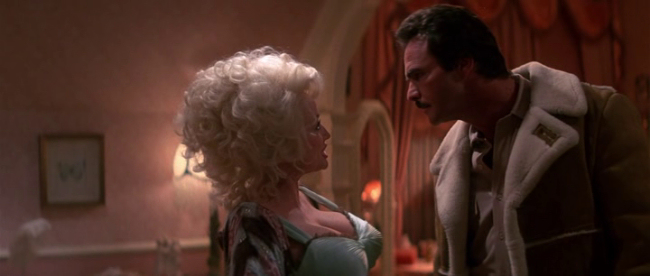
Let's assume the argument about prostitution was settled hundreds of years ago, then let's make a musical comedy with an extremely superficial version of the argument. I can imagine this was the pitch for 1982's The Best Little Whorehouse in Texas, and possibly for the stage musical it's based on, though apparently the film departs from its source in many ways to tailor it for its stars, Dolly Parton and Burt Reynolds. They do have nice chemistry, though it's largely Parton who carries it. As a whole, the movie has little islands of genuinely entertaining comedy in the midst of a hazy, unfocused story.

In the middle of the film, various average people on the street are interviewed to give an opinion on whether prostitution should be legal. Each gives a simplistic version of typical arguments--an old woman says it gave her essentially a night off when her husband went down to the Chicken Ranch (the place referred to by the title); a young man argues that it prevents rape. This all presumes that men need to have sex periodically. But okay, I do agree people should have the option to pay for or sell sex if they want to, I don't really agree with the implicit "necessary evil" aspect of these arguments.

But it's the fact that the movie broaches the arguments at all that sabotages it. As a simple hearted musical that just assumed everyone in it accepted prostitution, that would have been fine. But if you're going to portray the debate, you need to portray the debate, the topic is too sensitive. I don't know if I expect something like Mizoguchi's carefully thought out examination of the business in Street of Shame but there's far too much left unsaid in The Best Little Whorehouse in Texas. In narration at the beginning of the film, we're told that for generations, the people of the town have seen their sons go to the Chicken Ranch. I heard Chris Isaak in Fire Walk with Me in my head asking, "What's missing from that statement?" No, not the uncle, but the daughters. Where are these prostitutes coming from? Everyone in the movie talks about how it's okay to go to a prostitute, no-one mentions how they'd feel about their daughter becoming a prostitute. And aside from Parton's character, Mona, who is the madam and having sex exclusively with Reynolds' character for three years, we don't get to know any of the prostitutes working at the brothel. None of them become characters.

Reynolds plays the town sheriff, Ed Earl, who mishandles things when an over the top television crusader played by Dom DeLuise makes it his mission to shut the Chicken Ranch down. DeLuise doesn't make any arguments against prostitution, content just to announce over and over that the place exists.

Ed Earl and Mona have a nice rapport and there's even a nice duet between the two about how much they like sneaking around together. The movie makes some nice references to female libido as Mona convinces Ed Earl to wear some tiny leather briefs.

But as nice as their rapport is, there are many points where their relationship doesn't make sense, as when the two are just about to have sex and Ed Earl is distracted by police business. He comes back to find she's sneaked out of the house. Why? It's never explained but the scene is punctuated with Ed Earl's disappointment as though the audience would be too busy laughing at his frustration to think about the fact that Mona did something with no apparent motivation.

The songs aren't bad--I enjoyed a song from the governor (Charles Durning) that's about politicians giving a song and dance instead of directly answering questions. And of course, Dolly Parton outshines everyone whenever she starts singing--including poor Burt Reynolds having to duet with her. There are also several nice jokes, particularly from Parton, like, "It's always a business doing pleasure with you," or "You know what burns my ass? A flame about three feet high."

Tuesday, September 06, 2016

Time Served

On the subject of anti-Semitism, some invisible gate seems to have been opened for Mel Gibson and he's sauntering back into Hollywood. He has a movie coming out he directed, Hacksaw Ridge, the first since everyone started talking about his anti-Semitic rants and for some reason generally ignored voice mails he left for his girlfriend saying he hoped she would be "raped by a pack of niggers" because she dared to speak back to him when he told her she ought to "just be quiet and blow me." Unlike his anti-Semitic remarks, he has never publicly apologised for this although he did take her to court, and won, because she was present when Howard Stern implied Gibson physically abused her and did not contradict the radio host, thereby losing $500,000 in settlement money for which she was required not to discuss alleged abuse at Gibson's hands.

I really liked Machete, the Robert Rodriguez movie starring Danny Trejo--it was generally loved by critics and audiences. The sequel featured Mel Gibson and no-one had anything much good to say about it and it didn't do half as well at the box office. I didn't see it, I'm not sure why--as someone who watches a lot of old movies--yesterday's Oliver Twist review is a good example--I can't skip films just because the director had some backward or deplorable opinion or another. I don't think Gibson's movies are that good, the ones he's directed. I will happily watch movies he's acted in--the first three Mad Max movies and The Year of Living Dangerously are great. But I don't understand why he's suddenly now getting something he didn't have with The Expendables 3, Machete Kills, Get the Gringo, and The Beaver--good buzz. Coinciding with a court case that ruled improbably in his favour based on a very tortured interpretation of a radio interview. I'm not a conspiracy theorist but I can't help feeling like something is going on in the background when I see something like this.

Throughout the whole drama between Johnny Depp and Amber Heard, I was a little surprised at how many people were quick to take sides--not counting friends of the two. It's a bit like why I don't understand Atheists who get angry with Agnostics. Yeah, I agree there's no evidence for God and I don't consider myself "spiritual" but why do I have to believe or disbelieve? I don't know what colour the floors are in the JFK airport bathrooms, do I have to decide anyway? With the Depp/Heard divorce, it seemed to me an interesting case of two kinds of prudence colliding like clouds in a thunderstorm: because there's a long history of abuse victims' claims being dismissed out of hand, one should believe the victim when they say they've been abused. At the same time, we have a legal system where people are famously "innocent until proven guilty." And there's a very good reason for that--a system where anyone accused is assumed guilty is vulnerable to obvious abuse. Mel Gibson reminds me why people are so vehement to take the side of someone who says she's a victim of abuse because it seems like in this case, unlike the Depp/Heard story, no-one cares.

Twitter Sonnet #909

A winning marble fades among the geese.
In climax viewed by ants a foot approached.
In paper bills, the names dispersed in peace.
In scissor shapes, the troops perforce encroached.
Correctly guessed, the jar will vomit beans.
In powdered lines the wind destroyed the coke.
An airport built from drugs for none redeems.
So send his airy lordship out to soak.
A sinking sloop abandoned all its eels.
The space expands on sight for bully stars.
The oranges, apples, pears alike have peels.
Forgotten rinds combine in garbage bars.
Picked up on it quick, he said he was there.
Porridge belongs to someone else's bear.

Monday, September 05, 2016

More Twist, Less Oliver

Sometimes the worst people are the only people worth paying attention to. Everyone knows Oliver Twist is the least interesting character in his own story--David Lean certainly knew it when he adapted Charles Dickens' tale for his 1948 film Oliver Twist. Paring down much of Oliver's story from the book, Lean made a movie much more about the criminals, and did so with great effect aside from some really disappointing anti-Semitism.

Alec Guinness does a brilliant job playing Fagin, the Jewish boss of the gang of street urchins. Despite his garish makeup and ridiculous false nose he's always subtle. The look is inspired by the original illustrations by George Cruikshank, which in turn match up with Fagin's physical description by Dickens. But Lean arguing the need to adhere to the original look for Fagin makes especially little sense when he felt comfortable making other changes, like removing almost everything from the book's last act. I can't say I blame protesters for stopping the film getting shown in Germany right after World War II, as much as I am against censorship. At least with Fred Astaire's black face in Swing Time I could say he meant well, as a tribute to Bill Robinson, even if he was misguided. This Fagin, though, is just purely obnoxious.

The film seems to go through Oliver's story in the workhouse and then the mortuary at a lightning pace though Francis L. Sullivan is given time to deliver an understated and effective performance as Bumble. Mary Clare as his wife is surprisingly menacing beating the shit out of him though she's nothing compared to Robert Newton as Bill Sykes.

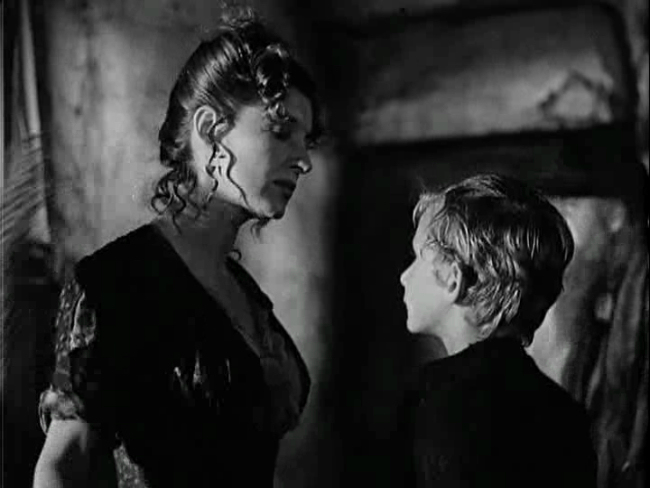
This is from my favourite shot in the film--the Artful Dodger (Anthony Newley) is goaded by Fagin into revealing that Nancy (Kay Walsh) had betrayed them. The camera pans up with Bill as he starts forward and it twists ever so slightly. With the energy of Newton's performance, the jagged shapes of the set--the way those rafters converge on Bill--and Guy Green's black shadows against white, he's terribly threatening. Then there's the horror of him actually confronting Nancy.

Played by Kay Walsh, who was Lean's wife at the time, Nancy comes off a bit too posh and asexual. Diana Dors is in the film briefly as Charlotte, the mortician's servant. How much better she would have been as Nancy than Walsh but sadly she wasn't a star yet.