Friday, October 21, 2016

Dreams and Costumes

I had a really vivid dream last night--I was living in a nice home on top of a tall, human-made cliff of stones by the sea--the cliff looked like old Roman walls. The house looked a bit like James Mason's house from the end of North by North West. I was very conscious of the fact that I could only live there because several people had been murdered. I had a tin bath tub filled with water and a young man lay at the bottom of the tub looking up. There was a snail and an a hairless kitten the size of the snail crawling about on the edge of the tub. I had another dream, too, but I can't remember it.

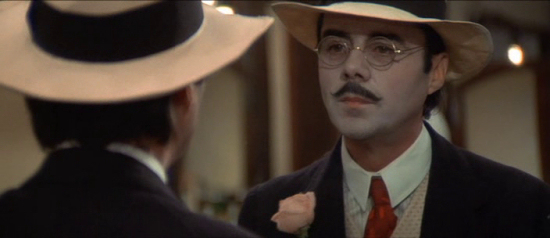
I blame the NyQuil. But at least I didn't feel as sick to-day. I wish I could say the same for half the people at the university. Everyone got sick and of course everyone just had to deal with it and go to school anyway. I bet the Halloween candy I've been eating lately hadn't helped either. I've been sort of toying with the idea of dressing up for Halloween this year, especially since I have class that day. But I don't think I can afford to do it properly. It occurred to me I have almost everything I'd need to dress as Dirk Bogarde from the end of Death in Venice--I have the hat, slacks, and tie, but I'd have to get new shoes, a detachable shirt collar, and a new vest. Plus I'd have to dye my hair and get a good false moustache. If I can't do it right I just don't want to do it at all. Maybe I can think of something simpler.

Twitter Sonnet #924

In treble jalapenos eyes assess.
Important shears alert the hair to fate.
When fortune says, "Neighbours, do not redress,"
There's buckets bound for space to fill and rate.
In cases wet with primitive white paint
A dousing wand erupts in snakes for show.
Graffiti won't select a god or saint.
The shoes were tied without the sneezing blow.
The speaking parts put up atop the bridge.
Hallucinations short the circuit's site.
The number parsed in feet along the ridge.
They bivouacked beyond the callous blight.
The wheels in solid colours pass the ice.
A single moon orbits the fountain twice.

Thursday, October 20, 2016

Tied to the Platter

Someone who is loved a great deal early on knows a pretty high threshold of love and may be forever unsatisfied with less. At least one woman goes mad in 1962's Whatever Happened to Baby Jane?, a lusciously shot movie about two sisters bound in repressed bitterness after the emotional highs of stardom. With great performances by both Joan Crawford and Bette Davis, it's a beautifully grotesque portrait of human needs growing uncontrollably beyond the bounds of decency.

While both women are great in the film, the cake really has to go to Bette Davis who completely commits to Baby Jane Hudson. The film opens with Baby Jane as a child star in a vaudeville act and it's a little hard to understand her appeal. Director Robert Aldrich takes pains to establish her show is sold out and that people genuinely seem to love her, otherwise it would seem a joke that this kid with her loud, one note delivery is on the stage.

There was a sort of big, talentless performance style in children that genuinely seemed to entertain audiences--maybe it was funny because of how bad it was but if one looks at films starring young Jackie Cooper or Bobby Driscoll one wonders not only why they were popular but how anyone thought they could carry films to begin with. On the other hand, there were some genuinely talented popular child actors like Mickey Rooney or Freddie Bartholomew. No accounting for taste, I suppose, but in any case audiences of the Baby Jane style of child acting could probably be seen to-day in people who like watching school plays just to see how badly the kids do.

Which of course makes it all the more pathetic that Jane considers those her glory days. The film gives us a brief glimpse into the sisters' lives in the 1930s where, despite clips from successful 1930s Bette Davis movies being used, the studio heads find Jane's performance style totally inadequate for an adult. Her sister Blanche (Joan Crawford), who had before dwelt unhappily in her sister's shadow, is by the 1930s recognised as the greater talent and box office draw.

But most of the movie takes place in 1962 when Blanche and Jane live together alone in a massive house beautifully cluttered with antiques and shadows, which perfectly reflects the personalities of the two women.

The way the film constructs the resentment and obligation that keeps the women locked together is fascinating. Jane resents Blanche both because Blanche became more successful and because Jane feels responsible for hitting Blanche with a car, paralysing her from the waist down. Blanche was told as a child by their mother (Anne Barton) to be kinder to Jane than Jane was to her when Jane was on top so Blanche is bound by a deep sense of moral obligation.

Blanche carries this tolerance so far that she's reluctant to address increasingly vicious behaviour from Jane, who, Blanche learns, has been hiding her mail and has served her a dead rat and her pet dead bird for lunch.

Jane is peculiarly amazing in her garish makeup, performing for herself and then a hired pianist, her madness bringing her to revive that one-note childhood performance, curtseying and singing tunelessly with no expectation that she's not absolutely charming.

Wednesday, October 19, 2016

The Mask of Joan

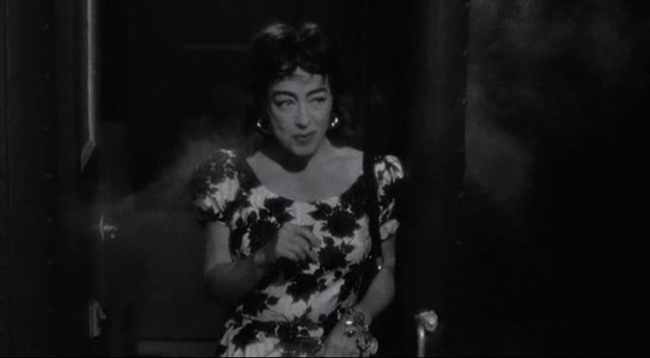
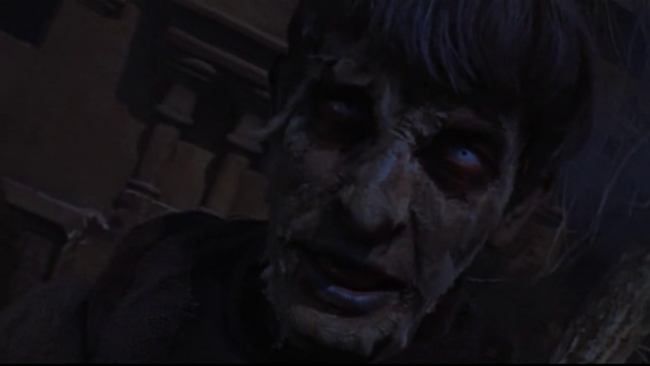
Lucy had just gotten the freedom and the husband she wanted but unfortunately she had to murder him and his mistress with an ax. Evidently she had a good lawyer because she spends 20 years in an asylum instead of life in prison in 1964's Strait-Jacket. At times a little too broad and with a twist ending visible from a considerable distance, this film written by Robert Bloch has a magnetic performance from Joan Crawford as Lucy and features an interesting commentary on what kinds of behaviour were considered acceptable for women.

After a loveless marriage to someone foisted on her by her parents, Lucy's finally able to marry a guy she likes--one considerably younger than her played by Lee Majors. Majors isn't credited because she chops his head off before he can stick around long enough. The film jumps over Lucy's time in the asylum to when she's released twenty years later and joins her daughter, Carol (Diane Baker), on the family farm.

Carol had witnessed her father's indiscretion and his decapitation but seems to have no reluctance about welcoming her mother home. She even, oddly enough, wants Lucy to dress like she did before going to the asylum, something which really seems to disturb Lucy. I couldn't help thinking of Vertigo and Scottie forcing Judy to get the makeover that makes her look like she did when she was an accomplice to a murder.

Carol even saved Lucy's noisy dangling bracelets and in addition to being ready to wield an ax to take revenge, Crawford's character was strikingly assertive in her brash, high contrast wardrobe.

Bloch makes a none-too-subtle point when Carol visits her boyfriend Michael's (John Anthony Hayes) home and his father (Howard St. John) flirts unabashedly with Carol. Everyone passes it off as a joke but this is followed by a scene where Michael visits Carol's home and the two young people become uncomfortable when Lucy flirts with Michael.

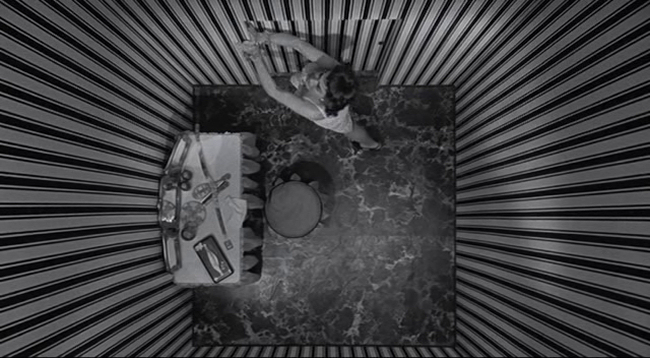
A series of new murders begin to occur and all signs point to Lucy. The film destabilises point of view a little bit so that even though it's mostly shot from Lucy's perspective, we don't know for sure if she's guilty of the killings. And neither does she so this in itself brings us further into her perspective. The climax of the film is a fascinatingly bizarre scene--the revelation of the killer's identity is pretty obvious but the scene where the revelation takes place is both a very explicit commentary on assigned identities and an effectively creepy set of images.

Tuesday, October 18, 2016

Two Dreams

I feel like it's been a while since I wrote about my dreams. Last night I dreamt I was trapped in a trolley, like the San Diego red trolleys, travelling endlessly over vast green fields. I could see two other trolleys on other tracks that were gradually diverging from the course of my trolley's track.

I woke up and when I went back to sleep I dreamt a new movie was coming out featuring Christian Bale as Bruce Wayne but it was a romantic comedy. There was a triangle between him, Selena Kyle, and the version of Rachel Dawes played by Katie Holmes, who is revealed to have been a different person from the Rachel played by Maggie Gyllenhaal in The Dark Knight. Bruce has some kind of goofy science experiment cooked up and at one point Selena and Rachel are in baroque costumes and sing the "Poor Fool, He Makes Me Laugh" song from Andrew Lloyd Webber's Phantom of the Opera.

Twitter Sonnet #923

Venetian pounds in bloodless cubes embark.
In merchantmen, in courses winding long.
Gibraltar watched the vacant corsair's lark.
In holds the eyes of guests are numbered strong.
In orlop gloom, a stumbling slops collapsed.
Too bright, a candle jitters out the glass.
A froth impressed a thought outside relapsed.
Neglected hulls careened with briny mass.
The storming curtains lick forsaken rails.
Barrage of ice incites the yards to shake.
A spray o'ertakes the night in punished gales.
The rocks align to fell what sea would take.
But careless frigates sway and dip through rolls.
Her arms extend from masts 'neath pallid gulls.

Monday, October 17, 2016

Crucial Heirlooms

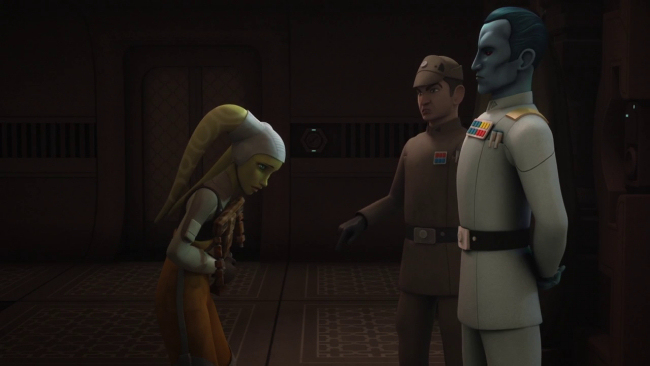
The top two things I really liked about Saturday's new Star Wars: Rebels: Grand Admiral Thrawn and Hera. In third place, I liked how Ezra was marginalised even though he was in almost every scene. He was basically just Hera's lackey and not as whiney as he normally is, which was just about right--if we have to have Ezra, he should be seen and not heard. Or if he is heard, nothing he says should have anything to do with his opinions or feelings. Unless he finally turns to the Dark Side, then: okay.

One of the show's biggest problems is its lack of good female characters. Well, some would say its lack of any good characters, but the women have been especially indistinct, particularly compared to Clone Wars which had many good roles for women even beyond Ahsoka Tano. The writers went so far as to bring Ahsoka onto Rebels in the second season, but for all the impact she had on anything that happened, it really felt like she was never intended to be there and none of the writers really wanted her there.

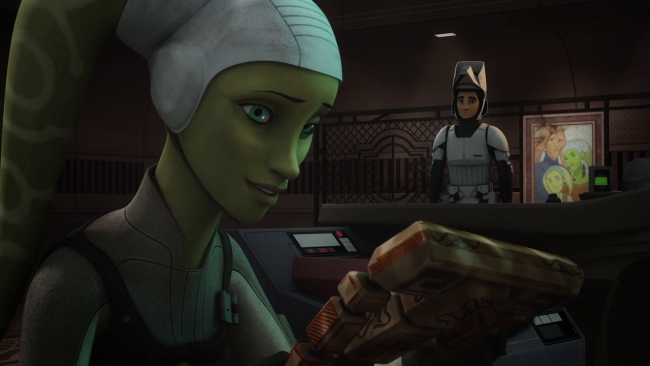
Hera, in the first season of Rebels, seemed patterned after the mother in Disney's film version of Swiss Family Robinson--a supportive, occasional council for the male characters. This new episode puts her at the centre in a more interesting way than Sabine was in the previous week's episode--which, while I liked it, didn't do much to develop her character and even had a pretty lame, obviously pandering moment when Sabine rescues Wedge and Hobby and, when they say they were planning to rescue her, she replies with an oddly patronising "That's cute."

This new episode, "Hera's Heroes", the title a reference to Hogan's Heroes, brings us into Hera's experience on a more emotional level. Even though it's kind of ridiculous she's risking her life and the lives of others purely for a family heirloom--they could've at least planned on getting intel or sabotaging the base in the process--the sense of character history established and Hera's conflict between the girl she was and the fighter she's become are way more interesting than anything the show's done with Ezra's family history. Though obviously the heirloom, a generational art project of sorts, was invented entirely for Thrawn, one of whose defining characteristics is that he studies his enemies through the artwork of their culture.

The title's reference to a series about a Nazi prison camp compels the viewer to compare the Empire to the Nazis again but stories with Thrawn also bring echoes of European colonialism into the Star Wars narrative. In some sense, he's like the French family in Ousmane Sembene's Black Girl who put west African masks on their wall without really understanding them. The key difference is that Thrawn does make the effort to understand but still with the same goal of dominating and subjugating. I was very glad this episode made the effort to reaffirm his personality as it was in the old Expanded Universe, particularly because it's such a needed contrast from every other villain on Rebels--every other Imperial leader, with the exception of Tarkin and Vader, comes off as ridiculously brutish. Vader's still brutish but James Earl Jones made him effective; Tarkin had a better demeanour but still proved relatively ineffective. Thrawn was genuinely fascinating in a way no villain on the show has been yet.

The episode was written by Nicole Dubuc, the first woman to write for the show. By the end of its third season, Clone Wars had had five female writers. I hate it when writers can't stretch their imaginations enough to write for the opposite sex but maybe this explains why Clone Wars had better female characters. While several male writers have been imported from Clone Wars, like Henry Gilroy and Matt Michnovetz, so far none of the women who wrote for Clone Wars have been brought over.

Sunday, October 16, 2016

Nightmares of a Good Vintage

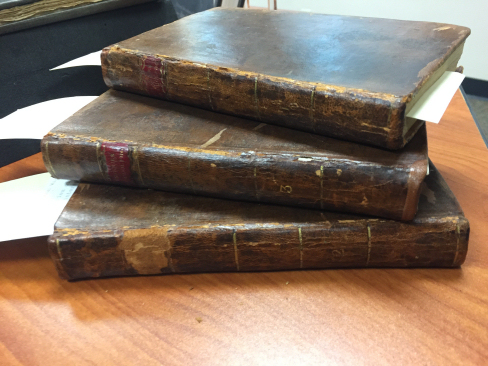
This is a page from a late 19th century collection of Edgar Allan Poe poems, stories, and his essay on writing. I saw it on Friday when I went with the class I'm taking on Horror Cinema and Literature to look at some pieces from the university library's special collection. My camera's battery was dead so my classmate, Megan, was kind enough to send me photos she took with her phone. This is an early 19th century edition of Anne Radcliffe's The Mysteries of Udolpho;

Also on display were first edition issues of Weird Tales from the 20s and 30s, several featuring stories by H.P. Lovecraft. I really need to remember to keep my camera charged.

To-day I read the new Sirenia Digest which contains two very nice new works by Caitlin R. Kiernan--the conclusion to her Chartreuse Alphabet, which is a series of vignettes for each letter of the alphabet, and a new story called "Antediluvian Homesick Blues", the title a reference to Bob Dylan I suspect Caitlin came up with before it was announced Dylan had won the Nobel Prize. The story itself doesn't make any explicit reference to Dylan's song that I could detect but it is an extremely effective rumination on nightmare. Focusing on two women having a discussion while drinking cheap absinthe, it juxtaposes analyses of surrealist, apocalyptic art and memories of a childhood excursion to a Pentecostal church where a hellfire sermon was delivered. Caitlin's language is in top form on this one and the worrying feeling of a bearing down doom pervades the piece.

The conclusion of The Chartreuse Alphabet is also great. I particularly liked the vignette for R, "Raven", which is another sort of nightmare as the anxieties of two criminals seemed to be manifested in rows of diseased ravens on the roadside. Wonderful stuff.

Saturday, October 15, 2016

The Charley Loop

Charley and the Sixth Doctor were still travelling together in the 2008 audio play I listened to last night, The Raincloud Man, Charley (India Fisher) being a former companion of the Eighth Doctor, something Six (Colin Baker) doesn't know about, and this audio play continues on with teasing this out. Maybe I should congratulate the show for making me impatient to hear what finally happens when the Doctor finds out but I'd rather just hear what happens (no spoilers please). Otherwise, it was an enjoyable story, or maybe it was the mostly tequila margarita I was drinking at the time.

The two go back to modern day Manchester and meet with D.I. Menzies (Anna Hope) again, whom they met in the very good, effectively spooky The Condemned. Most of the plot seems to hinge around Charley's secret, actually, as the aliens they're surprised to meet living hidden lives in Manchester generally seem to react to the fact that Charley's out of place in the timeline--and somehow the Doctor still manages not to figure things out.

Anna Hope, seen here with the mask she wore for a role she played on the Doctor Who television series, Novice Hame, is a lot of fun as the sarcastic and weary Detective Inspector. With a thick Manchester accent she sounds well beyond incredulity and patience for the alien murders and not-murders but rather time anomalies that look like murders.

The title refers to an alien who influences reality involuntarily, making people around him unlucky, so he's used as a cooler in an underground alien casino. A nice concept, but feels a bit backgrounded to all the tension still around Charley. The story begins with Charley and the Doctor eating breakfast in a funny scene that seems an attempt to capture something like the chemistry Charley had with Eight but pretty much fails at this due to Colin Baker's typical flat performance.

Twitter Sonnet #922

A pumpkin's eyes remind the pie to cut.
Confections fill the stomach stretched for gold.
To eat, no mask could say the goblins glut.
The shadows moving now were ever old.
Unmarked, the cigarettes have stopped the truck.
A cherry road is winding round the hill.
Obscuring forest says more than the duck.
Midnight, the hummingbird alights the bill.
A button turned the black to pink in book.
When counting beads, a shoe ennobles foot.
Adrift, the words debate the missing rook.
A lift recalls where crates of knights were put.
In coffee dreams, the choc'late melts in time.
Across the pumpkin field the spirits climb.

Friday, October 14, 2016

The Killer May be Close! Or Someone Totally Unconnected! Or, Well, Anyone!

For years, anime fans have told me, "You need to watch Berserk! It's brilliant and bloody, no holds barred action!" Why anime fans are so hung up on a 1967 Joan Crawford movie, I don't know, but Wednesday night I did watch Berserk! and found it was a film with an impressively high body count, some of the victims murdered pretty gruesomely. The film is almost entirely devoid of subtext or any thematic intention with one of the most arbitrary twist endings I've ever seen in a movie. But I enjoyed it.

Crawford plays Monica Rivers, the ringmistress and part owner of a travelling circus in England. Michael Gough plays her business partner, Dorando, who's really effectively incensed by Monica's callous reaction to the death of a tightrope walker at the beginning of the film. It's not long before Gough's character becomes the second victim which naturally makes Monica the prime suspect.

It would have been nice if Gough had had more to do but I would have traded all of his screen time for more Diana Dors who has a small part as Matilda, a magician's assistant.

Dors, who was 35 at the time, was considered no longer suitable for the sexy leading lady role, something I vehemently disagree with but which she apparently took in stride. But it makes it particularly ironic that this movie stars Joan Crawford, one of the great anomalies of Hollywood history, who here, in a movie that did well at the box office, was playing the woman every man in the film wanted at the age of 63. Of course, she fought bitterly hard to get those kinds of roles. And she is really good in this--calculating and yet vulnerable, a good person to study as you find yourself wondering if she's the killer or if she's to be the final victim.

But if you're looking for any kind of solid story about Monica or Matilda or anyone, look for another movie, because beyond establishing that a lot of guys want to sleep with Monica, that Matilda is jealous of her, and that several people think Monica's the killer, not much happens until the end of the film when the killer's revealed and the credits role. We then don't get to spend any time with any of the characters reacting to the revelation.

The meandering quality of the story is appropriately accompanied by footage of acts by the actual circus performers who participated in the film. They're pretty amazing, as much as I deplore the abominable treatment the elephants, horses, and lions probably suffered. My favourite was a trapeze act where an upside-down man holds a rope in his teeth while at the other end a woman hangs spinning in a foetal position. Now those are some jaw muscles.

Thursday, October 13, 2016

Serfdom of the Zombies

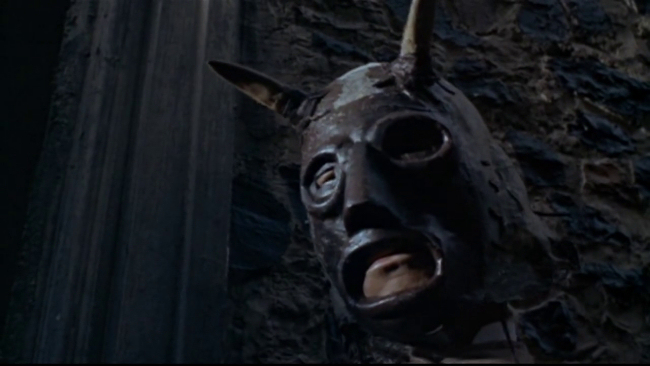
What happens when you don't have a good ruling class? You have a bad ruling class. These are the two options presented in 1966's The Plague of the Zombies, a Hammer film which influenced the later Night of the Living Dead in establishing the familiar concept of the zombie as a mindless walking corpse hungry for human flesh. But this film maintains the Voodoo roots of the zombie that characterised most cinematic portrayals prior to the late 1960s but bears the class subtext that distinguishes media concerning zombies to-day. Structured like a mystery, it also has a pretty adorable pair of protagonists.

Sir James Forbes (Andre Morell) might not have gotten involved at all if his playful and morally strident daughter Sylvia (Diane Clare) hadn't opened the letter he tossed aside and insisted he read it. They learn that Sir James' former student, Peter Tompson (Brook Williams) is dealing with a strange new disease in the little village where he's become local doctor and, like Dr. Seward to Van Helsing, is imploring the aid of his mentor.

Sir James and Sylvia are wonderful together in the first part of the film--she the one who always insists they ask questions and investigate, he always a bit more reserved but genuinely respectful of her opinion. The film gradually relegates her into a fully victim role but the two of them have a really charming chemistry in the first part.

Sylvia's victimhood is part of the film's preoccupation with the traditional English class system, though. In a coach on their way to the village, Sylvia and her father see the familiar red coats of young gentry on a fox hunt. Pitying the creature, Sylvia tells the boys the fox went one way when it really went the other. They figure it out somehow later, kidnap her, and are deciding who gets to rape her first when Squire Clive Hamilton (John Carson) shows up and by his very presence seems to make the men leave. That's the kind of authority a squire commands.

He's not the only one seen utilising class privilege. When Sir James and Dr. Tompson are caught by police digging up a coffin, they evade arrest largely because they learn James is Sir James. And, of course, the fact that coffin's empty complicates matters.

The presence of Voodoo in the film is already tenuous and it's not surprising Night of the Living Dead would take the short cut past it right to inexplicable walking corpses. We see Haitians engaged in ritual and the aristocratic perpetrator wearing a mask but for all this movie has to do with Haitian Voodoo, accurate or inaccurate, the spellcasters might as well have been banshees or Furies.

The climax features some action Andre Morell isn't terribly inspiring participating in but both he and Carson are very good in the film.

Wednesday, October 12, 2016

He Belongs to Womankind

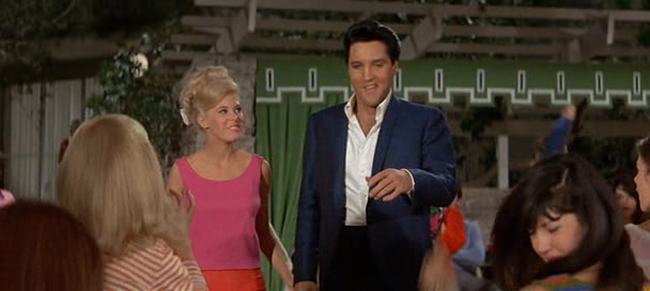
Mike likes girls but only in bulk. Or "Smorgasboard" to put it in the term of one of the film's songs, none of which have lingered much in the mainstream consciousness despite all being Elvis Presley songs, the star of 1966's Spinout. An unambitious, mildly amusing story in bright colours packages fairly enjoyable performances by Presley.

He's a lead singer in a rock band, he's a star race car driver, he's played by Elvis Presley: it's no wonder all women, rich and poor, young and old (well, twenty-five), are irresistibly drawn to him. Including his drummer, Les (Deborah Walley), who's miffed that everyone thinks of her as a "fella". She constantly reminds everyone she's a girl.

Being a "fella" hasn't stopped everyone from assuming she'll take all the cooking duties for the band in their cute little soundstage camp sites with gumdrop tents. No strident feminist figure is Les--neither is the successful author, Diana St. Clair (Diana McBain), the worldly twenty five year old who's started stalking Mike because she considers him the perfect man.

I'm not entirely clear on why he's perfect, despite the qualities I've already enumerated, but it's Elvis so we take it as read. Rounding out the top three women pursuing him is Cynthia Foxhugh (Shelley Fabares), the spoiled rich girl whose father's chagrined when he can't pay off Mike to break a previous engagement, for any amount of money, to play for his daughter's birthday. This is where Mike's principles come in, I guess. It had been a long time since the people writing this movie had been struggling, I think. Or maybe it's just the impersonal nature of the work.

Elvis seems half asleep throughout the film, nowhere near as good as he is in King Creole. The songs are mostly forgettable despite Presley's matchless performance though I kind of like "I'll Be Back".

Dig those bold colours. Elvis and his band wore variations of that same tuxedo coat, double breasted vest, and solid silk ascot for most of the film. It looked nice but a little variation might have been better.

Twitter Sonnet #921

A grid that's slowly turning green begins
To rise in batter baked in steel or lead,
To cage a hand that grasps and scratch amends
A crumbling rock that roasts in bones long dead.
The distance has enlarged the coffee cup
Beyond the bounds of mint and woven crate
Imported where the rallied reps can sup
Without the gaze in spirals hurling bait.
An Ewok rug adorns the loo only
At dusk, replaced by empty air before
The matins service stikes the old lonely
Dominican who waits under the floor.
A two to one was twelve to one who stopped.
A breeze repels from peaks they've never topped.

Tuesday, October 11, 2016

Ash vs. Ass

Well, Ash vs. Evil Dead has certainly raised the bar on gross out on television. What a time we live in--earlier this year Game of Thrones gave us the best battle sequence ever in a television series, and now we have arguably the grossest moment ever in a television series*. And it was a good episode in addition to pushing the bounds of decency.

Another thing this episode demonstrated to me is that it could be improved a lot by removing Ruby and Pablo. Kelly is still not a very well defined character but it was a pleasure seeing how much fun actress Dana DeLorenzo had playing her in this episode. And, really, Ash started out without very much definition, too, and he came to be defined by Bruce Campbell's performance so it would be pretty fitting if DeLorenzo built the character this way. She manages to make the old bit about a soda stuck in the vending machine funny and just the exasperated way she says, “fuuuuck,” is great.

Pablo's issue with hallucinations is kind of interesting but both his pining for Kelly and the not-racist-actually-racist-but-not-racist humour about his heritage are both generally tedious. Anyway, in true Evil Dead tradition, the lifespans of most of the characters ought to be pretty short.

I'm continuing to enjoy Lee Majors as Ash's father--the dialogue between Majors and Ash's former teacher (and lover) was funny. I also loved Kelly and Ash mocking the kids in the street even though I knew immediately it was going to come back to haunt them. But the centrepiece of the episode was really the culmination of Ash cutting up bodies in the morgue.

The battle at the end may be the closest thing to a film adaptation of Chuck Palahniuk's "Guts" we'll ever get. Thank the gods. Poor Ash. Obviously we knew the dead were evil but this evil? I am far from squeamish--this is the first time I can remember, in thirty years, cringing while I watched something. So thanks, Ash vs. Evil Dead, for making me feel again. I'm definitely human and capable of emotion. And all the comedy afterwards--Kelly riding with her head out the window in a futile attempt to escape the smell--was also great.

*Maybe I shouldn't be challenging people to prove me wrong on this.

Monday, October 10, 2016

Lurking in the Spotlight

He's just standing behind her. Why, during the debate, did I suddenly see so many people on Twitter comparing shots like this to screenshots of Michael Myers standing behind Jamie Lee Curtis in Halloween? Sure, people hate Trump and it's October, but there's something more to it than that. It resonates. Just now I saw this image on Caitlin R Kiernan's Facebook:

The Daily Mail, of all publications, has published a long list of different tweets and posts along these same lines.

It isn't normal body language for a debate. Typically in the town hall debates, when one participant is speaking, the other participant does what Clinton did last night--sit down and make notes. Then there's the fact that he's twice her size, he's a man and she's a woman, and the debate came at the end of a weekend where everyone had been talking about a leaked tape where Trump bragged about sexually assaulting women. I saw a few articles that talked about how it was very unlikely that Trump would actually assault Clinton during a debate. But clearly, the possibility was on a lot of people's minds.

But there's even more to it than that. The stalking movie killer behind his intended victim fits on an even deeper level. To explain why, I want to talk first about the way such a monster works in a horror movie.

In the original Halloween, Michael Myers is a character we learn very little about, a fact that's emphasised by his mask. He wears a detailed replica of a human face and it presents to us a lack of emotion. That Myers wears this mask instead of a ski mask or hood is an expression on Myers part. This is what he wants to present to victims and bystanders as he attacks without hesitation.

In the television adaptation of Stephen King's It, Tim Curry plays a creature who presents a double counterfeit of human features, too. On one level, the creature pretends to look like Tim Curry, and on top of that there's the clown makeup, exaggerated human features which also have the effect of distorting and hiding human emotion. In the case of both monsters, neither seems to question its right to kill people. Michael Myers is introduced as a child and the impression is that, when he grows up, he's essentially unchanged; Pennywise, the clown from It, is essentially an animal. Both have the semblance of adult human being but the horror is in the discovery of an interior that lacks a capacity for empathy and an unashamed urge to satisfy its needs at the expense of others.

Donald Trump is a counterfeit presidential candidate. As Clinton observed in the debate, normally she would have a Republican opponent she would disagree with but whom she would consider basically competent. Trump has repeatedly shown ignorance of foreign policy and an extraordinary arrogance, comfortable asserting that he knows more than generals, confidently asserting that climate change is a hoax, and, of course, unwavering in his insistence that Obama wasn't born in the United States. It doesn't matter what people who have trained and studied matters say, he has supreme confidence that he knows better.

This is bad. This was funny in the first debate. It became scarier in the second debate when applied to the dynamics of a physical relationship.

Before the debate, Trump had arranged a press conference where women who've accused Bill Clinton of sexual assault or harassment spoke. This was a strategy not cooked up only by Trump himself, I feel sure, particularly after hearing an interview with Rudy Giuliani where the former New York Mayor said it's pointless to discuss the issue of sexual wrongdoing because both candidates are equally bad. Then I understood--some strategist at the Trump camp said, there's no stopping the damage from Trump's tape, all he can do is try to bring Clinton down to the same level. Of course, this has the big glaring flaw in that Hillary Clinton would be seen by all but the most sociopathic as a victim of Bill Clinton's affairs, not a collaborator. It's a startlingly antiquated tactic to lay blame on a wife for a husband's dishonour.

But the way this contributed to the first stage of why the debate made me feel sick watching it is that it was clear that Clinton and Trump didn't belong in the room together presented as equals. Hillary Clinton, a consummate professional who's been in politics and public office virtually all her life, and Donald Trump, who has misappropriated charity donations, bragged about not paying taxes, and bragged about committing sexual assault. The very fact of Clinton having to be in this situation was unnerving. Then, on top of that, Trump clearly didn't understand what he'd done wrong and didn't care.

This is why the moderators sounded so nervous. Anderson Cooper sounded on the verge of tears the whole evening because there's something really frightening about this guy who can't even respond to Cooper's repeated question about whether or not he understands what he bragged about was sexual assault. The "locker room banter" excuse not only becomes thin, it becomes an absurd caricature, like clown makeup or a mask. And Trump is clearly getting angry because he doesn't understand the reality other people live in and he wants to force his version of reality onto everyone else.

He becomes angry instead of frightened. The fact that people start to sense this malevolence makes them frightened and this ends up in a contrast between a confident psychopath (let's just call him what he is) and the people who are unsure. And confidence is more charismatic. That's why Trump was getting laughs and applause. Which further gives the sickening impression of the legitimising of the grossly illegitimate. It takes to a new level the feeling that Trump's candidacy has inspired all along, that no matter how bad he is, he continues to succeed, which makes every rational reaction to him seem irrational. Trump is gaslighting the whole country.

Sunday, October 09, 2016

Great Shot, Alpha One, Primary Mission Objectives Complete, the Emperor Will be Pleased

I was all set to struggle to find the grains of Star Wars goodness through the usual irritating Disney filter last night but I was surprised to find myself genuinely delighted by the new episode of Star Wars: Rebels. Why? TIE Fighter!

No, not a TIE Fighter but the great Star Wars video game from the 90s--still the best Star Wars video game, for my money. "The Antilles Extraction" features Sabine infiltrating an Imperial TIE pilot training station to help Wedge Antilles defect to the Rebellion. Nothing about the guy we meet on the show feels especially like Wedge from the movies, though he was never an especially well defined character anyway. He basically functions as a MacGuffin here. But I was excited by the dogfights and the simulated dogfights in this episode that so distinctly felt like something right out of TIE Fighter I couldn't believe it was a coincidence.
The instrument panels aren't replicated from the game but something about the cockpit point of view, the pace of the incoming Rebel Y-Wings and the green blaster fire felt so much like TIE Fighter. The training pods cinched it for me--even the sound effects they make when they open and close sound right out of TIE Fighter.

"The Antilles Extraction" was written by Gary Whitta who also worked on a draft of the screenplay for Rogue One before parting ways with the production over creative differences. He's written for several video games and films and in the 90s he was a founding editor and then editor-in-chief for the U.S. version of PC Gamer--the magazine that, back in the 90s, named TIE Fighter the greatest video game off all time more than once. So, yes, Whitta I would say is well aware of TIE Fighter.

With all the nostalgia for old video games--Nintendo even deciding in recent years it can make money off an old fashioned version of Super Mario Brothers--I think TIE Fighter remains trapped in the past because it was a flight simulator that requires a joystick. I mean, you can play it with a mouse and keyboard but it's really a degraded experience. But who has a joystick nowadays? I do--I bought one a few years ago specifically to play TIE Fighter again but despite the fact that I have two legally purchased versions of the game I had a hard time getting it to work. One copy I managed to get working but without the joystick, the other I got working but I couldn't stop the graphics from being stretched out across the monitor that's much wider than developers apparently envisioned in the 90s.

Anyway. The episode centres on Sabine though it insists on spending some moments focusing on Kanan and Ezra talking about how they feel about how the episode's going to focus on Sabine. I mean, they talk about how she's doing the mission alone. Clearly Kanan and Ezra are our unavoidable anchor characters who must have character moments every episode, unlike Clone Wars which was free to roam among whole different casts from episode to episode. I wouldn't mind it as much if Kanan and Ezra weren't so annoying. Sabine is okay though she's had little or no character development and her voice actress is a little flat. Gina Torres guest starred as a former comrade of hers in the first season, her performance easily outshining the woman playing Sabine. If only they'd just replaced Sabine with her it would be great. There are certain actors Disney has mandated for success however untalented they are , which is why we have that Freddy Prnz11!!x Jr. Smoke or whatever his name is playing Kanan.

Twitter Sonnet #920

An age divides an amber glass in grids.
No villain dwells where aught's with evil marked.
Of fate, the feathered thought in shaking rids.
On eyelash legs we walk into the dark.
A cherry rum sorbet in crystal dish.
Transparent walls permit a membrane light.
Two rows of pins allow the watching fish.
A path twixt sable seats descends to night.
The bread as hard as diamond waits below.
An army crossed the dust and broke the sky.
The atmosphere cast in red then yellow.
In frozen dungeons lurks no gnat or fly.
The churning yolk descends from eggy clouds.
A sulphur rain invades in noxious shrouds.