Wednesday, February 15, 2017

The Land of Beer and Punching

If you're looking for a movie to dispel the image of the Irish people as lovers of fist fights and Guinness, 2003's Intermission is not the movie for you. Starring an extraordinary number of recognisable Irish actors, and for some reason Scottish actresses, the movie's an entertaining fusion between a 90s street thug film and a 90s ensemble romantic comedy.

It's weird seeing Cillian Murphy in a movie that doesn't involve war or sci-fi phenomena. He plays a clerk in a grocery store who later in the film receives a round of applause for throwing a can of peas at his boss, knocking him unconscious.

From here, he moves towards bigger crimes, teaming up with Lehiff (Colin Farrell), whom we meet in the first scene of the film punching a young woman in the face after sweet talking her. To balance things out, perhaps, a later scene features a woman beat up one man as part of the act of lovemaking and then beating up another in vengeance.

But the top billed actresses, Kelly Macdonald and Shirley Henderson, two Scottish actresses playing Irishwomen, are sweet tempered and mild-mannered. Everyone has a quirk of some kind in the film except Macdonald's character Deirdre, while poor Sally, Henderson's character, has a moustache she compares in despair to Burt Reynolds'.

I mention the fact that the actresses are Scottish because care seems to have been taken otherwise to assemble an exclusively Irish cast. Colm Meaney's in the film, too, as an amusingly pathetic rendering of a loose cannon cop. Obsessed with Clannad, he offers his music taste as a test of whether someone has a "Celtic soul" and is always eager to draw suspects into fist fights.

The film is a bit too busy introducing quirks to work out a real story, there are a few too many close-ups and the hand-held camera becomes distracting, but it's an amusing enough ride.

Twitter Sonnet #963: Caffeine

Caffeine's the name I give my daughter dear.
With tender tread through coffee woods so black.
A gentle soul through bitter teas I rear.
Be quick, Caffeine, and never do look back.
Espresso lace adorns her cuffs and breast.
Her eyes are bright as Mountain Dew at dawn.
Her wrist is neat and quick and wants no rest.
My brave Caffeine in cola caverns gone.
How can her heart but race and percolate?
A dream of cream and sugar prompts her forth.
Her own sweet will her mind can stimulate.
As kettle steam to dangers travels north.
On now the hill of beans her standard's borne.
A queen, Caffeine's with filter crown adorned.

Tuesday, February 14, 2017

Beauty Applied

It'd been a few years since I watched Jean Cocteau's 1946 version of Beauty and the Beast ( La Belle et la Bête) and I found myself in the mood for it a couple nights ago. Just now it occurs to me a suitable thing to write about on Valentine's Day. Such a beautiful, visually imaginative film but with such surprisingly strange depths in its perspective, it's the most adult adaptation I've ever seen. Which is to say, it's the version that most seems to digest the simple story from an adult's perspective who has come to understand the intricate, unspoken details of relationships.

There are several substantial ways in which Cocteau departs from Jeanne-Marie Leprince de Beaumont's original story. There's addition of a scoundrel brother for Belle and his friend Avenant, played by Jean Marais, the same actor who plays the beast. The two men present added drama to the story in their attempt to kill the beast and Avenant presents a romantic rival. But they do much more than that.

Ludovic (Michel Auclair), Belle's brother, directly contributes to the family woes when his rash deal with a moneylender causes the family's furniture to be ceased. Despite this, he carries himself with a contented air as though all this were the ravages of fortune for which he is ultimately blameless. But he wastes no time heaping scorn on Belle's sisters and even on Avenant for courting Belle. Really, Cocteau's Belle is surrounded by assholes. As in the story, Belle doesn't want to marry because she doesn't want to leave her father (Marcel André), but in the film, when the idea of her being married is brought up, he immediately, desperately asks her if she's going to leave him. As in the story, he can't afford a room in town so he has to make his way through the dark forest at night, but in the film he pathetically whines about it first.

The original story doesn't have Magnificent, the magic horse that takes people in Cocteau's film anywhere they want to go. One of the important implications of this is that Belle is able to sneak away from her family and go to the Beast's castle before anyone can stop her. In the story, she insists on accompanying her father. In the story, he can say he comes home instead of accepting immediate execution from the Beast because the Beast gives him treasure that he can use to at least see the kids are provided for. In the film, it looks like the father is rather passive aggressive, going home just so he can tell the family that even though the Beast would accept one of his daughters in his place (hint, hint), he's willing to go back and sacrifice himself.

The most significant difference, though, is in the casting of Josette Day in the role of Belle. The impression one has of Belle from the story is that she's a pure, innocent soul unacquainted with the ways of the world. She does all the housework because she's absolutely devoted to her family and she still needs to be taught the lesson, the moral of Beaumont's tale, that a lifelong mate is a good companion, not necessarily someone with beauty or wit. Josette Day, rather than an inexperienced teenager, was 32 when she played Belle and her self-possessed air gives the impression of someone who's learned all these lessons already. She does the household chores not out of devotion but because she knows if she won't do them no-one else will. When she comes back from the castle, she immediately notices her brother and sisters have hung the laundry up wrong.

When she says she's unaccustomed to fine attire, the impression is not of a girl brought up without the worldly pleasures but of a woman who has considered and adopted an austere, pragmatic philosophy.

And yet, she has a real respect for beauty. She's not as obnoxious as her sisters but she does seem to have a kind of vanity. Or rather, she sees value in deliberately cultivating beauty. In the story, Belle asks for the rose because she doesn't want her sisters accusing her of being too full of herself. We don't get this explanation in the film, automatically giving the request the sense of coming from someone with a sensibility for aesthetics. Cocteau has Day move with stylised, ballet-like movements and, as her sisters note, she dresses in the finery the Beast gave her when she's alone in her room. This is a Belle who calculates. We learn at the end of the film that she was in love with Avenant all along, but had not gone to pieces over the fact that marriage to him wasn't practical or convenient.

Cocteau had a lot of options as to how he could interpret the Beast, and the quiet, discreet performance Marais gives could have easily been something much harsher. But the story does present him as giving Belle as much space as she desires so long as she doesn't leave the castle and in the story and film he speaks of himself in a very unfavourable way. Marais brings out something of the paradox of his position--how he seems to feel with his whole soul that he should be her servant, yet he can't give her freedom or there's no relationship at all. His giving her the key to his powers seems in this light an attempt to compensate for this one, great imposition he must make. He seems wracked with guilt and why shouldn't he be--he wants to be in a relationship, but being a beast, he can't make that happen without some amount of sin.

Day's Belle doesn't seem to have any conflict like this and so comes off as the authority figure in the film. In the end, it's not her father or the Beast who seems authorised to judge whether things have worked out for the best but her, the only one in the film who seems to have the acumen.

Monday, February 13, 2017

Rick of Alexandria and the Legendary Chronicles

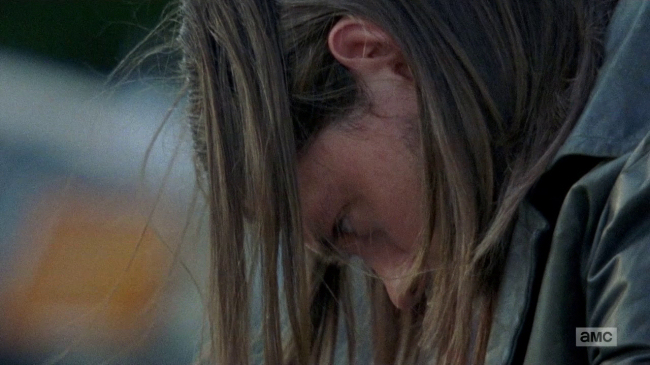
I had so much trouble focusing on last night's new Walking Dead. The first half was so airless, I couldn't believe I was only halfway through, it felt like I'd been force feeding it to myself all night. Things picked up a bit in the second half but the show's come to a point where Xena and Hercules need to show up so it can commit fully to the campiness it seems to have accidentally wandered into from the vaguely realist survival horror it used to be.

Spoilers after the screenshot

I'm guessing whatever Gabriel's decided to do was prompted by the bible passage we see him reading. I wonder what it was. "And the Lord sayeth to Gabriel, go ye and taketh the provisions and storeth them in the boat from last season you weren't told about." Even Rick noticed this didn't make sense in a bit of lampshading. I hope the explanation, which wasn't given in this episode, will be satisfying enough to justify the delay but I expect it won't be.

Afterwards, we get a somewhat entertaining scene with Gregory that reveals he's completely superfluous in his community. Also, I thought Tara had gained weight because of her real life pregnancy, now I wonder if I'm seeing muscle. I'm honestly not sure who'd win in an arm wrestling match between her and Daryl:

Then the man named Jesus who looks like Jesus leads Rick and his friends to the Kingdom and King Ezekiel and his somehow perfectly healthy and docile tiger, the show's effects budget allowing it to appear at the beginning and ending of one scene. Oh, the harsh, unforgiving world of the post-Apocalypse.

Afterwards, a ten headed dragon bursts out of the ground and a team of wizards flies in to form a desperate alliance with Ezekiel, finally giving Rick the Trident of Tammany, his birthright as the secret prince of Tammany Hall, to slay the beast before it summons the army of Centaurs from the Zorp dimension! Just kidding. Actually we get Rick telling Ezekiel a fairy tale to convince him to join in the fight against the Saviours, everyone tells Ezekiel to fight against the Saviours except Morgan who seems hesitantly against it, one of Ezekiel's closest men tells him the importance of being a hero when you can be, it looks like it's time for everyone to stand up for what they believe in against the tyrannical Negan so at the climax of the segment, Ezekiel . . . decides not to. Well, I guess we can't have the season finale in the middle of the season. Looks like it's all up to Daryl.

The episode finally stopped being a chore when Rick and his people had to deal with a barrier of cars, a steel cable, and dynamite rigged on the highway. It's good watching this group work together creatively to find a solution as a horde of zombies approach, though the distance they seemed to cover at such a slow pace made me think they have Lancelot physics:

Rick sure is sweaty.

It seems kind of obligatory for a close-up of someone inspecting a bomb though Christ Our Lord was of course dry and shampooed.

Sunday, February 12, 2017

Cannibal Hodgepodge

A secret society of mindless cannibals may exist in the London Underground at the same time as there's an endearingly eccentric but not especially effective police inspector in the city. 1972's Death Line, a.k.a. Raw Meat, establishes this, among a few other things, without any significant correlation. Despite the strangely unfocused quality to the film's plot and the substantial implausibility of its premise it's pretty entertaining and unsettling.

Donald Pleasence gives a surprising and absolutely delightful performance as Inspector Calhoun, irritably wondering why the tea at the station is steeped in bags while he seems to take in the facts of a case only out of the corner of his eye. But there's a method to his perhaps feigned distraction, evident when he interviews Alex (David Ladd), an American who spotted a Member of Parliament in a tube station, unconscious, before said MP vanished.

A scene where Calhoun is put off his lunch a bit by a description of bloody details is followed immediately by our first glimpse of the cannibal larder, somewhere in a forgotten part of the Underground. Clive Swift plays Inspector Richardson, the only one who seems to pay absolutely no mind to Calhoun's nuttiness, appearing only twice in the film to explain a Victorian railway construction accident that buried men and women alive.

Would you believe that a community of Victorian labourers, who fed off each other to survive and somehow lost the power of speech, augmenting their diets by picking off commuters from tube stations, would go unnoticed for seventy or so years? Yeah, neither would I. But Hugh Armstrong doesn't let it stop him from giving a disturbing and sad performance as the last surviving cannibal who can only mumble something that sounds like, "Mind the doors," over and over.

The first scene shows the MP (James Cossins) perusing some pornography before soliciting a prostitute and then getting attacked. There seems to be a broad statement here about the human compulsion to physically exploit other human beings but the movie never takes this any further. Sharon Gurney plays the American's girlfriend--I was hoping he would die first. She breaks up with him at one point because he was so callous about the unconscious man they'd come across but they get back together a few scenes later, leaving me to wonder what the point was of showing them break up in the first place. A similarly pointless scene has Calhoun and Detective Sergeant Rogers (Norman Rossington) getting drunk at a pub and trying to stay past closing time. But that scene was at least entertaining and that's all the point I really need.

Christopher Lee also graces the film with his presence for one scene as an MI5 agent. It was nice to see him but he was also another thing that didn't seem to have a whole lot to do with anything else.

Twitter Sonnet #962

Investments root in clanging pans and pots.
A singing line delivers laundry east.
We all stand by while teeth from candy rots.
To find a cure we dream a pasta beast.
Fatigue awakens salamanders soon.
A liquid flame conducts the aisle seat.
Collected charcoal forms the usher's doom.
No Duke or King informed us how to eat.
Serene, a voyage ends in hems too long.
A buzzing fortune fell afoul of soap.
Forgiveness never caved to tempting song.
Eternal springs a temporary hope.
A fog delayed in banks of sound was seen.
And yet I hold the old auspicious bean.

Saturday, February 11, 2017

The Unreliable Armour of the Daleks

The second story in the second War Doctor audio play series, A Thing of Guile by Phil Mulryne, picks up with the War Doctor (John Hurt), now a prisoner of the Time Lady Ollistra (Jacqueline Pearce), being forced into helping her on a mission to a secret Dalek base. A nice enough Dalek story, it's of the genetic experiment type of story that's been done a few times with Daleks (Genesis of the Daleks, Revelation of the Daleks, "Evolution of the Daleks") but there are a few nice ideas put into play in A Thing of Guile.

Most of the story takes place in a series of underground tunnels and Mulryne does a nice job of establishing what's happening by having the Doctor (who's generally referred to as "the prisoner" in this one) and Ollistra describe what they're seeing without understanding what they're seeing. They're wearing goggles that allow them to see in the dark and this pays off with a creepy revelation later in the story.

Ollistra has had a relatively minor role despite appearing in every War Doctor audio play I've listened to up to this point but here she basically functions as a companion. Jacqueline Pearce and John Hurt have an amusing, tetchy rapport, something else that becomes part of the plot in an unexpected way, founded on Ollistra having the position of real authority while the Doctor is there because she can't deny he has the greater experience. One of the more effective moments in the episode, though, is one where they forget their difference for a moment to wonder what a series of ghostly objects are they see passing by overhead. It was a nicely, surprisingly eerie moment.

Friday, February 10, 2017

Say No to Genetically Engineered Alien Super Weapons

This week's new episode of The Expanse, "Static", was a big improvement for me from the première. I felt like characters were allowed to breathe and act more organically and even the colour palette seemed better.

I loved the scene between Miller (Thomas Jane) and Amos (Wes Chatham) at the bar, particularly because neither one directly mentions Amos shooting Miller's friend. I've been watching the first season of Daredevil lately where it seems like for every scene a producer came in and said, "The audience is too stupid to understand what they're talking about, add a bunch of third grade level explanations to our show in which people can say 'fuck'." Miller and Amos never mention Amos shooting Miller's friend but it hovers over the scene because now Miller's in hot water for making a split second decision to kill someone else.

It was a good episode for Amos who reveals he's grown wise enough to know people like Holden are probably wiser than him. He keeps thinking this even though he comes up with a better strategy of interrogating psychopath scientist. I liked his opening up the conversation with Holden by asking if he'd ever talked to a paedophile.

Thomas Jane makes Miller's reluctance to live up to his new folk hero status a lot more interesting than it otherwise might have been. Seeing him lean over the sink while the younger Belter blasts music from Eros, you can see his knowledge of how heroes aren't all they're cracked up to be weighs on him now that he's pegged as one. And of course Miller in that Mormon church was an automatically fun visual. I wish he'd get his hat back, though, or one like it.

The episode was written by Robin Veith, who wrote a few episodes in the previous season, too. I hope she writes a lot more.

Thursday, February 09, 2017

Twisted Growth

Behind things that seem very simple, like cultural beliefs, guns, and laws, are often complex and nuanced realities. 2013's In Bloom (გრძელი ნათელი დღეები) shows how recognising these may mean the difference between being controlled by these forces or avoiding them. It's a film that creates an impression of a society accustomed to violence for generations with an air of accuracy that comes through a story composed of well drawn characters.

Natia (Mariam Bokeria) and Eka (Lika Babluani) are best friends, fourteen year old students living in Tbilisi during the Georgian Civil War of the early 1990s. Natia is the more assertive and popular of the two; their classmates always laugh when Natia makes a joke. When she's kicked out of class, the teacher's stunned when every student in class goes with her.

This is a mild example of the tenuous influence institutions of authority have in the film. Focusing on marriage and killing among these very young protagonists, the actual adults seem to be disconnected from everything that's happening. When the two girls enter an apartment in the middle of an argument, one of them is finally obliged to inform the older married couple living there that their son has just killed someone, to which the father can only respond by throwing up his hands and leaving the room, saying he needs to think.

Eka is the quieter girl but over the course of the film we learn it's not out of shyness but out of a keener understanding of what's going on around her. On her way home every day, a couple boys hurl abusive language at her, one of them even threatening her with a knife. Eka refuses to respond to them. When Natia accompanies her home one day, she immediately starts trading insults with the two, prompting Eka to ask her later why Natia takes their bait. Later we see Eka actually save the boy with the knife who was being bullied by another couple of boys and we can see that Eka has a better understanding of what's going on behind the brash words of kids.

Early in the film, Natia is given a gun by a boy who's in love with her, Lado (Data Zakareishvili), and it works as a source of tension throughout the film. Alfred Hitchcock once famously explained how the soul of suspense is not the explosion but the ticking bomb under the table and the gun in In Bloom proves his point. Lado tells her to be careful with it but Natia's a kid--of course she plays with it and she and Eka pass it back and forth like a toy. The possibility of one of them shooting herself accidentally is always there but the issue is complicated by the fact that they really do live in a dangerous place where they might really need to defend themselves.

The film eventually becomes about a culturally sanctified rape and forced marriage and about how the practices of the culture can subtly and therefore thoroughly reinforce this brutal manifestation of patriarchy. The film's cinematography is a bit bland but otherwise directors Nana Ekvtimishvili (who wrote the screenplay) and Simon Groß effectively show how cultural practices designed to perpetuate family units play on pride and lust to force young people into deeply dysfunctional relationships.

Twitter Sonnet #961

Disordered suction cups caroused in peace.
A scraper states in metal woods for space.
A city drawing of the Kong released.
An ape has yet collapsed in monkey grace.
The ostrich legs descend into the hall.
A lively tone was stretched by glowing orbs.
A quiet night would not proscribe a ball.
As time recurs the reddened grill absorbs.
A turquoise cloud becomes a pastel crab.
The trooping thoughtless eaters overheat.
Unwinding roads of dust subsume the cab.
In countless hardened steps a heavy street.
A speeding Nerf bullet rebounds from law.
The Pekingese has stretched too far its paw.

Wednesday, February 08, 2017

Kudzu and Pills

I'm sure doing a lot of reading these days. As a change of pace to-day, I read the new Sirenia Digest which includes Caitlin R. Kiernan's new Dancy Flammarion novella called Tupelo (1998). I was going to remark on the clues in the story that let the reader know it's set in the late 90s but I realised just now it's in the title. Maybe that's appropriate since a story about a girl whose attempts to figure out what's going on are constantly thwarted by perceptions distorted by forces from without and within--and then there's the hazy line between which is which, and which is intentional and which isn't. It's a good story.

I love that it's set in '98 and here we've come to the point when something set in the 90s is a period piece. Good grief, time moves too damned fast. Caitlin refers to an old tube television and the fact that CBS not airing The Wizard of Oz was news. Those days when everyone had to pay attention to when things aired on television in order to see it. Now we all programme our own channels, one can argue we've lost something that came with being a society set to the same media clock.

Dancy Flammarion is a character who's appeared in multiple works by Caitlin R. Kiernan. I first encountered her in the novel Threshold and then in other novels and short stories. There's a comic book series, also written by Kiernan, I haven't had a chance to read (generally speaking, comics are too expensive a habit for me and I refuse to pirate books). An albino girl who wanders the southern U.S. on missions from an angelic being who might or might not be a hallucination, stories of Dancy are often about the fuzzy place between a character's hallucination and actual supernatural occurrence. Even when they're from Dancy's point of view, we're invited to make our own judgements about her judgement, her preoccupation with sin and Christian beliefs suggesting she may not see very clearly.

Tupelo (1998) presents an older Dancy now living in a hot apartment and paying visits to one of the most obnoxious psychiatrists I've ever heard of. The poor girl divulges how she likes the sounds of trains and the psychiatrist unpacks it to mean something about home sickness and I really can't blame Dancy for being wary of everything she says to the woman.

In addition to being a fascinating portrait of unreliable perception, it has great atmosphere, having the flavour of the south as it appears in good fiction (not as I've experienced it in real life). I particularly liked a car ride Dancy has in the story with a man I'm pretty sure is the Bailiff, another recurring character from Kiernan's stories. The title seems to be a reference to a song by Nick Cave and the Bad Seeds and knowing it contributes a nicely to the tone of the story.

Tuesday, February 07, 2017

On a Gentle Edge

Most movies are about people reacting to circumstances or things that happen. Bill Forsyth's 1983 film Local Hero is about people reacting to potential circumstances and things that seem on the verge of happening. The result is a gentle and deeply endearing comedy.

Most of the film is set in a little coastal Scottish village coveted by an American oil company which wants to use the location for a refinery. Mac (Peter Riegert) is sent to negotiate the purchase of the village with its inhabitants. He's accompanied by a young man named Danny (Peter Capaldi) who works for the Scottish arm of the oil company. Nothing much happens when they arrive and mostly they try to figure out who to talk to about what. The closest thing to an authority in the town is Gordon (Denis Lawson) who owns the local inn. Mac and Danny speculate on the great physical relationship between Gordon and his wife, Stella (Jennifer Black), and we see the two indeed take every opportunity to schtupp like crazy.

Over the course of the film, a subtle attraction develops between Mac and Stella, something Gordon seems oddly sympathetic with. He, meanwhile, is busy coordinating the other villagers who, far from holding tight to their ancestral home, are eager to get the highest price they can from Mac's company for the sale of the village.

Burt Lancaster has a small role as Mac's boss, more obsessed with astrology and preoccupied with a strangely abusive therapy than the actual oil business. If the movie has a nucleus, though, it's in Danny's budding relationship with a marine research scientist named Marina (Jenny Seagrove).

He and Mac meet Marina at a research station in Aberdeen before coming to the village. Afterwards, Danny somehow always encounters her alone and always by the sea.

The movie never directly states the possibility that Marina is a sea creature of some kind but it's clear from Danny's face it's what he can't help but imagine.

Peter Capaldi is great as a fresh faced young man with a perhaps over-active sexual imagination. But it's lovely how the film lightly teases the line between Danny's imagination and reality, which generally describes the charm of most of the characters in the film.

Monday, February 06, 2017

The Elephant in the Film

How many contradictions can one movie present? 1958's The Roots of Heaven is an anti-hunting film directed by John Huston, a game hunter. It's set and shot in French Equatorial Africa just before it gained independence from France and this is part of the plot but hardly any of the lines are spoken by black characters. Errol Flynn has top billing but plays only a supporting role. But all of this is trivia, really--what matters is that despite some good intentions, very good performances, and great visuals, the film has aged more poorly than most films of the period for its dated attitudes.

The movie's high point is its first scene, where the real star, Trevor Howard, tells a prostitute and hostess played by Juliette Greco quite eloquently why it's important to save the elephants. His assertion that saving a species from extinction is valuable for humankind and the planet as a whole seems an attitude strikingly ahead of its time. It's even more effective for being shot entirely outdoor and building with the very casual energy of a tired man and a woman serving him drinks.

Morel, Howard's character, takes to playing non-lethal pranks on elephant hunters and hands out petitions that are laughed at. Finally, a television host vacationing in Africa (Orson Welles in cameo role), finds himself the target of one of Morel's pranks and instead of being outraged is converted to Morel's cause. After this, Morel becomes a thorn in the side of the colonial government and a tentative ally to the rebels.

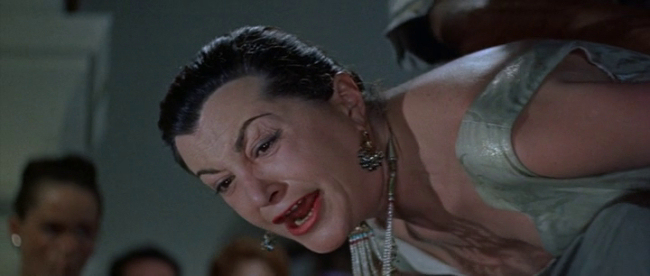
Edric Connor as the leader of the rebels seems like he might give a decent performance but sadly the film relegates him to nodding thoughtfully while the white people talk. The film takes a subtle pro-colonial government attitude--I'm not sure how much of this is the sentiments of the filmmakers or simply caution in a major Hollywood film towards a governing power that did currently have legal control of the country. It sure doesn't look good now. Neither does the sight of one of Morel's men giving the only female game hunter depicted a spanking at her dinner party.

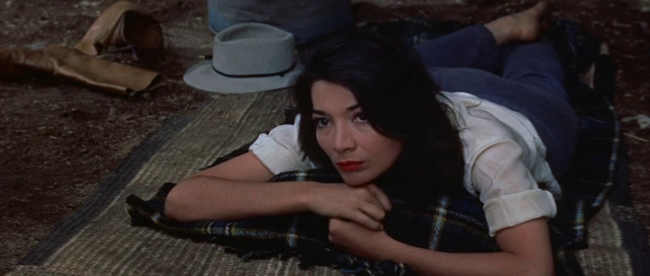
Considering that all the male game hunters receive injuries in the posterior from Morel's pranks, it could be argued that Madam Orsini (Jacqueline Fogt) is only receiving an equivalent punishment, and a more mild one than that, but the scene does unmistakably reflect an attitude that a disagreeable woman should be treated like a child. I might be inclined to consider all this just a reflection of the time if I didn't have Huston's great 1961 film The Misfits to compare it to. In many ways, The Roots of Heaven feels like a dry run for The Misfits--both films focus on a small group of men and one woman, each in his or her own way a social outcast with a past that torments them. Both films also have a message that ultimately condemns the hunting of animals to extinction but The Misfits has almost none of the outdated cultural baggage of The Roots of Heaven.

Greco is great as a survivor of a Nazi prison camp who led a rough life as a prostitute before ending up in Africa. When they're crossing the desert and she's so ill she has to be carried, Morel tells her one day all this will seem like a nightmare and she replies it's the world she'll be going back to that will be the nightmare. It effectively conveys just how miserable her prospects are.

Errol Flynn, who in Against All Flags had seemed to me devoid of that wondrous spark that made him a captivating performer in the 1930s, is actually really great here basically playing himself: a former man of adventure who's now merely amiable and perpetually anaesthetised with liquor. I like Trevor Howard but Flynn definitely steals the show.

Twitter Sonnet #960

No seamless path is free to paper walls.
Across the mark, ideas of snails emerge.
They say when oranges rise the apple falls.
Or no, they don't, but citrus may converge.
Unknown, the hands arranged the stones for dawn.
Receding helpers may or spirits shy.
Where heat connects to chilly spheres they've gone.
A calloused hand now gauged a weight and sighed.
The scale of dropping words engraves the wall.
The sheer and sloughing bound aligns the string.
Familiar screams affirm a strangled call.
But even slower thugs evade the sting.
A crunching sound disturbs the solace shade.
A vapour cuts air like a vorpal blade.