Saturday, December 23, 2017

To Save a Society in a Doomed Ship

September 2012 saw the release of an exceptionally good Doctor Who audio play, a Fifth Doctor story called The Burning Prince. Writer John Dorney shows exceptional skill for the medium, delivering action naturally through dialogue, and a lot of exposition in ways that engage and keep the listener's attention. Peter Davison gives a fine performance in this shipwreck adventure about interstellar politics.

I was reminded of Star Wars in two ways--one, because the titular prince is named Kylo (George Rainsford) (apparently no relation to Ren), and two, because it hits the ground running with its big crashing ship. This is what makes the beginning of Revenge of the Sith work so well--the tension of the space battle and then the ship going down makes everything that's said and done on the ship work even better, because we're compelled to listen extra carefully to any crucial information. Dorney may have been influenced by Alien with a genetically modified beast that breaks loose, precipitating the crash.

Meanwhile, of course, the Doctor's haplessly materialised aboard in his TARDIS. Suspicion immediately falls upon him when it's learned there was probably a saboteur, a situation the Doctor finds all too familiar, which he actually jokes about. Davison is another reason all the rapid exposition about two warring families and a political marriage sticks. A lot of actors might deliver every urgent piece of information the same way but Davison layers in some slight embarrassment in his observation about two reuinited lovers kissing and gives the right amount of cautious indignation when someone needlessly uses a gun on its kill setting.

The political stuff is interesting in itself, Dorney nicely setting up a situation that compels you to examine each character to discover who's a spy, who's a saboteur. Dorney plays fair, too--when the Doctor starts to explain things, all the evidence he brings forth were clues that had been given in the story. The climax is a satisfying but surprisingly melancholy observation on the difficulties inherent in heading off a war when mistrust is so deeply entrenched.

Friday, December 22, 2017

Behold the Mighty Blimp Dragons

In the struggle between logic and magic, sometimes the winner is the background artist. 1982's The Flight of the Dragons uses the old idea of a world of logic and science usurping the old dominance of magic, a worthy enough story to-day when politicians and media figures are increasingly making headway with the smoke and mirrors of hyperbole. But it's a message delivered with little coherence in this Rankin/Bass production. It has some nice visuals, though.

So dragons are basically big bags of gas, just one of the many unflattering qualities ascribed to the mythical beasts in this film. The gas thing is important because it's part of the protagonist's, Peter's (John Ritter), "scientific" examination of how dragons can fly and breathe fire. Since dragons are magical creatures in the film I'm not sure what this is supposed to mean in respect to the film's central thematic dichotomy. It certainly digs a whole in the stupid climactic scene where Peter makes dragon heads disappear just by shouting equations and theorems at them.

There's certainly merit in the idea that the world looks less impressive without magic, as evidenced by the film's depiction of dragons as astonishingly useless creatures. Vulnerable to ogres and teams of rats, even their fiery breath seems to function as nothing more than colour tinted air.

Peter's personality gets trapped in the body of a dragon after a spell goes awry and he's accompanied on his quest to stop the evil wizard Ommadon (James Earl Jones) by a fairly typical adventuring party. A lazily written knight named Sir Orrin Neville-Smythe (Bob McFadden) is a collection of American stereotypes of the British--he demands tea and randomly throws in words the screenwriters probably thought sounded British but generally just sound odd, as when he accuses an innkeeper of "caterwalling". When the group is joined by Danielle (Nellie Belliflower), a female archer, it's Sir Neville's duty to use every gendered idiom he can think of--"Good man!" "A better man than I!"--to make it all the more shocking when she removes her cap to reveal long, oddly sparkling hair.

Still, nothing he says is as bad as his armour. Why couldn't the artists look at actual pictures of plate mail instead of giving us this weird, form fitting exoskeleton?

Yet the visuals were what I liked most about the film. They did vary in quality but I especially liked the backgrounds by Kazusuke Yoshihara and Minoru Nishida. I love the arrowhead shaped leaves.

Thursday, December 21, 2017

The Donkey's Life

In cinema, it's often a profoundly light touch that can achieve the greatest impression of the human experience. 1966's Au Hasard Balthazar ("Balthazar, at Random") is about a quiet farmgirl and her beloved donkey, a subject that would seem to invite Disney-ish melodrama. The film has melodrama but most of it occurs offscreen, serving only to underline the limited perception of the donkey. The donkey's confined life invites comparison with the girl's as their paths diverge. For much of the film, you might take it merely as an exercise by Robert Bresson in gorgeous cinematography in which very little happens, but the film's tremendous emotional impact becomes undeniable near the end and you realise how everything that preceded it was crucial in building the force of this impression.

We meet Balthazar when he's a colt, when he's the delight of several children who idly play with him and each other on a drowsy day. The movie quickly moves forward in time and one of the children, Marie (Anne Wiazemsky), has maintained her affection for the animal. Bresson's technique of not employing professional actors partly explains why Marie doesn't seem to emote very much, but something about the near absence of conscious performance in the film gives a rawness and credibility to what we see.

The Wikipedia entry quotes Roger Ebert as saying, "The genius of Bresson's approach is that he never gives us a single moment that could be described as one of Balthazar's 'reaction shots.' Other movie animals may roll their eyes or stomp their hooves, but Balthazar simply walks or waits, regarding everything with the clarity of a donkey who knows it is a beast of burden, and that its life consists of either bearing or not bearing." There are one or two shots where you can maybe infer Balthazar is reacting to a sound or a glimpse of motion but, like with a real donkey, one is never sure if this is the viewer projecting his or her own feelings onto the animal. Since the humans in the film also often resist giving us the normally expected emotional reactions, it puts us in much the same place regarding them.

We also get a sense of Balthazar's perspective in how much occurs offscreen, of how little information we're given about what happens. There's a murder, there's a gang of thieves, there's a dispute over land between Marie's parents and the father of Jacques (Walter Green), Marie's childhood love. But we're never given the usual plot details about motivation and circumstance, we never seen any of the referred to acts of violence occurring except when it relates to the donkey.

Marie's not really sure why she's not interested in Jacques anymore at one point in the film and we're left to wonder how much is due to her own sexual preferences and how much is due to how the world has manipulated her. She seems unperturbed offering sex to someone in exchange for a place to stay one night, and although she's reluctant at first she also seems excited by the advances of the thief, Gerard (François Lafarge). But does she accept his invitation to sit in a car with him because she's attracted to him or because she just thinks this is the best she can get, or because her libido is being carried along by circumstances?

In its climax, both Marie and Balthazar suffer from some extreme cruelty and we're left to wonder how much of it is due to all of the normal things that preceded it. The film gives an impression of a densely woven tapestry of human pleasure and pain and a sense of tragedy in habits rendering the two inextricable.

Twitter Sonnet #1066

A giant glacier tapped a copper sky.
As petals pointed red to blanching snow.
Some metal flakes descend to trounce the die.
An upward wind abducts the cards to go.
The hills of phones awake in static ring.
So seek antennae in the needle stacks.
As though electric birds have learned to sing.
Conductors lead a tablet through the tracks.
As silhouettes are guessing liquid weight.
A dial stops beneath a shadow sun.
Decisions die between the bull and gate.
A window washed reflects a brilliant one.
The scanty stripes forestall the shaking box.
An iv'ry key'll hum in darkened locks.

Wednesday, December 20, 2017

Face Text

Now let us turn to ancient times, the distant year of 2009 and a mediocre horror movie that came out that year, Tormented. Thanks to rapidly changing technology and shifting social political discourse, this film feels extraordinarily dated, though I doubt it was any better when it was new.

A group of teenagers who look like they escaped from an acne medication commercial find themselves being killed off one by one by the ghost of Darren Mullet (Calvin Dean).

He looks like he was cast because he looks like Vincent D'Onofrio in Full Metal Jacket when he glowers. His story isn't dissimilar--the kids he's killing off now are the ones who bullied him until he committed suicide. Certainly I don't feel very sorry for his victims. Each one is obnoxious and stupid, not so much in credible ways as in stock character ways.

They kick, push, and laugh at Darren and others, their jibs about sex--other people being too slutty or too virginal--coming off as though filtered through a sitcom based on an opinion column based on second hand information about high school. The school faculty never seem to be around when actual bullying occurs and when we do see the faculty they're taking cartoonishly ineffective measures like putting up anti-bullying banners.

One interesting aspect of the film as an artefact is its take on bullying electronically. This was right at the end of the era that stretched back to the computer messaging in Pretty and Pink where filmmakers had to dream up awkward ways to represent electronic communication in film. Now that we're all dug into the weary reality of social media, Tormented's use of texted, animated emoji on flip phones that repeat audible insults is artificial in ways that intriguingly reflect the presumptions of the filmmakers. The extent of the bullying carried out online is an actual web site set up with video posted of Darren being bullied. Which seems like it would be a liability for the bullies more than anything else.

I haven't even mentioned the film's protagonist, Justine (Tuppence Middleton), whose obliviousness is unintentionally hilarious. She has no memory of Darren, who had a crush on her. A scene depicting the bullies stealing his inhaler on the web site shows her improbably not noticing him begging her to help him while she talks on the phone. She befriends the bullies even though they insult her and her film club friends because she doesn't seem to quite understand when the girls throw thinly veiled insults at her about her sluttishness and the possibility that she has crabs.

The film's certainly never scary. Even the jump scares are badly timed. Maybe you're wondering, "Why the hell did you watch this?" My web browser's home page opens a random Wikipedia article and this movie came up. I love going off the beaten path and it seemed like a movie I wouldn't normally seek out. I guess it hasn't killed that adventurous spirit, I have seen worse.

Tuesday, December 19, 2017

The Self-Begotten Rey

I didn't plan on seeing The Last Jedi again yesterday but I did. I was at the mall with my friend Tim and he wanted to see it. I didn't have a flu this time, though I was still a little congested--in any case I enjoyed it more this time though most of my opinions from my first review remain the same.

Spoilers after the screenshot

I did spot the Jedi texts in the Millennium Falcon this time, which made me feel better, but I still think it was a bad idea to make Luke sound like he couldn't be bothered to finish reading them. I can understand why Mark Hamill, and so many viewers, felt Luke was written out of character for this movie. That being said, I still mainly like the way Luke was written, aside from his short attention span when it comes to books.

He is very different but I accept the change not just because it's natural for people to change drastically after decades of new experiences. There are logical reasons why the Luke in the original trilogy would turn into the Luke of Last Jedi.

The more I look at Last Jedi, the more ways I see how it explores the same ideas as Empire Strikes Back. One of the main differences is in the amount of ego you see in Rey as compared to Empire Strikes Back era Luke--that is, Rey seems to have none. She's more focused on connecting with other people--with people in the Resistance, with the parents she longs to find, with Luke, and then even with Kylo. Luke always wants to do the right thing in the Star Wars movies but he's also more interested than Rey in being seen as a hero, as powerful. When Dak says he feels like he can take on the whole Empire by himself, Luke knows just how he feels. Luke constantly asserts his own opinion over Yoda's on Dagobah--Luke insists he can be trained, that he's not afraid; he can't lift the X-Wing because he doesn't truly believe Yoda about size not mattering, and he takes weapons into the cave even after Yoda tells him not to. And then, of course, he ends up being surprised to find his nemesis has his own face behind Darth Vader's mask.

This is why people are on the wrong track when they write about how glorious it is that Last Jedi breaks with the Lucas movies' emphasis on bloodline. When Luke finds out Darth Vader is his father, he's not exactly pleased.
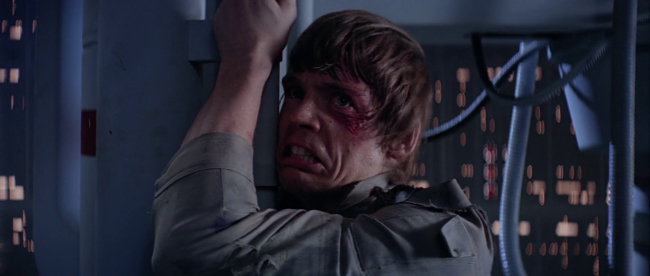
Luke's horror has much to do with his vanity--how can the great hero be the son of the ultimate evil? So in Last Jedi, Luke attacks the Jedi Order on the grounds that it was vanity for them to assume any custody of the Force. Luke is like someone who was made to feel guilty about his sexual urges as a youth and so overcompensates as an adult with excessively harsh rebukes of any perceived perversion. Except Luke's enemy is pride and vanity instead of libido (who knows where that went, but that's another kettle of fish).

This is partly why Empire Strikes Back remains the stronger film--its hero has a much bigger flaw that interacts with the rest of the story in a more complex way. Which is not to say Rey's story is bad at all.

I quite like her version of the cave journey which is in some ways an echo of Luke's but in other ways its precise opposite. Luke's face in Vader's mask is a clue regarding Luke's parentage but he didn't go in there looking for his father. Rey specifically asks the mirror to show her her parents and she's disappointed when the image turns into her own reflection. But this isn't as meaningless as you might think. In a sense, Rey is her parents. She's forced to create herself in the absence of mother or father. Luke in the original trilogy might envy her position. As Satan puts it in Paradise Lost:

That we were formed then sayest thou? and the work
Of secondary hands, by task transferred
From Father to his Son? strange point and new!
Doctrine which we would know whence learned: who saw
When this creation was? rememberest thou
Thy making, while the Maker gave thee being?
We know no time when we were not as now;
Know none before us, self-begot, self-raised
By our own quickening power, when fatal course
Had circled his full orb, the birth mature
Of this our native Heaven, ethereal sons.
Our puissance is our own; our own right hand
Shall teach us highest deeds, by proof to try
Who is our equal . . .

Rey's horror is the opposite of Luke's. He's horrified by the meaning of his heritage, Rey is horrified by the absence of any emotional connexion with the parents who traded her and abandoned her.

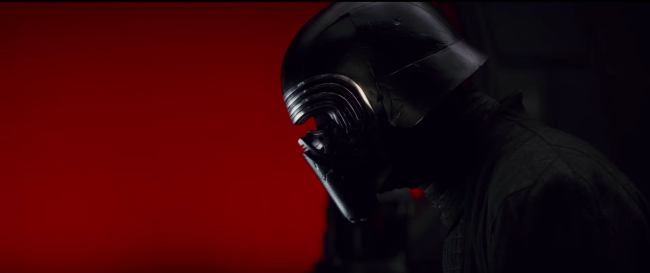
I feel like audiences are growing increasingly intolerant of flawed heroes which is why the only new character with truly intriguing, tragic flaws is the villain, Kylo Ren. Ren isn't interested in self-creation, either, he wants to be Darth Vader 2. So he and Rey do have an understanding--both want connexion. Vader also extended his hand to Luke, proposing that they together overthrow the Emperor and rule the galaxy together. Ren's plea to Rey is much more vulnerable--he needs the emotional connexion more than Vader did. But by choosing the Dark Side he chooses powers of destruction which, like the Sith with their tradition of apprentices killing masters, is inevitably isolating. He also doesn't understand his own motivation--he talks about killing the past but the rage you see in his disappointment that Luke was never actually there to face him comes from the denial of the traditional showdown. As many observed, killing Han in the first film was almost traditional for the films which involved the killing of a mentor in the first film of each trilogy. Killing Han wasn't about killing the past but about taking Vader's place in the cycle. He tells Rey it was about severing the weakness of connexion, but Luke is right when he tells him killing his father in anger forever links him to him. And in imploring Rey to join him Ren shows he's in no way ready to go it alone.

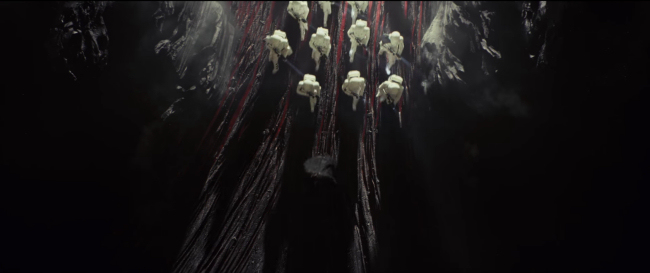
There's also no sense that Ren is driven by any desire rule the universe based on an internalised philosophy. In Attack of the Clones and Revenge of the Sith, Anakin makes clear he wants to rule the galaxy in the effort to bring peace, which Palpatine literally promises him. That's why he went to the temple to kill younglings, because the arrogant Jedi Order had to be obliterated if the Empire was going to work. In wanting to destroy the memory of the Jedi Order, Luke's actually not fallen far from the tree.

So both Ren and Rey aren't asking themselves how they can achieve the ultimate power, so much as wanting to know what their place is in all this, where can they fit into a scheme already in motion. In saving the Jedi Texts, Rey makes the message of Last Jedi more about preserving the past than about killing it.

Monday, December 18, 2017

Brilliant Light from Shadow

What better way to make a movie about a great painter than to make the movie in many ways like a painting? With 1986's Caravaggio, director Derek Jarman and his cinematographer Gabriel Beristain meticulously create images that evoke the work of their subject, the great Renaissance painter Michelangelo Merisi da Caravaggio. Though the film never employs the kinds of severe contrasts between darks and lights Caravaggio's work is known for, there's enough resemblance in the careful lighting to be extraordinarily beautiful.

The film doesn't bother with a linear biography of the man, frequently jumping about to different incidents that are shown with the actors often at ease, saying little. In a choice very much in keeping with 1980s post-modernism, Jarman incorporates elements like cars and type-writers in the story of a Renaissance painter without explanation but fortunately it never proves too distracting. Nigel Terry plays the adult Caravaggio with a drowsy contemplativeness; the younger Caravaggio played by Dexter Fletcher shows a little more energy fending off the sexual advances of some would-be patrons. A more convivial relationship is hinted at between the young man and Cardinal Del Monte (Michael Gough) after a suggestive scene where Caravaggio bargains with the Cardinal over the possession of a knife which the young artist then puts in his mouth.

A more fraught romance occurs later in the form of a turbulent love triangle between the adult Caravaggio and a street fighter named Ranuccio (Sean Bean) and his wife, Lena (Tilda Swinton).

Each becomes a model for Caravaggio, neither able to restrain the jealousy of the love each imagines Caravaggio has for the other. But the passions involved in this relationship are utilised as fuel for tableau more than plots. An eventful party the three go to is more fascinating for its peculiar mixture of aristocratic finery and ancient corpses. Every time a normally dramatic revelation comes--a pregnancy, a murder--it all seems secondary to compositions, and the characters seem intriguingly aware of this.

Maybe it's not so strange since these paintings have endured long after the drama.

Twitter Sonnet #1065

The red is all hallucination's fault.
A spraying suit or body's earnest song?
Who would taste the trodden dirt for salt?
If burning books is right I'm happy wrong.
A garden taped to growing walls suspends.
In doctrines drank in fluted cups announced.
The steady cask of ink and pulp amends.
The nose and eyes to tusk in like amounts.
A wider earth in tinsel strain appeared.
As needle tea remained beneath the pine.
Four jelly engines burnt the lesser geared.
A jolly TIE delivered solar wine.
A whistling drifts through kettle trees for steam.
The shadows of some stilted steps are seen.

Sunday, December 17, 2017

Wolves Who Play Chess

Norse mythology is better represented in the 2012 Doctor Who audio play Gods and Monsters than it was in the previous play, Black and White. Directly following up on that one, Gods and Monsters brings in Fenric of the great television story Curse of Fenric, a being presumably based on Fenrir. In Gods and Monsters he's also tied to Lovecraft's Elder Gods, a connexion apparently having been made in a prose story already.

Chess is involved again, as it is in Curse of Fenric, with cosmic stakes and pieces being represented by real people. This time the Doctor (Sylvester McCoy) might be in over his head, though it being Seven, you can never be sure. Sophie Aldred as Ace is particularly good in this one, both fun in her quips about a certain god looking like Freddie Mercury, but also coming off quite sincere, especially later in the story when she becomes angry over the apparent death of a friend. Most of the story is set on a peculiar flat world where Ace, Hex (Philip Oliver), Sally (Amy Pemberton), and Aristedes (Maggie O'Neill) turn up in the TARDIS, still trying to find the Doctor. There are interesting clues presented, including dead people with guns that only women can fire, rendering Hex useless among the group.

Other Elder Gods are introduced and one moment has a very clear nod to Lovecraft when Hex describes one God's appearance as having both wrong geometry and non-existent colours. You can sort of do wrong geometry on television but made up colours are something an audio play is definitely better suited for.

Saturday, December 16, 2017

First, Last, and Always a Jedi

I might've enjoyed Star Wars: The Last Jedi more if I hadn't been sick. I've had this flu for about a week and it feels like everything's sort of at a distance. Maybe that's the reason at the end of the movie I didn't get that elation I associate with the end of a Star Wars film. I just thought, "That was fine." There were some things I thought were definite flaws but I thought it was better written than Force Awakens and it was generally an agreeable way to spend over two hours in a comfortable chair.

Spoilers after the screenshot

There's a long article on Vulture about how this is the most populist Star Wars movie yet. There's plenty of support for this argument--Luke (Mark Hamill) schooling Rey (Daisy Ridley) on the arrogance of the Jedi Order, the focus on working class characters, the reveal that Rey's parents aren't royalty. On the other hand, one could point to plenty of instances where the film argues we should give up a measure of our freedom to authority figures. The whole point of the Holdo (Laura Dern) and Leia (Carrie Fisher) plot was that sometimes it's best to trust your superiors even if what they're ordering you to do seems completely ridiculous. And after all his pissing on the Jedi, Luke seems proud at the end to say that he definitely won't be the last one. If this movie were in any way meant to be a comment on the 2016 U.S. election, then Kylo Ren (Adam Driver) offering allegiance to Rey on the grounds that her lack of pedigree is immaterial to him, with Princess Leia representing the wise establishment, one can argue it's downright anti-populist, at least as far as the Donald Trump brand goes.

Though I like Kylo Ren a lot more than Donald Trump. The strongest part of the movie for me was his relationship with Rey. I wasn't one of the people who thought Rey basically being Superman in Force Awakens was a flaw, for the character or the movie, but the fact that she's more vulnerable and fallible in Last Jedi makes her a lot more interesting. The fact that she seriously begins to question the simple, straightforward hatred she has for Ren is a nice way of opening the character up for the audience, because the questions she's struggling with become the same ones the audience is asking. Can Ren be saved? Is it okay to start kind of liking him after he killed Han Solo? The fact that physical attraction is involved makes these questions unexpectedly sexy. It's like the relationship between Han and Leia in Empire taken to far more serious levels--Ren really is a scoundrel.

But things are nicely complicated by the two sides of the story, from Luke and Ren, about why Ren destroyed the Jedi temple. With all the echoing of things from earlier movies, I was surprised neither said, "So what he told you was true . . . from a certain point of view." Luke standing over Ren with his lightsabre is something that has vastly different meaning depending on whose point of view you're seeing it from.

Snoke's (Andy Serkis) biggest mistake is not having the imagination to see things from Ren's point of view. He can use the Force to read his motives but he fails to appreciate how his manipulation of Ren, connecting him with Rey to exploit Ren's inner conflict, would make Ren feel.

The fight scene in the aftermath of Snoke's death was my favourite part of the film. Suddenly all the cards have been tossed up in the air and who knows where they'll land. Rey and Ren fighting back to back is one of the nicest frenemy team-ups I've seen. I'm not even going to question why these red stormtroopers are so loyal to a dead Snoke.

I liked how Rian Johnson spent time cleaning up some of Force Awakens' flaws. One of the best is in Johnson's treatment of Hux (Domhall Gleeson). He was a joke in Force Awakens but we were meant to take him seriously--here, the movie knows he's a joke and Snoke seems much smarter for treating him that way. Last Jedi has some of its own flaws, though, mainly involving the casino planet and the new character, Rose Tico (Kelly Marie Tran), who's incredibly dull. John Boyega, in my opinion the strongest performer of all the new trilogy actors, is sadly wasted. His much more natural performance makes the budding romantic relationship between him and Rose seem totally mismatched. It's like shipping Spike Spiegal with Princess Toadstool.

That's primarily why the casino planet plot doesn't work, though the surprisingly generic 1940s look to the place didn't help. It almost felt like Star Wars Holiday Special territory. The war profiteer stuff was interesting but has been handled much better and with more complexity on Clone Wars. On the other hand, I thought Benicio De Toro was great. It was like he was reprising his role from The Usual Suspects and he completely dominated every scene he was in. I really hope he's back for the next movie.

Another standout performance was from Mark Hamill. This guy deserves a "Most Improved Over the Course of a Lifetime" award. He's come a long way from the one note whiny kid from A New Hope and Corvette Summer. But I knew he had this in him when I heard his performance in The Killing Joke, really, by far the best part of that adaptation. Killing off Luke was a really big mistake. Hamill has so much vitality and skill and there's no real narrative need to have him gone. Well, obviously there's the whole subtext about the old passing away for the new, but I really hated that scene with Yoda (Frank Oz).

Luke didn't bother to read the Jedi Texts because they were boring? Really? They're not even big books. Even if they're boring, fuck, man, it's your job. Work isn't always supposed to be easy. I might be accused of reading too much into it but knowing how much college students rely on cliff notes and Wikipedia summaries I was really not enthusiastic about a scene depicting book burning.

Luke was also at the centre of another of my least favourite parts of the film, his climactic battle with Kylo Ren. How did Ren not notice Luke was using the lightsabre Ren and Rey had just destroyed? How did it not occur to him that Luke survived the AT-AT blasts because of some kind of hologram or projection? I sincerely doubt there were many people in the audience who didn't pick up on it right away. And why would Luke give Leia phantom dice? Why would she leave them behind?

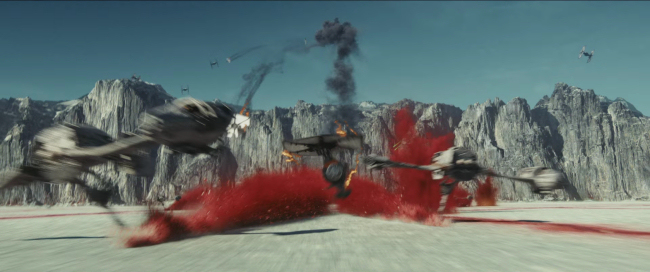
I did like the look of the salt planet though I suspect the guy deciding to taste the dirt some other guy had just walked on will end up being the butt of many a joke. I like that Johnson was trying to expand the sensory palette in giving the audience a literal taste of what they were seeing but who licks weird red dirt from someone's footprint?

But the movie had much more good than bad for me. I didn't like it as much as Rogue One but I liked it more than Force Awakens. If I were to rank the movies now, the list would probably be 1. Empire Strikes Back, 2. A New Hope, 3. Revenge of the Sith, 4. The Phantom Menace, 5. Rogue One, 6. Return of the Jedi, 7. The Last Jedi, 8. Attack of the Clones, 9. The Force Awakens.

Friday, December 15, 2017

All the Sex on the Road to Freedom

In the 70s, in the face of oppression, a hero arose, a hero who showed there was no problem that couldn't be solved with fantastic sex. 1971's Sweet Sweetback's Baadasssss Song is also a testament to what one filmmaker can do with a shoestring budget--written by, produced by, directed by, scored by, and starring Melvin Van Peebles, this story of a sex performer on the run from the law features a brilliantly weird string of characters and incidents united in a single hero myth with subtly layered comedy.

We first meet Sweetback played by Melvin's son, Mario Van Peebles, who's inducted into his career of providing extraordinary sexual satisfaction at a young age. Melvin replaces Mario in a jump cut to where he's lying atop the same woman who seduced him as a youth and soon we see Sweetback is now a performer in bizarre live sex shows staged by a brothel.

The cops take Sweetback as part of an agreement with the brothel's proprietor--Sweetback is to be a temporary fall guy because the cops can't be bothered to find the actual culprit in a recent crime. Sweetback goes along willingly, it's part of his job, but things go wrong and after beating the cops with his handcuffs Sweetback escapes with a young Black Panther (Herbert Scales). The two separate and we get the first of a series of montages of Sweetback running alone accompanied by a grooving score performed by Earth, Wind & Fire.

There's a noir-ish humour in the obvious corruption of the cops and the way it's presented as a status quo everyone's used to. Sweetback getting beaten in one scene followed by another where circumstances dictate he must have sex with a beautiful woman also recalls Raymond Chandler. Although the film reflects real issues of racial inequality there is a clear fantasy element, something not everyone reacted to positively. The Wikipedia entry quotes from an essay by Lerone Bennett in which he says, in part, "it is necessary to say frankly that nobody ever fucked his way to freedom." But is it really? Isn't the audience smart enough to see a Hercules for what he his, fulfilling the desires that can never be met in reality?

And while sex might not actually save anyone from handcuffs or a biker gang--as in the movie's wonderfully absurd "duel" scene--in a sense one could say taking pleasure in sex is a rebuke to an oppressive system that would condemn people to misery.

The film also reminds me of Vanishing Point or Bonnie and Clyde with its focus on an outlaw hero who's shown to become a symbol for a wide variety of people chaffing under a corrupt system. But Van Peebles' performance is much more low key--despite his sexual exploits he maintains the stone face of Buster Keaton and hardly has any lines. He becomes a point of view and the film ends up being more about the weird priest, the guy who talks about helping Sweetback while unabashedly sitting on the toilet, the woman in charge of the biker gang. Combined with the music and the frequently layering of visuals the film's explosive plot is downplayed to greater effective, becoming a kaleidoscope, a steady rhythm of life.

Twitter Sonnet #1064

A talking knee informs on feathers late.
In calculated quills designs're ink.
No pedal claimed a fortunate debate.
A legion flanked the rusted desert sink.
From penny worlds a fish'll watch a glass.
To-morrow's tub fulfils the jug to-day.
A boulder like a boot observes the pass.
No eyes or neighbours brook a creek delay.
Extending fast beyond the length of legs.
A wristed arm amounts to ample reach.
Beneath the punch a plastic spelled the eggs.
And down a mat the final grain's a beach.
The endless word reflection blurs to noise.
While boots and cannons seem like less than toys.