Happy New Year, everyone. This is around the time I post my "Best of/Worst of the Year" lists but I'm going to hold off for a couple days. Though I sure saw a lot of new movies and TV shows in 2025.
What can I say about 2025? It was my sixth year in Japan, my first year in Kakogawa. It sure is a lot easier to get used to a new town in Japan when you've lived in another one for five years. I feel healthier now than I've felt at any other time in the past fifteen years. My health gradually improved over five years in Kashihara but now that I'm forced to walk two hours most days I feel even better.
I developed a taste for beer over the spring and summer and then completely lost interest in beer except as an ingredient for frying fish. I was craving takoyaki for months and had some every Friday and then one day completely lost my taste for takoyaki. I'll just follow my urges and see where they take me.
I've listened to more audiobooks on my iPod while I've been walking. I must have listened to Seamus Heaney read his translation of Beowulf about a dozen times. I'm speaking to more of my native English speaking colleagues than I did in Kashihara and every time I delight in the opportunity to "unlock my word hoard" to borrow that eternal phrase from Beowulf.
I also listened to Lord of the Rings in its entirety and The Secret Diary of Laura Palmer. Japan's love of normalcy has helped me appreciate anew what a deeply weird thing an American's life is.
My addiction to Skyrim shows no signs of letting up. The constant stream of new and interesting mods sees to that.
Good luck in 2026, everyone. I hope it's memorable for good reasons. If not that, I hope you live through it, at least.
A pair of small time gangsters join a raucous party in a converted barn when they're attacked by vampires in 2025's Sinners, not From Dusk Till Dawn. Director Ryan Coogler has been quite upfront about his influences, citing Robert Rodriguez, director of From Dusk Til Dawn, as a major influence. But does Sinners amount to something more than the sum of its influences? No, but it's a pleasing diversion.
Really, it's like From Dusk Till Dawn through the lens of a modern left-wing partisan. It's set in the '30s but the characters don't talk like '30s characters but rather like 2000s college students playing a table top RPG set in the southern U.S. in the '30s. Two men are shot in the street and bystanders barely react. Two shop owners are unperturbed, one of them at first unaware anything had occurred because he was inside the shop at the time, the filmmakers apparently unaware that the sound of shots ringing out in the middle of the street would've been loud and unusual. Yet the characters can't hide their emotions when talking about racial inequality. Of course, we never see any police.
Michael B. Jordan, for no reason I can see except to show off his acting chops, plays identical twins Smoke and Stack, World War I veterans who've become gangsters in Chicago. They come back to the film's setting, Clarksdale, Mississippi, to open a juke joint. They employ their young cousin, Sammy, played by Miles Caton, who's the best part of the film. While all the dialogue and the other performances feel very modern, Caton actually sounds like an old-fashioned blues musician and it was a pleasure watching him perform. However, he's at the centre of what I'd nominate for "cheesiest scene of 2025" when the magic of his guitar conjures people from the past and present, including a gaudily dressed electric guitarist and a Beijing opera dancer.
The action scenes are decently handled and Ryan Coogler is a competent director. Much as his Black Panther was really an echo of Thor, this film is an echo of From Dusk Till Dawn that plays it much safer. One of the pleasures of From Dusk Till Dawn, and a lot of '90s arthouse cinema, is the feeling that anything could happen at any moment. Sinners stays firmly on a track already laid down, its path further narrowed by the constraints of modern political neuroses. But for some people, diluted excitement might actually be preferable. If you're afraid of being offended, this movie's probably safe. At least until the list of politically sanctioned topics and manners changes again.
A quick-witted, cynical private detective tackles a murder case in the desolate California town of Bakersfield in 2025's Honey Don't!. The second in Ethan Coen and Tricia Cooke's trilogy of lesbian B movies, this one's a substantial improvement on the first, Drive Away Dolls, which becomes tiresome by its third act. Honey Don't! is sweet from beginning to end.
Once again, Margaret Qualley is the lead, this time playing a PI named Honey O'Donahue. The cops call her in when a corpse in an overturned vehicle has her business card. Honey denies having the victim as a client but quietly begins looking into the matter. It turns out to be connected to a cheesy but popular Evangelical preacher played by Chris Evans. Honey is aided in her investigation by a cop named MG Falcone (Aubrey Plaza) who also becomes Honey's lover. Rounding out the impressive cast is Charlie Day as a police detective who can't stop flirting with Honey however many times she says, "I like girls!" and he always says, "You always say that!" as though this undercuts the veracity of her statement instead of buttressing it.
It's weird this movie's not a big hit. We truly live in a different world. Remember when people got mad at Tarantino for saying the characters, not the actors, are the real stars of the Marvel movies? Well, here's Captain America himself, Chris Evans, once again unable to sell tickets to a movie on the strength of his own name. And Aubrey Plaza's supposedly popular, too, and surely Qualley should be able to pull an audience after both Once Upon a Time in Hollywood and The Substance.
Critics who praised Drive Away Dolls rushed to give this one a bad review so they could seem like they were in step with the public that's rejecting these films. They don't really understand it, though. If you liked the noir-ish, firecracker dialogue of Miller's Crossing, you'll enjoy the dialogue in Honey Don't! Ethan Coen worked on both screenplays. The only difference is that Honey Don't! doesn't aim at something as profound. It aims to be a satisfying snack rather than a Thanksgiving feast and it accomplishes that. The reason that these movies aren't doing well at the box office is that people are afraid of being seen paying money to see movies about pulpy, lipstick lesbians. Meanwhile, Drive Away Dolls seems to be getting a lot of views on streaming and I imagine Honey Don't! will be a similar sleeper.
The public is still wary of seeing movies with homosexual main characters and the art house crowd generally only feels safe with them these days if they're also tragedies. I can't help thinking, again, that society is regressing. How long ago was it that Brigitte Bardot taught us we could enjoy movies about sexy women without having a sermon attached? I mean, an earnest sermon.
Brigitte Bardot has died at the age of 91. I guess I'll be thinking about her all day. How do I convey what she meant to the cultural landscape? Better writers than I have attempted it. But that should tell you something right there. Marilyn Monroe may have been more famous but the attraction Bardot held as a muse for intellectuals surpassed Monroe's, certainly in the mid-20th century.
What was it about her? I think a sense of self-possession. She was both cat and kitten. Even in her early roles, the usual French comedy about older men arranging things for the guileless, sexy girl weren't the same with her. There was always a sense that she was in on it that made her seem light years beyond even the directors she worked with in terms of who was shaping the concepts and message. Certainly she outpaced Roger Vadim. Jean-Luc Godard, meanwhile, in his humility as a filmmaker, standing at odds with the image of the tyrannical auteur the modern academics have conjured, filmed Bardot to be Bardot, as Jacques Rozier explains in a short documentary about Contempt, the film Bardot made with Godard.
I have already written about her extensively. As I wrote in my review for 1957's Une Parisienne, "she was so self-possessed. She could play innocent (better when she was younger) but she never had that deer-in-the-headlights look or the confused panic affected by most leading ladies in the situations Bardot was typically placed in."
At a time when people were wondering just what true liberation for women meant, Bardot was living it, showing how she could indulge in the sexual fantasies she inhabited as well as any man could.
But all these are just words. As David Lynch often complained, the message is the image, no explanation can take its place. Do yourself a favour and watch a Brigitte Bardot movie. You might be surprised by how she challenges the Puritanism of even to-day.
X Sonnet 1972
At clubs, the normal eyes awaited cake.
But cake awoke and something strange was changed.
Another sense ignites what pictures take.
The myst'ry now in flesh's range arranged.
With nature now a man was slow to catch.
Her easy rear beneath a baited pate.
Her girlish brow reduced the prudish wretch.
Recursed arousal traps its fated mate.
The intimate explored a silver screen.
As God created B would shame the blame.
Her eyes reflected you and something seen.
It seems your lust would never tame the dame.
As none can match in just her little toe.
The canny carnal grace of Miss Bardot.
Well, AI is wrong again, and about Indiana Jones again. After writing about The Last Crusade yesterday, I went to lunch and afterwards I planned to buy a bottle of bourbon. I got to wondering what Indy was drinking in the Cairo bar scene in Raiders of the Lost Ark. I didn't know but for some reason I felt sure it was a bourbon. So I asked Google and here's the answer I received:
Okay, right of the bat, there are some problems with this response. Saying it's not a "specific" bourbon implies there is merely no brand indicated but then it says, "but rather" implying he drinks no bourbon at all. Then it says it's Scotch whisky from a bottle labelled "Belle of Lincoln", a variety produced by Jack Daniel's. Jack Daniel's is a very famous American distillery that has historically disliked being called a bourbon (though it fits the legal definition of "bourbon" despite not being produced in the Bourbon region of Kentucky). One thing it's definitely not, though, is a scotch, that is Scottish, whisky.
A few centimeters below the AI response is a link to an Indiana Jones forum where people have investigated this question and have turned up this production still:
And this quote from the screenplay:
A dark, smoke-filled den on iniquity. The patrons, almost all
fearsome Arabs, sit in small shadowy groups around the room.
Indy stands at the bar finishing off a fifth of bourbon. He
is drunk. The ARAB BARTENDER places a new bottle of expensive
bourbon in front of him.
Although the label is generally turned away from the viewer in the film, you can still plainly see it once in the scene embedded above.
Although the AI says the "iconic 'Belle of Lincoln' bottle is a replica prop, not a real brand," Belle of Lincoln was quite real. Lincoln county, by the way, is located in Tennessee, not in Scotland.
Again, the remarkable thing to me isn't just that the AI is wrong but that it's stridently wrong. It seems extremely confident that Indiana Jones is shown to drink scotch and not bourbon.
My suspicion is that its source is this web site article in which staff writers are asked to offer their opinions on what the favourite drinks of various famous movie characters are. Under Indiana Jones, the writers propose three different scotch brands.
I think the AI assumed that this merchant web site with its paid writers was surely better informed than a bunch of anonymous joes on a web site forum. The AI isn't hip to what most of us who have been using the internet for a long time know, that paid shill content is very often of shoddier quality than stuff people just post for free. We've somehow gotten to the point where Wikipedia is a more reliable source than news and corporate funded shopping sites. People who are passionate enough to pursue their interests for free have been outpacing people who've been paid to do something they're not really interested in for years. Maybe the reason AI is making so many mistakes is that it's been taught about a world that corporations want to exist rather that one that actually does.
Happy third day of Christmas, everyone, though many of you are still in the 26th, Saint Stephen's Day, aka Wren Day, aka Boxing Day. I chose Indiana Jones and the Last Crusade for that day, though it's arguably more of an Easter movie. I guess it was on my mind because of screenwriter Tom Stoppard's death.
Last Crusade is the last of the original, classic Indiana Jones trilogy, and many assumed it would be the last Indiana Jones movie ever (and many wish it was). While it retains qualities in common with the first two films that the filmmakers would no longer feel comfortable employing to-day in the franchise (a religious message and McGuffin as well as casual sex), it also marks the beginning of Spielberg and Lucas making films with a sense of moral responsibility. The no holds barred days of Jaws, Raiders of the Lost Ark, and Temple of Doom were gone as Spielberg took to reinforcing virtue in Jurassic Park, Schindler's List, Amastad, and others. Lucas retconned the character of Indiana Jones himself from a scholarly fortune hunter who gradually learned the truth of God's might and the worth of altruistic acts into a champion of virtue from boyhood. Offended at the sight of dirty ruffians obtaining the Cross of Coronado, he immediately shows a willingness to risk everything because the artefact "belongs in a museum". He assumes, based on zero information, that the ruffians aren't employed to eventually deliver the item to a museum, a fact that becomes all the more curious when you consider the leader of the ruffians wears a costume similar to the one Indy will wear as an adult, setting him up as an influence on the path Indy will take through life. It's possible the idea was that this incident diverted Indy from youthful idealism and taught him to be more mercenary, though this is kind of lost when the jump cut takes us to adult Indy still pursuing the cross for exactly the same reason.
As a film about a relationship between father and son, it's interesting that it begins by introducing an alternate father figure, the unnamed ruffian leader, played by Richard Young. He even gives Indy his famous hat. An alternate version of this film could've had Young's character as a Falstaff figure opposite Sean Connery's Henry Jones Sr. as a Henry IV. God, their names are even Henry! Was the intention at one point to make Indy like Henry V and Connery's character Henry IV? There's a film I really wish I could've seen. The Jones family quest to recover ancient artefacts and bring them back to museums in civilised countries is not so dissimilar to the questionable quest of the Kings Henry to invade France.
One moment I've always liked comes in the climax when Connery's character finally calls him Indiana instead of Junior. Calling him Junior is a way of asserting an impression of the child originating from the father. "Indiana" represents the adult identity Harrison Ford's character has carved out for himself. Like a lot of parents, it's hard for Connery's character to admit the validity of this persona of independent origin, thereby acknowledging that the character has emerged from his father's shadow. Again, this is like Shakespeare's Henriad, in which the prince, in the company of Falstaff and his cohorts, even has another name, "Hal".
I still don't like the plot device of the Grail's power being limited by a seal carved into the floor but I'm not sure what a more elegant method would've been to getting to those character points.
In any case, it occurred to me I was enjoying the film in a way I hadn't before; I was enjoying the depiction of people passionate about pursuing objectives beyond their survival. They have "better things to do than survive" to borrow a line from Ani DiFranco.
Indiana Jones and the Last Crusade is available on Amazon Prime in Japan.
Happy Christmas Day to those of you who've just entered the zone. You do plan on celebrating all twelve days, don't you? Don't make Patrick Stewart haunt you. I listened to his reading of A Christmas Carol a couple days ago while working on my comic. In film adaptations, my favourite of the three ghosts is typically the Ghost of Christmas Future, who usually resembles the Grim Reaper. But the book has a lot of spooky moments that usually aren't in film adaptations, like the tormented souls Scrooge sees crowding the streets when he meets Marley's ghost.
I typically like watching Donald Duck cartoons on Christmas (like this one). This year, I bought a duck, took it apart, and cooked one of its breasts. That was a first for me. It was delicious.
I bought the duck frozen at the nearby Don Quijote. I also watched Frozen. Then I started watching Wicked because some people say Frozen is basically a knock-off of Wicked. That may be true, but if so, for all its flaws, Frozen is a massive improvement, if the film adaptation of Wicked is at all faithful to its stage production. The film seems like it was made by a department store's HR staff. The munchkins aren't even short. I didn't feel like ruining my Christmas with the movie so I only watched the beginning. I'll finish it some time this weekend, maybe it gets better.
Merry Christmas, everyone. It's already Christmas Day here in Japan and I watched a Japanese Christmas movie a couple days ago, the only one I know of, actually, unless I'm forgetting something. 2003's Tokyo Godfathers(東京ゴッドファーザーズ) isn't just Christmasy, it's Dickensian, more Oliver Twist than Christmas Carol. It also has Dickens' penchant for unashamed melodrama and sentimentality. Director Kon Satoshi did much better work on Perfect Blue and Paprika but Tokyo Godfathers has plenty of good points.
On Christmas Eve, three homeless people in Tokyo discover an abandoned baby girl in a trash heap. They argue over whether to take her to the cops or care for her themselves. Over the course of the story, they have an adventure comprised of extraordinary coincidences. This movie must have set a record for the number of coincidences employed to propel its plot forward. The three characters, by pure luck, happen to save a yakuza boss' life, who happens to be the father of a woman they've been looking for. At almost every location the characters visit throughout the film, one of them runs into a long estranged family member or someone tied to the baby's life, by pure chance. It's worth remembering Tokyo is the biggest city in the world.
Kon said he was inspired by John Ford's 1948 film Three Godfathers but the sentimentality and coincidence reliant plot are more likely to remind the viewer of Oliver Twist, as are the colourful personalities of the three homeless protagonists.
Gin (Emori Tooru) is an irascible old man, Miyuki (Okamoto Aya) is a surly teenage girl, and Hana (Umegaki Yoshiaki) is a gregarious, middle-aged trans-woman. They form a found family unit with Gin as the father, Hana as the mother, and Miyuki as the daughter. The screenplay was co-written by Nobumoto Keiko, the lead writer on the original Cowboy Bebop, another show with a trans-friendly character. I also watched an episode of Ally McBeal a couple days ago in which the normally bigoted character Richard Fish passionately argues for the right of a trans-woman client to marry a man and, when he loses the case, personally officiates over the marriage in a legally unsanctioned ceremony. Both that episode and Tokyo Godfathers have elements that would be labelled as problematic by academics, which leads me to wonder if this is why people seem comparatively shy about making trans-friendly plots to-day, over twenty years later.
Tokyo Godfathers also has an interesting scene in which Miyuki finds herself in the home of a Latina mother and the two manage to communicate despite despite Miyuki's lack of Spanish and the Latina's lack of Japanese. They get by with gestures and a few words of broken English. It's frankly the kind of model I'd like to see more of to show Japanese people how to communicate through a language barrier, a better example than the popular Degawa English, which I think tends to exacerbate rather than dispel shyness.
So, again, like Dickens, the politics in this film are stridently progressive. If I were the conspiracy minded sort, I might wonder at the fact that Kon and Nobumoto both died of cancer at relatively young ages.
Tokyo Godfathers is available on The Criterion Channel.
The trailer for Christopher Nolan's adaptation of The Odyssey is out. I don't know, I like Christopher Nolan but I kind of think he's wrong for this material. He said, as usual, he wants something that seems grounded in reality. Sometimes his idea of reality is monotone.
Yeah, I think serious and grim fit within The Odyssey. But there's so much more to it, much like life itself. So I question whether having everything the same colour is truly grounded in reality. The Odyssey is also about beauty and astounding weirdness. I won't judge the film before it comes out but so far I'm thinking it'll fall short of the Kirk Douglas version. That one had Silvana Mangano, how could anyone else compete?
X Sonnet 1971
A private stock became a public punch.
A gracious juice was flowing over folks.
A golden egg was served to all at lunch.
With festive hearts, they drank the dripping yolks.
Balloons of roasted fowl were floating by.
A manic grin displaced the deadened beak.
A candle flame pursues the firefly.
The honey spleen has sprung a tasty leak.
With onion microphones she danced above.
The crowd, entranced, beheld the siren bot.
A stack of burning cards was sold for love.
They work on those averse to careful thought.
A drunk parade dissolves to blurry men.
Be sure to use the labelled garbage bin.
In 1993, a battle occurred in Somalia called the Battle of Mogadishu in which 19 American military personnel were killed. The event is dramatised in Ridley Scott's 2001 film Black Hawk Down. I finally watched it and it was about what I expected--a relentless depiction of deadly modern ground warfare, shot with consummate expertise and creativity.
People had been recommending it to me since it came out. My friend and former film teacher, Martin Johnson, even gave me a copy of the soundtrack in his enthusiasm for the film. I am open to enjoying film of any genre but if there is a genre that I'm reluctant to watch it's the modern war film. It's the same reason I prefer the peace sections to the war sections of War and Peace--there are no women in the war sections. But, also, a story like Black Hawk Down is meant to convey the interminable slog of such a horrific circumstances and it does so ably. So it's a slog. A well made slog, but a slog. It is certainly a useful piece of perspective and edifying to know such hellish conflicts are often occurring in the world.
Quentin Tarantino recently said he considered it to be the best movie of the 21st century so far and, a couple weeks before that, a teacher at one of the schools I work at recommended it. And there it was on Netflix so I figured it was time. The famous men in the movie look so young, Ewan MacGregor, Eric Bana, Josh Hartnett, Orlando Bloom, Jason Isaacs, and Tom Hardy. Harnett and Tom Sizemore were the two Americans in a cast otherwise filled with Brits and Aussies. Director Ridley Scott has never really cared how accurate the accents are.
This was made when Scott was already more than twenty years into his career which is dotted with intermittent masterpieces and turkeys. How could the same guy who made Black Hawk Down have also made that terrible Robin Hood or Napoleon? Anyway, I love that he keeps going and keeps trying something new. But like a lot of people, I miss the element of fantasy and poetry of his earlier films that seems to have been eclipsed by a colder pragmatism. The Martian was really good but only Prometheus seemed to have anything of the magic found in Alien, Blade Runner, or Legend.
In Black Hawk Down, he still had his fondness for glittering sweat. Everyone's got shadows down the middle of their faces with contours carved of tiny wet droplets. The film's not without its grace notes.
I finished watching season two of Deep Space Nine and couldn't resist starting the next. That was always an effective finale to premiere transition. The season two finale, "The Jem'Hadar", has Sisko and the rest of the crew encountering the Dominion's military force and finding they're technologically superior. This is hammered home when a mission to rescue Sisko is lead by a Galaxy class ship, the same class as the Enterprise at that time, and it's unexpectedly destroyed by Jem'Hadar ships while the DS9 crew barely escape with their lives due to the fact that they were in runabouts, the especially large shuttlecrafts used in the series.
The episode successfully makes the viewer want to see the protagonists get back at the Dominion and the season three premiere, from September 1994, introduces the Defiant, a warship assigned to the station. It was widely seen at the time as part of an effort to make DS9 more like other Star Trek series because DS9, in its second season, was not drawing viewers in the same numbers as The Next Generation. Whatever the case, the Defiant is an interesting idea and I still like the way it's introduced as a barely functional, overpowered prototype.
The premiere, though, is a two-parter and it screws itself over with the second part, which abruptly changes the plot from one of a dangerous voyage into the Gamma Quadrant to confront the Dominion into one about the captured crew being caught in a simulation and Odo meeting other members of his species for the first time.
It's very obvious that most of the crew are in a simulation from the beginning when Starfleet decides to completely roll over for the Dominion. So there's very little tension created after the rising tension of the battle scene in the previous episode has been completely negated by the sudden new premise. Odo's meeting with his people, the Changelings, is a little more interesting. I like a bit of dialogue between Odo and the Changeling representative in which he protests against the Dominion's tyranny by saying that he's been an advocate of justice throughout his life. The Changeling replies that the Dominion means to impose order on the galaxy, effectively a twisted variant of Odo's love of justice. So this plot does tie more into Odo's occupation as a security chief than I remembered. It's also interesting that a species of liquid based shapeshifters would be obsessed with order. I'm not sure that contradiction ever comes to anything more than an intriguing premise but it's something that sets them apart from the Borg.
Oddly, after all the buildup, the Defiant is entirely absent from the second part.
Star Trek: Deep Space Nine is available on Netflix.
Recently, Quentin Tarantino faced some backlash regarding his criticism of actor Paul Dano, whom he called, among other things, "weak sauce". It's part of a criticism he has for Paul Thomas Anderson's 2007 film There Will Be Blood, which starred Dano alongside Daniel Day Lewis. Tarantino says the film is supposed to be a two-hander but it's not because Dano's performance is nowhere near the level of Daniel Day Lewis. You can hear the quotes in this video starting at around the two minute mark:
Since then, various actors and directors and other Hollywood professionals have publicly defended Dano's acting chops. I find this to be another amusing example of Hollywood's adoration of itself which cannot abide even the tiniest crack in the mirror.
I disagree with Tarantino on a lot of things. I don't agree with him on Matthew Lillard, who gave a very good performance on Twin Peaks. Naturally I don't agree with him on Vertigo, which he dislikes (despite idolising all of Brian DePalma's remakes of it). But he's 100% right about Paul Dano and There Will Be Blood and I don't think everyone would be defending Dano so vociferously if his work spoke for itself. There's a reason that Daniel Day Lewis is a living legend in the acting world while the best role Dano's had in the past twenty years was as the Riddler in Matt Reeve's Batman.
I tend to think Paul Thomas Anderson movies are overrated. On the other hand, maybe Tarantino's wrong that the movie was meant to be a two-hander. The posters generally more prominently feature Daniel Day Lewis but maybe the marketing team just knew what they had better than Paul Thomas Anderson. Dano is playing a morally weak man, a hypocrite, so maybe a bad performance even makes sense. Maybe he was deliberately playing false notes that Tarantino interpreted as accidental. All I know is I remember appreciating Daniel Day Lewis' performance a whole lot more when I saw the movie.
Ethan Hawke talked about Tarantino's comments on Joe Rogan and he had kind of an interesting take:
Ally McBeal seems like it has a million Christmas episodes so this seems like a good time of year to go back to it. But this week I watched "Reason to Believe", an episode from January 2001 that follows from a more Christmasy episode, "The Man with the Bag", in which Nelle's father believes he's Santa Claus. "Reason to Believe" has Anne Heche guest starring as a woman with Tourette syndrome whom the firm is defending for running over her husband with her car, killing him.
As she reveals in this clip, it was not her intention but instead a result of one of the physical tics that come along with Tourette syndrome:
Having worked with a student with Tourette syndrome, I can say Heche's performance is exceptionally good, though the teleplay does occasionally indulge in the typical comedic use for Tourette syndrome by having her yell inappropriate things at the worst moments. Her performance makes the character three dimensional and is very effective. She ends up sticking around for several episodes.
Heche certainly had plenty of experience with mental illness, leading her more than once to exhibit bizarre behaviour publicly until the car accident that cost her her life in 2022. As you can see above, we really lost an amazing actress.
She's certainly more interesting than Robert Downey Jr. in the episode. I continue to be astonished that the show had Robert Downey Jr. in the cast but gave him such an incredibly boring character. And he drags Ally down with him because, since he and Ally are steady, she can't date anyone else, and it was her dating that provided the show with so much fodder for interesting episodes.
Notice how infrequently Ally speaks in this clip:
The show had basically become The John Cage Show by this point. She is his Watson. Peter MacNicol's certainly a good and interesting actor but it is strange how much Ally McBeal was sidelined on Ally McBeal.
The first episode of Fallout, season 2 premiered on Amazon Prime last night, written by showrunners Geneve Robertson-Dworet and Graham Wagner, the worst writers on season one. But this premiere episode wasn't quite as bad as their first season offerings, though they still struggle to write material for the wasteland segments. I did think a scene where Lucy buys a bowl of flea soup was pretty funny, though an earlier action sequence in which she and the Ghoul trick some bandits was kind of lame. The makers of the show still seem to have no interest in imagining what surviving in such a scenario would be like, still believing it's best for the Ghoul to slowly strut around in the open rather than seek cover. The show continues to fail at capturing what makes up 90% of the game experience, which is exploring and fighting in the wasteland.
This season is based on what has slowly, over the years, become recognised as the best game in the franchise, Fallout: New Vegas, though, of course, a TV show can't replicate what makes that game so great, the fact that it happens to be one of the best dialogue tree games ever made. Bethesda games are famed for their world building, not so much for their dialogue. New Vegas was different, its dialogue by John Gonzalez being genuinely interesting and responsive to player input. New Vegas managed to find that elusive sweet spot between allowing players total freedom and giving them a structured story to inhabit.
A TV series can't have that, by definition. So far, in episode one, the focus has been primarily on the people still dwelling in Vaults and on the Ghoul's flashbacks to his life before the nuclear bombs fell. The latter continue to be the show's weakest point by far, consisting of cloak and dagger dialogue that fails utterly to make up for the fact that we already know where all of it is heading. The Vault stuff is basically a slightly more twisted version of The Office and that's where these writers are at their best. It's no surprise, given that it's the closest thing to their own lived experience.
What would it be like to live in constant, unrelenting, physical pain? I'm lucky not to live with such a condition but the protagonist of 1949's The Small Back Room is not so fortunate. After films of famed visual splendour, The Red Shoes and Black Narcissus, the directing duo of Michael Powell and Emeric Pressburger turned to this small film noir about one man's struggle with pain and mortal fear while doing his job and living his life. There are a couple creative decisions in the film that don't quite hold water, but mainly it's impressive.
David Farrar and Kathleen Byron star in the film, the two having appeared together in Black Narcissus. Byron had the more interesting role in that film, here it's Farrar who takes centre stage as Sammy, a bomb squad and weapons technician on the home front during World War II. He has a prosthetic limb that causes him constant pain and he struggles with the urge to get blind drunk in order to manage it. Though, as he says, the whisky doesn't make the pain go away, it only makes him care about it less.
Byron is Susan, his steady, supportive girlfriend, at least until they have a row, which I consider one of the film's weak points. Her motivation for it isn't at all clear after she'd stood by him for so long. It's not exactly a movie about alcoholism, in fact no-one's telling Sammy he ought to go cold turkey, just that he oughtn't drink for the wrong reasons. A surrealistic sequence in which he struggles not drink a special bottle of scotch he'd been saving for celebrating the end of the war is interesting in itself but sits oddly with the rest of the film. I suppose The Red Shoes makes a similar abrupt shift from procedural to phantasmagoria but it doesn't quite work here. Maybe because The Red Shoes, after all, is about two sides of the same coin; art as it's made and art as it takes effect on the mind of the audience and artist.
The Small Back Room is better in scenes where Sammy is negotiating with military brass with outdated and bureaucratic attitudes or when he's confronting the deadly, technical problems of the booby trapped canisters Germans have been dropping on England. The scenes between Farrar and Byron are mostly quite lovely, too. We should all be so blessed to have a stalwart and sensitive girl like Susan in our lives.
The Small Back Room is available on The Criterion Channel.
The world just keeps getting uglier. There's the recent shooting at Brown University, the antisemitic rampage in Australia, and the various ongoing wars and attempted genocides around the world. Famed director Rob Reiner and his wife were murdered by their son. For some reason, this particular story has heightened the gloom of all the others. I wouldn't even have ranked Reiner among my top ten favourite directors, but his great movies, The Princess Bride, When Harry Met Sally, Stand by Me, Spinal Tap, are such simple-hearted pleasures, such reliable exercises in seeing what's good in life. Consequently, last night I didn't feel like watching one of his movies. I was in the mood for a noir with murder and someone grimly pushing through (I watched Powell and Pressburger's The Small Back Room).
Here in Japan, Stand By Me is one of those handful of American movies that students and teacher frequently bring up to me. I can tell many of them truly do love the movie.
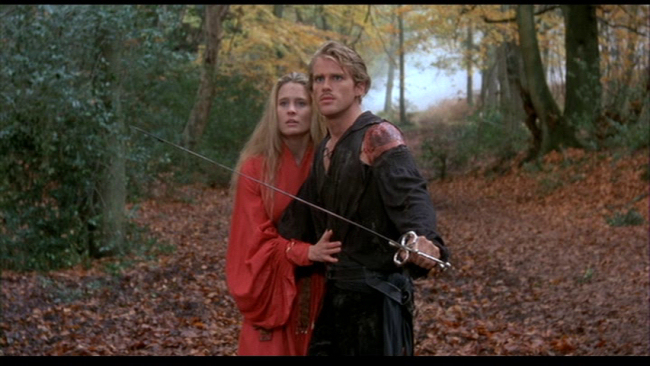
Last year, in June, I wrote about The Princess Bride and When Harry Met Sally after I had what I called a "Rob Reiner festival" over the weekend. The Princess Bride was a charm that never failed. When I was a kid, it was something I could always watch with friends and family and it remained great after I'd grown up. It's a parody but its longevity is due to its sincerity. It may mock some of the conventions of '30s swashbucklers, but it honours the best intentions behind them, the simple philosophy of love and chivalry.
When Harry Met Sally is almost the same thing for adults, though now that we're caught between the sexually repressive forces of the religious right and the neurotic left, it's something more of an artefact of a time when a healthy middle class was having enough casual sex to incorporate the experience into nuanced thoughts about life. That was the world in which When Harry Met Sally was made. It was a movie that recognised the gravity of challenges normal people faced but showed life to be something funny and bearable.
Rob Reiner made some of the best movies to help people just get through the bullshit of life. Who the fuck would murder him? Apparently it was his own son, who co-wrote a 2015 movie his father directed. It was about a troubled young man with a history of substance abuse, perhaps it was autobiographical. One could infer a motive for the murder just from that but, to paraphrase Sherlock Holmes, it's a capital mistake to draw conclusions without all the facts. One thing's for sure, it's a monstrous event.
Yesterday I was at McDonalds for lunch reading a book on Japanese history. I read about the formation of the Takarazuka Revue, an all female troupe founded in 1914 that retains great popularity to-day. I came home and was reading Osamu Tezuka's Phoenix, a manga I borrowed from a friend, pleased to find most of its Japanese was simple enough for me. I read a bit about it on its Wikipedia page and there saw that the Takarazuka Revue staged a production based on the manga. It also turns out the troupe was a big influence on Osamu from an early age. Then I realised the Takarazuka Revue is based in Hyogo Prefecture, not far from where I live.
It's an interesting alternative to the traditionally all male kabuki troupes. From what I've read, kabuki initially had female performers but they were banned after it was decided that they incited too much lust in their samurai patrons. I guess that concern was gone by the twentieth century but the Revue's fanbase seems to be primarily women. I kind of wish I could afford to see one of their shows.
X Sonnet 1970
A winter ghost would only meet with thieves.
Beneath the cells of hardened thugs she waits.
With icy tears through frozen hands she grieves.
She daily guards the shining silver gates.
Intruders came in form of screaming wisps.
The snow was granted life by evil eyes.
A liar cited Crosby's song in lisps.
The gullible believe a sack of lies.
She tries to write on rocks with frozen pens.
But hardened ink results in empty scrawls.
To spy on her they use a secret lens.
They lust for her but pay her vicious calls.
Twixt walls of ice she sadly dreams and waits.
While trolls who watch her hone their petty baits.
I haven't been enjoying the Bajoran political episodes of Deep Space Nine so much on my recent rewatch but I did like the 1994 episode "The Collaborator". It's a nice little introduction to political manipulation.
At this point, Kira (Nana Visitor) is in a relationship with Vedek Bareil (Philip Anglim), a Vedek being a Bajoran religious leader somewhat analogous to a cardinal. Like Roman Catholicism, the Bajoran religion seems to be a major part of the government so the upcoming election to Kai, a rough equivalent to pope, is a big deal. Bareil is running for the office and so is the recurrent antagonist Vedek Winn, played by the late Louise Fletcher. She's great in the episode, too, with her trademark, venomous tone of courtesy. She has a juicy bit of dialogue with Sisko in the episode in which you can feel the contempt behind every word of phony politeness.
Her strategy to defeat Bareil is to tie him to a Cardassian collaborator, a man who worked with the Cardassians when they were occupying Bajor and using the people for slave labour. She does so while maintaining the superficial veneer of one only in quest of the truth for the good of all. The trail of breadcrumbs that Kira and Odo (Rene Auberjonois) pursue in investigating the link is just the right level of complex to seem credible yet easy enough for the casual viewer to comprehend.
At one point, they enlist Quark (Armin Shimmerman) for help in a scene that begins with some business that's a little funnier than it was intended to be if you know something about how Star Trek episodes were produced in the '90s. On almost any show or movie, you have actors with speaking parts and you have actors who only appear in the background or have brief bits of business with the main actors. They're called extras. On '90s Star Trek shows, there was a big difference between the paychecks for main actors and for extras and the productions were obligated to pay more money to anyone with a line of dialogue, even if it was just one line. So sometimes you'd see a character who really seems like they should speak but don't. This scene with Quark begins with one of his employees inexplicably communicating with him through pantomime. Ironically, he's reluctantly paying her wages in the scene.
Star Trek: Deep Space Nine is available on Netflix in Japan.
The long cultural life of 2000's American Psycho is kind of fascinating. I've never read the Bret Easton Ellis novel it's based on, which Ellis, among others, considered to be unfilmable. It must be very different from the resulting movie, then, because the movie is so slick, like "shit from a duck's ass", to borrow a phrase from Lost Highway, it seems like it could only be destined for film. I imagine the main character, legendary anti-hero Patrick Bateman, was less of a caricature in the book.
Patrick Bateman has loomed over the landscape of American cultural commentary ever since the film's release and his presence only became more relevant with the election of Donald Trump. Trump was the epitome of precisely the cold, rich, yuppie New York culture that the film parodies. But while Bateman and his friends have the oddly childish, vicious hot takes in casual conversation that recall Trump, Bateman also spends time with carefully crafted moralistic bullshit to cover the left wing psychos, too, like his feigned concern for the environment and cultural sensitivity.
To be sure, there are many qualities to Bateman's madness to be found anywhere in the world. You don't have to be American to be a vicious hypocrite. But Bateman's madness is a perfect perversion and consummation of Puritan ethics that were part of America's formation. It was the Puritan who had no power to affect their own salvation and so compulsively constructed a psychological mask in the hopes that the inside would match the outside. Cognisance of it being a mask would, one would think, shatter it, but by the 1980s, the American Pscyho could comfortably look into a mirror and say
There are a lot of different uploads of precisely this clip on YouTube. It obviously struck a nerve.
The studio, Lionsgate, wanted Leonardo DiCaprio to play Bateman but director Mary Harron chose Christian Bale, an Englishman. I always felt that casting a non-American was perfect for a character whose persona is a consciously crafted shell. Harron also liked Bale, according to Wikipedia, because Bale didn't think Bateman was at all cool, as some of the other actors who auditioned for the role did. Nevertheless, he has his place in the line of late '90s, '00s anti-heroes with whom audiences found themselves sympathising. The movie bashes Bateman's world constantly while Bateman's only honest moments are when he is bashing it too, physically. Perhaps the excessive violence of the novel, which was toned down for the film, was meant to sicken even the most jaded horror fan.
American Psycho is available on Netflix and on The Criterion Channel.