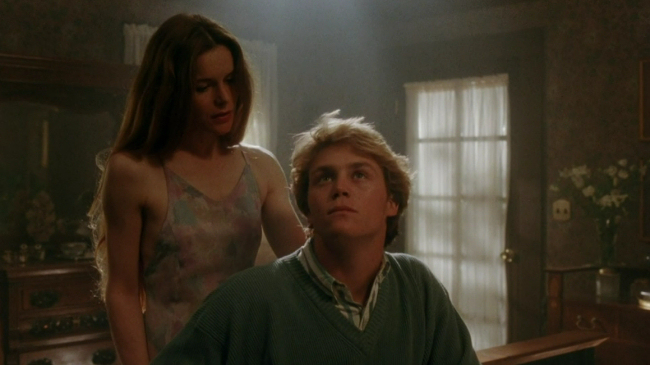
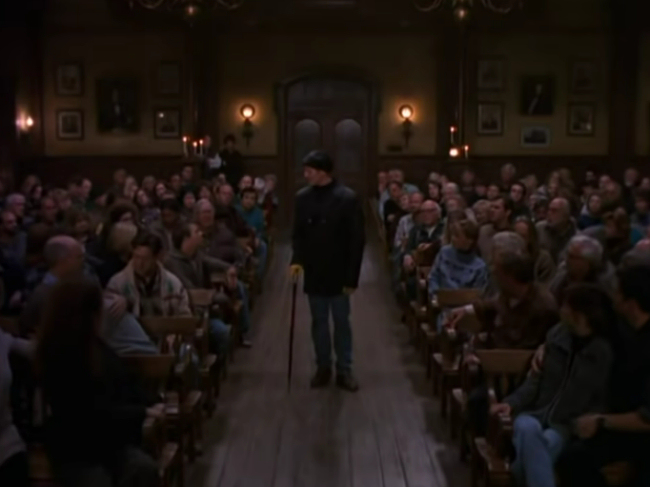
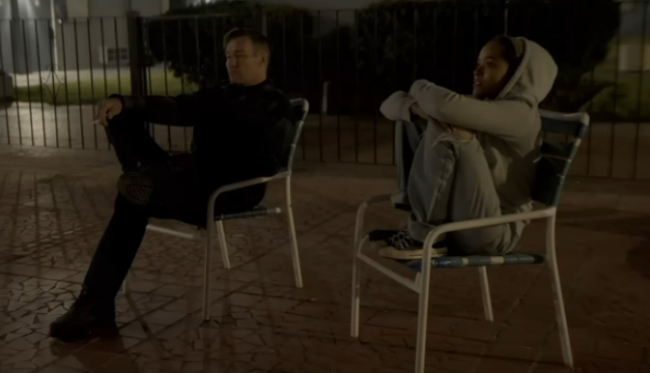
I've been watching so many good Stephen King productions lately I was a little surprised to come across something sub-par last night. 2023's Sleepwalkers was written for the screen by King and has Alice Krige, Madchen Amick, Ron Perlman, and Mark Hamill (though he's uncredited for some reason). But it's about vampires who are allergic to cats and it's about as silly as you could imagine that premise being.
Charles (Brian Krause) and his mother/lover, Mary (Alice Krige), are down on their luck vampiric demons who require the souls of virgins too sustain them. Lucky for them, Charles meets the beautiful young Tanya (Madchen Amick).
Tanya's the best part of the movie and I suspect King wrote her as his own dream girl. She works at a movie theatre and she's introduced dancing alone to her headphones while sweeping. The camera gazes long and appreciably at her in the sequence.
I suppose it's the kind of thing you might see in a commercial but, hey, it's Madchen Amick.
The Sleepwalkers, as the vampiric beings are called, have some interesting powers and there a few cool, vicious scenes, like the one where Charles decides to murder his creative writing teacher (Glenn Shadix). I get the sense that King isn't a big fan of creative writing teachers.
Unfortunately, when a cat attacking Charles consists of the actor holding a stuffed prop to his neck and writhing, it looks exactly like what it is. It's hard to make a movie about cats that gives them the majesty we cat lovers know they possess in life. Lots of people have tried, though.
Sleepwalkers is available on The Criterion Channel as part of a Cat Movies playlist on The Criterion Channel.
X Sonnet #1807
A normal box for ev'ry pace was checked.
Reflective marble blushed beneath the blood.
The dancing busts in ivy wreaths were decked.
A pterodactyl lifts the deadly bud.
Deducted metals scored for lead in rings.
Remember time when baking space for air.
Whenever pots're washed, enamel rings.
No messaged mind could find a worthy pair.
Aggressive fungal ghosts are sleeping late.
Omitting falls, the water changed to mist.
Forever, questions swirl about the gate.
Perverted sleepers marvel at a kiss.
Returning time has rendered red to grey.
The ancient oak became a paper clay.
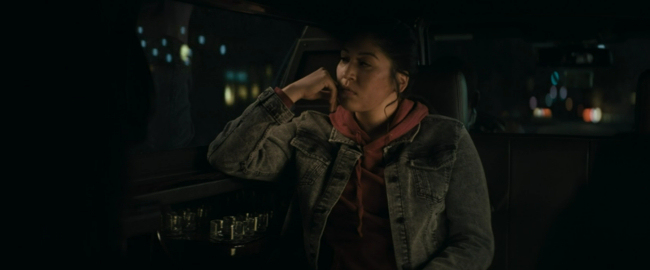
Disney released the new Marvel series, Echo, in its entirety last night. I don't binge, I just don't have the time, but I watched the first two episodes. It's not really a bad show. Alaqua Cox's performance is really good, nice and subtle. The fact that she's actually deaf lends a lot of authenticity to her performance.
The show was created by Marion Dayre, who won a Peabody Award for her work on Better Call Saul. Yet every episode of Echo has at least four credited writers, The last two episodes do not include Dayre among the writers. Sounds like Dayre wrote something Feige or Disney wasn't happy with and so they brought in a gang to tamper with it and Dayre left unhappy and signed a non-disparagement agreement. That would be my guess.
The action scenes are pretty good, especially the big fight with Daredevil (Charlie Cox). More than his appearance on She-Hulk, it really felt like we were back in the old Marvel Netflix world. And, of course, Vincent D'Onofrio is great as Wilson Fisk.
Maya's motives still seem a little hazy. There are a lot of little moments where I wonder, "Why did she do that?" like when she tore her pant leg during the train sequence. I'm also not clear on why she had to come to her hometown in order to wage war on Fisk's organisation.
I'm also not clear on the exact nature of the superpower she seems to have inherited. I kind of liked the sequence set in 1200 Alabama, though very little is known about the Native American civilisation at that time so we're seeing a lot of inferences when it comes to costumes and customs. I liked the big burly bad guy, he seemed like he could really tear things up, but altogether I wish the sequence had been weirder.
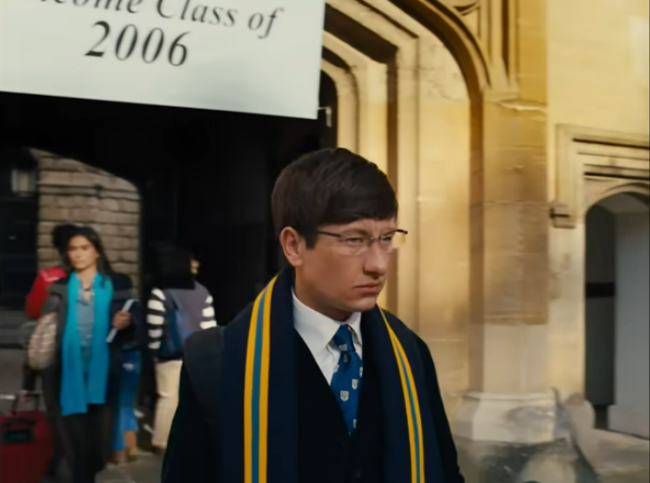
I thought I was done with new films for a while but my sister recommended 2023's Saltburn. So I watched it last night and I was glad I did. It's sort of a Dark Academia Kind Hearts and Coronets. It kind of loses focus about two thirds of the way through but it's a pleasant diversion.
Barry Keoghan plays Oliver Quick, a new student at Oxford who's shy and awkward and watches the popular Felix Catton (Jacob Elordi) with smouldering intensity.
He tells us in narration how much he wants Felix. There's an apparently chance meeting on the way to school and slowly Felix starts to take Oliver under his wing. Eventually he invites Oliver to his family's lavish manor, Saltburn.
Writer/director Emerald Fennell reveals a gossipy comedy from there as we meet a cast of dim-witted, spoiled rich people who inhabit the place. The matriarch played by Rosamund Pike with her wasted friend Carey Mulligan ponder the location of Liverpool--the patriarch, played by Richard E. Grant, informs them Liverpool is "north."
One thing I like is how things that you'd usually take for just thoughtless fantasy elements end up being clues, like how Oliver is in much better health and is much better educated than his supposedly poor background would suggest.
The tone of the film and Oliver's obsession with Felix strongly reminded me of reading The Secret History and I see there's debate online over whether Saltburn counts as Dark Academia since most of the story is not set at school. I say, the shoe fits.
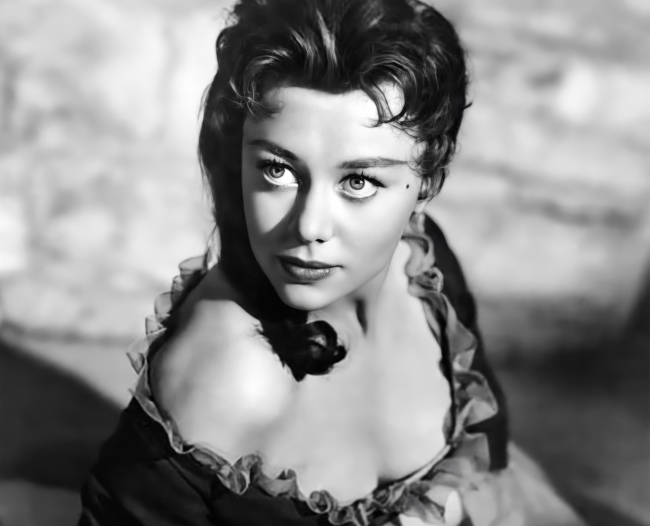
I somehow missed the news last week that Glynis Johns had died. She was a hundred years old, the English actress died in Hollywood. Most people remember her now as the mother in Mary Poppins but that fine film was preceded by many years of divine turns by the great Glynis. A comedic actress of wonderful subtlety and instinct, her wit paired well with her cheesecake looks. Perhaps her finest hour was as Danny Kaye's love interest in The Court Jester.
It seems she was a delightful person in life. This interview about her mermaid comedy, Miranda, has stuck with me for years:
On top of everything else, she was also a singer and she was the original singer of the song "Send in the Clowns"--Stephen Sondheim wrote the song for her.
Here's to you, Glynis Johns.
X Sonnet #1806
Addressing digits, clocks create a time.
As eras close, eruptions pop for corks.
Forgotten days were special hills to climb.
The year became an extra pack of forks.
Her foggy breath revealed the airy sprite.
But now the clouds disrobe the pixie pack.
They danced as lightning charged the lounge with light.
The while waiting trolls prepare a sack.
From dizzy heights to frothy shores she swam.
Desire plucked her bottle off a shelf.
No greater light was ever shed by dame.
Yet all were charmed as by a little elf.
The bosey bits ascend above the tank.
She enters now among the angels' rank.
Last night I finally finished watching Stephen King's Storm of the Century, the 1999 miniseries King wrote for television. I started watching it back in the summer but, considering it concerns a town besieged by a blizzard, it seemed better suited for winter viewing so I saved the last two of the three parter. It was pretty good. Crummy effects and director Craig R. Baxley's unimaginative style aside--but I think that's just what King likes, a director who leaves all the imagination up to King.
The writing was good. It's a "Monsters are Due on Maple Street" kind of story, that kind of Twilight Zone-ish essay story you don't often see anymore (I suppose I ought to finish watching Black Mirror).
Supernatural serial killer Andre Linoge (Colm Feore) psychically manipulates people into killing and taunts other people with dirty secrets from their pasts, setting them all up for a grand finale moral test.
Linoge turns out to be an ancient entity who, it's hinted, was responsible for the disappearance of the first Roanoke colony. As a conspicuously moralistic spirit he could be interpreted as a Puritan's nemesis or exterminating angel. You're left at the end wondering if the people in this town are exceptionally bad people or if secret rot is the common human condition.
Now I feel somewhat free to watch old movies since I finished my Best Of/Worst Of lists. And TV shows. I want to keep watching Fringe but Amazon gives me an error whenever I try to watch the next one. No clue why and by the time I settle down with my dinner to watch something I don't have the patience to wrestle with the technical problems. My internet is shit, especially when it comes to websites owned by Google. My provider is Softbank, a company with a good reputation in Japan but that doesn't stop them from being shady as hell. That's why it takes six hours for me to upload a three minute YouTube video (by the way, video versions of my Best Of/Worst Of lists are up on YouTube).
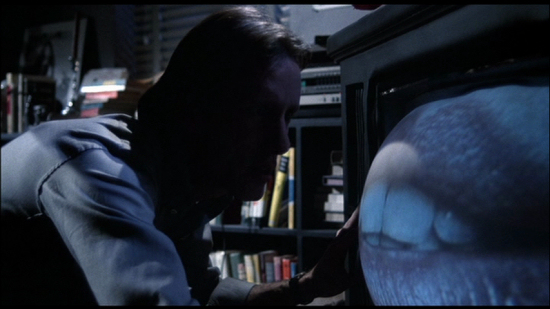
I've been dozing off at 12:30 or so with some old favourites on the screen. Chinatown, Videodrome, Wild at Heart, The 39 Steps. None of these movies should be comforting but they are. I guess The 39 Steps is kind of cosy. I love when Robert Donat checks into the hotel and orders whisky for himself and milk for the girl.
Being handcuffed to Madeleine Carroll seems like it would be nice.
I have been playing video games. Lately Metroid II, Kirby's Dreamland, Final Fantasy Legend II, and, of course, Skyrim. Here's my current character, Gwen:
I named her that because I have a mod that expands the dialogue of an NPC character, Serana, to be able to say certain names--there's a list of well over a hundred. This free mod has a professional voice actress and was covered in Forbes magazine. I'm taking my expanded Serana through another mod about rebuilding Helgen, a fort town that was destroyed at the beginning of the vanilla game. This mod is also fully voiced and totally free.
Since the last time I talked about the remarkable phenomenon of Skyrim mods, Bethesda has introduced new purchasable mods, which are causing controversy in the gaming community. I'd advise people not to worry, I think we all know nothing will come of them. It's funny, I believe in capitalism as a motivator for human achievement, except when it comes to art. More often than not, the profit motive has inhibited art rather than advanced it. The evidence is everywhere. Lousy movies make lots of money while hundreds of better achievements have to fight for funding and then end up losing money. Exceptions exist but are extremely rare--rarer than they might seem because they take up a lot of media space. And a lot of the best Skyrim mods are better than what people were paid to create for the vanilla game. Of course, this leaves the problem of the most creative people barely being able to afford basic necessities.
I heard recently that Miyazaki Hayao doesn't like video games, that he feels they're taking up too much space in children's lives. I've addressed the topic before of whether or not video games can be art and my position was always that they're not art but they can contain art. For example, the NPC mod I mentioned features lots of written and recorded dialogue. I consider that to be art but the interface for encountering that art, I'd still call a game. This comes from my definition of art as something created by a human mind to transmit an idea or feeling. For a game to achieve this, it has to utilise assets in a way that a communicated idea or feeling clearly comes through only because of player input, only because of an achievement or failure. Often, dialogue scenes in games feel detrimental to the gaming experience because the game really stops and becomes a movie. So when we're talking about art there, we're really talking about short films. I have yet to experience any kind of game dialogue that approaches the immersive experience of a movie. By and large, although I obviously like and play video games, it's always a shallower experience than a movie.
But on that note, I recommend watching video game designer Kojima Hideo's recent visit to the Criterion closet:
What he's saying about young people in Japan being unaware of Japan's great history of cinema is, unfortunately, quite accurate. Many of the teachers I work with, let alone the students, have never heard of Mizoguchi or Naruse and, though they may have heard of Kurosawa or Ozu, have never seen any of their movies. I was thinking of putting together a presentation on old Japanese films to show students but I knew if I didn't use a Japanese source some of the students wouldn't give credence to what I said. So I went to the bookstore to see if I could find a book about Japanese cinema. What I found were two walls of books about Hollywood, written in or translated into Japanese. They had a really lovely copy of Lulu Goes to Hollywood even, Louise Brooks' book of criticism. Then there were half a dozen books on Kurosawa, a couple on Ozu, all on the bottom shelf. Nothing comprehensive like what I wanted. I guess I wasn't surprised. Even Kurosawa complained in his lifetime about the lack of interest in Japan for the giants of '50s Japanese cinema, which is of course why he had to get funding from Francis Ford Coppola and George Lucas for his '80s movies.
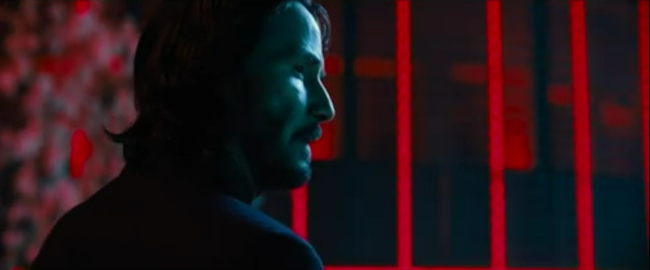
Once more into the punch-athon; 2023's John Wick: Chapter 4 is, as of now, the final installment. Like the second and third films, the plot is a thin excuse for an endless fight scene. And that's fun, particularly with Donnie Yen now playing one of the villains.
Just like in Rogue One, he plays a blind fighter. This seems to have become his specialty. If Charlie Cox ever stops being Daredevil, Marvel oughta think about Donnie Yen.
The John Wick films exist in a fantasy version of our reality in which no earthly factions or governments matter; there is only the shadowy organisation controlling lavish, criminal hotels worldwide. Now Wick (Keanu Reeves) must defeat an important nobleman (Bill Skarsgard) to settle things once and for all.
Chapter 4 was filmed on location in France, Germany, New York City, and Japan. The first portion of the film is set in Osaka though the only shot that looks like a real location shot is a rooftop dialogue scene in which the city skyline is blurry in the background.
It could be a lot of cities in Japan. Or South Korea. The rest of the segment looks like it was shot on soundstages. It's not as bad as the time Doctor Who went to Osaka but, since the segments in France and Germany feature major landmarks, it would've been nice to see a few famous locations in Osaka. Maybe the Hep Five Ferris Wheel or Osaka Castle. Umeda Station is mentioned but no recognisable part of it is ever shown (googling now, I see all the interiors were shot in Berlin and the two exteriors were shot in Tokyo).
The two Japanese characters, the manager of Osaka's Continental and his daughter (played by Hiroyuki Sanada and Rina Sawayama, respectively) are both played by people who've lived and worked outside of Japan for a long time. None of this really surprises me; it's notoriously difficult for American productions to make anything authentically Japanese in Japan. If you're curious to know more, I recommend listening to Paul Schrader's commentary track for the Criterion edition of his film Mishima, in which he talks about the slow and difficult process of working within the Japanese film industry to really make a movie feel Japanese.
Donnie Yen is so good in this last John Wick movie, all the other fight scenes seem kind of slow in comparison. Maybe they ought to be making a movie centring on his character next.
John Wick: Chapter 4 is available on Starz.
X Sonnet #1805
A cut of joy appeared as shiny knives.
The rampant dark dispersed the shopper's hell.
We build a brick retreat from rusty lives.
A knowing wink precedes the turtle shell.
Where brains were purposed back to heads
Decisive girls assembled stairs of glaze.
Inviting villains gild their golden beds.
Remember eyes were ever made to gaze.
Beyond the glass, the colours streaked across.
Dividing speed from dreams reduced the stress.
Lobotomised, the patient feels no loss.
So science bows before the angry guess.
As justice danced like wisps of smoke at night,
The bitter bot resumes its endless fight.
All right, I can delay it no longer, it's time to get some ranking done. As usual, there are many movies I still want to see, perhaps most notably Poor Things, but I live in Japan and it doesn't come out here until the end of January. I suppose I'll plug it into the appropriate spot at some point.
I'm doing something a little different this year. Usually I rank all the movies I saw in one big list, from worst to best. That's how I've been doing it for about ten years or so. Before that, I made more traditional top ten lists. This year, I think I'll try going back to that format. I've made a Ten Worst and a Ten Best list. In between, I've put runners up and movies I've decided don't warrant a ranking for various reasons.
Bear in mind, for the Ten Worst list, I haven't seen The Marvels because I heard it was terrible, and I hated Captain Marvel and was indifferent to Monica Rambeaux.
You know, Michelle Pfeiffer was really good in this movie. I liked Bill Murray's cameo and some of the monster designs were cool. It's a shame about the terrible screenplay and the even worse studio tampering.
Ridley Scott made a movie about how a man became emperor on his charming personality alone and he hired Joaquin Phoenix to play him like he played the off-putting and creepy Arthur Fleck. Oops.
Few things are quite so dumb as a dumb movie that thinks its brilliant. Leave the World Behind demonstrates how easy it is to manufacture conflict among characters who are all stereotypes. Maybe this is the new commedia dell'arte.
The director of Kate and Leopold saw Kingdom of the Crystal Skull and evidently thought, "This franchise needs more cgi. Also, a belligerent woman needs to physically abuse an elderly Indiana Jones because he's too stupid to know what's good for him."
4. M3GAN(Wikipedia entry, my review)
If you've seen the original Child's Play, you've seen a superior version of M3GAN, and Child's Play is by no means a masterpiece.
I truly believe an AI was involved in writing this soulless dollop of crap. Maybe the screenwriter ran it through a programme on the sly, I don't know. I just prefer to believe no human being would be responsible for something this devoid of emotion.
I am a sucker for haunted house movies but not that much of a sucker. Here we have ghosts without menace, editing without instinct, and characters without souls. So I guess they don't have to worry about the afterlife.
I still wish they'd make a Dragonlance movie and something less meta, but this one felt like it had genuine heart. The characters have problems you care about and they're played with real charm and integrity, particularly by Chris Pine, Michelle Rodriguez, and Hugh Grant. Praise the gods for small favours.
It's not one of Wes Anderson's most impressive or meaningful films but it has a wonderful aesthetic and it's always nice to visit Anderson's deadpan, sincere retro universe.
It's yet another iteration/reboot of the Ninja Turtles franchise but this time someone had the bright idea to make it like a real movie. The teenagers are written like the screenwriters actually thought about what it was like to be a teenager, the animation is terrific, and everyone feels alive in a way characters don't tend to in franchise fare these days.
Paul Schrader's throwback to the revenge, Searchers inspired movies of the '70s is a fascinating continuation of that particular conversation about human nature. What is the value of human life, what is the value of violence? Also, Sigourney Weaver has jellyfish wallpaper.
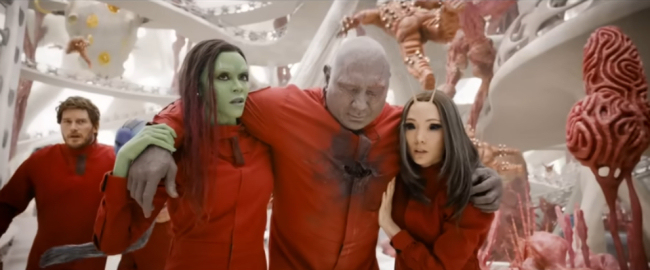
James Gunn's cocktail of space weirdness and a found family helping each other get through a life of brutal trauma is at its most potent in the third volume of his Guardians of the Galaxy films. He's definitely leaving on a high note and delivered the best Marvel movie in years (I know, there's not much competition, but still).
Scorsese delivered a fascinating rumination on human frailty and human corruption with this masterfully crafted film. Just like Henry Hill in Goodfellas laid out the appeal of the mafia lifestyle, Scorsese with Flower Moon shows just how insidiously corruption can take root in a community.
Wim Wenders' latest film is both an admiring portrait of zen-like acceptance as well as a criticism of it. Altogether, it's an excellent modern example of mono no aware and an incredibly poetic exhibition of how the human heart will always need more than it can get in life.
Christopher Nolan has made an ingenious sequence of cinema with this movie, this three hour movie that goes down smooth as finely aged whiskey. Every link in the chain of this non-linear narrative flows smoothly into the next; purely as an example of technical expertise it's a wonder to behold. The story, too, is brilliant: the story about how the unpredictable, or all too predictable, interweaving of human interests--of love, jealousy, ambition, and patriotism--can have consequences equal to the highest levels of achievement and the lowest depths of human dread.
The courage director Miyazaki Hayao had in making this movie is manifold. It took courage to make this kind of statement in Japan's current political climate, and it took courage to make an intellectually and aesthetically challenging movie in a Japanese film industry that mostly clings to producing empty fluff. It takes guts now just to make something this beautifully weird.
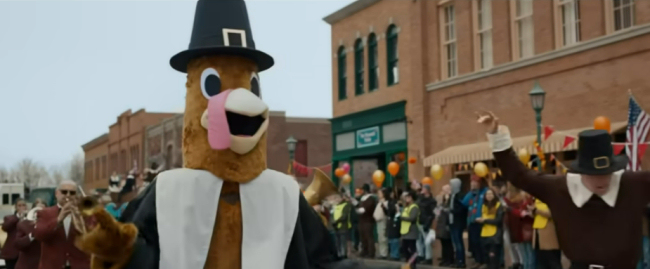
Now, that's what I call a feel good movie. 2023's Thanksgiving is the bloody holiday slasher with notes of satire I needed. It was very hard to stop smiling while watching it.
This is the latest film to come from 2007's Grindhouse, which at this point must be one of the most successful unsuccessful movies of all time. Originally a double feature consisting of Robert Rodriguez's Planet Terror and Quentin Tarantino's Death Proof, it also featured several fake trailers for films inspired by exploitation films of the 1970s. There was a trailer for Machete by Robert Rodriguez which he ended up making into two movies, there was Werewolf Women of the SS by Rob Zombie (the weakest of the lot), Don't by Edgar Wright (very funny), and, finally, the unexpected cream of the crop, Thanksgiving by Eli Roth.
It has to be said, the feature film is nowhere near as extreme as the trailer. There's really no nudity (aside from one bare bottom), no weird sex gags, and the giant Indian head was removed from the parade which now consists entirely of pilgrims, much like the Thanksgiving stuff on Wednesday. Isn't it interesting how political correctness has erased Native Americans from the holiday?
It's kind of sad, all these pilgrims, dressed up and waiting for their Indian dinner dates who will never arrive.
But as was suggested in RedLetterMedia's review of the film, I think 2023's Thanksgiving may be meant to be a 21st century remake of the faux '70s movie shown in the trailer. So it's not meant to be counted among grindhouse movies now but among 2020s slashers, which are careful to avoid sensitive political issues and sex even as they're willing to indulge in extravagant gore and torture.
Eli Roth is a big fan (and former collaborator) of David Lynch (he even made his own Twin Peaks knock-off show, Hemlock Grove). Like Twin Peaks, Thanksgiving presents us with a cast of small town characters, any of whom could be the killer, and Roth teases us with various clues. When the killer's identity is revealed, it's pretty satisfying and makes a lot of sense, even though I didn't guess it.
The beginning of the film is a brilliant mix of mounting tension and dark humour worthy of Hitchcock. A Black Friday (beginning, of course, on Thursday night) steadily goes from rough and ominous to baroquely catastrophic. Roth's sense of timing and detail is impeccable. Especially memorable is the man in the crowd who cuts his throat on a piece of broken glass when he's shoved through a broken door. Of course, his life's blood oozing away, he still staggers to the coveted waffle irons.
I wish I could've seen this movie in November but, I must say, it was so magical it took me back in time. I felt like it was Thanksgiving when I was watching it. Thank you, Eli Roth.
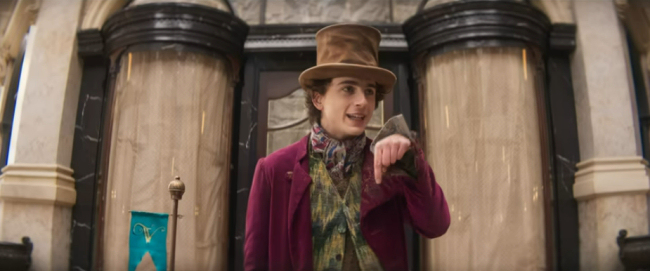
You may find it hard to believe after reading this, but I really wanted to like 2023's Wonka. I went in loaded with good will, I was ready to be swept away by musical magic. But, man, oh, man. Hugh Grant was right. This movie blows.
I didn't think the trailers looked great but then I heard about how this was a surprisingly good movie and saw how word of mouth was giving it good box office numbers. Even one of my students here in Japan recommended it to me. Well, I saw it in a theatre with an entirely Japanese audience. No-one laughed. Not once.
The film opens with a few notes from "Pure Imagination". Along with original songs, it includes a couple from the 1971 movie, to which Wonka is a "spiritual prequel". I thought, okay, sure, why re-invent the wheel? I feel like Danny Elfman's Batman theme should always be Batman's theme and John Williams' Superman theme should always be Superman's theme, through good movies and bad. Why not Wonka too?
Sure the new songs can't pull their weight. We meet Wonka standing on a topmast as his ship pulls into the harbour of an unnamed fantasy city, singing weakly (because Timothee Chalamet's voice is really weak) about how he's going to make his way here. The song, like all the other new ones, feels like a vague, tuneless echo of a song from Sweeney Todd or Aladdin. We see him gradually lose his only twelve shillings and there should be a lot of tension, we should be worried about this idealistic kid, except he has a magic hat and suitcase that can basically do anything and he never seems worried.
Okay, I thought, maybe I'm just approaching this film the wrong way. Maybe there's something else I'm supposed to get invested in. I never found out what it was. I'm pretty sure the filmmakers didn't know. Every time there's a moment I think, "Oh, this is going to be a problem to overcome", it dissolves instantly. He's thrown down a chute, forced to work in a laundry room to pay his overpriced hotel bill and he's separated from his magic hat, which was left on the counter. Guess he's going to have to use his smarts to--no, wait, he has his hat again. No explanation. His magic suitcase comes and goes, too.
There's a lot of dialogue about terrible poverty and the cruel owners of other chocolate companies but it all feels so pointless. Instead of leaving the theatre delighted by the human spirit, the magic to be found in an earnest dream and the common pleasure of chocolate, I left feeling oppressed by the sense of a soulless mechanical mind, draining all sense of possibility and joy from the familiar pleasures of home and childhood. The costumes were nice, though.
Wonka is now in theatres everywhere.
X Sonnet #1804
A flash of teeth between the flames at dawn.
The passing spark of scales on lively waves.
The little tremb'ling dasher's swiftly gone.
WIth razor claws 'tis meat the dragon saves.
With bubbles popped, the week began in green.
A waiting green persists for days ahead.
Reductive kindness smacks of something mean.
So offer, then, the honest torch instead.
A vaunted choc'late harboured only air.
Extracted darkness leaves confections weak.
A beaten candle struggles up the stair.
The fourth's the last but two was truly peak.
A coat sufficed for candy starved and sad.
A tasteless meal is worse than really bad.
A grimly methodical, quiet man tends the grounds of a large estate as 2023's Master Gardener. This latest film from Paul Schrader is a surprising throwback to his movies of the '70s, and is about as good as some of them.
Those who've read Quentin Tarantino's recent book, Cinema Speculation, will have read about how the great American filmmakers of the '70s were all inspired by 1956's The Searchers. In that film, a former Confederate soldier played by John Wayne leads a hunt for the Indians who murdered his brother's family and kidnapped his niece. The man has true racial hatred for Indians, something director John Ford depicts as negative, but good people also want to rescue the niece. The tension in the story is in the value of Wayne's character--is his peculiar tenacity and brutality necessary?
Like Rolling Thunder, Taxi Driver, and Hardcore, Master Gardener is another movie that borrows a basic road map from The Searchers. Joel Edgerton plays Narvel, a man formerly attached to a militant white supremacist group, who now works as a gardener under the witness protection programme. His employer is a wealthy, narcissistic woman called Haverhill, played by Sigourney Weaver.
It's an unusual role for Weaver, a broader character than she usually plays, but she sinks her teeth into it admirably. Mrs. Haverhill seems like she time travelled from the 1830s, a matriarch of a southern plantation. You could see Narvel as an overseer and the team of gardeners who works for him--a white woman, a Mexican man, and a black woman--as his labourers, if not slaves. Then Haverhill gives Narvel a very important charge, her recently orphaned granddaughter, Maya (Quintessa Swindell), whose father was black.
As they work together, Narvel and Maya start to like each other. So he's enraged when her drug dealer beats her up. Maya, like Jodie Foster in Taxi Driver or the porn actress in Hardcore, is kind of a combination of Jeffrey Hunter's and Natalie Wood's characters in The Searchers. She's the victim and also the sidekick foil for racism (Jeffrey Hunter's character had Indian blood).
One could argue that Narvel doesn't really fit the pattern because he's reformed, he turned against the white supremicists and now employs and works with black and Mexican people. But Schrader puts some slightly subtle, slightly conspicuous clues into the film that Narvel may simply have stopped hating non-white women. He makes an odd comment at one point about sexists and the one time we see him interact with a black man it's to immediately crack him in the head with a gun, without waiting for Maya to tell him if he's one of the ones who abused her. There are hints, also in his relationship with Haverhill, that he may have traded militant racism for militant feminism.
The cast is all great and the film is both an engaging action film and an unsettling, menacing vision. I also really love the weird artwork in Haverhill's house.
Happy New Year, everyone. Year of the Dragon. Above you can see the little toys I've collected from packaged New Years mochi. I arrived in Japan in March of the Year of the Rat (2020), so I couldn't get the rat toy. But I got the cow, the tiger, and the rabbit. In March of Year of the Dragon, I'll have been in Japan four years.
I've always been fond of dragons. I used to doodle them all the time as a kid. Not infrequently as an adult, too.
This is the time of year I usually post my ranking of the previous year's movies but I want to wait until I've seen a few more of them. Later this week, I promise.
To-day, I'll rank TV shows I saw:
9. Secret Invasion
It was hard to choose between this and Ahsoka for worst new show I saw this year but Secret Invasion wasn't just bad, it's become an emblem of all that's wrong with the MCU from bad special effects, lazy, committee filtered writing, and overall absence of creative spark.
8. Ahsoka
But Ahsoka was also terrible. I wonder if generations to come will ever know Ahsoka was actually a cool character at one point if this clod is all they have to go by.
7. Good Omens Season Two
It was cute, if generally lacking in stakes and tension.
6. The Mandalorian Season Three
Some decent moments are scattered through this overall lethargic season. Unlike some reactionary viewers, I actually like the idea of Katee Sackoff taking over the show. I only wish she had.
5. Demon Slayer: Kimetsu no Yaiba Season Three
I love that love Hashira but the show has never been able to hit the high water mark of its first season. It's gotten bogged down in Dragonball pre-fight dialogue, my least favourite kind of anime.
4. The Doctor Who Specials
"Wild Blue Yonder" is so good, it elevates the group all on its own. The others aren't bad and "The Church on Ruby Road" is a decent introduction for a Doctor and Companion as well as being one of the better Christmas specials. It seems this was the year for David Tennant to be gay, on this and on Good Omens. I'm happy for those of you who really wanted this to happen.
3. Only Murders in the Building Season Three
Selena Gomez's cleavage and Meryl Streep made this a fantastic season. It was also a great showcase for Martin Short.
2. Star Trek: Picard Season Three
They went to Nostalgia Factor 100 with this one but actually made it a pretty engaging story in its own right, even if the first half was a remake of Star Trek II.
1. Loki Season Two
This show was an almost unremitting blast. With a perfect cast, exhilarating pace, and effective character drama, it's hard to believe something this good came out of this MCU slump era.