Showing posts with label alec guinness. Show all posts

Monday, January 22, 2024

Luck, Audacity, and Guinness

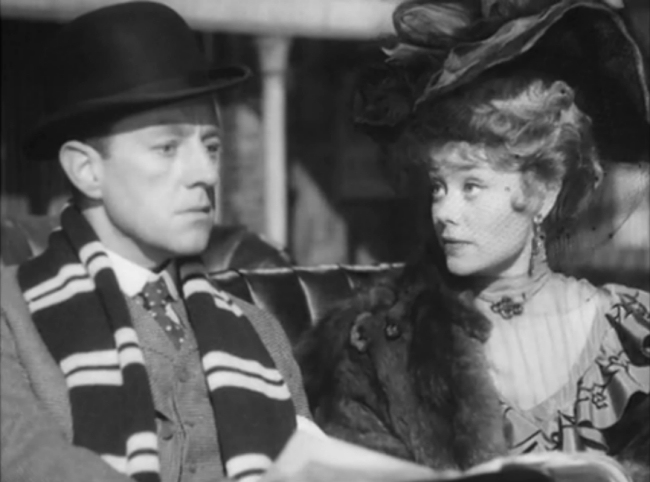
A young man of peculiar disposition climbs a wobbly ladder to success in 1952's The Card. Based on a 1911 novel, it stars Alec Guinness as the title character and it's one of the best Alec Guinness roles I've ever seen. The movie is endlessly amazing and watching him go to work, or deal with an unforeseen difficulty, is a continual pleasure.

After a brief introduction, we meet Denry (Guinness) at a shop window where he happens to spot a wealthy man drop his wallet. Instead of robbing him of it, he strides directly over to the man's place of business, returns the wallet, and asks for a job.

It's all above board and honest enough yet you can't help feeling that Denry somehow got something over on the man. Maybe it's his cat-who-ate-the-canary grin. Really, he's simply a man of remarkable luck who's able to see past social conventions to seize opportunities. After he gets himself invited to a countess' ball, and even has the audacity to ask the Countess for a dance, his boss later accuses him of wanting to dance with his betters. And with perfect innocence, Denry replies, "Well, yes, sir. Don't you?"

Glynis Johns plays Ruth Earp, a dance instructor whom Denry tries to trick into giving him free dance lessons. She, in return, tries to seduce him and just about bankrupts him when they go on holiday. By this point, he's become a rent collector and I was delighted by the simple, deadpan comedy of one scene where, during a storm, he, Ruth, and her friend, Nellie (Petula Clark), come across a closed off pier where men are struggling to save a boat that's run aground. They just want to be spectators--Denry bluffs his way in, pretending they're reporters, and hands his bag of collected rents (at this point he's a rent collector) to Ruth so he can go down among the fellows struggling to haul the vessel up from the waves, all the while grinning like the idiot we know he's not but still genuinely caught up in this silly adventure. Meanwhile, Ruth immediately starts spending the rents on chocolates for everyone. Of course. The set up is so obvious but also absolutely absurd--yet somehow credible. Guinness' performance is a big part of selling it.

The other most remarkable scene in the film is when Denry sees a repo wagon rolling out of control down a hill and takes it upon himself to try to stop it like an action hero. He manages to climb atop it but can't stop the thing from rolling into the canal. It's only then he hears a pathetic voice within and realises Ruth is inside, stranded upon her repossessed table.

Needless to say, Glynis Johns is wonderful in this movie, too.

The Card is available on The Criterion Channel.
Monday, November 06, 2023

The Voice of the Battalion

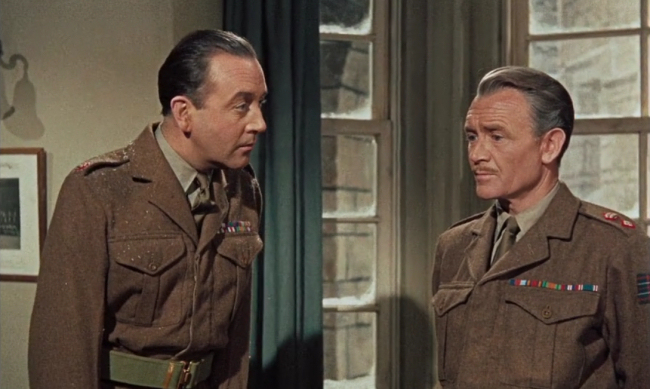
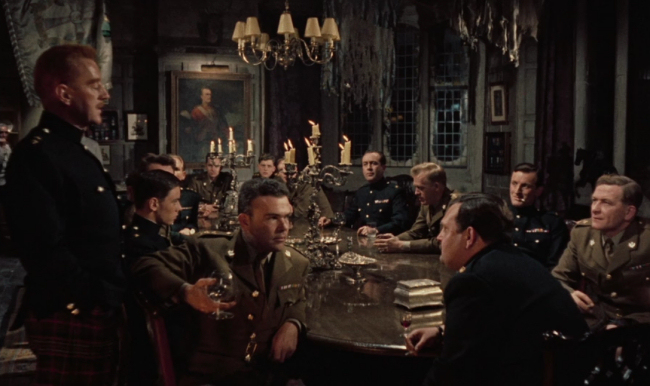
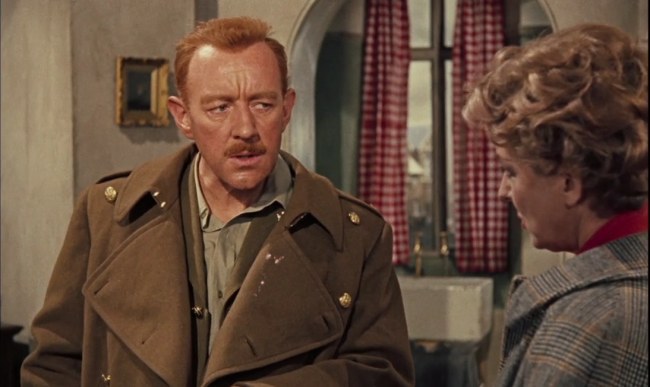
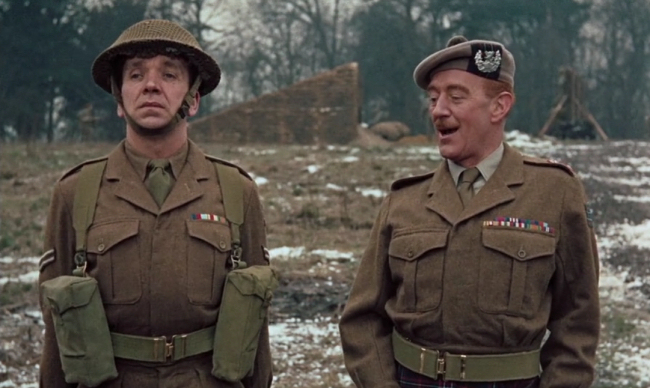
Sometimes I'm surprised by the films that stick with me. But ever since I first saw 1960's Tunes of Glory, I've often found it coming to mind. Particularly Alec Guinness' character. I often find some line from him coming to mind as he maintains his bombast and high spirit in the face of John Mills' micromanaging. I suppose it may be in part due to the loops of wasteful bureaucracy built into Japanese English education that I often hear Guinness' Major Sinclair saying, "What the Hell."

So I watched it again. I tend to remember it more as a comedy though Wikipedia quite rightly calls it a "dark psychological drama". As amusing as Guinness is, his recurrent line, "Have ye no teeth? Then smile, laddie, even under King's regulations that's allowed," is slightly vicious, at least tenacious.

But he'd have to be, wouldn't he? To be a successful soldier in the field. That's something I forgot to mention when I was talking about The Punisher a few days ago. The soldiers that choose to wear his symbol often do so as a display of viciousness to the enemy. Arguably, to do any job successfully, to be passionate about it, is to show your desire to do the job goes above and beyond your adherence to the cold letter of the regulations.

But then for someone like John Mills' Colonel Barrow, the regulations are everything. His reply when Sinclair tells him one man was the battalion's best heavy weight before a debilitating war wound is only to observe that the man shouldn't wear his hat cocked.

As the film progresses, it becomes clear that Barrow's zealous attention to the book is a very bad method of self-treatment for the lingering trauma from his experience as a war prisoner. His vulnerability becomes clear when Dennis Price cold-bloodedly manipulates him.

Somehow, I totally forgot about Dennis Price and Alec Guinness co-starring in the brilliant Kind Hearts and Coronets. But this is a very different kind of film, almost from another universe.

I noticed the film was restored by "The George Lucas Family Foundation". Again, the Star Wars purchase money is being well spent, What a gorgeous place this battalion calls home.

Tunes of Glory is available on The Criterion Channel. Here's my review from 2020.
Sunday, July 17, 2022

The Force of Guinness

No wave of destruction is so relentless or implacable as an artist. You can take that straight from 1958's The Horse's Mouth, a brilliant comedy directed by Ronald Neame from a witty screenplay by its star, Alec Guinness (adapted from a 1944 novel by Joyce Cary).

Guinness plays Gulley Jimson, a painter who looks and sounds a lot like Tom Waits. He lives on a ramshackle houseboat and spends his time harassing potential patrons or harassing his local publican (Kay Walsh) or painting. He does it all with a matter-of-fact momentum and is as likely to toss off a brilliant one liner about how he's really a terrible painter as he is one about how he's a great painter. He delivers every line with such little enthusiasm, and his statements are so baldly insubstantial, that he clearly seems to view linguistic communication as merely an annoying, occasionally unavoidable obligation.

Any lie is acceptable if it will get him money to eat, drink, or paint. Though occasionally food doesn't seem to be particularly important. He ravages the home of a wealthy acquaintance, selling off the furniture while the owners are away in Jamaica, and allows another artist, a sculptor (Michael Gough), to wreck the neighbour's flat, too.

The dialogue is relentless in its charm and wit as Jimson is in his demolition of civilisation. All in the name of art, as it should be.

The Horse's Mouth is available on The Criterion Channel.
Twitter Sonnet #1602

The glassy rim could carry light away.
Across an empty sea we planted trees.
With birds the lonely whale was led astray.
The greedy door devoured twenty keys.
Denuding music drops a key to drink.
We lost the paper boat and took the steel.
But ev'ry day the ship traversed the brink.
The galley preps a final savage meal.
The circles show where drinkers fly to space.
Identified, the flying object fled.
The number writ confounds the cops a pace.
But velvet sky could pass for cosy bed.
The broken bottle popped balloons of blood.
A story mixed with sand and sandal mud.

Sunday, August 19, 2018

Twelve Nights and One Thousand Nine Hundred Sixty Nine Years

One of the adaptations of Twelfth Night available on Amazon Prime is a 1969 made for television version with Alec Guinness as Malvolio, Ralph Richardson as Sir Toby, and Tommy Steele as Feste. It's not bad but I still haven't seen an adaptation of the play I really like. The BBC Television Shakespeare version is pretty lousy with weak performances except from Robert Hardy as Sir Toby. And Trevor Peacock as Feste isn't bad. I've also seen Kenneth Branagh's version from the late 80s which is okay but I think I like the 1969 version more. They have some things in common: Both Branagh's and the 1969 version turn Feste, the fool, into a sort of melancholy rock star.

Though while Branagh went for goth rocker the 69 version, directed by John Sichel and John Dexter, comes across as the teen idol Steele was at the time. He's so perfectly 60s it's kind of cute.

Joan Plowright plays Viola and Sebastian, so she plays a woman pretending to be a man and a man. She does a good job keeping the two performances distinct though she'd have been better off without the blue shadow when playing the masquerading Viola and it definitely looks out of place on Sebastian.

I guess we're meant to think Joan Plowright just has naturally blue skin in that spot.

But of course the best performances are from Guinness and Richardson. As a sort of low key Falstaff, Richardson makes a lot with a pretty simple role and it's always nice seeing a great actor play drunk. But Guinness takes the cake as the Puritan whose severe devotion to virtuous living goes right out the window when he thinks Olivia is in love with him. Watching him smiling and strutting in those stupid yellow stockings he's tricked into wearing is pretty great.

The play's themes of crossing gender and class lines are well known. For a Puritan, the idea of a servant daring to think he could have a relationship with the woman in charge of the household does kind of make sense given that the Levellers were one of the groups associated under the blanket pejorative of "Puritan". Shakespeare may be poking fun at England's most zealous Protestants though Malvolio is represented primarily as an extraordinary hypocrite:

MARIA.

The devil a puritan that he is, or any thing constantly, but a time-pleaser; an affection'd ass, that cons state without book, and utters it by great swarths; the best persuaded of himself, so cramm'd, as he thinks, with excellencies, that it is his grounds of faith that all that look on him love him; and on that vice in him will my revenge find notable cause to work.

For a comedy, it's strange that Malvolio ends the play with his issues unresolved. His last line before exiting is, "Ill be revenged on the whole pack of you." I wonder if Shakespeare was commenting on the increasingly serious division in English culture at the time. Interestingly, though Malvolio here as elsewhere is portrayed as kind of villainous, there's nothing actually in the text that indicates he's such a bad guy, certainly not deserving the treatment he receives from Sir Toby and his comrades. He wouldn't have been trying to woo Olivia if he didn't believe he'd received a letter from her indicating her affection. I feel bad for him, a feeling enhanced by the unresolved nature of his story. He's punished for basically not being as perfect as he thinks he is--in fact, either way you look at it, whether you're meant to sympathise with him or not, the story seems to be critical of puritanism.