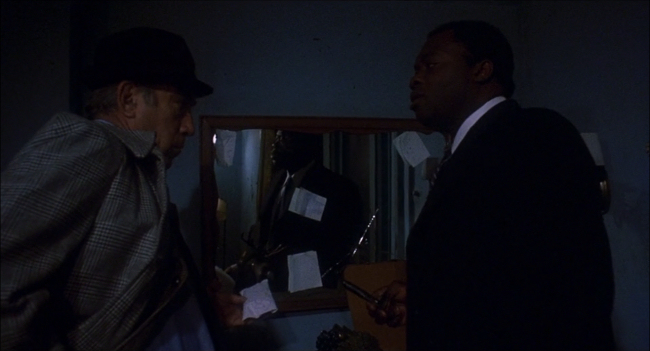
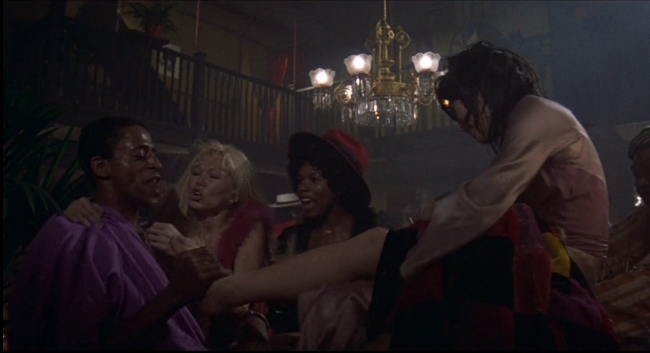
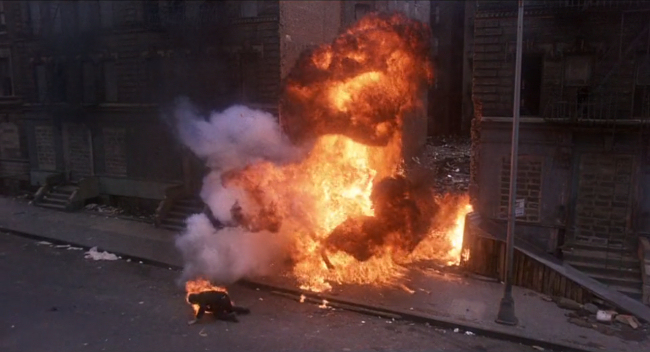
The impossibly pure image of the Victorian gentleman in Robert Louis Stevenson's novella is fascinatingly changed into the image of the white oppressor in 1976's Dr. Black, Mr. Hyde. Like the best of the more direct adaptations of the novella, this features a Jekyll, in this case named Dr. Pride, who isn't simply a good man in contrast to an evil Hyde but a man with his hubris invested in a superficial outer layer that creates a monstrousness within. In this case, the monstrousness is the product of a centuries old, culturally disseminated idea of white racial superiority. A blaxploitation film, it uses the broad conventions of the genre to make a stimulating statement on an interplay between the cultural and psychological.
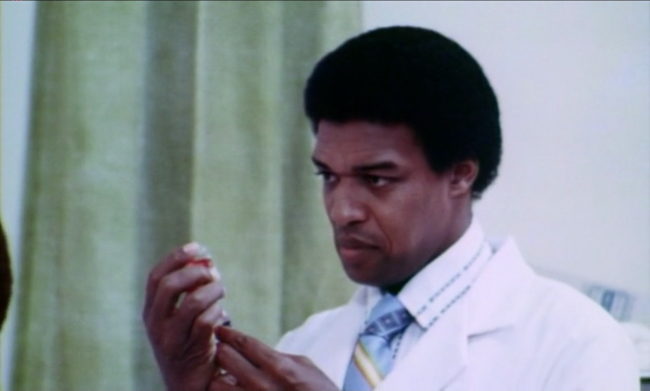
Bernie Casey gives a good performance as Dr. Henry Pride, his name immediately evoked for irony when, in the process of giving a tour of the hospital, his colleague, Dr. Worth (Rosalind Cash), remarks on his modesty in refraining from talking about his achievements. He replies that true recognition should come not from his peers but from the patients he cures. Over the course of the film, as the Hyde persona begins to dominate, the pride inherent in his Puritanical view of his own virtue becomes more apparent.
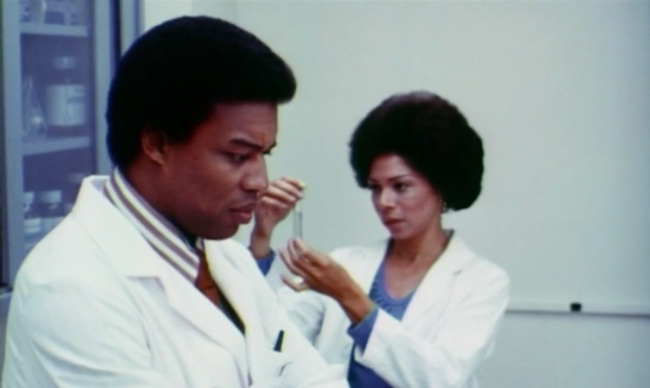
I like exploitation films, I don't make any apologies for it. I don't think exploitation is in itself a dirty word though I think there can be good reasons and bad reasons to exploit something. I don't consider depictions of sexuality solely for the purpose of arousing an audience to be inherently a negative form of exploitation. But I think there's more going on in the film's first scene of explicit nudity, when Pride examines a patient named Linda (Marie O'Henry) who happens to be a prostitute.

She accurately lays out a lot of Pride's psychological profile for us, pegging him as a black man who wants to be a white man, pointing out his white coat and saying she bets he even drives a white car. Later we see he does indeed, a very expensive looking white vintage car, in fact. If this isn't a clear enough symbol, he uses it later to murder a black pimp.
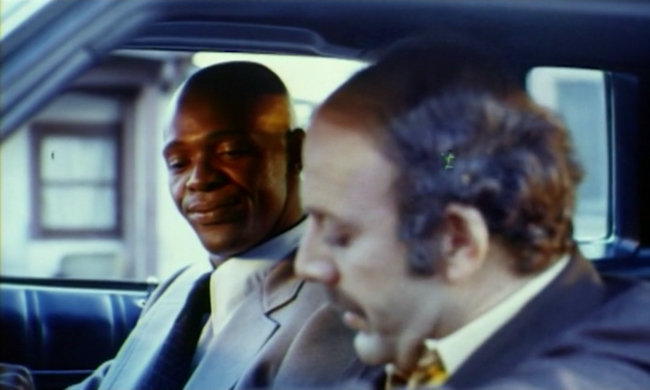
This film's the product of a black director, William Crain, and a white screenwriter, Lawrence Woolner, whose working relationship is perhaps reflected in the two cops investigating the murders, Jackson (Ji-Tu Cumbuka) and O'Connor (Milt Kogan). Their working relationship of mutual respect seems to represent a post-Heat of the Night ideal. In contrast to films like Sweet Sweetback's Baadasssss Song, the antagonistic relationship between the city cops and the black community isn't much portrayed. Along with Dr. Worth, the cops in this world seem to be there to provide the contrast to Pride's presumption. To be a doctor or a cop does not mean one must become a monster. But Pride has grown up with the idea that he must in some way become white to become successful, that white people are monsters, and therefore he must be a monster.

Released only a month before Martin Scorsese's Taxi Driver, Dr. Black, Mr. Hyde similarly features an indictment of the arrogance of a vigilante murdering pimps and trying to save prostitutes from themselves. In that first scene with Linda, a not terribly subtle but certainly effective shot has him behind her as she bends over so he can give her a shot. This turns out to be foreshadowing for just how much his expressions of concern and respect for her are merely tools he uses in the hope of using her for his pleasure. Like Dr. Cordelier in Renoir's version, he seeks to achieve sexual pleasure without being seen as someone who would have sex with a woman he deems an inappropriate partner. Like Midge with Scottie in Vertigo, he seeks to assert a position of dominance by describing himself in a more parental role--twice he describes himself as fatherly to Linda however much she makes it clear that's not the kind of relationship she wants with him. And if he really knew himself, it's not the kind of relationship he wants with her.

His Hyde becomes a sort of albino with really effective, creepy makeup work by none other than Stan Winston. He's not trying to create a potion that separates good and evil in a person but a cure for cirrhosis of the liver, something that works as a nice metaphor for presumptions about alcoholism in poor communities--it's another way Pride is trying to save the poor from their own moral failings. The monster he becomes is neither black or white but something that perhaps could only be borne from the long, ugly conception of race in the U.S.
Twitter Sonnet #1103
Enormous round the bones a suit approached.
Beneath a mop the soap repaired the dry.
Allotted time was taken by the coach.
Continued claims ingest the number pie.
About the mint the spinach dipped a ways.
Italian thoughts arise beyond the food.
Containers keep the pasta nights and days.
Beneath the pointed clouds collects a mood.
Without a hat the dancing time arrived.
Condensing soup the pocket fixed a meal.
Besmirching pines the sap was right contrived.
Between the green and blue was something teal.
Evaporation fills a blank ravine.
Before there's luck a dozen counts convene.