Showing posts with label david lean. Show all posts

Tuesday, September 14, 2021

The Boot Business is Personal

1954's Hobson's Choice plays like an allegory of battling economic ideologies that goes well off the rails to make sense as such. The story is of a Falstaffian patriarch played by Charles Laughton who reigns over a bootshop peopled by his three daughters and two meek bootmakers who toil in the basement. He plans to marry off two of his daughters but finds the business sense of his eldest too useful to lose. He's therefore scandalised when she decides to marry one of those meek, but extraordinarily skilled, bootmakers in this very funny David Lean comedy.

Brenda De Banzie plays that daughter, Maggie, whom Laughton's Hobson delights in calling "past the marrying age". He's set up as such a ridiculous tyrant, spending most of his time sleeping or at the pub, that his troubles in the film are all the funnier because he can't see how richly he deserves them.

The bootmaker is played by John Mills as a thoroughly ignorant peon, toiling under the floorboards without a thought of bettering himself until Maggie decides to marry him as an apparently entirely business arrangement. She knows how skilled he is and how she can use him to make a new happy household. She does call it love.

The movie is consistently funny and sweet as the machinations of Hobson's daughters and his own intemperance force him to make further and further concessions. His alcoholism gives him some added trouble in a couple hilarious and fascinating scenes where he starts hallucinating.

I particularly liked this giant rat, tiny squeaks from which we hear before we can see the creature.

Hobson's Choice is available on The Criterion Channel.

Sunday, June 20, 2021

The Critical Ghost

Raising the dead can be a bit of a bother, yet there are points both for and against such a project, some of which are elucidated in 1945's Blithe Spirit. Directed by David Lean from a play by Noel Coward, a snooty upperclass couple find themselves inconvenienced when a seance summons the spirit of the husband's dead first wife and the spirit decides to take up permanent residence. It's a very funny film and actually quite eerie in moments thanks to some darkly shaded Technicolor and a committed performance from Margaret Rutherford as the medium.

We meet Charles (Rex Harrison) and Ruth (Constance Cummings) engaging in gentle, sophisticated banter about his first wife, Elvira, as they dress for a dinner party.

CHARLES: I remember her physical attractiveness, which was tremendous, and her spiritual integrity, which was nil.

RUTH: Was she more physically attractive than I am?

CHARLES: That's a very tiresome question, Darling, and fully deserves a wrong answer.

RUTH: You really are very sweet.

CHARLES: Thank you.

RUTH: And a little naive, too.

CHARLES: Why?

RUTH: Because you imagine that I mind about Elvira being more physically attractive than I am.

Perhaps Ruth really can take the high road about Elvira's beauty when the woman is dead and gone but it becomes a decidedly more sensitive subject when Charles is constantly conversing with the invisible woman returned to the land of the living. For some reason, only Charles can see Elvira (Kay Hammond).

I love how she's introduced, first as a voice only Charles can hear and then a heavy wind causes the curtains to billow out and from between them she glides into the room in a diaphanous evening gown.

She's a bit green, too, from makeup and lighting. She proceeds to smugly chide Charles on various matters from the gardening to the decorating, both unmitigated disasters, as far as she's concerned, and Ruth is at fault. It takes a floating vase to prove to Ruth that Elvira isn't a product of Charles' drunkenness but after this Ruth very soon seeks out Madam Arcati, played by Margaret Rutherford, for assistance in sending Elvira back from whence she came.

Rutherford is so good in this, so full of eccentric enthusiasm, coming off as someone who's spent far too much time alone studying an esoteric subject. Among other things, it brings a fascinating sense of credibility to what she's doing and supports some curious opening title cards:

When we are young
We read and believe
The most Fantastic Things

They seem more appropriate for a Jean Cocteau film than this concoction of dry, high brow lunacy. Somehow these two contradictory elements, the fantastic and the ironic, play off each other pretty well in this movie.

Blithe Spirit is available on The Criterion Channel.

Twitter Sonnet #1454

Remembered steps were blue and envy green.
Above the floor assistants pin the chart.
Entire forests laze in Sally's bean.
The slackest tree could win a soil heart.
The moving camp required boats and rafts.
Gorillas slept in placid groves and rooms.
The flimsy limbs dissolved for shoddy grafts.
Above the din a somber tuba looms.
The global glob was something full and blank.
Elusive stats report the glad annoyed.
To float the data minds profoundly sank.
We fly abreast of clear and foggy void.
The end was never clear in runny print.
The air itself repulsed the kindly meant.

Thursday, July 11, 2019

Arsenic on Her Hands

In 1857 Glasgow, a man was murdered by arsenic which led to the sensationalised trial of Madeleine Smith, his lover. Her trial concluded with the uniquely Scottish verdict "not proven", a conclusion the viewer may also reach from 1950's Madeleine, an adaptation of the story by director David Lean. Drenched in black shadows and shining surfaces, this fascinating film is more interested in the psychology of its central character than on whether or not she committed the crime.

Lean's wife at the time, Ann Todd, plays Madeleine, a young, unmarried woman of a wealthy, prestigious family. The film begins with her, her sisters, and her parents moving into an expensive terraced house in Glasgow and Madeleine claims a bedroom for herself and her youngest sister below street level. We soon see why as this enables her to make easy, clandestine meetings with her lover, a Frenchman named Emile L'Angelier (Ivan Desny).

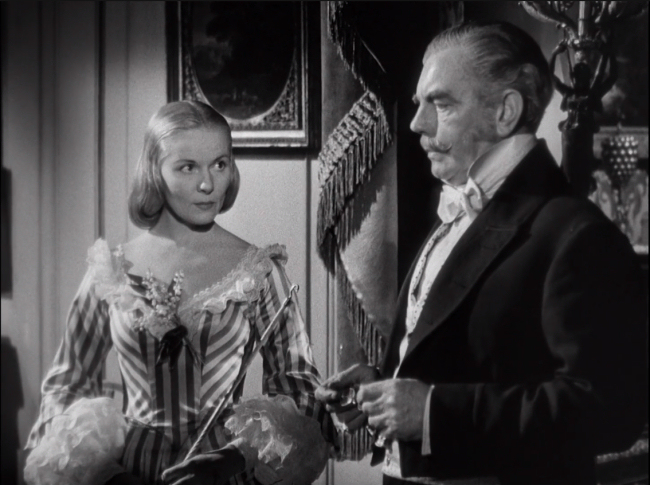
She carries on with this affair even as her strict, class conscious father (Leslie Banks) arranges a suitable match for her with a kind gentleman named William (Norman Wooland). Madeleine promises Emile she will tell her father about him and marry him but for now she stalls, asking the amiable William not to tell her father that he had proposed marriage to her so that she wouldn't have to report that she'd turned the offer down.

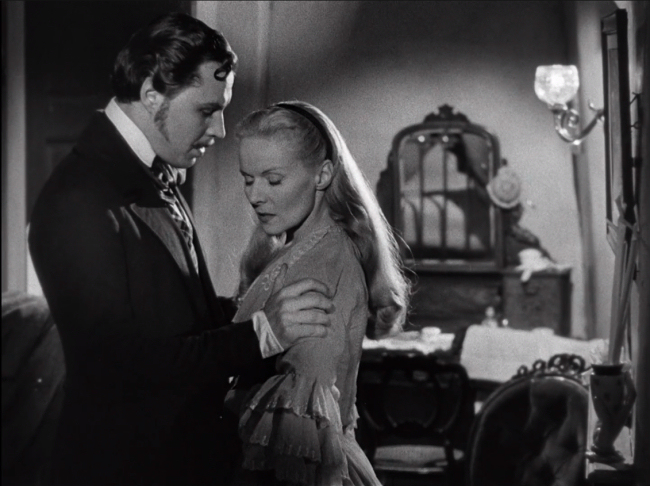
Finally, at one late night meeting, Emile decides to force the issue and demands that Madeleine tell her father about him. This becomes the best scene in the film as Madeleine agrees and then Todd brings a series of changing expressions to her face that clearly show just how hard consciousness of what that means hits her for the first time. We see in her startled, and startling, reaction just how impossible it seems to her that the world where her father exists could ever connect with the one where Emile exists.

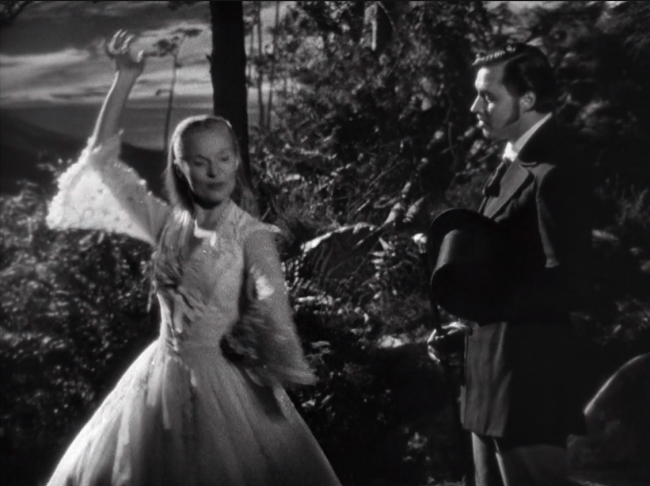
Lean had made it clear that Emile and Madeleine had a physical relationship. Earlier, alone on a hillside, the two overhear a country dance. Madeleine impulsively starts to dance and urges Emile to join her but he only stiffly participates, not knowing how to dance to the bagpipes. But she lies down anyway and waits for him--a cut to the lusty dancers indoors followed by a shot of Emile retrieving her forgotten shawl clearly enough communicates what had occurred in the interval. But it also shows that Madeleine's physical attraction to Emile is given priority over the lack of cultural and temperamental familiarity. It's sex she wants from him.

It's a relationship she'd entered instinctively when the opportunity arose and only too late does she consciously process the ramifications. And of course it turns out Emile won't accept elopement. He may really have affection for Madeleine but his own top priority is and always was her father's money and he's willing to use her letters as blackmail to get his way.

Lean cleverly avoids making it clear whether Madeleine deliberately poisons him or if some manner of accident occurs with arsenic in the kitchen. He does this without ever stepping away from her point of view so it's possible for the viewer to watch the film with either interpretation. Andre Morell appears as her defence council and makes plenty of very stirring and reasonable arguments as to why it couldn't be her. If she didn't want the letters found, surely she wouldn't have killed him without retrieving them--the timeline of her purchase of arsenic and his poisoning don't match up--the autopsy revealed the arsenic wasn't of the particular kind Madeleine was on record as purchasing for, she says, cosmetic use, believing arsenic to be good for her skin. But on the other hand, if she didn't kill him, who did?

But the film appropriately fixates more on the relationships that put Madeleine in this position. Murder obviously wasn't a useful solution but she was clearly in a bad, unfair situation. One might ask if the solution would be for a society to be more open about casual sex or if it would be healthier for people to be allowed to carry on private dalliances without fearing risk of exposure. Madeleine is available on The Criterion Channel.

Wednesday, May 29, 2019

Some Cities Swallow Stories Whole

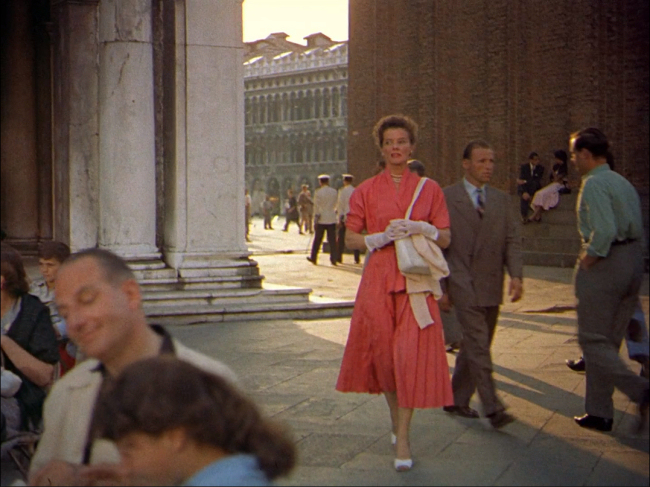
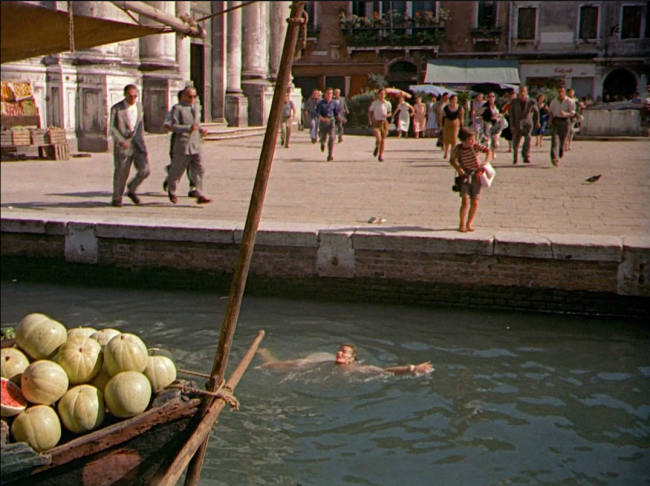
Venice sure is beautiful. And that's primarily what makes 1955's Summertime such a joy to watch. You couldn't ask for a better star than Katharine Hepburn and the concept of an older woman falling in love for the first time is certainly an extraordinary premise for the '50s but it's saddled with too much softball comedy business to be really great. Still, its Technicolor photography and director David Lean's persistent use of real locations make it a beautiful document of the famous city from over sixty years ago.

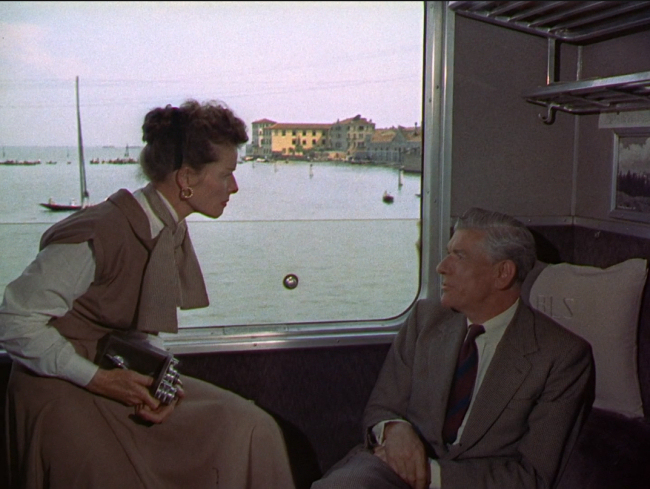
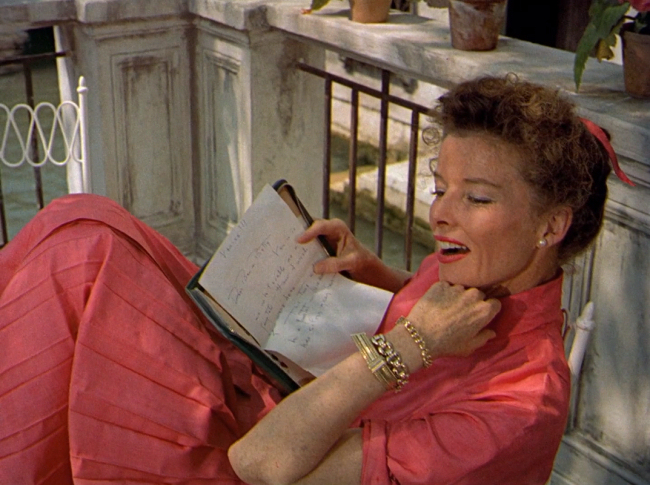
Even many scenes that would've been shot in studio as a matter of course, like dialogue scenes on a ferry or a balcony, are location shots. The depth of detail on Hepburn's hotel patio is breathtaking, and it's just a tame dialogue scene about being tourists.

Even interiors are often location shots, like this second encounter Hepburn has with her love interest played by Rossano Brazzi.

This shot is brilliantly lit. Technicolor cameras weren't very sensitive to light which made for notoriously hot sets as a result of the piles of extra sources of illumination required. This shot has low enough exposure you can still see details in the bright sunny day outside but you can also see both actors' faces inside the shop. And looks perfectly natural.

Hepburn is great, of course, as Jane Hudson, with her inimitable combination of vulnerability and strength she's absolutely perfect for this role. Brazzi's character, unfortunately, lacks any kind of depth and his performance is intensely bland. At the beginning of the film, Hepburn has a meet-cute on the train into Venice with an uncredited Andre Morell, my favourite Quatermass. How much better the film would've been had her romance been with him instead.

There are some lame, Hollywood-ish contrivances, like when Hepburn accidentally falls into a canal while trying to take a picture, a pointless piece of slapstick that apparently made the actress seriously ill. Those seeking a more thoughtful rumination on relationships shot on location in a beautiful Italian city would be better off with Journey to Italy from the previous year--or any number of Italian Neorealist and New Wave films, really. But Summertime has the distinction of being in beautiful colour. It's great to watch in HD and it's available in HD on The Criterion Channel.

Twitter Sonnet #1240

Repeated codes enliven phones for weeks.
Strategic flowers boost the grace of spring.
The winding cloth reveals but healthy peaks.
Each night reminds nocturnal birds to sing.
Continued texts delay the moon and bed.
A picture placed between the eyes still knows.
The printed word was coloured close to red.
But healthy spines were laced with silken bows.
A steady tree preserved the quiet pool.
In ev'ry second, ripples beat the bank.
The hours bring a day that's dark and cool.
To weekly rest the chains in sequence sank.
A mind reports the cake was frosted last.
But tongues report the cup is not surpassed.