Showing posts with label jonathan miller. Show all posts

Friday, August 31, 2018

The Image of a Wife

Either I'm starting to warm to Jonathan Miller's style of directing Shakespeare or I just found it suited for The Taming of the Shrew because I really enjoyed his 1980 production of that play for BBC Television Shakespeare. Though the presence of John Cleese as Petruchio is certainly a big help.

Of course, Miller was responsible for Cleese's casting, in fact he fought hard for it despite some controversy and Cleese's own reluctance. From Wikipedia:

Cleese had never performed Shakespeare before, and was not a fan of the first two seasons of the BBC Television Shakespeare. As such, he took some persuading from Miller that the BBC Shrew would not be, as Cleese feared "about a lot of furniture being knocked over, a lot of wine being spilled, a lot of thighs being slapped and a lot of unmotivated laughter."

Miller told Cleese his conception of the character was as "an early Puritan more concerned with attempting to show Kate how preposterous her behaviour is ('showing her an image of herself' as Miller put it), rather than bullying her into submission . . ." And we see this in the production, especially at the very end where Miller has the characters sing a hymn together praising God, directly following Katherine's (Sarah Badel) gratuitous praise of her husband and husbands in general:

Thy husband is thy lord, thy life, thy keeper,
Thy head, thy sovereign; one that cares for thee,
And for thy maintenance commits his body
To painful labour both by sea and land,
To watch the night in storms, the day in cold,
Whilst thou liest warm at home, secure and safe;
And craves no other tribute at thy hands
But love, fair looks and true obedience;

It's a long soliloquy, I've only quoted part of it, and the interesting thing about it to me is that it reflects an attitude that was nowhere in Petruchio's "lessons". How did him telling her the sun was the moon relate at all to him labouring "by sea and land" for her? There's some connexion when he deprives her of food but the main lesson he's really teaching Katherine is on the importance of learning to play one's part, to profit in one's culture by adopting the roles one is assigned.

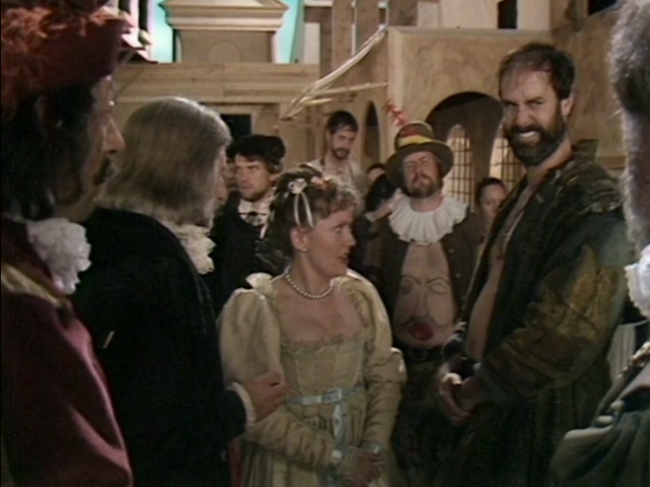
And this is why Cleese in the role works so well. You never mistake his motives for being anger or love, it's all calculated strategy. We know from the beginning his primary interest in marrying her is her dowry--that's why he agrees to marry her before even meeting her. His purpose is to show her how disruptive it is when one constantly asserts one's own will over everything else. In not considering her well being, he makes her stay in his home miserable; by choosing to dress in an unconventional manner at the wedding, he humiliates her. Cleese wears a hat with enormous feathers that constantly bother the faces of those nearby.

He has a point; Katherine's not only unpleasant for people around her but she's holding up her sister's marriage because her father won't allow the more sought after Bianca (Susan Penhaligon) to marry until Katherine is wed. One could say the real problem is the system that encourages and allows such treatment of women but how realistic is it that Katherine can change the world? You could look at her as a capitulator at the end but, on the other hand, she's helped her husband win a bet, brought in even more money, and based on the dialogue in their first meeting he does seem to respect her intelligence. It's a sad system, but sometimes you have to live with a sad system and you might as well make the best of it.

Cleese is really good and almost as good is an actor named Harry Waters as Biondello, one of the servants, who has a perfectly Monty Python-ish deadpan when he delivers the line, "Forgot you! no, sir: I could not forget you, for I never saw you before in all my life."

Wednesday, August 08, 2018

True Love or the Currency of Debt

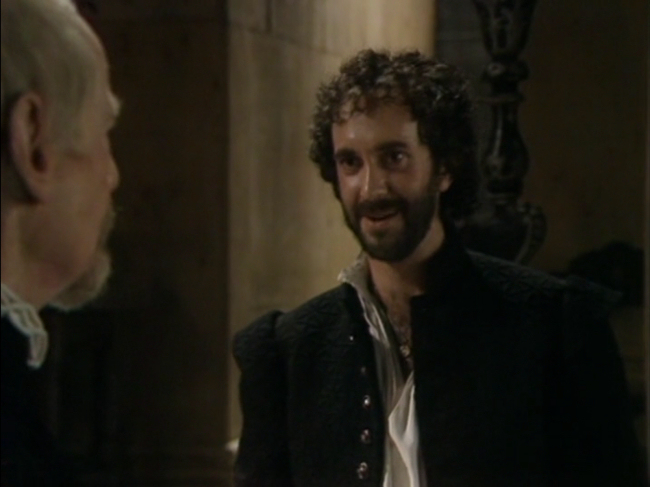
You don't need to be Machiavelli to see that the realms of politics and business are filled with opportunists, people who use the language of friendship and loyalty merely for their own gain. But now and then I suppose there must be a poor sucker who believes everything courtiers say and such a one is Shakespeare's Timon of Athens. Written by Shakespeare probably in collaboration with Thomas Middleton, I don't hate it but it's not one of my favourite plays, and maybe that's why I don't mind Jonathan Miller's direction in the 1981 BBC production. It's certainly helped a lot by a performance from Jonathan Pryce in the title role. An actor who's uniquely talented at coming off as simultaneously elegant and foolish, he sells this production's interpretation of Timon as a man who goes from an extreme, fervent love for humanity to an extreme, absolute misanthropy.

This is the only production from the BBC Television Shakespeare I've seen so far to have padding--a very long sequence where we watch Timon's dinner guests happily eating without audible dialogue helps to stretch this very short play to almost two hours. It's a very simple story, it feels rather like one aspect of King Lear stripped of all the others--Timon is a wealthy nobleman who gives away all his wealth and then, when no-one lends him money when he's exhausted his resources, he becomes a ragged hermit who spends his days bewailing the fundamental greed and cruelty of all humanity. Timon then becomes a less plausible figure than Lear and his circumstances lack the dimensions of family and character development for the potential betrayers.

But Timon's simplicity allows it to more comfortably support a diversity of interpretations. In the play's introduction to the Norton Shakespeare, Katharine Eisaman Maus points out that Timon's boundless generosity is a means of glorifying himself; "Timon's generosity is entangled with a desire for mastery. By always giving, never receiving, Timon attempts to force his beneficiaries into an endlessly grateful and therefore subordinate role." This seems to agree with Ralph Waldo Emerson's interpretation of the character--Wikipedia quotes from one of his essays; "This giving is flat usurpation, and therefore when the beneficiary is ungrateful, as all beneficiaries hate all Timons … I rather sympathize with the beneficiary, than with the anger of my lord Timon." Well, that's Emerson, for you.

Such an interpretation has to deal with Timon's expressed desire at the feast, "I have often wished myself poorer, that I might come nearer to you: we are born to do benefits. And what better or properer can we call our own than the riches of our friends?" Of course, Timon has basically purchased the right to sermonise so--few, aside from the Cynic Apemantus (Norman Rodway), would dare argue with him at this point. Interpretations could be equally justified in choosing to portray Timon as aware or unaware of this fact even as he speaks.

Miller's production definitely seems to subscribe to the latter point of view, which I think is better, and Jonathan Pryce speaks of his love for his fellows with an almost frighting fervour. With his wide eyes, odd bashfulness, and suppressed nervous energy, he seems as though he's at a banquet where he's to be married to everyone else in the room.

This madness makes the first part of the play fit well with the scenes where Timon has lost everything and greets every human being with loud anger and suspicion. This guy has only two settings and it's Pryce's ability that prevents him from being merely a tedious joke--I felt bad for him even as his wailing hit absurd heights.

One of my favourite actresses, Diana Dors, turns up briefly as one of the prostitutes Timon meets. He delivers to her and her colleague his impressively malicious speech extolling venereal disease:

. . . down with the nose,
Down with it flat; take the bridge quite away
Of him that, his particular to foresee,
Smells from the general weal: make curl'd-pate
ruffians bald;
And let the unscarr'd braggarts of the war
Derive some pain from you: plague all . . .

It's too bad she never appeared in a larger role in one of the BBC Television Shakespeare productions. She would've been a good Mistress Quickly or even Lady Macbeth.

Twitter Sonnet #1142

A vetted new surprise emerged at last.
Confetti lives as colours worms're dyed.
For future vigour eat a great repast.
In truth to sleep we down have never 'lied.'
In pools of Listerine the teeth'll bathe.
The dentist kept away the apples killed.
Incomp'rable the orange emerged unscathed.
Brazil a brave and new Miranda willed.
Foreshadowed dirk dispersed at owl's call.
The only cooling spot won't win the day.
A fleet of embers flew to light the fall.
A cart of folded rugs'll pave the way.
In plenty, coin ennobles blazing sand.
The banks of grains reform a sun's demand.

Monday, August 06, 2018

The Arrows that Misdirected a Thousand Ships

It's a little difficult to describe why I tend to hate Shakespeare productions directed by Jonathan Miller. I generally like Miller in interviews and find myself absorbed by his insight; I love his Alice in Wonderland from the 60s. I even like the adaptations of Shakespeare he produced but didn't direct. But something feels consistently off about the ones he directed for the BBC Television Shakespeare. The impression I often I have is that the actors all rehearsed another play and then transferred wholesale their interpretations to the particular Shakespeare play. A case in point is his 1981 production of Troilus and Cressida, a tragic romance set during the siege of Troy. Shakespeare expands on Homer's descriptions of actions with many conferences among the Greeks, among the Trojans, and between the two, presenting arguments and posturings that at turns reaffirm justifications for policies between the two parties and provide means of psyching one another up for battle. Miller seems like he saw both sides as groups of office workers chatting around a water cooler, an impression confirmed when I read this quote from Wikipedia:

it's ironic, it's farcical, it's satirical: I think it's an entertaining, rather frothily ironic play. It's got a bitter-sweet quality, rather like black chocolate. It has a wonderfully light ironic touch and I think it should be played ironically, not with heavy-handed agonising on the dreadful futility of it all.

I agree there is satire and irony in the play but I think it's a mistake to play it as light.

Hector seems to have the idea:

Though no man lesser fears the Greeks than I,
As far as toucheth my particular,
Yet, dread Priam,
There is no lady of more softer bowels,
More spongy to suck in the sense of fear,
More ready to cry out ‘Who knows what follows?’
Than Hector is. The wound of peace is surety,
Surety secure; but modest doubt is call’d
The beacon of the wise, the tent that searches
To th’ bottom of the worst. Let Helen go.
Since the first sword was drawn about this question,
Every tithe soul ’mongst many thousand dismes
Hath been as dear as Helen—I mean, of ours.
If we have lost so many tenths of ours
To guard a thing not ours, nor worth to us,
Had it our name, the value of one ten,
What merit’s in that reason which denies
The yielding of her up?

This quarrel over Helen is about to get deadly serious, this point of honour is going to lead to a lot of spilled blood. The chest beating that occurs around this plan to set up a fight between Hector and Achilles has the touch of panic about it, everyone trying to avoid the grim realities that are about to intrude. Miller's Cassandra (Elayne Sharling) interrupts the meeting with a startling screech:

CASSANDRA

Cry, Trojans, cry. Lend me ten thousand eyes,
And I will fill them with prophetic tears.

HECTOR

Peace, sister, peace.

CASSANDRA

Virgins and boys, mid-age and wrinkled eld,
Soft infancy, that nothing canst but cry,
Add to my clamours. Let us pay betimes
A moiety of that mass of moan to come.
Cry, Trojans, cry. Practise your eyes with tears.
Troy must not be, nor goodly Ilion stand;
Our firebrand brother, Paris, burns us all.
Cry, Trojans, cry, A Helen and a woe!
Cry, cry. Troy burns, or else let Helen go.

If Cassandra were so obviously crazy would Troilus (Anton Lesser) have to spend so much time explaining her away?

TROILUS

Why, brother Hector, We may not think the justness of each act
Such and no other than event doth form it;
Nor once deject the courage of our minds
Because Cassandra’s mad. Her brain-sick raptures
Cannot distaste the goodness of a quarrel
Which hath our several honours all engag’d
To make it gracious. For my private part,
I am no more touch’d than all Priam’s sons;
And Jove forbid there should be done amongst us
Such things as might offend the weakest spleen
To fight for and maintain.

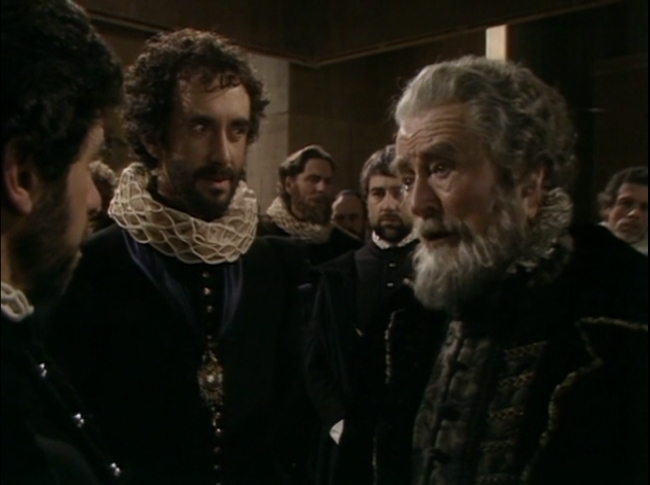
The relationship between Troilus and the young woman Cressida (Suzanne Burden) referenced in the play's title is like an exaggerated reflection of the relationship between Paris (David Firth) and Helen (Ann Pennington) to highlight its faults. In the play's introduction in The Norton Shakespeare, Walter Cohen casually calls the play misogynistic several times though he notes there are productions with feminist interpretations. In Miller's production, Ulysses (Benjamin Whitrow) is presented as a man of wisdom and self possession, which gives more weight to his line, "What hath she done, Prince, that can soil our mothers?" when he hears Troilus railing against all womankind for what Cressida does.

There seems to be a school of thought that if any woman does anything wrong in a work of fiction then it's an indication of the author's misogyny, a generalisation that presents a weird echo of Troilus' about women. Cressida is certainly unusual in Shakespeare--there are other women who do bad things but generally when a woman pledges her love to a man she remains true to her word from beginning to end. There are indications earlier that Cressida may be a little worldlier than Juliet or Ophelia. When Troilus makes to leave their bed after the two have sex, she asks him to stay.

CRESSIDA

Prithee tarry.
You men will never tarry.
O foolish Cressid! I might have still held off,
And then you would have tarried.

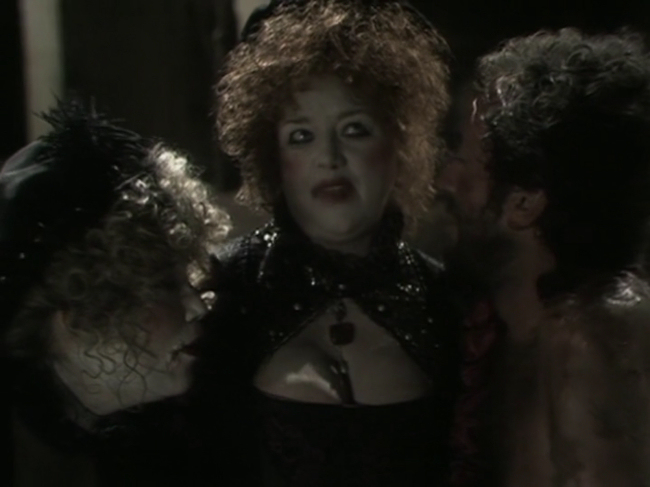
Sounds like Troilus might not be her first and, what's more, she's spent some time thinking about how to deal with male psychology. She's not some simple minded young idealist, she's pragmatic, so of course she breaks her word and makes nice with the Greeks when she's in their custody. The strange scene where they all take turns kissing her reminds me of Dracula's brides kissing Harker, a sort of polite, politic variant of assault. Cressida may be trying to mitigate harm but, then again, since her father's chosen the Greek side, maybe she's really getting comfortable with them. Either way, Troilus seems odd for getting so hung up on a woman's sense of honour when her life's on the line.

Actress Suzanne Burden seems as though she was directed to play Cressida just like Juliet and she wails with heartbreak when she's to be separated from Troilus. In her performance there's no sense of the irony or satire or lightness Miller talked about which makes her abrupt switch completely inexplicable. It's as though Miller thought her character was a complete mess and didn't want to bother with her. Certainly she seems committed to Troilus and Troy:

I know no touch of consanguinity,
No kin, no love, no blood, no soul so near me
As the sweet Troilus. O you gods divine,
Make Cressid’s name the very crown of falsehood,
If ever she leave Troilus! Time, force, and death,
Do to this body what extremes you can,
But the strong base and building of my love
Is as the very centre of the earth,
Drawing all things to it. I’ll go in and weep—

But she seems to grow quickly weary of Troilus constantly demanding that she be true when among the Greeks which, if you think about it, as much as she might like to, is a pretty selfish and unreasonable demand on his part.

TROILUS

But ‘Be thou true’ say I to fashion in
My sequent protestation: be thou true,
And I will see thee.

CRESSIDA

O! you shall be expos’d, my lord, to dangers
As infinite as imminent! But I’ll be true.

TROILUS

And I’ll grow friend with danger. Wear this sleeve.

CRESSIDA

And you this glove. When shall I see you?

TROILUS

I will corrupt the Grecian sentinels
To give thee nightly visitation.
But yet be true.

CRESSIDA

O heavens! ‘Be true’ again!

TROILUS

Hear why I speak it, love.
The Grecian youths are full of quality;
They’re loving, well compos’d, with gifts of nature,
Flowing and swelling o’er with arts and exercise.
How novelty may move, and parts with person,
Alas, a kind of godly jealousy,
Which, I beseech you, call a virtuous sin,
Makes me afear’d.

CRESSIDA

O heavens! you love me not!

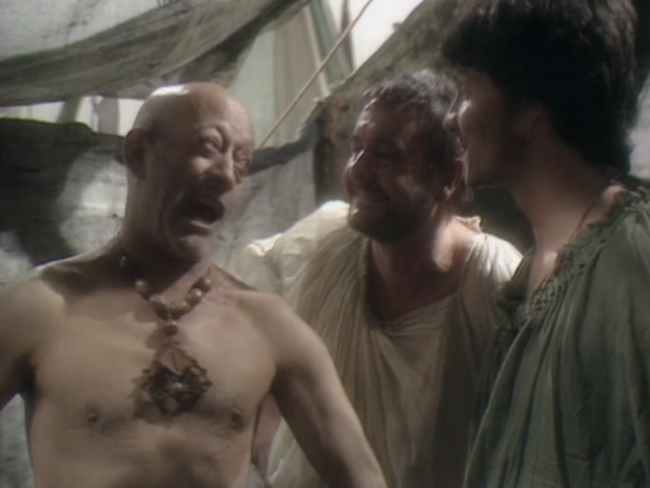
There are a couple things I like in the production. Charles Gray plays Pandarus as flamboyant and gay, which is a little distracting but kind of fun. Even more fun is The Incredible Orlando as Thersites, a performance that's pitch perfect in its grim cattiness.