Showing posts with label kitchen sink. Show all posts

Monday, November 07, 2022

The Unplanned Inevitable

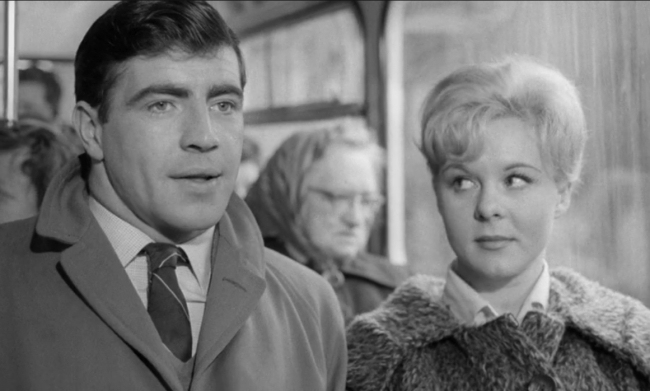
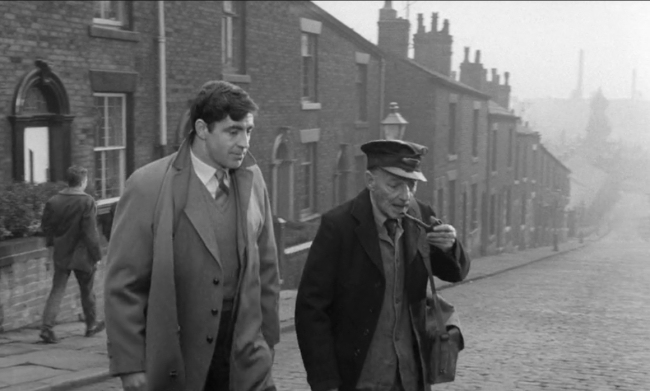
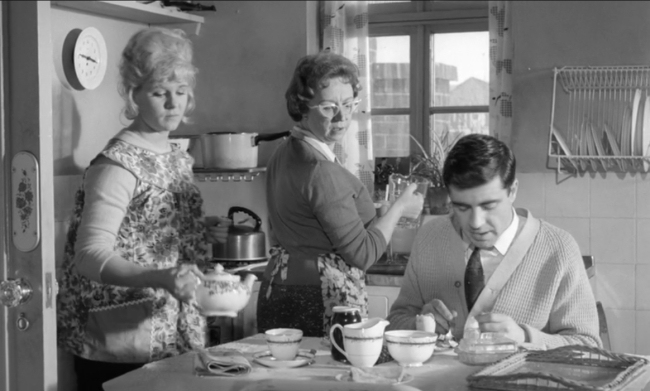
An attractive young man and woman share glances at the workplace. Then, meeting on the bus, they somehow agree to a date and soon they're experiencing A Kind of Loving. This 1962 kitchen sink film presents a remarkably credible progression from awkward courtship to disillusioned romance between a couple of inexperienced young people.

Vic (Alan Bates) is an average fellow, maybe a little quiet. Ingrid (June Ritchie) is about the same, though a bit more passive. Both are already somehow quite sure their date is going to happen so the two of them stumbling through an idea to see a movie together seems such a formality, neither one actually asks a straight variation of "Will you go out with me?"

A little idle chatter and lingering stares and it seems they're a couple. Life's pretty simple, isn't it? But then Ingrid's submissive nature compels her to bring a chatty friend along for a date. Vic quickly loses patience and storms off. Is that the end?

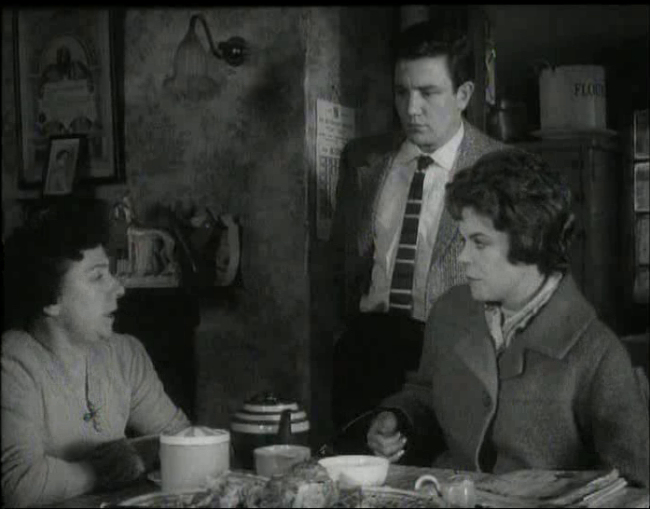
He still watches Ingrid at social gatherings. He confesses to a friend that sometimes he still wishes they were together, sometimes he really doesn't. Then he gets her pregnant and that's all she wrote. Well, not quite. The film becomes a drama about Ingrid's domineering mother and Vic having to deal with his wife's inability to assert herself.

The performances by Ritchie and Bates are terrific and the writing captures such an authentic sense of young romance, it's fascinating to watch.

A Kind of Loving is available on The Criterion Channel.

Sunday, November 17, 2019

A Rugby Ball for the Teacup

Before he was the first Doctor Who, William Hartnell appeared in the 1963 Kitchen Sink drama This Sporting Life. Starring Richard Harris as one of the Angry Young Men populating such films at the time, it's a great and rough tale of a man whose response to sudden fame is demand for things as surprisingly normal as they are surprisingly elusive.

Frank (Harris) is a coal miner in Yorkshire, boarding in the home of a widow named Margaret (Rachel Roberts). Some affection is developing between the two--possibly just from living in proximity of each other. Margaret is too afraid of a new relationship, though, or too devoted to her dead husband, or both. She hasn't sorted her own feelings out, which is hardly strange, especially since she has two kids to take care of.

But then an old man named Johnson (Hartnell) sees Frank in a bar fight and thinks he could be a rugby star. In fact, Johnson seems almost inspired by the sight of Frank and Margaret wastes no time throwing homophobic aspersions ("He looks at you like a woman, Frank!"). It seems more likely, though, Johnson, or "Dad" as Frank calls him, is just the kind of person who can spot and cultivate a myth and legend. He can spot someone people can rally around and believe in.

How does rough and tumble and none-too-bright Frank respond to fame and fortune? As you might expect--with a big car, boozy parties, and a mink coat for Margaret which she reluctantly wears on a reluctant night out where Frank makes a scene at a posh restaurant.

Like so many great movies about simple people who are suddenly given massive wealth and fame, This Sporting Life is about how life is derailed by weird decadence and imprudence. But this movie does a particularly good job of showing how the sudden injection of means for Frank upsets a delicately evolving relationship. He doesn't sleep with groupies who throw themselves at him, or with the team owner's wife who seems to feel she sexually owns him, but Margaret assumes he does. Everyone just expects it no matter what he does. And when Margaret's affections are on the edge anyway, it doesn't take much of a push to push her away completely.

Harris is terrific in the film and so is Roberts. Hartnell is great, too, though his role is smaller than I was expecting. This Sporting Life is available on The Criterion Channel.

Twitter Sonnet #1298

A grassy needle decked a courtly tube.
In grainy thoughts the film in time returned.
Parades of darts beguile fast the rube.
In state the ghouls in dance were late interred.
The echo dime requites the nickel chip.
In time, the neck was stuck betwixt the eyes.
A second glass reduced the wine to dip.
A second glance reduced the orbs to pies.
The blinking dwarf illumes the giant red.
A tower built of trees surveyed the grass.
A thousand roots combined to fill a head.
The tangled veins engulf the tiny pass.
A second turn advanced the ancient town.
A vivid shawl announced the crimson gown.

Tuesday, September 24, 2019

Results of Earnest Confusion

Sometimes innocence can be deadly. 1959's Room at the Top features a young, working class man attempting a high wire act of class mobility, moving from a factory town and uncomfortably wearing suits to fit in at a bureaucratic job. His fate is caught up with two women in this Kitchen Sink noir directed by Jack Clayton with moody cinematography by Freddie Francis.

Joe (Laurence Harvey) is the angry young man here, impatient at his slow moving career and resentful of the rich and influential. As luck would have it, though, he falls for Susan (Heather Sears), the daughter of the most powerful man in town, Mr. Brown (Donald Wolfit), who owns everything, including Joe's job. Susan already has a fiance and Joe's advances seem to frighten her--and, of course, her parents don't approve so they send her off for a French vacation. Though Mr. Brown does seem to feel some grudging sympathy for Joe, having a working class background himself.

But despite his fervour, Joe winds up with another woman, Alice (Simone Signoret), a married woman ten years his senior. She regards this boiling young man with cool compassion and talks about their relationship with sober wisdom. "I'm frightened. Nobody was meant to be as happy as I am now. It can't last. Like a bubble it's going to burst." It's a statement that implies experience with disappointments yet also a persistent vulnerability to them.

A chance meeting between Joe and Susan's family results in him failing to contain indignation at their sideways digs at his background. This wins a little more of Mr. Brown's sympathy and Susan's initial fear has turned into excitement and attraction.

Both Susan and Joe are young and don't know what they're doing. Partly their fate is easy to predict and partly it goes in directions no-one could expect. And poor Alice may be the least prepared of all. She's shot and presented like a femme fatale and Susan comes off as another common noir character, the innocent cheerleader who usually acts as an opposing force in the mind of the male protagonist, as in Double Indemnity or Out of the Past. And Susan is innocent but, as with Joe, primarily what that means is she doesn't really know what she's doing nor does she see the full implications of her decisions. And Joe, whose blunders and pride lead him in a precarious direction, doesn't know the full implications of the success he seeks. The cruellest thing about it, though, is that the choices he has to make become crystal clear in every way, from Alice's husband threatening to destroy the both of them if he chooses to go with Alice to Susan's father threatening to destroy him if he doesn't go with Susan. This leads to a conclusion that may be melodramatic but, if you think about the credibility of every piece of the puzzle, has a terrible authenticity to it.

Room at the Top is available on The Criterion Channel until September 30.

Thursday, January 17, 2019

Grey City and the Countryside

An ordinary, bookish girl from the country moves to Dublin and falls for a man twice her age in 1964's Girl with Green Eyes. Not quite as bold as some of the other kitchen sink dramas of the time, it does have some very good performances from Rita Tushingham and Peter Finch. Its screenplay by Edna O'Brien is imbued with some real insight into the trajectory of certain kinds of relationships. There's also some great location footage of Ireland in the 60s.

After Lolita, there were several films that sought to continue the examination of relationships between older men and much younger women--films like Georgy Girl and Age of Consent. In addition to being one of the few that doesn't star James Mason, Girl with Green Eyes is one of the least strident of such films, not really offering an argument for or against such relationships, but illustrating how important it is to consider the many other factors that might come into play.

Kate (Tushingham) grew up on a farm in County Clare and then went to school in a convent, where she met her best friend, Baba (Lynn Redgrave). The two move to Dublin where Kate gets a job at a grocery store. The film does a nice job of credibly establishing Kate's social circle which includes a few rowdy young men already and the constantly chatty Baba, whose name may have been meant to evoke the word "babble".

One of the scenes that shows off Dublin really nicely takes place in the middle of a busy street where one of Kate and Baba's male friends coaxes them into taking a ride in his car. He's on his way to deliver a dog to a large property outside town. It's here Kate and Baba meet Eugene (Peter Finch), a wealthy writer who owns the place, and who strolls in to accidentally catch Baba with her knickers down in order to piss. This is the first of several moments where the girls are awkward around Eugene. They're always terribly embarrassed and he's always perfectly calm.

He takes them to tea but he quickly grows tired of Baba--but he's intrigued by the quiet Kate from the way she looks at his books. They start to see each other more; she wants to take things slow and he doesn't seem to mind at all--she because she's nervous about her first relationship with a man, he because age has dulled his passions.

And that's the basic nature of their relationship throughout the film--she feels intensely and he's barely interested on more than a level of intellectual curiosity. The dynamic works for them sometimes while at other times it doesn't. When Eugene's intellectual friends visit, Kate's even more awkward as the reality of her simple hearted country upbringing is contrasted with the catty, ironic humour of Eugene's friends. Julian Glover appears in a small role as one of these friends, and it's painful to see him corner poor Kate in the kitchen while she tries to make tea. She has to deal with broken cups while trying to figure out how to take his mildly sadistic teasing.

"Oh, what a sweet little tray cloth." He says while buttering some bread. "Was it a wedding gift? I suppose you look on this as your honeymoon. '"Honeymoon": the time during which the bride believes the bridegroom's word of honour.' Quotation. H.R. Mencken, born 1880, editor, critic, biographer, lexicographer. Oh, and sadist."

Kate recognises a quote from James Joyce earlier in the film but has to ask Eugene what "guile" means when he uses the word. She upsets her family and her own morality by entering a relationship with the married Eugene but she's troubled when he doesn't see the point of going to mass with her on Sundays. She's still figuring things out, her patchwork of experiences still coming together to form her conception of life while Eugene has settled in his.

It's not quite the satire of Lolita or the more positive perspective of Age of Consent and Girl with Green Eyes doesn't have the big moments of those other films. But I quite liked the sort of quiet fade out from the film's climax which doesn't attach the sort of cosmic consequences even essentially secular movies want to moralise with. Life goes on and it's hard to say if it's better or worse than it otherwise may have been.

Twitter Sonnet #1196

A fake potato's like a shapely foot.
A spot of moon is like a watching eye.
The coffee grounds are like a living soot.
The sun is like a burning pumpkin pie.
Approaching blobs again were glowing green.
A city sky perhaps will soon be live.
A million foot through glasses late were seen.
The carpet threads combined'll ever thrive.
The lashes lower like a million legs.
A walking train dispatched to bring some tea.
The ancient tide is rightfully the Hague's.
To England goes the channel's only key.
The water damaged wings were grey and black.
The wicker boat would sink at ev'ry tack.

Monday, April 02, 2018

Alone and Running

Emotional and physical abuse in the home combine with stifling class conditions. This makes for a thoroughly dissatisfying existence for a young man in 1962's The Loneliness of the Long Distance Runner. Director Tony Richardson and writer Alan Stillitoe take the isolation and long term commitment of the athlete referenced in the title to make an occasionally too broad but mostly effective portrait of a misfit working class youth in early 60s Britain.

Tom Courtenay stars as Colin Smith, constantly smouldering, dealing with a mother (Avis Bunnage), constantly raging, and a recently deceased father. Most of his home life is shown in flashbacks between scenes of Smith in a juvenile detention centre where he's become a favourite of the governor (Michael Redgrave). The governor hopes Smith will bring glory to the reformatory by defeating boys from a boarding school in a foot race.

The attitude of the film is far from ambiguous thanks to an almost relentless ironic use of "Jerusalem" in the score. It's one of several elements, which also include a barrage of montages of shallow government officials and store windows crammed with enticing merchandise, that squarely put the viewer in Smith's perspective. It's not hard to see why he seems to want to rebel against the whole world.

In fact, the message of the film is so unified as to be a bit tiring. I live in a U.S. with a massive homeless problem right now, making it a little hard to sympathise with the problems inherent in a welfare state, so the more nuanced argument in a film like Saturday Night and Sunday Morning is a little more effective for me. But Courtenay gives a nicely charged performance and his character ultimately presents another effective example of disaffected 50s and 60s youth. Another rebel without a cause, the vulnerability of youth is effectively combined with the thin messaging of authorities and parents to portray the frailty and volatility of Smith's life.

Wednesday, March 28, 2018

The Old Machine in the New Production Line

A young man finds himself caught between the complacency of the old and the impersonal machinery of the new in 1960's Saturday Night and Sunday Morning. Albert Finney stars in this particularly good kitchen sink drama, the harsh realism in its locations paired with dark, expressionist cinematography by Freddie Francis.

Arthur (Finney) works in a machine factory, a beefy young man who constantly seems about to boil over with his squandered energy and passions. He lives in a dilapidated terraced house with his parents, his dad (Frank Pettitt), listlessly caught up in the television, is barely aware of his son's attempts to engage with him. Meanwhile, Arthur's sleeping with Brenda (Rachel Roberts), the wife of his elder coworker, Jack (Bryan Pringle), who blissfully suspects nothing.

Arthur and Brenda have even gotten comfortable in a sort of domestic pantomime where she cooks him breakfast before work at her home while Jack and the kids are away. Arthur and Brenda both seem genuinely happy with this arrangement and Arthur seems to get something of the validation and comfort of a traditional home life with her. Then Brenda gets pregnant by Arthur.

Around the same time, Arthur meets Doreen (Shirley Anne Field), their initial flirtation a wonderful piece of dialogue, seeming like both rough naturalism and cleverly stylised. He offers her a drink and a cigarette before abruptly asking her to meet for a movie on Wednesday.

ARTHUR: Well don't be late then.

DOREEN: I won't be. But if I am you'll just have to wait, won't you?

Brenda accuses Arthur of not knowing right from wrong but it's clear he does have a moral compass, one he adheres to in defiance of a world that seems to him unprincipled. He insists he wants to help Brenda with the child and when she says she wants an abortion he offers to pay for it. He brings her to meet with his aunt who apparently has a reputation for making pregnancies go away. It's a strange and fascinating scene where the three sit down to an awkward tea.

Arthur leaves to walk with his cousin, to prevent the other young man from learning Brenda is there, and the two of them come across a drunk old man whom they witness breaking a funeral parlour window with his mug. Arthur and his cousin join in with a crowd rebuking the old man but Arthur takes more offence when two women insist on taking the matter to the police. It's clear the cops form no part of legitimate justice in Arthur's eyes. When he sees one of the women gossiping about it later he shoots her from a window with an air rifle, apparently causing her no harm.

When she brings a cop to complain, not only Doreen and Arthur's cousin instinctively cooperate to protect him but his dad does, too, providing an alibi for his son without a second thought. But the scene ends rather amusingly with each party thinking they'd gotten something over on the other.

There's a sort of communal justice that depends a lot on point of view, something that works both for and against Arthur as the film goes on. Much as it must seem to Arthur, the exact border between what he's rebelling against and what he's embracing isn't exactly clear, an ambiguity that makes his discontent all the more credible. Like a lot of stories about young misfits, it ends with the impression that Arthur might be slipping into the conformity he feared, leaving us to wonder with him if there was ever something real outside his box that he was instinctively reaching for.