Showing posts with label mario bava. Show all posts

Monday, April 04, 2022

A Disconnected Web of Shadows

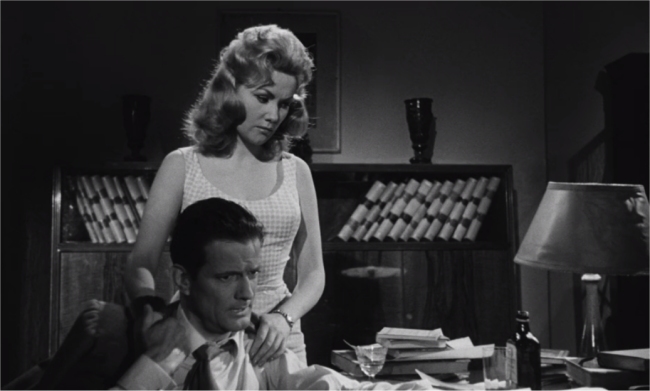
A beautiful young American tourist witnesses a murder in Rome. Perhaps. It's hard to say what's really happening in Mario Bava's preposterous 1963 film The Girl Who Knew Too Much ( La ragazza che sapeva troppo), aka The Evil Eye. But it sure is beautiful.

Italian actress Leticia Roman plays the tourist, Nora, and American actor John Saxon plays her Italian love interest, Marcello. Like most Italian films from the period, a lot of the stars aren't speaking the same language and everyone's dubbed.
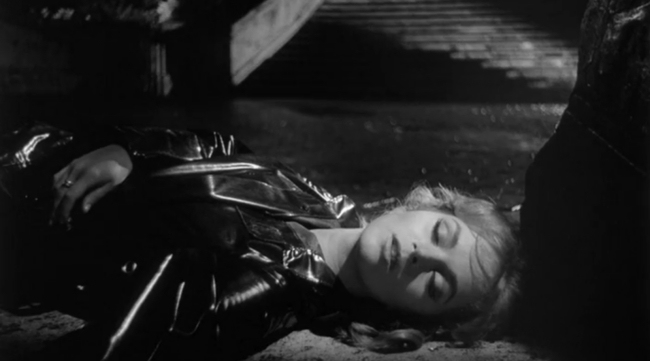
One night, Nora's mugged and, lying dazed on the ground, she witnesses a woman being stabbed. Everyone says it's her imagination because she has a habit of reading pulp murder novels. Later in the film, a neurosurgeon she meets at dinner explains that she must have had a vision of a murder that had occurred ten years earlier. He says it like it's the most natural thing in the world. And that's one of the more sensible scenes in the film.
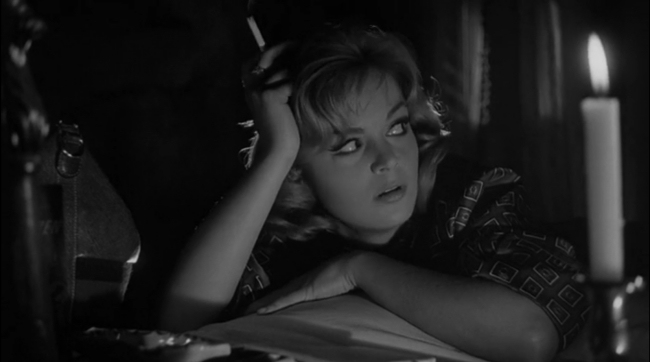
It's a serial killer targeting victims who line up alphabetically--first a victim whose name began with A, then one whose name began with B, then one whose name began with C. Now it's Nora's turn because her last name is Davis (Drowson in the cut called Evil Eye). When the killer's revealed, it makes absolutely no sense of the clues that had led up to the reveal, particularly a fantastically creepy scene where Nora wanders into an apartment of white walls and bare, swinging light bulbs.

Bava brings the visuals to be sure. There are so many gorgeous shots of Roman.
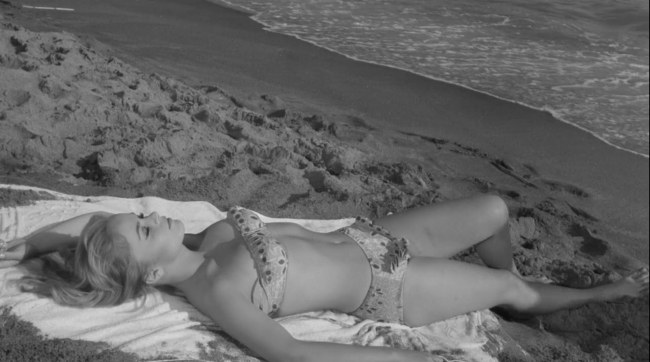
And a few nice ideas, like when Nora decides to make a spider-web of yarn to frustrate any intruders.
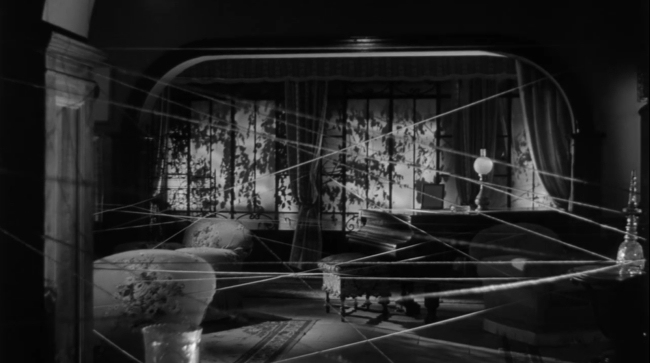
If only the writing matched the visuals. Well, I guess it all kind of works in a sort of dream logic way.

The Girl Who Knew Too Much/Evil Eye is available on Shudder.

Monday, February 21, 2022

The Labyrinthine House in the Labyrinthine City

Tourists should take care not to get lost in a strange city. You could run into the Devil himself, as Lisa did in 1974's Lisa and the Devil (Lisa e il diavolo). At least she was lucky enough for Satan to be played by Telly Savalas and even luckier for the director to be Mario Bava. So it's a beautiful film, even if it is nonsensical and sadly loses track of its own protagonist despite the fact that she's played by the lovely Elke Sommer.

She's part of a group of tourists in Toledo viewing a mural depicting Satan at the beginning of the film. She wanders off and spots Leandro (Savalas), who happens to look just like the painted Devil.

One of the best parts of the film follows as Lisa finds herself suddenly wandering endless, empty, unrecognisable streets in the old Spanish city. Finally, she ends up at a mansion where the bulk of the movie is set. It's inhabited by a countess (Alida Valli) and her handsome son, Maximilian (Alessio Orano). From here on, the movie becomes primarily about him and his derangement. The Devil, meanwhile, is the butler.

There are also two other guests, one of whom is played by the always ravishing Sylva Koscina. I wish she were more prominently featured in the film but she tears through a rapid, bloody subplot.

Dramatic things seem to happen in the mansion without ever quite pulling together into a cohesive whole. There's something about ghosts, something about possessed dummies, and, of course, the Devil is mischievously up to . . . something. It's all beautifully shot and of course Bava was a fountain of great composition ideas.

Lisa and the Devil is available on Shudder.

Friday, February 14, 2020

Amoeba Mama

Happy Valentine's Day, everyone. Have you told your giant unicellular blob goddess lately that you love her? You may want to lest you suffer the fates of several intrepid explorers in 1959's Caltiki: The Immortal Monster. A fairly low budget Italian horror film, it has terrific atmosphere, a silly plot, and a too limited wardrobe department.

The beautiful female lead, Didi Perego, wears the same check dress for weeks while her husband, the morally upright scientist (John Merivale), tries to solve the puzzle of how to kill the goddess blob. They try to disguise the dress by adding a big collar to it but it's pretty obvious.

The film may have been directed by Mario Bava or by Riccardo Freda; apparently this was a dispute that was never settled so to this day the film has no credited director. Certainly the best part of the film is its atmospheric cinematography reminiscent of Bava's black and white work, like Black Sunday. Instead of vampires roaming European ruins, English explorers tread unwisely into the secrets of a Mayan temple. Although the shot continuity is all wrong, I particularly loved a sequence where one man dives into a pool to find a lost member of the expedition. The small pool is intercut with the submerged diver in a vast, dark body of water where he finds human bones and ancient treasure on the flat seabed.

He's also much thinner underwater somehow but the dark void around him is so great I forgive the discord. It even adds to the dreamlike quality.

The film's message about the folly of European explorers venturing where they don't belong is so plain and heavy handed it's oddly unobtrusive. It's like a blue whale that's been too zoomed in on so the shape loses meaning and I found myself focusing more on poor Didi Perego who's forced to hide from the growing blob in her nightgown, clutching her little girl tightly.

What does it mean when a scientist unlocks an amorphous blob that threatens his wife and child? I leave it to you. Happy Valentine's Day.

Caltiki: The Immortal Monster is available on Amazon Prime.

Wednesday, October 02, 2019

Back to the Old House

Halloween month has officially begun so it's time I started watching more horror movies. I got started this month where Mario Bava finished, his final film, 1977's Shock. It's gory and stylish, as you might expect from Bava, but with a kind of nastiness unlike Bava's earlier work, a nihilistic plot about murder and revenge with heavy tones of incest. The movie's excesses become so absurd as the film progesses, though, I found myself enjoying it more. It's rigorously illogical but star Daria Nicolodi gives such a committed performance that the film comes off like a decadent nightmare.

The movie begins with Dora (Nicolodi) moving into a house where she'd previously lived with her now deceased husband. She has a seven year-old son from that marriage, Marco (David Colin Jr.), and a new husband, an airline pilot called Bruno (John Steiner). Bruno's at work for much of the movie, mostly he shows up to tell Dora to pull herself together after she's seen a floating x-acto knife or a zombie hand has sprung from the ground to grab her ankle.

Some early scenes feature Marco looking on wrathfully while Dora and Bruno have sex and we learn that his father, Dora's first husband, had committed suicide. One might easily imagine, maybe accurately, the screenplay was written by a vindictive misogynist. There are some similarities to American horror fiction of the 1970s, particularly works by Stephen King, that focused on horror based on domestic issues but Bava's instincts lead him to much more operatic places. So the process of punishing Dora with supernatural manifestations becomes much more about jump scares and weird sounds--pretty good jump scares and weird sounds, mind you.

The camera's focus on Nicolodi, though, and her persistent portrayal of raw terror anchor the film more in her perspective and it feels less like an exercise of bashing a woman as conveying the experience of being caught in a world of inescapable pain and shifting metrics of guilt. Dora's responsibility in her first husband's death is never entirely clear to us or to herself.

There are lot of impressive dream ideas and creative shots. I love a vision Dora has of an off-key piano being played that precedes her attempting to play piano but being cut by a razor between two keys. There's also a really neat shot that appears to have been accomplished by strapping Nicolodi to a bed and then slowly rotating the bed but keeping the camera fixed on her face. This seems to have been done entirely for the purpose of making her hair seem to wave about in an unnatural manner.

Shock is available on Amazon Prime in the U.S.

Twitter Sonnet #1283

To choose a car above a boat's for land.
To fly a plane beyond a desk is real.
To sail a ship beside a fish is bland.
To catch a trout inside the net's a meal.
An extra sock encased the travelled foot.
A welcome chill accords a pleasant class.
Remember where the granite marker's put.
Between the licking rocks some dragons pass.
Between the roads a lake condemns a dam.
The mountainsides endorse the running car.
In awe the walking boat ingests a dram.
A week of bottles broke the lucky bar.
A steady house'd shake the tenant's feet.
Between the choppy waves the horses meet.

Monday, April 08, 2019

An Erik of Errors

The conflict between the English and the Vikings is the product of a wicked Scotsman in 1961's Erik the Conqueror (Gil Invasori). Sort of a remake of the 1958 American film The Vikings, this one's directed by Mario Bava with lots of colourful lighting and some really beautiful outdoor shots. The story becomes oddly diluted by a thematic fixation on siblings. But I'm not sure if I consider that a problem because there's something intriguing about how it dislocates motive.

The movie begins with a massacre overseen by the Scottish knight Rutford (Andrea Checchi), who was under orders from the English king to negotiate peacefully with the Viking King Harald. Instead, Rutford razes the village and his comrade murders the English King so that the Queen (Francoise Christophe) is forced to secretly take an orphaned Viking boy as heir to the English throne.

I love this shot so much--it looks like a natural sunset with just a little red light from the left.

Anyway, it all sort of makes sense. The baby has a tattoo on his chest that's the same as a boy who grows up among the Vikings. Time elapses and one boy becomes the Viking warrior Eron (Cameron Mitchell) and the other becomes Erik, the Duke of Helford (Giorgio Ardisson). Adding another layer to the sibling mix-up drama, there are a pair of Viking Vestal Virgins (the old triple V) played by the Kessler sisters, Ellen and Alice, who each fall in love with one of the brothers. We're almost in A Comedy of Errors territory.

Except it's never played for comedy, though there is a tragic misunderstanding when Eric mistakes one sister for the other and almost gets killed. Both of the brothers are established as being honourable men who prefer to show their opponents mercy. Eron is more or less positioned as the villain at times but this is undercut again and again. Even in the climax Bava frustrates any attempt for the plot to lock down into standard form--he has Erik rescue the Kessler sister his brother's in love with rather than the one he likes who's back at the camp trying to comfort a wounded Eron.

I guess he's the Erik of the title but he never conquerors anything and seems to spend most of the movie trying to escape captivity and trying to untangle confusing pieces of information. Giorgio Ardisson gives an appropriately passive performance. Mitchell is more fiery and seems more focused in his passion which makes his moments of confusion and change of motive captivating.

I'm pretty sure the whole thing was shot in Italy but I love the castle used for the climax. All of the coloured lighting in the many cave interiors was a bit much for me but Bava's passion for colour makes for some visually arresting outdoor shots, most of the outdoor scenes improbably taking place at sunrise as a result. Erik the Conqueror is available on Amazon Prime.

Twitter Sonnet #1223

The explanation takes a longer time.
For floating numbers foam inventions work.
So vines begin a slow and legless climb.
The leaves and fruits award the only perk.
In drawers we filled with staples wait for me.
A destined page with page at last will meet.
To break the trunk's to see a ghostly tree.
With reeds the wind creates compulsive beat.
A likely glimpse permitted clouds to drift.
Assignments turn to dreams or thoughts abroad.
Ideas or rice between the grains we sift.
A candy weighed approached the whales per pod.
The toupee glue removes the final hairs.
The dust retains the shape of absent chairs.