Showing posts with label max ophuls. Show all posts

Sunday, November 27, 2022

From One Bed to Another

The wheel turns and lovers change in their significance and identity, each caught in the ever changing stream of reflections in 1950's La Ronde. Max Ophuls' adaptation of the 1897 play was considered obscene in America, of course, as it not only acknowledged the existence of sex but of extramarital sex. But it's a lovely, delicate, oddly sweet film about how people are isolated in a crowd by discreet lies and the roles they play.

Anton Walbrook plays our interdimensional host, striking a graceful, slightly melancholy, ruminating tone as he tells us how people are doomed to only seeing one half of their relationships. He alone, a strange figure who stands outside the logic of the film, sees La ronde, sees the unending cycle. Identifying the film set and the artificiality of the production, he transports us to 1900. "I adore the past," he says. "It's so much more peaceful than the present."

He meets with the first of the film's magnificent ensemble cast, Simone Signoret, playing a prostitute. Frustrated at being unable to find a john, she finally offers free sex to a soldier. He hastily accepts. Clearly she expected some consideration in the end, but she ends up loudly rebuking him for not even giving her a cigarette as he rushes off to his girlfriend, a chambermaid played by Simone Simon, whom he will also abandon.

Walbrook consoles her that she will find a better situation, romantically and professionally, as a chambermaid to a wealthy family. She makes love to their handsome son, perhaps his first love, and then we follow him to the arms of a wealthy, married woman (Danielle Darrieux). We follow her seemingly sexless husband to a scene where he seduces a 19 year old shopgirl (Odette Joyeux).

This after a lecture to his wife about the moral decrepitude of adulterous women. With his wife and with the shopgirl, he arranges things to be perceived as a moral and/or sexual authority, but to us, and, to some extent, to them, he only looks small and foolish. But everyone in this chain tells lies, clings to a perception of sexual dynamics, however obviously false. To borrow a phrase from Bob Dylan, do any of them on line know what any of it is worth?

La Ronde is available on The Criterion Channel and HBOMax.

Saturday, August 03, 2019

Light Through the Diamonds

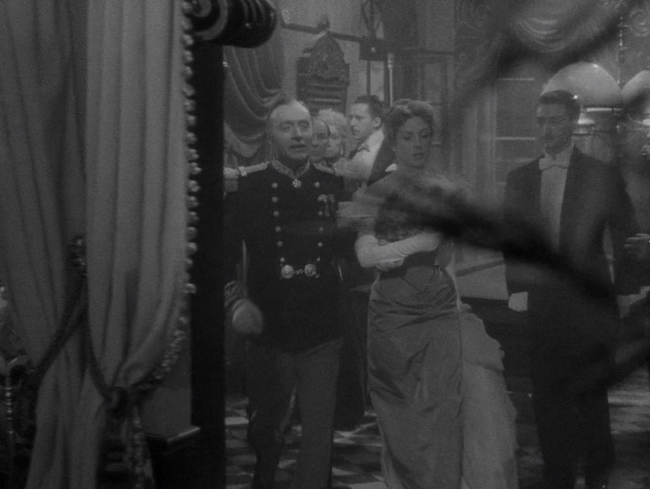
What might a pair of earrings mean to a woman? The question remains intriguing and unsettled throughout 1953's The Earrings of Madame de . . . but, as the title suggests, we don't even learn her surname or her husband's. Louise lives in the comfortable, decadent world of late 19th century Parisian aristocracy created by director Max Ophuls with beautiful sets and mesmerising camera movements. These elements help ensure the story's persistent mysteries remain fascinating. The first thing we see Louise (Danielle Darrieux) try to do with the earrings is get rid of them. They were originally a gift from her husband, Andre (Charles Boyer), but now she would rather sell them to settle her private debts than appeal to him for more money.

You could make a fair argument that the earrings represent Louise's sense of independence. After a series of improbable circumstances in which the earrings travel to Constantinople and back to Paris, they're given to her again but this time by her lover, an Italian diplomat named Donati (Vittorio De Sica). She wanted to get rid of them before, now they're objects of intense value. You would think she would choose another memento of Donati's love, one that didn't have previous association with her husband. But they almost seem more precious to her than both men when Andre sternly commands her to give them to her cousin.

He does this clearly as a form of disciplinary action. A military man, a general, Andre also usually seems generally permissive. In early scenes in their palatial bedchamber where their seperate beds are sequestered in different lavish alcoves, he seems to casually hint at the normalcy of discreetly ignored adultery among upperclass 19th century Parisians. Yet as he detects one crumb of evidence after another he can't seem to help himself getting involved. His initial confrontation with Donati, though, isn't so much a fight as a simple dialogue in which Louise's own simplistic manipulations are laid bare.

She's no Machiavelli. Her usual technique is to pretend to faint when things don't go her way--she seems to accomplish her ends for how charming people find the transparency of her methods more than for the methods themselves. Maybe that's her tragedy--she lives in a world thriving on polite, complex deceit and she happens not to be particularly clever or insightful.

Does she know herself why she suffers for Donati, a man for whom her favourite expression is, "I don't love you, I don't love you, I don't love you . . ." generally whispered as they embrace in secret. Maybe the earrings represent a life where she might love both men, or neither, or maybe they represent some more fundamental impulse that no language has yet invented words for.

It's a beautiful film, restless in its camera movement and provoking in its subtle enigma. The Earrings of Madame De . . . is available on The Criterion Channel.

Twitter Sonnet #1263

Discovered jewels encased the ears again.
A never carved in golden trees suspends.
As boats and leaves were ever quite akin.
On what the common heart at times depends.
Insistent sleep ensures reflected sheets.
In black and white the gilded frame would glow.
A shadow crowd completes the thousand seats.
Again reflected candles lit the show.
A heavy stone eclipsed the dusty lake.
A pilgrim stopped in webs of tangled hair.
The drunken walker smashed against the rake.
A quiet crowd returned to watch the fair.
Between the bars of blue a curtain drifts.
A steady moon returns the night in shifts.