Showing posts with label max von sydow. Show all posts

Friday, July 01, 2022

Intrusive Fire

Governments and revolutionary groups spend a lot of time convincing citizens that the ideological motivations behind war are deeply personal. And yet, it often seems that to the people whose lives are affected by mass armed conflict, such phenomena are invariably, violently alien. Ingmar Bergman's 1968 film Shame (Skammen) presents the lives of a young married couple suddenly caught in the gears of war. Bergman's normally quiet and desolate Faro is quite plausibly transformed into a war ravaged hellscape. Max von Sydow and Liv Ullmann find the physical and psychological threads of their existence upended and violated by bombs, soldiers, and officers whose motives seem surreal or arbitrary but always terribly human.

Von Sydow and Ullmann play a couple of musicians, Jan and Eva, who have been exiled from the world of concert symphonies for reasons that are never divulged. They dwell in a poor little home on Bergman's desolate island, growing bored and dissatisfied with each other.

Bergman establishes their relationship very effectively in the first scene as they wake up one morning. Beautiful Eva walks around topless and Jan doesn't seem to care and neither does she. He tells her about a dream he had that brought him to tears and she responds only by coldly asking if he plans to shave to-day.

A friend in town talks about his panic at the idea of being drafted and says he knows no-one will miss him if he dies. Jan and Eva's reactions confirm this is probably true and that they only feel faintly sorry about it. They awkwardly excuse themselves from the house.

Troops move about the streets and crowd the ferries. Jan and Eva run into Bergman regular Gunnar Bjornstand, in this movie a wealthy man to whom they sell fruit. Their acquaintance proves lucky when he manages to save them from execution later in the film. But it comes with a price as human psychology is wedded uneasily to the responsibilities retained by military officers in a conflict.
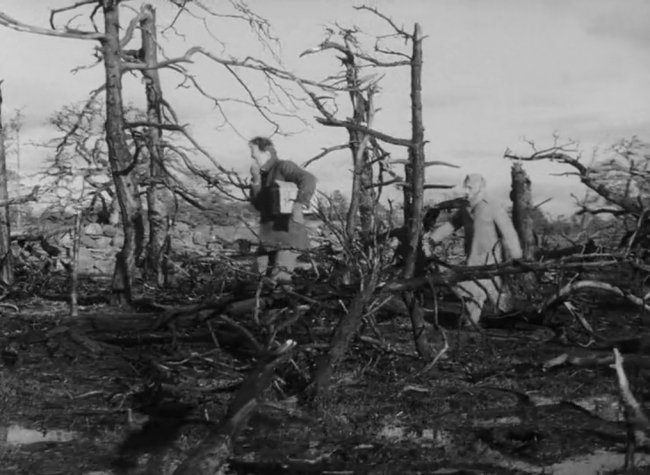
Paratroopers from the enemy faction force Eva to make statements on camera which are later used for propaganda. Even when it's obviously faked and coerced, it seems interrogators think she ought to be executed anyway. Everyone in a uniform seems dead certain but it's never really clear what's happening or for what reason. All that's clear is that people who used to have lives and dignity are robbed of both as they're hustled en masse into small rooms or confronted by random murder and destruction.

Shame is available on The Criterion Channel.

Monday, March 09, 2020

Max von Sydow

It seems hard to believe Max von Sydow could die at this point. But he has, he passed away at the age of 90 yesterday. The man who was so vital in some of Ingmar Bergman's greatest films of the 50s and 60s, who contributed an awesome presence to fantasy films and video games for decades.

Sometimes, when you're young, you take movie stars for granted. Like many things in life, you might not recognise how extraordinary they are until you're older. Much as the fortunate child accepts as a natural fact he or she has food and shelter, you might accept there's a Harrison Ford handy to play Indiana Jones or that Ripley sprang out of the ether fully formed as Sigourney Weaver. One of the first times I really appreciated what a great star is and does was that moment in The Seventh Seal where the knight played by Max von Sydow, standing in the confessional, proclaims to himself in wonder that he, a mortal man, is engaged in a game of chess with Death himself.

More even than the mood conjured by Bergman's compositions or the eerie performance from Bengt Ekerot as Death, Max von Sydow in that moment sells the concept. In the middle of this grim, sometimes funny, film, we're let into the fundamentally wondrous nature of the circumstance. Which is, of course, in part the exhilaration of surviving by one's own efforts. He was a great actor but with his deep voice, gaunt face, and large eyes, von Sydow had presence that went beyond skill or talent.

For any one of the leading roles he played for Bergman, and several of the supporting ones, Max von Sydow might have justly considered himself possessed of a lifetime's worth of accomplishment. His complex role in The Magician uniquely conveys the life of an artist in a world that takes art for granted. His raw, terrified performance in Hour of the Wolf is a big part of what make that film an extraordinary nightmare.

And after that, he went to Hollywood. Not shrinking from bit parts in B movies, he was a king in Conan the Barbarian and Ming the Merciless in Flash Gordon. He was also a priest in The Exorcist, showing up later in the film, that incredible presence of his enough to convey the fact that a powerful force contrary to the Devil's had arrived.

His presence was so reliable for so long. A couple years ago, he had a bit of a renaissance thanks to, of all things, a video game, one of the best ever made, as it happens. Skyrim is a great game and it had what not every great game gets--great trailers. Like many great trailers, the voice is key and in this case the voice belonged to Max von Sydow. When you hear him say, "They're already here," you get a chill and everyone knew in their hearts the game was guaranteed to sell millions of copies.

It was little wonder, after Skyrim, he would show up in Star Wars and Game of Thrones. Not as a favour or a gesture of respect to a veteran actor but because he clearly had the goods. Everyone could see he would make their projects better, even if the kids watching had no idea who he was. Fortunately, kids and adults for generations will have the opportunity to discover him in so many ways.

Friday, September 13, 2019

Gifts Met with Suspicion

When you go to see a movie or view a work of art, do you want an emotional, transportive experience or an autopsy? Ingmar Bergman's 1958 film The Magician presents the tragedy of the cynical, analytical critic and the difficult line trod by the artist in creating an impression of wonder while being subject to human infirmity. Few works of fiction so brilliantly capture the sad relationship between these two people.

This is an ensemble film featuring a small travelling magic troupe in the mid-19th century being interrogated in the home of a village consul, Egerman (Erland Josephson). The cast includes various troupe members, the local intellectuals analysing them, and the servants who carry on their lives of toil, broken up by sexual play. But primarily the story is of a contest between the Magician, Vogler (Max von Sydow), and the Minister of Health, Vergerus (Gunnar Bjornstrand).

When Vergerus examines Vogler, he announces that he can find no physical reason to account for the claim that Vogler is mute, and a look of anguished disappointment passes over Vogler's face. It's not simply the disappointment of a ruse seen through but the disappointment in perceiving Vergerus' motives. When Vergerus sits down to challenge Vogler's talent for mesmerism, the Minister of Health finds himself rambling about his desire to dissect Vogler and analyse the parts of his brain.

Despite this, Vergerus sarcastically announces Vogler's attempt to mesmerise him was a failure. The consul's wife, Ottilia (Gertrud Fridh) indignantly asks how Vergerus could say Volger failed when Vergerus had plainly experienced profound emotion. This makes Vergerus dig his heels in even further and claim any emotion she perceived may have been his disappointment in not feeling anything. Vergerus is very clever but unfortunately he uses that cleverness to evade an honest contemplation of his own reactions. It's terrible what the officials put Vogler through but at times I found myself pitying Vergerus even more.

I found myself thinking of Sullivan's Travels when the coachman (Lars Ekborg) and the housemaid (Bibi Andersson) use a love potion given them by a witch travelling with the troupe (Naima Wifstrand) as an excuse to sleep together. "She's normally so reserved!" remarks another servant about Andersson's character. One senses the two sexual partners may on some level realise the love potion is a fake but, on the other hand, maybe it isn't since it accomplishes exactly what a love potion is meant to do.

The final act of the film is a pretty effective horror sequence in which Vergerus gets his wish to perform an autopsy on Vogler. But even when an eyeball mysteriously turns up in his inkpot he's unwilling to admit the value of his own emotional reactions to the experience. Again and again, Vergerus claims triumph and, again and again, we see Vogler is genuinely effective. I won't say Vogler triumphs because the contest exists primarily in Vergerus' mind. Vogler isn't really trying to prove his powers but to engage in a reciprocal experience, to create something for his audience. The distrust of the critics, the inability to be vulnerable to experience, results in the talented Vogler being nearly reduced to beggar or criminal. But the reality of his talent means that his fortunes can also reverse at any time provided he has the right audience.

The Magician is available on The Criterion Channel.

Wednesday, March 21, 2018

The Inexorable Appointed Time

The path of damnation must be one where all things held beautiful and good are each in turn deprived of significance and wholesomeness until all things signify guilt or nothing at all. The demons that plague Johan in Ingmar Bergman's 1968 film, Hour of the Wolf (Vargtimmen) don't seem to be tempting him so much as processing him for a fate that's already been decided and are assisting him in dismantling his capacity for affection and reverence. His wife and muse, Alma, present to witness the process in horror, doesn't seem an agent assigned by God to offer him an alternative as much as someone who, through some strange chance, has ended up where she's not supposed to be. It's an eerie, frightening, and deeply sad film.

Johan (Max von Sydow) and Alma (Liv Ullmann) have taken up residence in a small house on a remote island. He's a famous painter who has fled the world due to some kind of terrible event or scandal. Alma is selflessly devoted to him and we see most of the movie from her point of view, in fact the film begins with her directly addressing the camera, recounting the events.

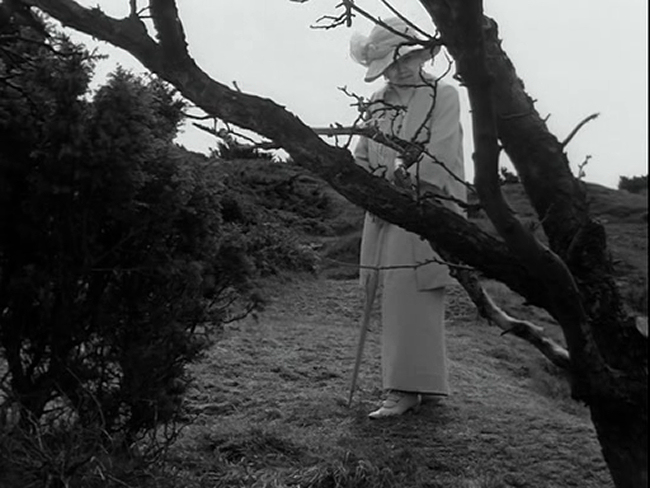
Bergman frequently illuminates her face more than Johan's, concealing his face in shadow and by blocking, which, together with Von Sydow's often solemn and listless performance, suggest someone who's no longer struggling against his doom. He tells Alma about the demons he encounters on the island, the eeriest among them an old woman (Naima Wifstrand) who, he says, "Is always threatening to remove her hat." The implication that something horrible will happen if she removes her hat is one of the ways the demons give the impression of an entirely superficial reality behind which there is only destruction or void.

Alma then encounters the woman with the hat and she encourages Alma to read Johan's diary. Since the diary reveals Johan's thoughts are dwelling on his former lover, Veronica (Ingrid Thulin), maybe this is one of the things that leads Alma to conclude the demons are trying to drive them apart. I never got the impression that the demons were worried Alma's love, however beautiful and compelling, would divert Johan from his path to damnation so much as they were mildly uncomfortable entertaining a guest who simply didn't belong. When Johan and Alma are invited to the demons' castle, where they're presided over by one calling himself Baron von Merkens (Erland Josephson), in their laughter and incessant mockery they seem like the catty, shallow Hollywood crowd that can't tolerate someone as sincere and ordinary as Alma.

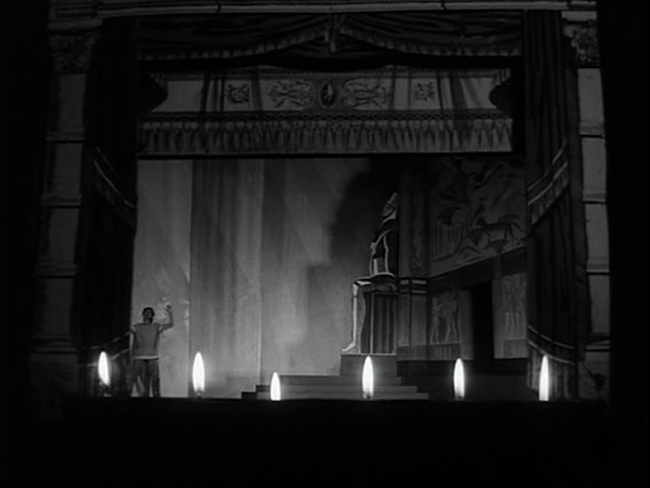
One of the demons, Lindhorst (Georg Rydeberg), puts on a puppet show in which Bergman uses forced perspective to put a full sized actor on the tiny stage, something that reminded me of the Sultan's mechanical players in the 1940 Thief of Bagdad. In the Criterion DVD commentary for that film, Francis Ford Coppola talks about how much that image haunted him as a child and I wonder if it had the same effect on Bergman. In Hour of the Wolf, it's one of the things that make art itself seem sinister and demonic.

The demons continually endeavour to trivialise and demean art. Johan tells them he's fully aware that art isn't that important, he says the insight comes from being an artist and knowing that it's only a selfish compulsion that keeps him painting. They congratulate him on the insight and in the film's climax they go further, demeaning and mocking his reverence for the beauty of women.

A final sequence where the characters are lost in a wood is effectively horrific, as is a flashback in the middle where Johan tells Alma about an act that may have been the cause of his damnation. The former is shot in unnatural darkness and the latter with unnatural brightness, both methods stripping detail and nuance from the image, emphasising the world of hard, inflexible meaning tightening further and further around Johan.