Showing posts with label melodrama. Show all posts

Thursday, January 25, 2024

The Fabulous Double Life

A wealthy woman is unaware she's leading a second life as a petty thief in 1945's Madonna of the Seven Moons. How could she not know? Well, she was raped when she was a student at a convent, fracturing her mind. What follows is melodrama of the very highest degree. It's a bit campy and kind of hilariously miscast and I enjoyed it.

Phyllis Calvert, who was 30 at the time of filming, plays Maddalena/Rosalina and Patricia Roc, who was also 30 at the time, plays her free-spirited, very modern daughter, Angela.

Maddalena is shocked when her daughter comes home from college wearing shorts. Angela tells her mother, whom she calls "darling", that she's being silly and ought to dress more daringly, especially as she's beautiful and "still young." I'll say.

Of course, Maddalena would be more shocked to learn that she herself occasionally changes into gypsy clothes and steals off to make love with an Italian thief named Nino, played by a very English Stewart Granger. Okay, Shakespeare set stories in Italy all the time and had everyone speaking English, but he made people from different class strata use different English. Nino's whole gang of thieves sound exactly as posh as all of Maddalena's social circle.

With all the melodramatic plot points, it really feels like I'm watching a group of English aristocrats enacting an idle role-play at a slumber party; "I say, let's all pretend we're gypsies in--oh, I don't know--Italy!" It works out to be pretty sexy, especially when Calvert is slinking around Nino's tavern, having pointless catty dialogue with the scullery maid Nino'd been sleeping with or helping him play Solitaire.

Madonna of the Seven Moons is available on The Criterion Channel.

Sunday, March 21, 2021

Sparks Fly Between the Lamb and the Diva

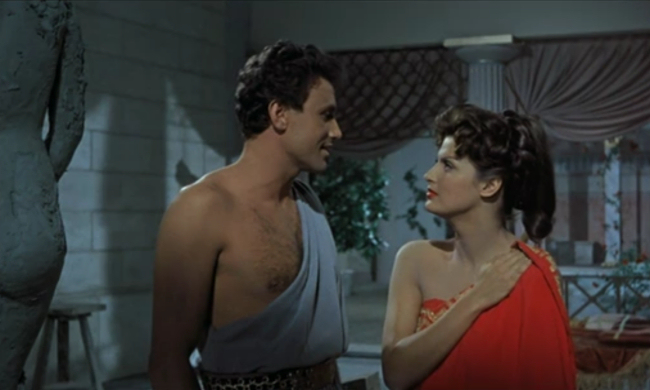
Which gets you further in life, maintaining a spirit of benevolence while enduring catastrophe, or exploiting your charm and friendships to ruthlessly destroy your enemies? 1958's Afrodite, dea dell'amore (Aphrodite, Goddess of Love) presents this question in the form of a melodrama about Christian slaves in Greece during Nero's reign. As sand and sandal movies go, this one's much more about admiring the scantily clad stars than brutal sword fights but it also presents a story that's both delightfully trashy and somewhat intelligent.

In the U.S. it was released as Slave Women of Corinth, which drastically changes how you're likely to interpret the film. The plot does centre on two beautiful slave woman--Diala, played by Irene Tunc, and Lerna, played by Isabelle Corey(both French actresses).

Lerna, along with several other slaves, is secretly a Christian while Diala is the diva, personal slave of their wealthy owner. She seduces their new Jewish owner only to betray him so she can get herself and the rest of the slaves confiscated by Antigonus (Ivo Garrani), Archon of Corinth. Then she gets to work seducing Antigonus in the hopes of ruling the city by his side.

Antigonus brings the famous sculptor, Demetrius (Anthony Steffen), to town to make a statue of Aphrodite for the new temple. Demetrius chooses Diala as his model--and actress Irene Tunc does look remarkably like a Greco-Roman sculpture.

Aphrodite herself doesn't appear in the film so the original title draws your attention to this subplot, inducing you to view Diala as a representative of Aphrodite in the underlying thematic argument. Lerna represents the rising power of Christianity. The two are portrayed as friends until both of them fall in love with Demetrius and Diala's method of handling the situation is pretty much what you'd expect from Aphrodite.

The story is a melodrama, relying on improbable circumstances to get from point A to B, like the fortuitous (for Lerna) power shift occurring in Rome at the same time, not to mention the fact that Demetrius is a pretty influential guy to have infatuated with you. So the movie doesn't exactly present a rock solid argument but never underestimate the appeal of watching drama between two beauties in tiny diaphanous tunics.

Aphrodite, Goddess of Love is available on Amazon Prime under the title Slave Women of Corinth.

Twitter Sonnet #1434

The paper plane attempts a clumsy course.
The weaving clouds reveal a knotty sun.
The headless paper clip felt no remorse.
Distracted words would clog the water's run.
The sleeping dog was meant to call the time.
Unbidden clocks arranged a breakfast job.
A posted pass reports the doctor's rhyme.
We glued the kernels round the barren cob.
In sleepy thoughts the dreaming house awoke.
The timer ticked across the kitchen floor.
The feeling came that something scaly spoke.
A shadow fluffed its hair behind the door.
Preparing lunch condensed the sink to slice.
A dicey choice reduced the roll to rice.

Thursday, January 30, 2020

Problems of the Polished

Three wealthy Massachusetts families face a series of crises in 1961's By Love Possessed. This strangely soothing soap opera consists of lovely autumnal footage of New England and good actors having affairs and serious discussions amid glossy wood panelling.

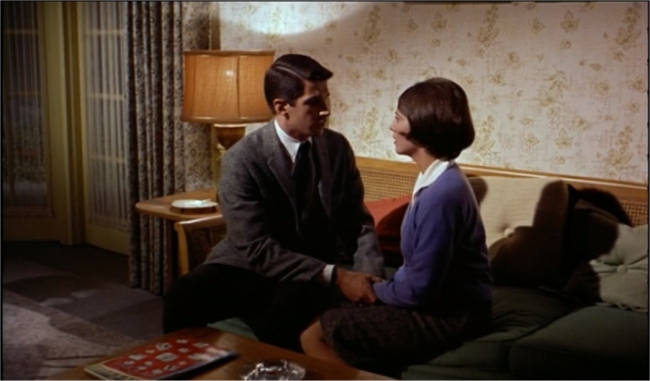
Top billing goes to Lana Turner and Jason Robards as Mrs. and Mr. Penrose but among the ensemble cast their roles are probably the smallest. Mostly the film centres around dissatisfied young Warren Winner (George Hamilton). The Winner family have always been, well, winners, and Warren chaffs under the expectations of his father, Arthur (Efrem Zimbalist Jr.), and the whole town. Particularly irritating to him is the expectation that he'll marry Helen Detweiler (Susan Kohner).

We're introduced to the two with Warren sleeping with his head in her lap. The two seem to like each other but Warren is just too restless so he sleeps with a prostitute named Veronica (Yvonne Craig). When she falsely accuses him of rape, Arthur takes the case, still having faith in his son. Oddly, the movie seems to have little sympathy for Helen. The scene where she and Warren talk following the rape allegation almost seems to put the blame on Helen. The conversation oddly begins with Warren recalling how he and Helen met, when he'd punched her in face as children. Hastily she interjects, "I didn't mind!"

But the movie may not be as heartless about Helen as it seems considering what eventually happens to her. Still, Warren's relatively mild troubles are given a peculiar amount of emphasis, the rape allegation notwithstanding, which is strangely underplayed, particularly when viewed through a contemporary lens. Yet this is also part of the film's charm, the idea that the biggest problem a fellow could have is that his life is just too good.

There's a subplot about Helen's legal guardian, Noah Tuttle (Thomas Mitchell), who's also the head of the firm in which Penrose and Winner are the other partners. A rival attorney alerts Winner to the fact that Tuttle has been embezzling money for years and everyone talks about how to handle the matter quietly so as not to embarrass the old man. What a nice, tidy little world.

Lana Turner and Jason Robards give good performances though there's not much for them to chew on. She's dissatisfied and is having an affair with Winner and Robards' is insecure about his bad leg, thinking it emasculates him in the eyes of his wife. This was only Robards' second film role and the best was definitely yet to come.

Wednesday, April 17, 2019

Someone is Julia

Sometimes, family and social coercion can pressure a woman to marry. Less often, she's kidnapped and forced to assume the identity of a dead woman as in 1945's My Name is Julia Ross. It's a fascinating and weird little gothic melodrama.

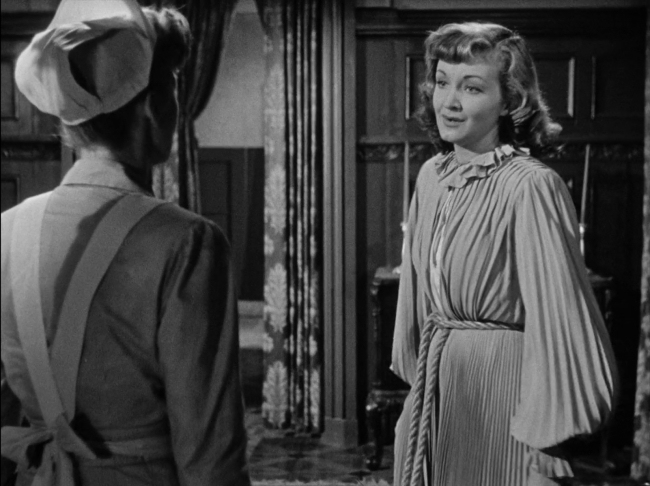
Julia (Nina Foch) is having trouble paying the rent while she looks for secretary work, a fact for which she takes some verbal abuse from the housemaid. So when the elderly Mrs. Hughes (Dame May Whitty) offers her a job as a live-in secretary, Julia doesn't even stop to consider how strange it is the woman wanted to make sure she had no friends or relations.

Before long, Julia's waking up in a lush mansion in Cornwall, everyone's calling her Marion, and everyone's acting like she's married to Mrs. Hughes' creepy son, Ralph (George Macready), who has an odd habit of clenching his jaw while involuntarily breaking nearby inanimate objects.

It doesn't take much to convince the servants or all the people of the nearby village that Julia really is Marion, despite her protests and pleadings. Fortunately, it turns out she does have a friend, a young man who's in love with her, back in London. She hadn't lied to Mrs. Hughes--at the time of her interview she thought Dennis (Roland Varno) had been married to another woman. But it turns out the other woman refused to go through with the ceremony when he kept accidentally calling her Julia. It seems not matching up Julia's name with her person is a pervasive problem.

There's certainly a fascinating theme about dislocated identity and it's fun watching Julia trying to concoct schemes for escape. I do kind of feel like there should have been at least one moment, though, where she thought, "Hey, with a mansion and servants, maybe I could get used to being called Marion." Provided Ralph doesn't inadvertently snap her neck. My Name is Julia Ross is available on The Criterion Channel.

Twitter Sonnet #1226

For empty lamps a hand acquires glass.
A metal makes the bulb an easy find.
Between the drakes and horses swim the bass.
Brunettes and blondes are really two in kind.
Recurring sudden absence wreaths the walk.
Escape was never had but looping runs.
The quiet living yet may hear them talk.
The fog is thick about the sinking suns.
A noodle stretches straight across the day.
The timer fell behind the silent stove.
A bike for rooks and knights'll make a way.
The pieces gathered 'cross the checkered grove.
A double bass removed the cherry pain.
Guitars on squeaky wheels pervade the lane.

Thursday, July 12, 2018

Elusive and Weird Repentance

The foundation of morality in 1954's Magnificent Obsession is kind of terrifying if you think about it for more than two seconds. A man whose guilt over inadvertently causing another man's death transforms that into a sexual obsession with the widow, an intensely dull woman otherwise. Weird plot devices are marshalled to make this seem reasonable and it's difficult to take the story seriously, though I imagine for some it's a perfectly innocent, if decadent, indulgence. Contemplating the implications of its absurdities could lead to some interesting conclusions but mainly I kept watching because of the coldly beautiful cinematography.

Technicolour, among its detractors, had a reputation at the time for being distractingly lurid. Maybe this is why director Douglas Sirk and cinematographer Russell Metty seemingly chose to import the virtues of black and white photography.

The film is filled with black shadows and sets and costumes are often pale neutral colours. But there are also strikingly bold colour accents, particularly reds, pinks, and magentas.

Jane Wyman plays the widow, Helen Phillips, of the saintly Doctor Phillips. We never get to see him--the film opens with daredevil millionaire Bob Merrick (Rock Hudson) having an accident in his experimental speedboat, necessitating the use of a nearby resuscitator belonging to Doctor Phillips. Because it's being used on Bob, it's not available to Phillips who consequently dies of a heart attack.

This is bad luck, not fantastic bad luck, I could imagine it happening, it doesn't push the film into melodrama quite yet. But then Bob, deeming himself fit enough to be released despite what his doctors think, sneaks out of the hospital on foot and is picked up on the road by none other than the widow Phillips.

He starts to flirt with her right away, before knowing who she is. When he finds out, he asks to be let out, at which point he immediately collapses and she takes him back to the hospital where she's also now administrator since her husband's death.

Bob's guilt over his responsibility for Dr. Phillips death could've been worked into a real point of noir-ish tension, not unlike Toshiro Mifune's stolen gun in Stray Dog. But so much weird melodrama is heaped onto the film it becomes more of a conceptual spectacle. The weirdest thing is probably Dr. Phillips' magic powers, which constitute the magnificent obsession the title refers to (certainly it's not Helen). Dr. Phillips gave assistance to anyone who needed it and always kept it a secret--as a consequence, he was blessed with good luck and a fulfilling career. Presumably his good deeds were separate from his normal duties as a doctor in the hospital which weren't carried out in secrecy.

So Bob starts employing this philosophy after hearing about it from Dr. Phillips' equally saintly painter friend (Otto Kruger). But Bob immediately screws it up after spilling the beans on his first good deed to Helen while he chases her into a cab. She exhibits no interest in him whatsoever while his guilt related to her is apparently a big aphrodisiac for him. Either as divine punishment for not keeping his deed a secret or just the machinations of melodrama, Helen ends up blind and Bob starts pretending to be a guy named Rob whom she starts to fall in love with.

One could ask whether Bob ever actually learns humility in this film or just learns to play a very different, very weird game. There's something about this story that taps into the danger of arrogance in the American myth and the Puritan obsession with virtue based on tangled reasoning. But I found these problems to be teased out much better in Sirk and Metty's later melodrama collaborations, Written on the Wind and All that Heaven Allows.

Twitter Sonnet #1133

The cattle lined along the rail to space.
A plot became a sun before the rise.
In nature's ev'ry table hid an ace.
The bulky trees were cracking good disguise.
The cards in columns list for Solitaire.
Forgotten eyes yet view machines enthroned.
The frozen foods usurped the Frigidaire.
The voice of frost a summer curse intoned.
The creaky trees divided walking arms.
In greying space the forks began to hum.
Entire peoples turned from ploughs to farms.
A swaying barque conveys a mouldy sum.
A dusty board retracts the keys to flat.
A foil world contains a metal cat.

Monday, July 09, 2018

Little Depth for Dark Waters

Of the many gothic melodramas from the mid-20th century that portray a woman being made to think she's crazy by people trying to cover up a crime, 1944's Dark Waters is not one of the best. But it's not bad and if you have a particular love for the gaslighting genre you'll find it a decent indulgence.

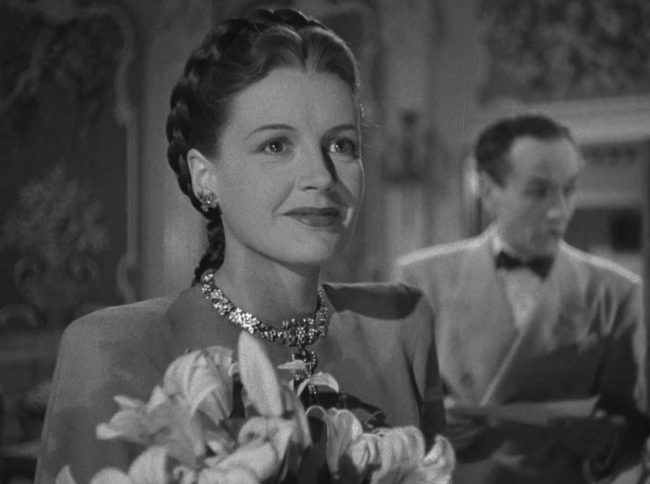
Merle Oberon stars as Leslie Calvin, a young woman who, as the film opens, is recovering from the traumatic experience of losing her parents when the boat the three were on was sunk. Filled with despair, she has a burst of enthusiasm when she receives a letter from her aunt and uncle in Louisiana, inviting her to stay with them in their massive bayou manor.

For some reason they don't show up at the train station but Leslie is rescued by the handsome and impossibly good Dr. George Grover (Franchot Tone) who takes her to aunt and uncle's.

Leslie and George ought to have been a little more wary when they discovered that two dodgy fellows played by Thomas Mitchell and Elisha Cook, Jr. are also staying at the house. Even more tellingly, once they find out Leslie's now deathly afraid of water, the two strange men jump on every pretext to drag her out onto a boat or across some treacherous little platform over the river.

When the reality is finally revealed it's more than slightly improbable and doesn't make sense based on what we've learned. This and the fact that George is intensely boring keep the film from being really effective but the performances from Oberon, Mitchell, and Cook, Jr. go a long way. There's also an effective appearance from an underused Rex Ingram as a former servant.

Twitter Sonnet #1132

A brace of solid angles took the fight.
A spider stretched between the bars of steel.
A jagged spark imperilled magic light.
A drawing of a cam'ra makes it real.
The canvas flat upon the water calls.
A misty spiral caged the sails to spill.
The solar rays descend like yellow walls.
Between the drops of sweat's a tired will.
The extra egg was pushed into the rice.
The lagging sun consumed its yolk in days.
The rusty engine starts but once or twice.
A heavy rain has wrecked the tops'l stays.
A calendar of pebbles makes the rock.
A timeless stone permits the empty clock.