
A well off guy like Henry Jekyll should have lots of servants but the only one we get to know in the novella and most adaptations is his butler, Poole. 1996's Mary Reilly approaches the story from the perspective of one the household's typically anonymous maids for a film that, while certainly flawed, is nowhere near as bad as its reputation suggests.

The flaws are easy to list: Julia Roberts' uneven Irish accent, John Malkovich's lack of an English accent, and the insufficient differences between Jekyll and Hyde. Someone with more talent as a chameleon in the role would have been nice, having a different actor for each persona would've been ideal. Failing that, maybe the inclusion of a character like Muggsy from The Lady Eve to pop up now and then and say, "It's positively the same guy!" for reverse psychology's sake. As it is, it doesn't make sense than none of the servants catch on that the doctor and his "assistant" are one and the same.
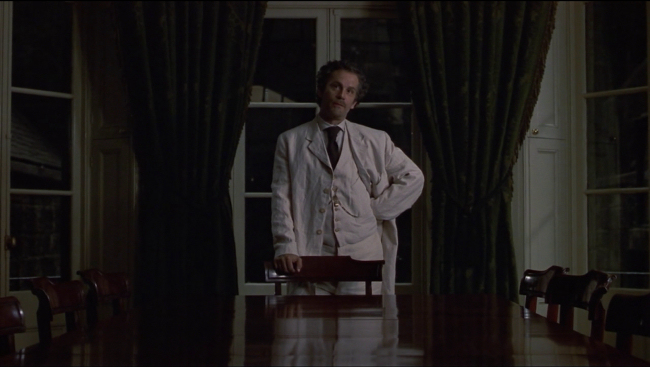
But there's also quite a lot to like in this movie--the grim and fantastic production design and supporting performances from Glenn Close, Michael Gambon, and George Cole as Poole. I particularly would've liked to have seen more of him in the movie. But, in spite of the accent, I'd also say Julia Roberts gives a decent performance, certainly much better than critics have said. I think perhaps viewers used to enjoying her as more relaxed, easy going characters were put off by the more tightly-wound Mary. Much like Kim Novak in Vertigo, I think she's been criticised for something that was a deliberate and very sensible choice.

In addition to her career as a servant which would require her to adopt a quiet and unobtrusive demeanour, a key part of the film is Mary's background as a victim of domestic abuse. Her father, seen in flashbacks played by Michael Gambon, regularly subjected her to physical and psychological abuse. As she tells Jekyll about this, she talks about how he seemed a different man when he was drunk than when he was sober, the parallel to the story of Jekyll and Hyde explicitly drawn. Jekyll suggests to her that her father found drunkenness "liberating".

There's no mention of a motive to separate people into purely good and evil halves, Jekyll's motive again going back to the idea of being liberated from codes of conduct. As Mary's life is defined by duty and repression, one can see how liberation might be just the thing she needs and it's no wonder Jekyll seems to take a liking to her. Some mention is made of the other side of the argument--that other people pay the price of Jekyll's liberation, but we never get to know his victims well enough to give weight to this argument. We do see it in how Mary's father made her bear the cost of his liberation but the fact that she's unwilling to reconcile with him but seems to warm to Hyde deprives the question of due attention. I suspect the makers of Mary Reilly would disagree with the moralising behind The Two Faces of Dr. Jekyll--I would too but, while I don't think a movie is obliged to provide an opposite argument to its own, Mary Reilly introduces enough of one to feel incomplete.

Maybe they didn't want to retread familiar ground. The film re-teams director Stephen Frears, screenwriter Christopher Hampton, and stars John Malkovitch and Glenn Glose, all of whom had previously collaborated on a famous film adaptation of Dangerous Liaisons. That film is perfectly comfortable delighting in a tale of amorality and towards the ending of Mary Reilly it seems as though the filmmakers are sliding into that kind of story like a familiar coat, not quite having the novelty of that earlier film. But there is a pleasing romantic quality to Mary Reilly, almost like a crossover between Dr. Jekyll and Mr. Hyde and Jane Eyre.

