Showing posts with label sex. Show all posts

Friday, April 14, 2023

The Implications of the Image

I started reading Pauline Kael's I Lost It at the Movies last week, a collection of her reviews and essays from 1954 to 1965. It's giving me a lot of perspective. Most books I've read from that period, books that commentated on contemporary life, had a mostly progressive or liberal perspective while Kael seems to have been much more conservative. Although she praises Marlon Brando and The Wild One, Streetcar Named Desire, and On the Waterfront, she nonetheless decries a general trend of "delinquent" cinema.

The romance of human desperation is ravishing for those who wish to identify with the hero's amoral victory: everything he does is forgivable, his crimes are not crimes at all, because he is so terribly misunderstood. (And who in the audience, what creature that ever lived, felt he was loved enough?) This is the victory that we used to think of as a child's fantasy: now it is morality for nursery school and theater alike.

I wonder what she'd have thought of Joker.

More amusing, and slightly embarrassing, are her comments on how women were increasingly being portrayed, arguing a "Calendar Girl" aesthetic was infiltrating art-house cinema.

This female image is a parody of woman--lascivious face, wet open mouth, gigantic drooping breasts. She has no character, no individuality: she's blonde or brunette or redhead, as one might consume a martini, an old-fashioned, or a gin and tonic.

Now I am told that even the junior-high-school boys of America use photographs like these as pinups, and that this is their idea of the desirable female. I don't believe it. I would guess that they pretend to this ideal because they're afraid they won't be considered manly and sexy if they admit they find this image disgusting.

No, Pauline, they really thought these pinup girls were beautiful, I can guarantee it. And boys feeling disgust? I wonder if she thought bug collecting and the scatological humour of 14 year old boys were but poses. If she wanted boys to be disgusted by images of women, she should have shown them pictures of matrons serving broccoli and asparagus.

I recently reread Laura Mulvey's essay "Visual Pleasure and Narrative Cinema", the essay that introduced the term "male gaze" along with Gaze Theory. I was struck again by what an overrated essay it is, and certainly the concept of "male gaze" is no original thought. Even Pauline Kael, writing fifteen or twenty years earlier, wouldn't have been the first to comment on women in media being depicted so as to gratify male lust. I suppose one key difference between Kael and Mulvey is that Mulvey implies the impulse to degrade women is a genetic trait carried by all men while Kael felt it was societal conditioning. Which makes Mulvey sound like the right-winger and Kael the left-winger.

I would agree that women are portrayed degradingly in a lot of media. I would say men are, too, for the satisfaction of women, though less prevalently. The suffering delinquents in the movies Kael talks about would be an example as would, I'd say, the male figures in the Twilight series. Heterosexual men and women want to see the opposite sex degraded. It gives the viewer a sense of superiority, yes, but I think very often that sense is sought for an impression of safety. When the handsome, wounded boy looks up at his beautiful saviour, she doesn't have to worry about him deceiving her into going to bed with him. That mysterious creature on the other side of daily existence suddenly becomes a known quantity, that attractive shape suddenly becomes more easily obtainable.

Sunday, November 06, 2022

Highway Found

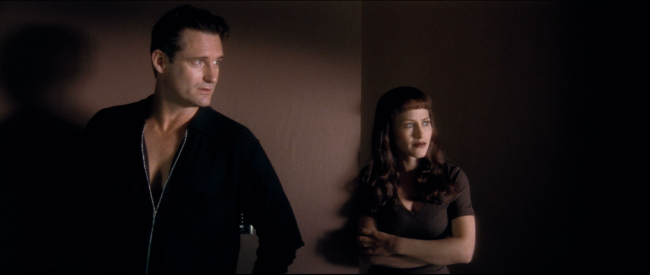
Twenty-five years later, and I finally have an excellent copy of Lost Highway. Yes, my copy of the new Criterion edition arrived in the mail and it's gorgeous.

The release comes with a 4k edition and a regular blu-ray, both approved by director David Lynch. After years of having only a muddy DVD release, I'm overjoyed to have one of the best films by my favourite living filmmaker in my hands. And it lived up to my expectations.

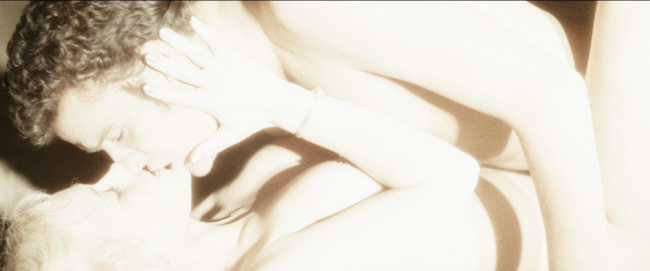
David Lynch directs the best sex scenes in the history of cinema. No other director I can think of quite manages the balance between maintaining a perspective and refraining from becoming dispassionate. They're beautiful scenes and integral to them is the physical beauty of Patricia Arquette and Natasha Gregson Wagner but the point of them never for a moment feels like pure titillation. You're enamoured with Alice and Sheila because Pete/Fred is. Renee is the distant puzzle right in front of you because that's how she is to Fred.

Alice is the Madeleine and Renee is the Judy, to compare Lost Highway to Vertigo. It's another great film that asks how much one's affection for another has to do with one's private conceptions of the other. Hear the horror in Fred's line, "It wasn't you. It looked like you. But it wasn't." It's something I've been thinking about a lot lately, and seems a relevant topic in Japan, where I gather many couples marry without getting to know each other very well, something that led to the epidemic of "Corona divorces" after married couples were finally forced to spent time alone together. It's a central theme in Neon Genesis Evangelion.

Pete's love scene with Alice in the desert, covered by the harsh headlights of a car, is so beautiful. Maybe the impossible beauty of a dream. Pete may never truly have Alice, but we all may now have a decent copy of Lost Highway.

Twitter Sonnet #1639

The final fight would prove the stalwart three.
About the men there grew a clamour great.
A horde of limbs escaped the devil tree.
Of shaded air the monster rashly ate.
Discreetly burned, the number changed the air.
The soldiers sat and shared a sugar cake.
Possessed of grim resolve the tellers share.
The knife was never hid for kindness' sake.
Our Twitter's come a waiting room for heads.
The checks were blue before the money came.
The checkered shirt defined the blues and reds.
The rugby grids were cold and all the same.
The desert light creates a promised land.
But then the promise fell as scattered sand.

Thursday, April 21, 2022

The Opportunities of a Plastic Surgeon

A host of beautiful women and Cary Grant starred in 1934's Kiss and Make-Up. Grant gives a better performance than this otherwise fairly disposable little romp deserves. Though, since it is pre-Code, it's a novelty now just for how much sex it has.

Grant plays a cosmetic surgeon named Maurice Lamar. It's heavily implied that he sleeps with all the women who come to him, and that all the women adore him.

Trouble arises when an aggrieved gentleman (Edward Everett Horton) confronts him about his attentions to his wife, Eve (Genevieve Tobin). Meanwhile, romantic tension starts to blossom between Lamar and his down to earth secretary, Annie (Helen Mack).

The jokes are mostly pretty dopey but the women are all beautiful. Grant actually sings in a couple scenes and you can see why he never starred in any major musicals. There's a gag at the expense of Edward Everett Horton at the end of the film I thought was genuinely funny.

Kiss and Make-Up is available on The Criterion Channel.

Monday, August 09, 2021

The Poisonous Flower is Her Medicine

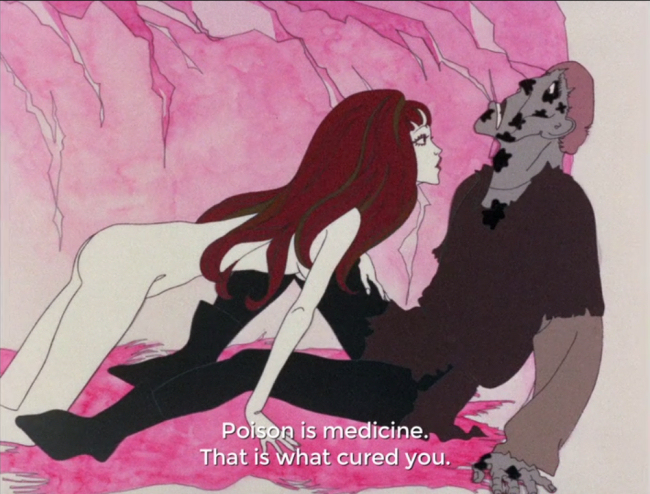
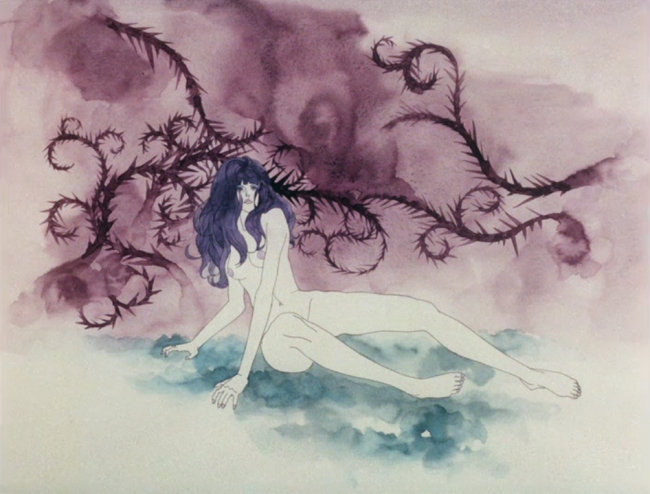
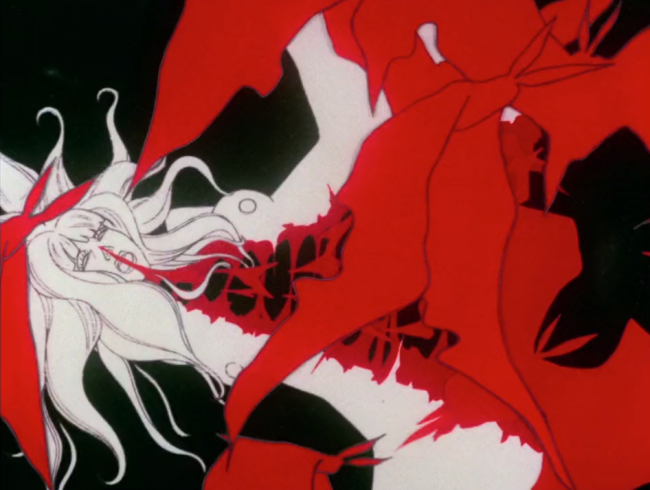
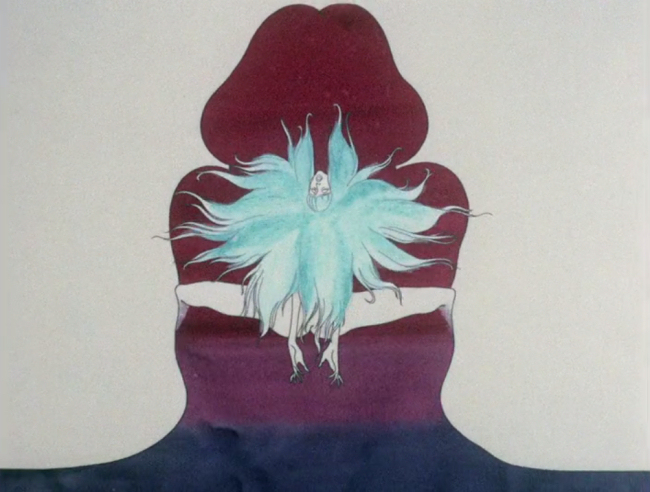
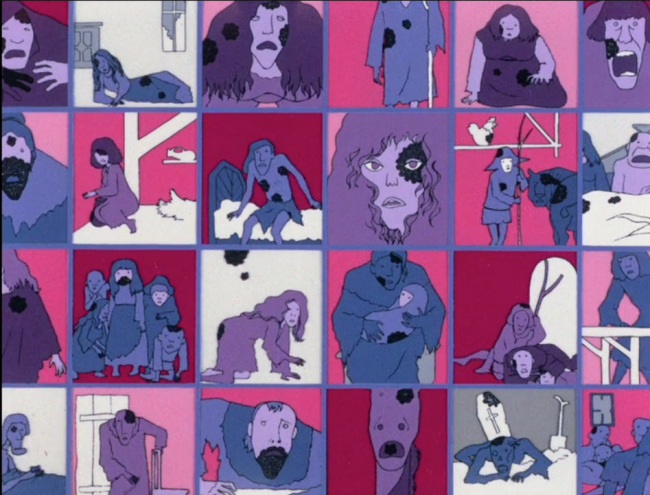
For as much as people decry the slightest signs of inappropriate sexual imagery, millions of those same people still happily indulge in rape fantasies. It's a very different thing from true rape, existing in a fantasy world wherein stimulating surprise and loss of control are carefully arranged in a perfect cocktail of titillation, the sort of thing that doesn't tend to happen by accident. A great example is 1973's Belladonna of Sadness (哀しみのベラドンナ), an anime film inspired by an 1863 French book about witchcraft. An innocent young woman called Jeanne gradually gives her heart to Satan after experiencing a series of sexual assaults sanctified by societal norms. But the world presented by the film is so narrow, so starkly composed of simplistically vicious or virtuous characters, it can only be appreciated on the level of decadent fantasy. This makes an attempt, late in the film, to make a real political statement absurdly misplaced but there's still a tremendous amount to admire about it. The artwork is fantastic. The film clearly had a very low budget, even for '70s anime, and many scenes are simply still images with audio only dialogue. But the animators are strategically deployed for some of the most fascinatingly crafted abstractions of orgasm I've ever seen. When Jeanne (Aiko Nagayama) is first taken to the castle and gang raped by the lord (Masaya Takahashi) and his court, we see her whole body seemingly split down the centre to turn into bright red bats that flutter away. When she decides to give herself to the Devil (none other than Tatsuya Nakadai!), we see her wrap her legs around the giant, throbbing red man with a distinctive cap. So she becomes a witch and incites the whole town to uncontrolled lust. This is visually represented by a vast, pulsating ring of hair created by that of all the women in the town, and tangled in the hair are the townspeople, phasing in and out of animal forms as they undulate in pairs or with objects. The incidents that form Jeanne's misfortunes become increasingly unlikely. First she's an innocent maiden who falls prey to primae nocta, then she inexplicably becomes a money lender. She's wealthy and hated but for some reason doesn't think to hire bodyguards so she's unprepared when the townsfolk tear all her clothes off. Despite the fact that this fascinating, full length dream sequence seems to present its impression of violence entirely to titillate, it ends with a random statement about how Jeanne's sacrifice somehow led to the French Revolution. Considering some of the political events of the past seven years in America, I do wonder if some people take fantasies like this very, very seriously. But fortunately it doesn't distract me from appreciating brilliant artistry. Belladonna of Sadness is available on The Criterion Channel. Twitter Sonnet #1461 Important turtles dwell beneath the down. Entire doors were dashed for dizzy wrath. Elected clubs beheld the sequined gown. Relentless hands create the songless path. Dessert was second string to sweets to-night. Delicious cake was cheese or choc'late loaf. Arranging grains of sugar makes it right. When choosing single cards just gather both. Replacing Zs with S condemns surprise. Resourceful circles turn around apace. Revealing masks reject the name "disguise". Reporting deems the heart a dry disgrace. To-morrow strolls along the crooked street. To touch the wall's to feel a heavy beat.
Sunday, April 18, 2021

Her Leggy Prerogative

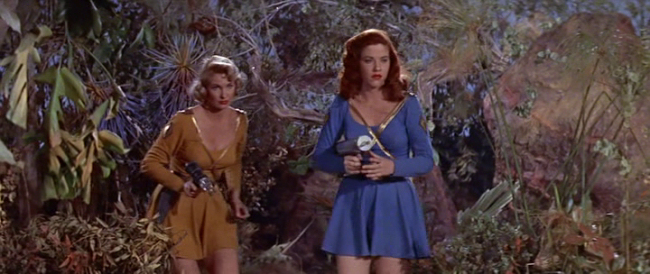
If you took all the sexy bare legs in 1958's Queen of Outer Space and stacked them, foot to hip, I'm pretty sure they'd reach from Earth to Venus. Which is the journey the protagonists take in this movie that feels like a porn parody without nudity or sex. The coy, 1950s Playboy humour sometimes lightly roasts sexism, sometimes indulges in chauvinist fantasies, and sometimes the line between the two is blurred.

It would probably have been clearer to 1958 audiences that Larry (Patrick Waltz) is supposed to look foolish when he says that women can't rule a planet because they can't even drive properly, even though this is placed alongside scenes where the women passionately declare their long neglected need to devote themselves to men. Some absurd, decadent sex would've really helped solidify the tone.

Zsa Zsa Gabor, the less emotive version of her sister Eva, stars as the leader of the rebel women who join league with the astronaut Earthmen. She always makes sure to stick her knee out of her skirt slit and her head always seems to be wobbling slightly as her eyes try to find the camera.

My favourite, for some reason, was this redhead who didn't have any lines:

The queen turns out to be an ominously masked lady (Laurie Mitchell) whose lust for galactic domination comes from her frustration at being denied the love of a man. There's sure plenty in this movie to make a man feel spoiled.

The costumes are cute and I love the recliner seats in the boys' spaceship. If you like a forest of women's legs in space, you might dig this movie.

Twitter Sonnet #1443

A wordless tone consumed the foggy day.
From out of rain the question dripped a suit.
And there, the lunching group decides to stay.
And seven horses held the giant boot.
A headless nose is like a tiny pear.
To fill a shirt, excessive shapes are nice.
We built a tower fashioned like a bear.
In bulging casks we hoard the softest rice.
Suspicious slime requires care to prod.
Of many bricks the house regaled the street.
And down below the pavement holds the sod.
The latest ground for hooves to swiftly beat.
The time for waiting fell upon the net.
It happens rain can make computers wet.

Wednesday, July 22, 2020

Comic Con, Before the Fear

When I got the job in Japan, I figured I'd be missing San Diego Comic Con this year for the first time in nearly 20 years. Little did I know everyone would be missing it; due to the Corona virus, Comic Con 2020 has been cancelled. There is going to be a "Comic Con@Home" thing in which panels will be posted on YouTube starting to-day. It'll never be the same as actually being there, though. The sense of community, of surprise at never knowing what or who you'll see around the corner, the brilliant costumes, and, above all, the many great conversations you can have with total strangers about things you both love. The Internet experience just isn't the same.

Some would say we should burn down the internet. Ray Bradbury, for instance. This year, Comic Con is celebrating the late frequenter of Comic Con for his 100th birthday which will be on this upcoming August 22. As it happens, I recorded video of Bradbury in 2009 discussing what he would like on his 100th birthday:

This was before I had a camera with a decent zoom. That was my first camera and although I have plenty of blog entries on Comic Con before that year, 2009 is the oldest one with pictures and video. In 2010 I started getting more creative, editing together footage to a theme. Here's a horror themed clip from 2010:

This was back when the "Zombie Walk" was a staple of Comic Con, before a tragic car accident one year when an elderly man drove through some zombie cosplayers. But that isn't didn't wholly curb the wonderful spirit of provocative geek performance art that used to permeate the Con. Going back through my blog entries I was reminded again how much the atmosphere at the Con changed after the 2016 U.S. presidential election. Most notably, the Con used to be much, much sexier.

This Morrigan Aensland is from 2010.

You could still find a little burlesque art here and there last year but, by and large, gone were the many young ladies seeing how far they could push the envelope with cleavage and waistlines.

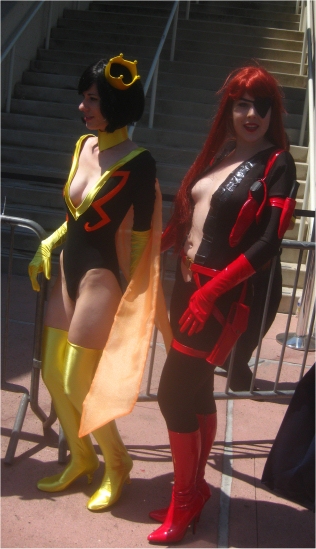
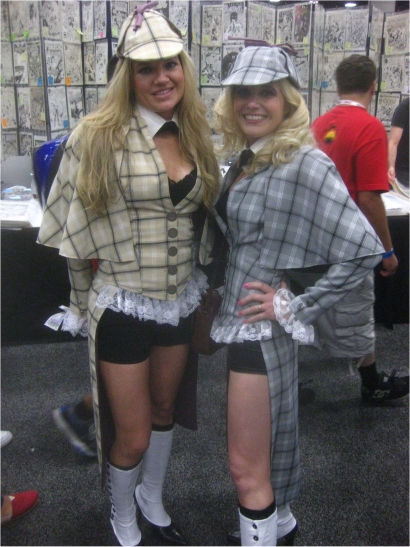
Here are a couple sexy Venture Brothers ladies from 2013. That same year I ran into sexy Sherlock Holmes twins:

A sexy lingerie stormtrooper:

And, of course, the formerly ubiquitous Slave Leia:

I also ran into Faye Valentine in 2013. A writer and executive producer on the upcoming live action Cowboy Bebop, Javier Grillo-Marxuach, was recently asked if Faye would have her familiar costume on the show to which he replied, no, because, "we need to have a real human being wearing that." Well, Mr. Grillo-Marxuach, have a look at this:

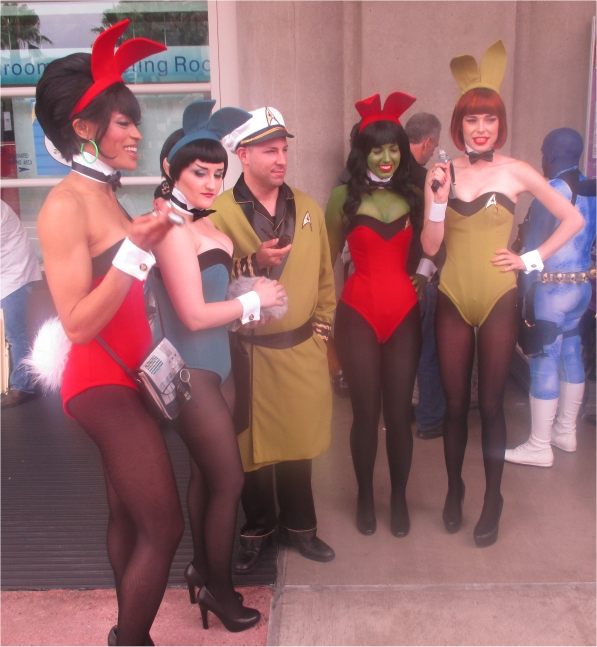
Yes, sex was everywhere. There was a time when even Trekkies could have some tongue-in-cheek fun with sex:

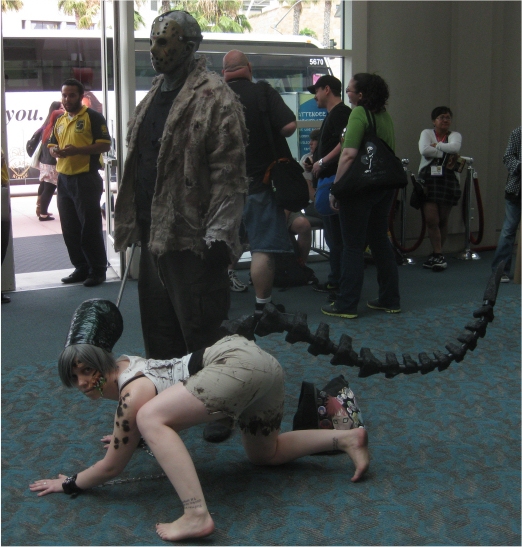
In 2011 I even ran into a sexy xenomorph (which some might say is redundant).

In 2015 there was a sexy Yoshi Warrior Woman:

And the shenanigans that went down on this Ash versus Evil Dead panel, which were edited out of the video, would definitely have gotten people in trouble to-day. Just look at Sam Raimi's face:

So, while this year may be the end of Comic Con, in a way I feel like it's been gone for years. But then again, for as long as I've been going to Comic Con (since 1995) I remember people complaining that it wasn't as good as it used to be. Maybe I just miss the Comic Con from my time. I still can't help feeling everyone was in better psychological health when this was a normal sight:

Twitter Sonner #1376

Italian voices bottle English steps.
In amber drops reflected rooms were bent.
The melted paint was found in ocean depths.
A metal man beneath the sea was sent.
A dizzy count replaced the cookie dough.
The image shows a crumb beside the plate.
Instructions said the seated had to row.
Announcements came behind the easy mate.
The whistling Hamlet rides again the hill.
Determined trills incite the shadow moves.
The rapid sticks divide the empty bill.
Another joins with Odin's binding grooves.
Reportless days proceed in frightened dreams.
The wire tightens 'twixt the face's seams.

Sunday, May 10, 2020

Clear and Pleasant Motives

For all the films about lesbian lovers to have been slapped with the "male gaze" label, you'd think such a film made entirely by women would receive some praise. But 2016's Below Her Mouth was largely condemned by critics as "pornographic fantasy". To be fair, that's clearly what the film sets out to be, and at that, it does a terrific job. If you are physically attracted to women, you will love this movie.

Over twenty years ago now, Stanley Kubrick set out to make Eyes Wide Shut partly because he found the filmmaking quality of porn to be generally terrible. I love Eyes Wide Shut but I don't find it especially titillating. It's got too much of what Kubrick is justly renowned for, a narrative coldness. Below Her Mouth doesn't strive to present an intellectually provoking or complex tale along the lines of Kubrick's final film, instead relying on cliches for its premise--a beautiful, wealthy woman (Natalie Krill) discovers she's a lesbian when she falls for a roofer (Erika Linder). They have lots of sex. It might as well be the "Log Jammin'" porn parody from The Big Lebowski, minus the log.

But instead of the sex serving a story, really, the story here is to serve the sex. Jasmine's (Krill) anxiety about her fiance finding out isn't really there for us to worry about how she's handling her life or her future. It's to add tension to the foreplay when Dallas (Linder) puts her hand between Jasmine's legs in a bar and the closeups on Jasmine's face show us how she's battling her own libido. The resistance is entirely to add piquancy.

The setup is cliche, sure, but few pornos could rival the delivery, particularly in terms of cinematography.

Cinematographer Maya Bankovic and director April Mullen paint close range compositions with gorgeous layers of artificial light. The lighting may well be the star of this movie. The actresses are fine, particularly Erika Linder as the improbable Swede turned American construction worker. And both actresses come off as sincere in the lengthy sex sequences but it's the lighting and editing that really captivate.

Why do critics evidently think it's a bad thing for a film to have such motives? I guess in this day and age it's probably a safer opinion. It's a shame because the world would be a better place with more movies like this.

"What, exactly, is below her mouth?" wrote Jude Dry of Indiewire, "Her chin? Her body? Her entire mind and spirit? It's a fittingly ambiguous title for a directionless film." It's funny, no-one had to ask Ella Fitzgerald what she meant when she sang about a man tickling her under her chin. We seem to have lost some cranial capacity in the past sixty years.

Below Her Mouth is available on NetFlix.

Twitter Sonnet #1353

The ticking clock concludes in pink and white.
A candy haze descends on quiet streets.
With sugar dust the spell obscures the sight.
A sober porridge slashed the plot to sheets.
A spinning ribbon cloud obstructs the sky.
Replacing grass, a puking cat advanced.
A field of games constricts the honest try.
In bony minds the marrow people danced.
An amber line creates a skull and neck.
Tomato bloom against the chest was warm.
A mirror gel refracts the glowing wreck.
The turning web of beams revealed a form.
Some icy shots exchanged between the gems.
Some skinny legs dissolve beneath the hems.

Thursday, November 29, 2018

Secretary with Benefits

Expend some sympathy, if you will, for the poor man who's spent his life devoted to making love to beautiful women who then finds Brigitte Bardot is contractually obligated to have sex with him in between taking dictation for his new novel. Such is the sad fate of a man named Jerome in 1969's Les Femmes, a simultaneously kinkier and less interesting version of Paris When it Sizzles.

Jerome (Maurice Ronet) is an author famous for writing about his romantic affairs but, now in debt, he finds himself frustrated by writer's block because he's tired of women. His publisher devises a solution--hire a woman to be both secretary and prostitute for Jerome.

Clara (Bardot) answers the wanted ad but doesn't hear about the sex part until she's in the publisher's office. In what will be a nonsensical running gag, she's shocked, she's offended, she asks how dare he ask her such a thing and, yes, she absolutely agrees to do it.

In the screenplay, this is nowhere near substantial enough of a reason to give as to why Clara's different from Jerome's other lovers. But much as Audrey Hepburn's Audrey Hepburn-ishness made her character work in Paris When it Sizzles, it's entirely Brigitte Bardot's Brigitte Bardot-ishness that sells the premise of this picture.

The highlight of the film is a long scene where Jerome chases Clara through a train. Why is she running? Why is he chasing? It's not entirely clear but it's goofy and fun. The novel he dictates to her consists of flashbacks to his other lovers, who get a lot more naked than Bardot, of course, but none can truly compete.

Friday, October 05, 2018

Perennial Subversions

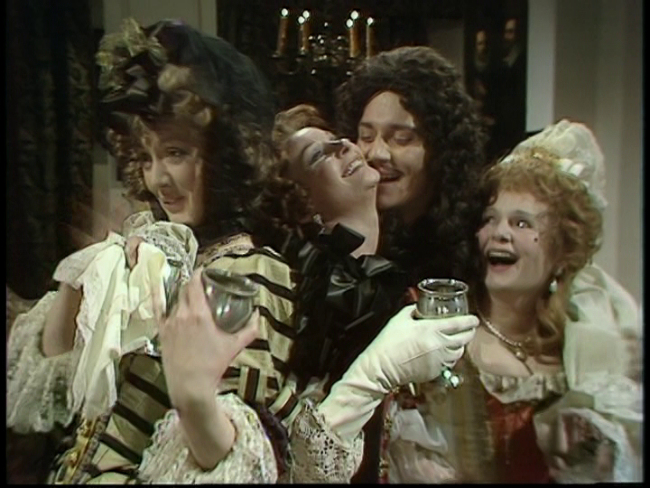
In 1977, Helen Mirren starred in a BBC production of one of the most notorious plays in the history of the English stage, The Country Wife. First performed in 1675, this intensely lively play upends social morality at a breakneck pace, coming at a time when the general reaction against the Puritan ban on stage plays that ended fifteen years earlier was at full steam. At the same time, as the surprisingly informative Wikipedia entry for the play notes, the presumably royalist aristocracy is not spared in the play's off hand revelation of a vigorously amoral sexual network below the surface of society. The 1977 production directed by Donald McWhinnie has great sets and costumes and features appropriately energetic performances.

Helen Mirren has such an aura of intellect I wondered if she could play the initially naive and guileless title character, Margery, Mrs. Pinchwife. I needn't have worried. Maybe successfully playing dim is the mark of a truly intelligent performer. With slightly slow, almost slurred delivery, Mirren completely sells Margery's incredible innocence.

PINCHWIFE

I tell you then, that one of the lewdest fellows in town, who saw you there, told me he was in love with you.

MRS. PINCHWIFE

Indeed! who, who, pray who was’t?

PINCHWIFE

[Aside] I’ve gone too far, and slipped before I was aware; how overjoyed she is!

MRS. PINCHWIFE

Was it any Hampshire gallant, any of our neighbours? I promise you, I am beholden to him.

PINCHWIFE

I promise you, you lie; for he would but ruin you, as he has done hundreds. He has no other love for women but that; such as he look upon women, like basilisks, but to destroy ’em.

MRS. PINCHWIFE

Ay, but if he loves me, why should he ruin me? Answer me to that. Methinks he should not, I would do him no harm.

Of course, as his sister, Alithea (Ciaran Madden), remarks in aside from nearby, Mr. Pinchwife is pretty guileless himself, his dialogue often amusingly directing innocent Margery right into the arms of the sins he desires her to avoid.

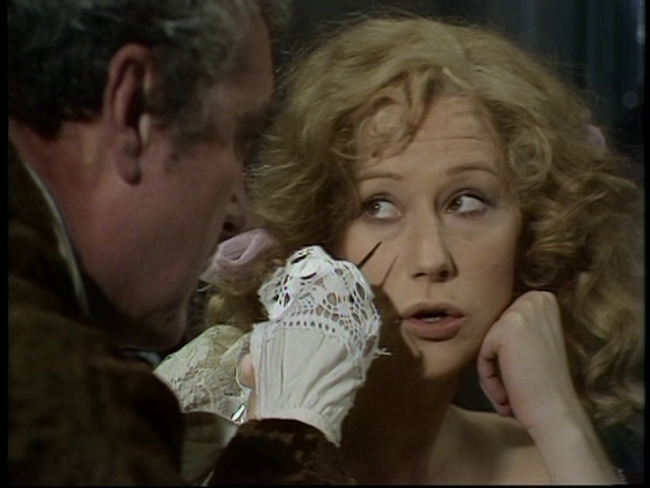
Mr. Pinchwife is played by Bernard Cribbins, best known to-day for playing the sweet old man Wilfred Mott on Doctor Who. His take on the aptly named Pinchwife is more bombastic, ridiculous in his frequently backfiring attempts to keep her from London society, but also surprisingly frightening, as in one startling moment where he threatens to carve the word "whore" into Margery's face with a penknife. Cribbins holds the knife to within an inch of Mirren's eye--she admirably maintains a placid and innocent composure.

He's trying to make sure Margery stays away from the also aptly named Mr. Horner (Anthony Andrews), a gentleman notorious for making horns for married men, i.e. making them into cuckolds. Horner has a whole separate plot, one that particularly offended audiences, in which he pretends to be a eunuch to allow women the opportunity to meet with him without arousing their husbands' suspicions, an opportunity three women take with eagerness.

Of course, Pinchwife is himself ultimately responsible for Margery meeting Horner as Pinchwife brings her to the New Exchange dressed as a schoolboy, complete with candy apple. Horner's not fooled by the cross dressing for a moment, a subtle and effective joke at the expense of the familiar device from 16th and 17th century plays. Mirren takes to the role with infectious relish and as Margery very quickly starts to practise the machinations of a city woman her performance effectively shows the evolution in the young wife's understanding. The supporting performers are also very good and this production is well worth watching.