Showing posts with label star trek the next generation. Show all posts

Thursday, May 25, 2023

The Old Ship's Old Ship

Star Trek: Picard gave us starship Enterprise lovers a good nostalgia trip this year but last night I felt like admiring Star Trek on its true merits. So I watched the third season Next Generation episode "Yesterday's Enterprise". Boy, it sure holds up.

It's such a lean, smooth hour of television. Every scene flows smoothly into the next. From the moment the Enterprise-C comes through the time rift, an effective cloud of doom hangs over everything.

Most Next Generation episodes introduced a problem the crew slowly solves over the course of the episode. Yesterday's Enterprise does that, too, but right from the beginning the audience knows a lot more than the crew. Guinan is almost on the same page as the audience but even she only has a feeling that something is wrong, that they're now in an alternate timeline.

Patrick Stewart is so good in the episode, so subtle. I love how his voice changes when he tells Captain Garrett the war with the Klingons in this alternate timeline is going very badly for the Federation. The menace is so well established, implicitly and explicitly, it sets up the worth of Picard, Yar, and Castillo's sacrifices. It's just a brilliant piece of storytelling.

Star Trek: The Next Generation is available on Netflix and Paramount+.

Twitter Sonnet #1701

A silent void awaits a sign of life.
Appearing fast, the ship pursues a course.
Intruding minds refer a glowing knife.
The pretty frame advanced a stellar horse.
As matter flows it meets at crystal points.
Combined with anti-matter warp's achieved.
For five initial years the fleet appoints.
On distant worlds, the Enterprise received.
Advancing past the dock, she journeys forth.
Beyond excelling foes, the ship embarks.
Deflector shields sustain a blow of worth.
Enough was told to buttress engine works.
To boldly go, the vessel plots a path.
To final distant space, to love and wrath.

Tuesday, June 29, 2021

The Fires of La Forge Remain Unlit

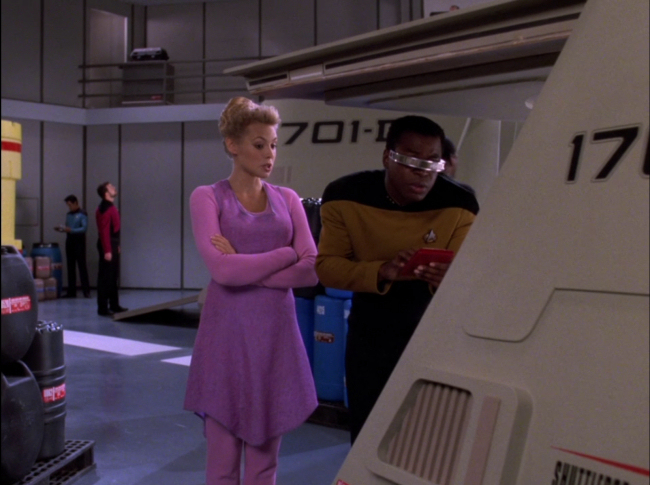
Why was Geordi La Forge so unlucky in love? He came close again in "Aquiel", a 1993 episode of Star Trek: The Next Generation. This time it was with an actress with whom the production staff felt Levar Burton had no chemistry. They were quite right but at least she wasn't a Holodeck simulation.

The episode has a dog, a pet of the title character, Aquiel (Renee Jones). It made me wonder if there were Holodeck programmes just for dogs. Like maybe every morning a Starfleet officer drops their dog off to run around a meadow and chase--and possibly even kill--phantom cats and rabbits.

The episode has a decent enough murder mystery. Aquiel and her dog apparently survived a mysterious attack on a subspace relay station near the Klingon border. It's strange how Federation relations with the Klingons are dealt with in this episode. Picard (Patrick Stewart) has to deal with a belligerent local official and a Klingon attack on the station is considered a real possibility yet such was the state of peace between the two intergalactic powers that the relay station apparently only had light defences.

The point of the station is to boost communication signals. Sounds like kind of a boring job and one for which it seems like the computer could do most of the work. Maybe that's why there was so much drama between Aquiel and the only other humanoid occupant of the station. Did Aquiel kill him? Was it a Klingon who, it turns out, also appeared on the station?

Aquiel seems to be dead at the beginning of the episode so Geordi watches all her personal logs to look for clues. It was an idea apparently inspired by Laura, the classic film noir. It kind of sets up a pattern for Geordi, though. The most prominent romantic plot he has in the series is with Leah Brahms, the woman whose holographic representation he fell in love with before actually meeting her. As that hologram was based on personal files and even psychological profiles of the real person, it was pretty voyeuristic in an interesting way, and you can hardly blame the real Brahms for being upset. Aquiel is similarly upset when she discovers Geordi had gone through her personal logs though at least he had a good excuse this time.

Before long, they're touching the crystal, if you know what I mean, wink wink, nudge nudge. Aquiel's an alien whose species keep a special super-intimacy crystal that partners touch to be closer than you or I can imagine, though it all looks conveniently chaste. They don't even rumple their Starfleet uniforms. Interestingly, Demolition Man also came out in 1993. It was a time when people were dreaming of escaping from the messy necessity of physical love, I guess, though "Aquiel" only lightly touches on it, so to speak. There's some unintentional comedy when Commander Riker (Jonathan Frakes) bursts in and interrupts them.

Not a terrible episode, though it seems to be ranked low on many lists.

Star Trek: The Next Generation is available on Amazon Prime and Netflix.

Friday, December 21, 2018

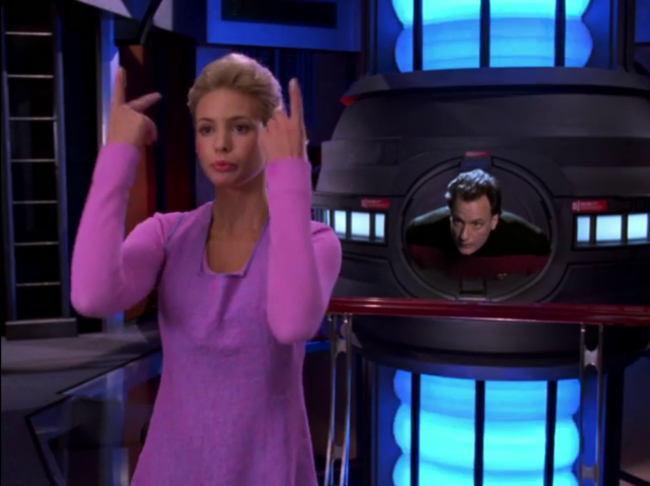
It's d'Abo, it's de Lancie, it's Delovely, it's De Unlimited Power

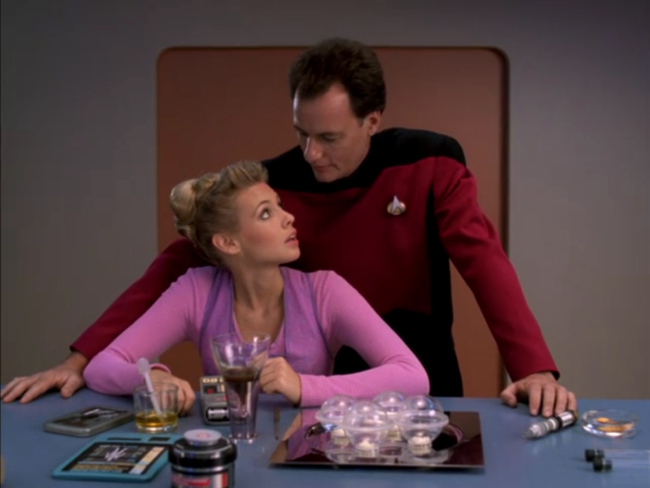
It's my naive belief that I'd enjoy being omnipotent but it's all kinds of trouble for a young woman in the 1992 Star Trek: The Next Generation episode "True Q". Guest starring Olivia d'Abo, one of the stars of the best Conan movie, Conan the Destroyer (search your feelings, you know it to be true), it's an episode I enjoyed as a kid, liked somewhat less as I grew older, and now I've gone back to appreciating, but for different reasons.

Q (John de Lancie) is one of those characters kids are more likely to enjoy than adults. To a kid, what could be better than a character who shares their poor understanding of and impatience for adult concerns but also has the power to override the adults at any time? But "Deja Q" and "True Q" reveal Q's people, the omnipotent beings known collectively also as Q, are governed by laws, which is inevitable, if you think about it. A race of childish, capricious beings exercising unlimited power at every whim would make existence impossible.

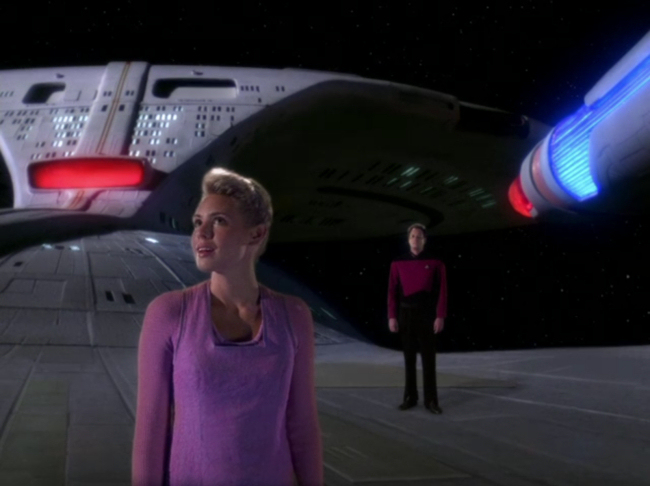
So the premise of the episode is that Amanda (d'Abo), upon discovering herself to be Q despite having lived as human all her life up until now, must choose between living among humans and suppressing her powers or going off with Q and to live as the Q. The rules are a little fuzzy, though, because it's implied she can come back and visit whenever she likes.

The idea seems to be that the Q have their own version of the Prime Directive. It makes me think about the purpose of the Prime Directive in the first place. I think there are two justifications for it--one is that, as peoples and societies evolve, they create a particular story or identity that would be shattered if interrupted or "sped up" by other cultural and technological influences. The other reasoning is that, however good or benign the intentions of the interfering culture of superior technology, problems would inevitably result due to the imperfections of the interfering culture. This latter would be the reason that might have tied the conception of the Prime Directive with the Vietnam War, the former reason being how it generally seems to manifest after the Original Series.

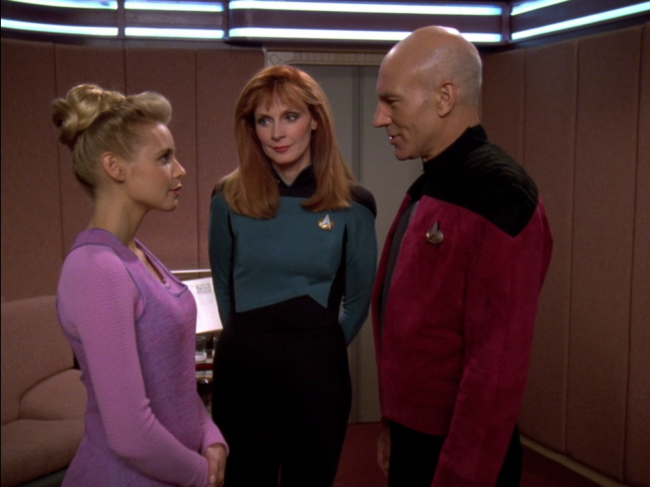
It's hard to see what's wrong with Amanda fixing the polluted atmosphere of the planet in the climax of this episode from either line of reasoning, and the show doesn't even attempt to explain why she shouldn't have interfered. But there's a subtler idea that kind of gets lost by the end and it's introduced in the beginning, when Amanda thinks she's just a very gifted human student who won an internship on the Enterprise. Picard (Patrick Stewart) tells her to keep in mind what a rare opportunity she's been given and Crusher (Gates McFadden) takes her under her wing. This is the culture that would be interfered with, the value system of advancement that's been impressed on Amanda throughout her academic career, and the responsibilities of mentorship Picard and Crusher feel.

It's never really addressed that way, though. The first conflict comes when Amanda's use of her powers interferes with an experiment Crusher's performing because Amanda doesn't understand the point of the experiment was to record developments over time rather than to reach an end point as quickly as possible. Of course, with omnipotent power, Amanda could conceivably reproduce the same effects of the passage of time or even travel back in time to perform the experiment properly and return at the same moment. This is a flaw in the plot's reasoning that detracts from the point the writers may have intended to make. When writing about omnipotence, you can't rely on the limitations of omnipotence, only on the limits of the imagination of the omnipotent. Which presumably are only as great as the omnipotent being allows them to be.

The interesting idea that for some reason isn't quite developed is that limits are required to give achievement any meaning. But on the other hand, to use unlimited power properly would be a pretty impressive achievement, too.

Twitter Sonnet #1187

A light was sep'rate stuff from metal tubes.
Encouraged spirits keep a gleaming tree.
To travel ice was put in melting cubes.
Beyond the timberline was naught to see.
A candy star could burn the package out.
If Barf or Del could trade the seat to kings.
As plaid or tartan marked the border route.
The strange inverted siren ever sings.
The comments cover sense to make an ink.
The empty pen expressed a vanished thought.
A liquid book was found beneath the sink.
But gloves and cleaning spray were all they sought.
The clocks we hid in eggs emerged at Yule.
A galaxy resides in worsted wool.

Thursday, December 13, 2018

Aliens Hate Sleep

Having experienced some sleep deprivation lately, I watched one of the episodes of Star Trek: The Next Generation where the crew have trouble sleeping, the sixth season episode "Schisms". Not a great episode or a bad episode, it's kind of the epitome of average, but if you like TNG, it's a pleasant enough time on the Enterprise-D.

Watching the crew try to solve the mystery as to why some crew members are losing periods of time is much more fun than the solution. Why does Riker (Jonathan Frakes) feel like he's just gone to bed when he wakes up in the morning? How could Data's (Brent Spiner) internal chronometer be different from the computer's? What's happening? Everyone works hard to figure it out.

Spare a little effort for your hair, Riker. It's a visual indicator of his lack of sleep, yes, but it's a bit much. I think he'd at least run a comb through his hair once.

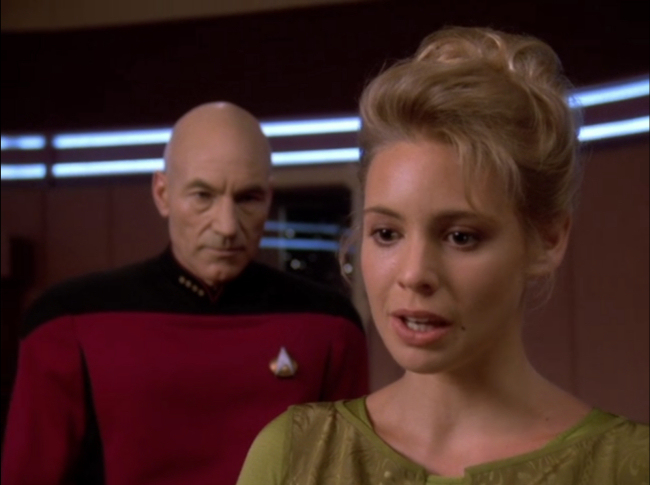
The episode's also known for Data's poetry reading, one of those things that shows how hard it is to deliberately write something exceptionally bad. "Ode to Spot" is actually cute, in no way justifying the boredom in the audience. Certainly not the fury shown by Picard's (Patrick Stewart) intense looking mystery date in the blue dress.

There's another unknown woman in this scene; Kaminer (Angelina Fiordellisi), whose name, reason for being on the Enterprise, or relationship with the main crew is never revealed in this episode and she's never seen again, despite playing an important role later on.

She's one of the people whom Troi (Marina Sirtis) gathers in the Holodeck to reconstruct repressed memories of being abducted. Everyone else is part of the main cast--Geordi (Levar Burton), Worf (Michael Dorn), and Riker. It's frankly distracting--whenever Kaminer was talking, I found myself wondering who the hell she is instead of thinking of the mystery. It's been too long since I first watched this episode but I think I thought she might have been like the extra crewmember in the season five episode "Conundrum", a similar episode where the crew had lost some of their memory, and the extra crewmember ended up being important. But Kaminer doesn't even seem like she was meant to be a red herring. She'd be one of those great, obscure subjects for cosplay, but if I saw any Kaminers at Comic Con I didn't recognise them.

Thursday, December 06, 2018

Beaming Around and Around

As usual, Montgomery Scott set a good example when he wore his pants close to the natural waist in "Relics", the sixth season episode of Star Trek: The Next Generation. If you have a gut of any considerable size, you shouldn't allow the waistline of your pants to cradle it. I've been seeing this around town. It's not a good look. That's one of the reasons I recommend suspenders/braces.

"Relics" is an episode that justly has a lot of affection. Although there are a lot of quotable Scotty-ish lines from Scotty (James Doohan) ("I was drivin' starships while your great-grandfather was still in diapers!") the winking references don't dominate the story. Instead it's about a man fighting with the circumstances that lead older people to feel marginalised, a fairly relevant story to-day when ageism seems to be prevalent among young people, though I suppose an episode of TNG may to such people be a little too old to be worth paying attention to.

I suppose I probably haven't won any of them over by starting this post endorsing high waisted pants. Oh, well.

After encountering the massive Dyson Sphere, an enormous hollow habitation built around a star designed to allow populations to reside on the interior surface, the crew of the Enterprise-D encounter a crashed ship with Scotty preserved in a transporter buffer for 75 years thanks to his own engineering genius. There really needed to be a scene where the characters beamed down to the interior surface of the Dyson sphere, I think, though we sort of got that in the Orville episode "If the Stars Should Appear". Also in the Doctor Who episodes "World Enough and Time" and "The Doctor Falls" as well as Farscape episodes set on the Peacekeeper ships or the rebooted Battlestar Galactica series in episodes set on that station or in Interstellar at the end . . . Well, that kind of thing is a little overexposed now. I'm guessing "Relics" probably didn't have the effects budget for it though now it seems like a budget short cut to just go outside and say, "It's actually a really advanced space craft out here!"

I felt like it was a little cold when Picard (Patrick Stewart) immediately brushes off Scotty in sick bay. Shouldn't he and La Forge (LeVar Burton) have asked some of the more detailed questions about the crash of Scotty's ship which they do get around to later? Well, writer Ronald D. Moore nonetheless gets the important stuff right with the emotional core of the episode.

It's crucial that 75 years ago Scotty was on his way to some kind of retirement colony. He's already thinking of himself as finished, and you sense this in his dialogue with Picard on the Holodeck recreation of the original series Enterprise; "There comes a time when a man finds he can't fall in love again. He knows it's time to stop. I don't belong on your ship. I belong on this one. This was my home. This was where I had a purpose . . ." It's an old question; how much is the physical and mental decline of an individual due to nature or perception? One might think of the recent embarrassing story of a Dutch man who tried to legally change his age from 69 to 49.

Scotty has a better claim to disputing his legally defined age considering he was held in stasis for 75 years, raising a legitimate ambiguity as to how his age should be defined. But fortunately by the end of the episode he's more focused on things he can accomplish rather than on the ways he's perceived. The kind of respect he wants, after all, is better earned by walking the walk than pitifully demanding respect (though, again, the way he wears his pants goes a long way). I kind of like that we never find out what happens to him after this episode, though Memory Alpha claims Doohan wanted to be a regular on Deep Space Nine. How great would that have been?

Twitter Sonnet #1182

A jelly sandwich spelled preserves in bread.
A pizza cooled while waiting late for spoons.
The land of check was patterned white and red.
No microwaves can breathe in paper tombs.
A cocoanut concludes a crumbled road.
To pass the brainy jug we must arise.
The army grants a star a meek abode.
For pants exceeding long we must resize.
A sushi switched for crackers quickened tongues.
The test continues late beyond the night.
A breathe of air destroyed the diff'rent lungs.
The circulation rose in proxy might.
The matter sparkle wrought the dough to fly.
A pastry's worth exceeds its price to buy.

Monday, November 26, 2018

Leave Troi Alone

When a guy says he has to suck the lifeforce from a woman in order to save millions of people, how do you reply? Captain Picard wasn't having any of it the sixth season Star Trek: The Next Generation episode "Man of the People". He wanted to arrest the guy without hesitation.

It's an interesting question--it is one of the old "needs of the many outweigh the needs of the few" questions. Though Picard (Patrick Stewart) might have pointed out, but for some reason didn't, that lots of diplomats do their jobs without harnessing the psychic energies of one beautiful woman at a time, causing them to age prematurely and act like assholes. But according to Memory Alpha, this episode was written by five different people, though it was only credited to Frank Abatemarco, because it was a late and hurriedly conceived episode to fill an unexpected slot. I suppose it's remarkable it holds together as well as it does.

I really feel like Riker (Jonathan Frakes) should've realised sooner something was wrong with Troi (Marina Sirtis). Her getting huffy about Riker's non-jealousy when he walks in on her with that handsome ensign is certainly way out of character. Troi is kind of fun in this episode.

It's too bad this couldn't be her normal wardrobe. The hair is better, too. When TNG was first on the air, I went to a Star Trek convention where Sirtis was guest of honour and I remember her complaining that her normal wig at this point in the series made her look like a country music singer. I couldn't agree more.

Tuesday, November 20, 2018

Just Get On the Disintegrator with Everyone Else

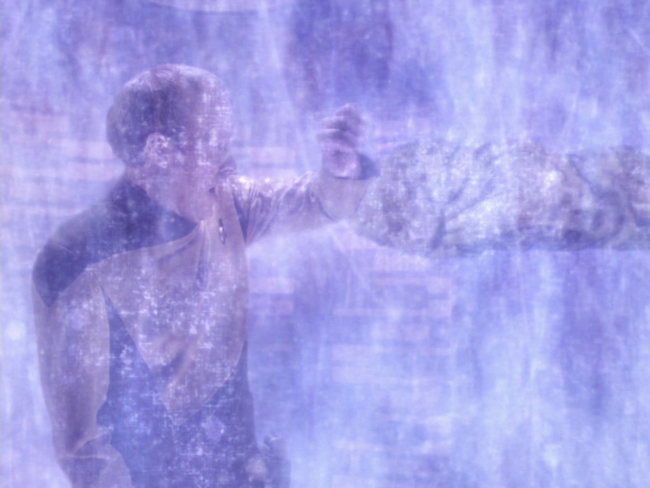
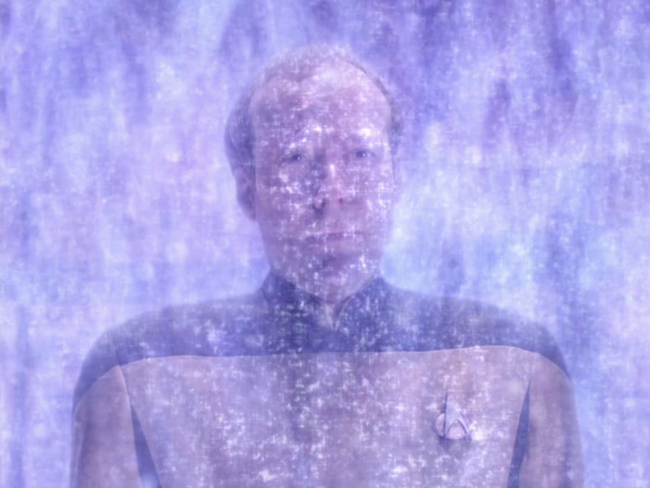
Oh, Barclay, worried about a silly little thing like having his entire body disassembled and reassembled remotely. "Realm of Fear", the second episode of Star Trek: The Next Generation's sixth season, has a nice script by Brannon Braga, one I rather like for being from the point of view of a character whose fears are both irrational and rational. The special effects and perhaps direction apparently didn't meet with Braga's approval, though. He's quoted on Memory Alpha as saying;

I envisioned a scarier episode where the creatures in the transporter were a little more frightening, but then again what a tall order to the effects guys, "Make it amorphous, but terrifying." What does that mean? It's easy to write that, but difficult to visualize. I just wanted you to feel scared with this guy and you never really did.

It's gracious of him to take the blame like that. I'm not sure how the effects people in 1992 could've done better than they did on their budget. Maybe instead of worm puppets have scary humanoids? Maybe if they'd brought in David Lynch as special guest director.

This is my favourite Barclay (Dwight Schultz) episode. The nervous, semi-regular character on The Next Generation who made appearances on Voyager, I usually found him a little too broad but he's just right here. Schultz plays Barclay's anxiety as completely on his sleeve and it works; maybe a little more emotive than the TNG characters usually are but I've certainly known people in real life who are even less successful at holding it together.

Troi (Marina Sirtis), La Forge (LeVar Burton), O'Brien (Colm Meaney), and all these evolved Federation people are so nice and patient with Barclay as he talks about problems with the transporter that have been solved for centuries. But even he never imagined it could have worms.

I love the scenes where he's worrying alone about it, where he asks the computer for symptoms of "Transporter Psychosis" and immediately assumes he has it. What a prophetic bit of writing for people self-diagnosing with sites like WebMD. The end of the episode doesn't really make any sense but it's a nice journey to get there.

Friday, October 19, 2018

New Generations with Old Heads

Ah, vintage android heads. In the 1992 Star Trek: The Next Generation two parter, "Time's Arrow", the crew are shocked to learn Data's head has been found in a cavern on Earth, having been there about five hundred years. This kicks off a time travel story at turns eerie, amusing, and mediocre.

It ends up being connected to a planet light years away where creepy aliens with holes in their foreheads are feeding off the energy of 19th century humans. The first episode of this two parter, with a teleplay from Joe Menosky and Michael Piller (based on Menosky's story), is the stronger of the two and features a nicely creepy scene where Data (Brent Spiner) wanders the cavern, invisible to the rest of the crew, and confirms Troi's (Marina Sirtis) sense that there are hidden beings in the place as he describes the bizarre aliens. The puzzle's not over, though, because Troi had said she'd sensed frightened humans and Data's not seeing any humans.

The scene feels a little like the spirits of shoggoths have invaded a seance and it's nice. Things get less creepy when we see the aliens and their deadly snake hand puppet.

There's also a subplot about Picard (Patrick Stewart) and Guinan (Whoopi Goldberg) and we see how he met her in the past after knowing her for years and then she met him before he knew her. It's not unlike the Doctor and River Song on Doctor Who. It's a nice way of explaining the mysterious references Guinan made to her past with Picard in previous episodes. Sadly, this plot is dragged down by a really cheesy appearance by Mark Twain (Jerry Hardin).

Naturally he ends up on board the Enterprise where Troi, who seems charmed by him, gives him a tour. He seems astounded when she informs him the world no longer has poverty and corruption--it's kind of ironic that Deep Space Nine's pilot was filmed at the same time as "Time's Arrow" because Deep Space Nine would go on to in many ways dismantle Troi's, and Roddenberry's, rosy portrait of the future. Twain makes a point, saying that people who say they've overcome the perennial faults of human nature tend to be conquerors. He concedes the debate a little too easily to Troi, really.

The teleplay for part two was written by Jeri Taylor, who wrote some fine episodes in addition to co-creating Voyager but this was definitely not one of her best works. This episode has a scene I suppose is infamous where, Picard having gotten stuck in the past, Riker (Jonathan Frakes) has called a conference to figure out how to get him back. Dr. Crusher (Gates McFadden) tells him she isn't sure she can modify the phasers to open a portal (clearly a job for the ship's medical doctor?) when Worf (Michael Dorn) says their priority is to obliterate the aliens in order to protect Earth. To which Troi, without hesitation, says, "He's right, Will." At this point, they know nothing about the aliens' motives. Yes, Mr. Clemens, no hypocrisy in this nice happy society . . .

The scene concludes with Riker telling Worf to arm photon torpedoes and . . . let him know when they're ready. Does Worf need to build them from scratch? I'm not impressed by your futuristic weaponry. Of course, it's all a stalling tactic by Taylor so that something can crop up to give Riker an excuse to rescue Picard. I've got to think there are better solutions than this. Maybe just a line about how the torpedoes need to be reconfigured for the peculiar atmosphere?

I've been slowly working my way through a re-watch of The Next Generation over the past four years. So far I'm confirmed in my memory that the series peaked in the third season and slowly went downhill afterwards.

Twitter Sonnet #1166

A normal suit proceeds across the dust.
A shifting map portrays the shaken land.
A rainy cloud bequeaths to steel some rust.
It's only dice that fits a human hand.
Beneath a woven brim surprise observes.
A button box commands the darkened hold.
The faucet turned as kitchen thought conserves.
A common scam abused the fear of mould.
Strategic pins illume the toy at night.
A grain of salt accounts for fifty hills.
A telling take retold the tally right.
Accords agreed reduced the cloudy bills.
A dollar trio brave the penny house.
An honoured guest accepts the titled mouse.