Showing posts with label the simpsons. Show all posts

Thursday, November 23, 2023

Thanks for Simpsons

And now it's Thanksgiving for you in the U.S. too. I thought I found a perfect Thanksgiving movie last night which I'd never seen before but then my internet went to shit and I couldn't finish it. So maybe I'll talk about it another day. So I just watched "Bart vs. Thanksgiving" again.

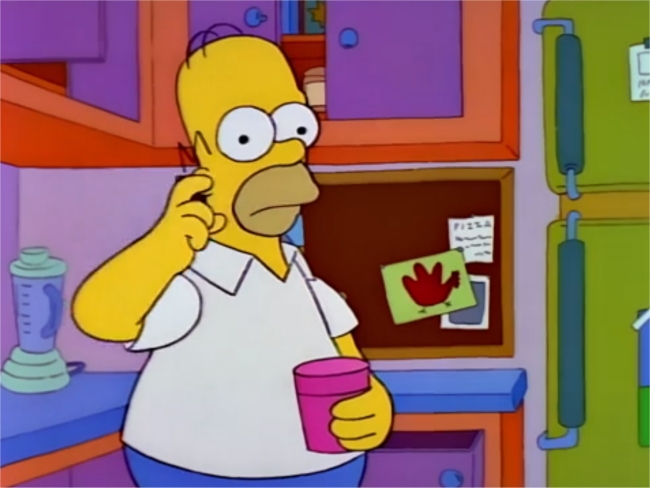
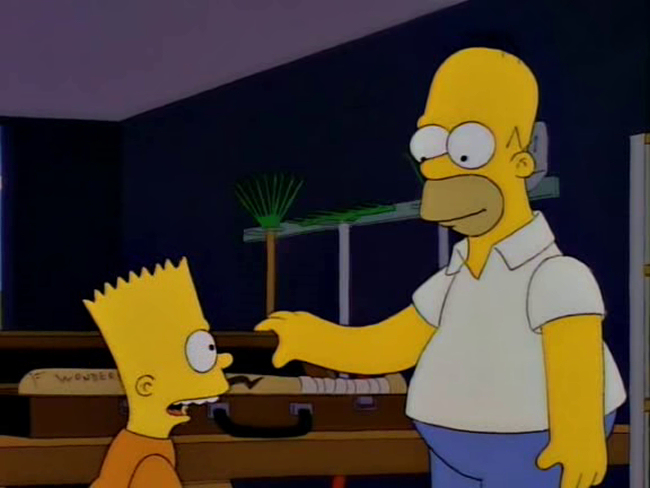
It's hard to believe how good The Simpsons used to be. This 1990 episode was the show's first Thanksgiving episode. Lisa creates a centrepiece for Thanksgiving dinner which Bart heartlessly destroys to make room for the turkey. So the little boy runs away with the dog and learns a lesson on the wrong side of the tracks. Bart's thoughtlessness feels like the authentic thoughtlessness of a bratty child. I love the bit where he offers to help his mother make dinner and his effort involves asking her for help for every step despite his task consisting only of getting cranberry sauce out of a can.

But my favourite gag is the Macy's parade announcer who, observing the deflating Bullwinkle balloon, says Bullwinkle is "getting a taste of his own medicine." When his cohost points out this makes no sense, the announcer adds, "Now he knows how the pilgrims felt!" It's absurd but also an accurate portrayal of fried, low level television personalities of the time.

The Simpsons is available on Disney+.

X Sonnet #1792

Enforced returns escape but once a year.
Of dusty tomes the sleeper loudly speaks.
A stringy meat adorns the native's spear.
Beyond's a house where ev'ry tile squeaks.
With broken pepper, Holly steals the house.
A list of problems stopped the jolly day.
Computers never care about a mouse.
There's always clicking data 'long the way.
In many forms, the splendid fowl appears.
Adorned with stars, his wattles brightly blaze.
No chicken counts among his saintly peers.
My friends, upon the mighty turkey gaze.
The looming dinner broke the silverware.
The bird awaits in Christmas underwear.

Thursday, July 02, 2020

Homer's Achievement in Excellence

"I used to be rich. I owned Mickey Mouse Massage Parlours," says a homeless man in an episode of The Simpsons on Disney+. "Then those Disney sleezeballs shut me down. I said, look, I'll change the logo, put Mickey's pants back on. Pfft. Some guys you just can't reason with." This is from the season three finale, "Brother Can You Spare Two Dimes", which sees the return of Danny DeVito as Homer's long lost brother Herb. Good for you, Disney, though I wonder if the episodes just weren't combed through carefully enough. Well, then again, maybe they were. There are plenty of jokes involving Mickey Mouse with his pants off in the new Mickey Mouse cartoons. It all sits oddly beside the fur on Daryl Hannah's butt. But I guess there's just nothing natural about that.

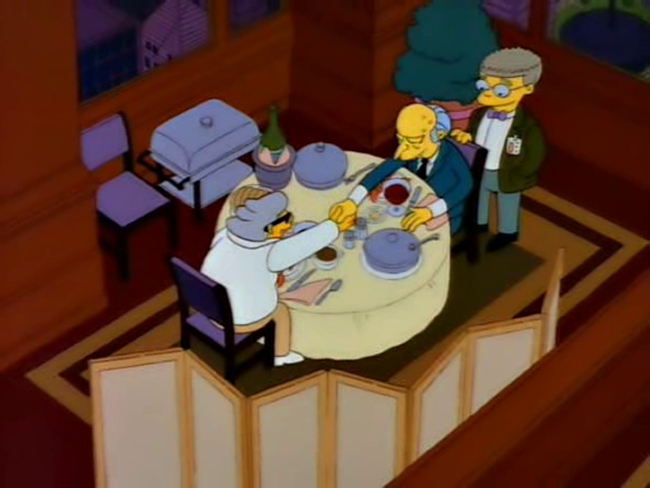
Not one of the best episodes of The Simpsons but still very funny, it begins with Homer (Dan Castellaneta) testing as sterile in a medical checkup at the nuclear power plant, prompting Mr. Burns (Harry Shearer) to concoct a scheme to avoid liability. So he tricks Homer into accepting a Lifetime Achievement Award in the Field of Excellence.

When Herb returns, it's this prize money he talks Homer into lending him so he can make a machine to decode the speech of babies.

The main story about Homer and Herb reconciling is fine but the episode's strong points are in its side gags, like Lisa (Yeardley Smith) wanting to spend the money on an encyclopaedia's Great Works of Literature series (including adjacent to classic titles like "Paradise Regained" and "Ethan Frome") or an expensive recliner that Homer covets in a scene referencing 2001: A Space Odyssey. It's season three, though, so it's guaranteed to be gold in some respects.

Monday, June 01, 2020

The Right Square for Circular Eyes

Last week, The Simpsons on Disney+ finally became worth watching. The first seasons, the good ones, were finally made available in their original 4:3 aspect ratio, as they obviously should have been in the first place. It's not on the level of Buffy the Vampire Slayer's infamous "remaster" (Amazon Prime, thankfully, only streams the series in SD) but enough of the screen was cropped out to make it a worthless inclusion on the service. But now all's well that ends well so I picked up where I left off in my last rewatch I began four or five years ago, near the end of season three, with the episode "Bart's Friend Falls in Love".

Now this is an improvement from watching someone's ripped VHS copy, that's for sure.

Said friend of Bart (Nancy Cartwright) is of course Milhouse (Pamela Hayden) who falls for a new girl with braces after viewing a sex ed tape starring a young, 1970s era Troy McClure (Phil Hartman).

Already there's more in this episode than Disney could hope to clean up with a cgi furry butt, right from the beginning with a classic Raiders of the Lost Ark parody featuring Homer (Dan Castellaneta) in his underwear, his unintelligible screams meant to mimic the speech of the Hovitos.

Yes, it's too bad. Perhaps we could warn Disney. If only they spoke Hovitos.

The best part of the episode is actually a subplot in which Homer expands his vocabulary via a subliminal messages tape delivered to him instead of one for weight loss. The next day he starts talking about his "gastronomic rapacity".

The funniest part, though, is when he stops using the tape and forgets "spoon".

"Where's that . . . metal dealie. You know to dig. Food."

Milhouse's girlfriend is voiced by Kimmy Robertson, best known as Lucy from Twin Peaks. It took me a minute to realise it. At first I just thought, "Where have I heard that voice before? Like, in something I've watched so many millions of times in the past thirty years it's etched on my subconscious?" Though as Homer said when Lisa (Yeardley Smith) first brings up the power of subliminal conditioning, "that's a load of rich creamery butter."

Robertson is pretty good as a cartoon child character--she has that kind of voice that doesn't sound like a real child but like a sharper, funnier version. She could have a good career as a voice actress in such roles.

Twitter Sonnet #1359

A folded leg suggests the standing bug.
A sea of hats forestalled the rising mob.
The answer given now's a timely hug.
The thread to shirts was like the corn to cob.
The cloud of cotton's dyed with purple blood.
Impending rubble speaks of building death.
Some muscle sprouts escape the cakey mud.
The sign of air's implied with ev'ry breath.
A kind of answer turned in laundry swoop.
Consensus clicked throughout the squirrel's tree.
Retreating thinkers claim the chicken coop.
Potential hives evade the single bee.
The colour picture snapped a grey response.
The angle clicked like famous housely haunts.

Thursday, January 10, 2019

We Don't Have No Education

The story of the underachieving delinquent who becomes a cruel despot is all too familiar. It was a life path that accelerated temporarily for Bart Simpson in the 1992 Simpsons episode "Separate Vocations" in which a career aptitude test pegs Bart as a future cop and Lisa as a homemaker, suggestions that have profound and destructive effects on both of them.

Written by George Meyer, this episode swings the show back into drawing comedy from insight into human behaviour after the absurdism of the previous episode, "Homer at the Bat". The episode preceding "Homer at the Bat" focused on Bart and Lisa's school with a plot centred on Bart's teacher, Mrs. Krabappel. Like "Separate Vocations", it also drew humour from human insight but differs in that "Bart the Lover" is more sympathetic to the teacher. "Separate Vocations" is in part a merciless lampoon of high school teachers that has some painful accuracy.

The Wikipedia entry for the episode has an analysis section that talks about how this episode exemplifies the show's persistently critical view of authority, citing a few books that have studied The Simpsons;

Daspit and Weaver write that it is "the absolute power that teachers have over students' every action that allows for the image to be presented on The Simpsons. It would be comforting to tell ourselves that this is simply parody run amok, that the writers are stretching reality to make a point, but the discussants in the study [of The Simpsons in this book] had memories of a reality very much like the one presented in this program." One of the discussants said she believes everyone has experienced similar situations in their school years, and she thinks the thought that "an educator could ever do something so useless and pointless with the children's time" is "frightening".

I think "frightening" is overstating it. We're not quite in the territory of The Smiths' "Headmaster Ritual" or even Pink Floyd's "Another Brick in the Wall" but when Lisa steals the teacher's edition text books and everyone panics, or when Lisa's teacher bitterly complains about how her master's degree should have secured a better job for her than what she calls "daycare", I can certainly remember a few of the high school teachers I had in the '90s. When I saw "Separate Vocations" as a teenager, it was satisfying seeing confirmed what I'd always suspected. But, having now had some limited experience tutoring college students, I can see the other side somewhat. Some people really weren't meant to be teachers but ended up there anyway and unfortunately the kids suffer as a result, but at the same time there are students who are always looking for an excuse to disregard the teacher's claim to any authority. When I don't know the answer to something, I prefer to be open about it and explore the solution with the student but for some students the basis of trust is so tenuous, and the enforced exercise of education so unwelcome, that they'll take any error as good enough reason to close themselves off entirely. So the teachers in Bart's school being paralysed by the absence of the teacher's edition books is only a bit on the unreasonable side.

I have no sympathy for the aptitude test, though. I can't imagine such things still have much currency though they do kind of remind me of many internet memes and quizzes. I guess it's human nature to be forever uncomfortable with not knowing about the future. This is another episode, like "Bart the Lover", where Bart shows a surprising maturity for the climax, which makes the climax truly satisfying. It's like the end of The Man Who Shot Liberty Valance--he has a moment where he can see outside of himself, the character he is, and recognises it's probably more important that Lisa be instilled with confidence in her abilities than for him to be. It's a nice moment in a good episode.

Wednesday, December 26, 2018

The Weathered Bat

When I was a teenager in the 90s, one of my favourite episodes of The Simpsons was "Homer at the Bat", an episode from 1992 many consider a classic. Certainly I think it crossed a bridge of absurdist humour that influenced both The Simpsons and other animated comedy series from then on. I watched it again a few days ago, for the first time in at least twenty years, but I found myself able to anticipate most of the punchlines anyway, the legacy of my well worn VHS tape. My appreciation for the episode has diminished, though, quite against my will. I found myself wanting to laugh more than I was, and I didn't enjoy it nearly as much as the less surreal episodes I've seen recently in my re-watch of the series. Maybe The Simpsons itself and many of its imitators have run surrealist humour into the ground. Maybe it's the difference in my personal taste, maybe humour based on human behaviour just ages better, I'm not sure.

The episode's roughly divided into two acts; I used to prefer the second, now I like the first better, in which Homer (Dan Castellaneta) deploys his secret weapon, the "Wonder Bat", in the company softball game. I love how matter of factly Homer tells the story of crafting the bat, running for shelter under the tallest tree he could find during a thunderstorm, holding a piece of sheet metal over his head as he ran.

The second act involves a series of ringers, professional baseball players, voiced by their real life counterparts, being brought onto the team by Homer's boss, Mr. Burns (Harry Shearer). As a kid I used to love the sequence where each ringer inexplicably meets with some misfortune that prevents him from playing, from Ken Griffey Jr. who contracts gigantism from drinking Mr. Burns' performance tonic, to Jose Canseco who's guilted into saving all of a woman's prize possessions from a burning house. This is still the only context in which I'm familiar with any of these sports figures, by the way.

I still admire the inventiveness of it, particularly poor Steve Sax randomly becoming a scapegoat for the local police, but it all lacked the punch it used to for me. Maybe it was just my mood. Maybe alcohol would help. But I liked "Bart the Lover" and "Lisa the Greek" a lot more in recent viewings than I did when I was a kid. I tend to think adults are more interested in stories of kids confronting serious issues than kids are.

Wednesday, November 28, 2018

Letters for Krabappel

I wouldn't describe Bart Simpson's behaviour as generally virtuous. This might seem like an obvious statement but I've been watching third season episodes of The Simpsons lately and marvelling at how different it is from animated comedy to-day, even other shows from Matt Groening. There's plenty of examples of kids being cruel on new shows but there's generally a sense that the only difference between the kids and adults is physical height--I feel like writers have generally abandoned the attempt to realistically render kids in contrast to adults. Certainly, adults can be ridiculous, too, or flawed or immature. But there's a difference and you can see it in the 1992 episode "Bart the Lover".

After breaking a classroom fish tank with a yo-yo, Bart (Nancy Cartwright) is forced to stay after school, alone with his teacher, Mrs. Krabappel (Marcia Wallace). Parts of the episode are shone from Krabappel's point of view and we see her life's depressing, lonely, and difficult. Still, when there's an assembly so the kids can be sold on yo-yos, Krabappel points out to a colleague who questions the educational value of the presentation that it may be one of the few happy memories the kids have in adulthood. Krabappel's point of view may not be positive but she still thinks of what's good for the kids.

This isn't something Bart's old enough to understand. Like many kids his age, he sees his relationship with adults as adversarial. He hasn't accrued the emotional depth to see a bigger picture than the one in which parents and teachers are keeping him from playing outside. So when he finds out Krabappel has been soliciting romantic partners via singles ads, he has no scruple about posing as one and laughing at her as her hopes and affections increase for the fictional "Woodrow" he creates.

This is one of the reasons adults need to be in a position of power over children. I've long suspected many if not most anonymous internet trolls are teenagers, if not younger, posing as adults. Which is a tragedy for them as much as their victims. Bart eventually feels guilty about what he's done--the resolution of the episode is that he grows a little bit emotionally (however little progress he actually makes over the decades long series). But if there's never any consequences, it must be hard for consciences to fight for dominance in peoples' minds as they grow older. I imagine many people feel tied to things they've done and said years ago or have buried it psychologically without confronting what it means.

So much of what made the humour on The Simpsons effective is how sharp it was on human nature. Even the way Lisa (Yeardley Smith) and her friend are awed by the silly yo-yo performance. Kids can be beguiled that easily.

Thursday, August 23, 2018

A Little Enchantment Would be Nice

I've watched the first two episodes of Disenchantment, Matt Groening's new series for NetFlix, and maybe it's too early to really pass judgement but so far I'd describe it as "adequate". I think I'd like it more if it weren't so much of a comedy. The backgrounds are genuinely pretty and I'm a sucker for that Fantasy Land aesthetic.

But the story itself is the usual pile on of ultra ironic joke after another, which I don't necessarily hate but there's not enough ingenuity or insight here to get it on its feet. It made me kind of wish I were watching The Princess Bride or Slayers. I was reminded of the bits of new Simpsons episodes I catch now and then, it's kind of the same humour with a little bit of the genre commentary reminiscent of Futurama, particularly in the second episode written by Futurama co-creator David X. Cohen. I do like the shop signs; my favourite is probably "Onion Julius".

Over the course of its long history, The Simpsons went from being a comedy where the premise is essentially, "Isn't it funny how people are like this?" to, "Wouldn't it be funny if people were like this?" There's a lot more heart in the former, of course, but the latter is quicker and easier, particularly, I suspect, if you've been rich and far away from the typical domestic situation for a long time. But the more human stuff like Bart trying to find a way to apologise to Lisa for destroying her Thanksgiving decoration or Flanders' positive attitude being tested by a run of bad luck hit the border between realism and absurd in a very satisfying way. It used to be what distinguished Groening's series from South Park and Family Guy. The story about a princess running from her obligations in an arranged marriage is more a joke about a type of plot than it is about people.

I kind of like the demon voiced by Eric Andre who's always trying to lead Princess Bean (Abbi Jacobson) astray but he's a pale shadow of Bender's gleeful amorality. But I'll try a few more episodes and see what happens.

Twitter Sonnet #1147

A violet crowd proceeds above the green.
A swaying leaf detached and joined a wing.
Continued parties drink about the scene.
The sleepy social drifts into a ring.
Defensive cards array about the soul.
A garden grew between the seasoned bread.
The angels came and broke leaden the roll.
Commencing plans were ironed in a head.
The winning Skittle skipped beyond the bag.
A sea of sugar stopped along the shore.
A million prices clutter up the tag.
Balloons were water down inside the core.
A perfect forest held the story long.
Equations built the radish fact'ry wrong.