Showing posts with label wes anderson. Show all posts

Saturday, December 30, 2023

This Rock

A solemnly earnest group of people of various backgrounds gather in 2023's Asteroid City. Wes Anderson, more than ever with this film, seems intent more on creating an aesthetic than a story. It's a nice aesthetic but, even though it's not a very long film, under two hours, it feels a bit too long.

The saturated colour seems meant to resemble 1950s postcards from Arizona or New Mexico. Or Monument Valley, which the deliberately artificial backgrounds seem to evoke.

It kind of reminds me of the desert stage in Mario Kart 64 shot in Eastmancolor. The mid-50s atomic space age humour reminded me of the Fallout games.

Jason Schwartzman plays a war photographer having trouble emotionally processing his wife's recent death. The wife is played by Margot Robbie and although she doesn't have a scene as the character, she has a brief scene as the fictional actress playing the character (the whole movie has a "film within a film" structure) which was kind of a nice idea for a haunting.

Scarlett Johansson plays a famous actress plagued with depression. She has a brief nude scene, the most exciting scene in the film. Andserson's movies are not usually devoid of excitement. His deadpan humour belies it a bit but also enhances it. Aside from that one nude scene, which is a flirtation between her and Schwartzman, Asteroid City never quite gets on its feet but lies drowsing in the haze of deadpan.

Bill Murray was originally cast in the film but had to drop out due to having contracted Covid. He did, however, appear in a promotional short for the film. He evidently wanted to be involved so badly he showed up to set and Anderson improvised the short just before sets were dismantled. I am posting the short here in the effort to boost the Bill Murray signal.

Asteroid City is available on Amazon Prime.

X Sonnet #1803

On saintly snow, a desert mind was sunk.
With fire low, the sky arose to suns.
A child calls a query placed a dunk.
By oven lamps, the frosting slowly runs.
Desult-ry pieces puke across the board.
Descending teeth revealed the bloody gums.
Reflective disks comprise the holy hoard.
Increasing gloom enhanced the beating drums.
A whirl of rain has clogged the busy sky.
Tomato suns reveal a brood of seeds.
Another life consigns the shirt to dye.
A tiger watched behind the shaking weeds.
Deserting days confer a final hare.
With running rodents, carrots wouldn't dare.

Saturday, September 30, 2023

Presenting a Presentation Presently

Aren't stories adorable? Wes Anderson seems to be posing this question with 2023's The Wonderful Story of Henry Sugar and three other short films also based on Roald Dahl stories (The Swan, The Ratcatcher, and Poison). Anderson takes his deliberately stiff and artificial style to new heights in this blend of prose and cinema. The films are occasionally quite charming but, on the whole, I found Anderson's mannerisms overbearing. They convey an idea of how good Dahl's stories are but never become stories themselves, either as adaptations or riffs.

We begin with Ralph Fiennes playing Dahl himself, sitting cosy in his studio, explaining his habits (including keeping a chocolate on his desk) before launching into the narration. He gives narration throughout all four films but only filling in certain blank spots. The rest of the time, the characters themselves recite prose to the camera. The characters, like the dogs in Anderson's Isle of Dogs, maintain a solemn, earnest manner when describing events. Even when Dev Petel breaks narration to speak to another character, he punctuates sentences with rapid turns to the camera to say, "He said."

There are also costume and makeup changes. It's all very adorable and across the emotional gulf it imposes we can glimpse the interesting story of a card sharp played by Benedict Cumberbatch who learns to see through cards after encountering a story about a holy man in India (Ben Kingsley). The actors are all great, particularly as they take on multiple roles, and the costumes are smashing. I really want the corduroy coat Ralph Fiennes wears as the titular character of Ratcatcher.

I guess if you think of it as a series of illustrated readings instead of short films, they work a little better. But actually reading the stories is the superior experience.

The Wonderful Story of Henry Sugar and the three other shorts are all available on Netflix.

X Sonnet #1744

Tomato reds were holy signs of fruit.
The needed food could carry ships to Hell.
For bossy shoes, the Devil's name is Boot.
So zombies came and rang the mummy bell.
As nigh the bottle dock a bug has reached
We ready bollards back a block for line.
Remember rust when rotten pastries breach.
The endless space is void but still it's mine.
Retractions cracked the foreign names to wit:
A pile knows a flattened dog can wait.
Recover mail to set the charging sit.
And then you launch your feet beyond the gate.
You're doing something, even laundry counts.
As soap and water swirl, the tension mounts.

Saturday, January 05, 2019

Separating the Inseparable

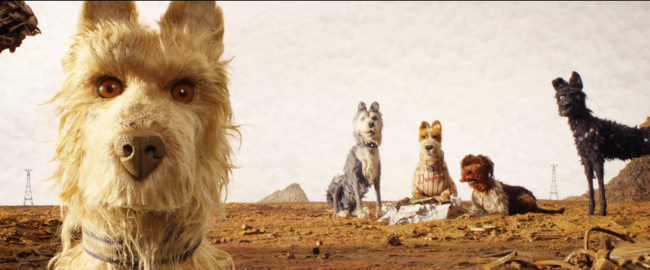
I'm more of a cat person, myself, but it seems like it would take a particularly mean person to be cruel to a dog. Certainly the seriously steadfast fellows in 2018's Isle of Dogs can't help but inspire affection with their angelic, unselfconscious loyalty. Director Wes Anderson's trademark self-consciously stylised aesthetic is perhaps part of the reason this never becomes cloying. Instead we have a beautiful stop motion diorama of some sweet, incredibly sincere souls.

You can't really invent a plausible motive for exiling everyone's beloved pets to a trash island, but plausibility isn't really the point of the film. So instead Anderson goes with a story about how a despotic mayor of the fictional town of Megasaki is fulfilling the agenda of his distant ancestors by concocting the myth of a "canine flu".

Many of the reviews that malign the film for cultural appropriation exhibit a weak understanding of Japanese culture and limited experience with Japanese film, generally fitting my impression that the ethnocentrism of such critics comes from the resentment they harbour for people who are better informed than they are (the movie's actual savviness about Japanese culture is well covered in this New Yorker article by Moeko Fujii). I was expecting references to Yasujiro Ozu, a filmmaker Anderson has acknowledged in the past as an influence, but mostly the film seems to be a love letter to Akira Kurosawa.

Much of the film follows a group of dogs, primarily the stray, Chief (Bryan Cranston), on the trash island as they endeavour to assist a boy named Atari (Koyu Rankin) in his efforts to find his beloved dog, Spots. The imagery is reminiscent of Kurosawa's first colour film, Dodes'ka-den, which is also mostly set on a trash heap, though Anderson's compositions are of course more broken into tidy coordinated segments. Though Dodes'ka-den certainly has a very carefully composed aesthetic.

Chief being a stray recalls Kurosawa's Stray Dog but the music associated with him early in the film is from Seven Samurai, probably the most recognisable Kurosawa element for the casual viewer. I was a little torn on it--it was sweet and I could see a thematic parallel between Chief and Kikuchiyo, but the theme from Seven Samurai is so indelibly associated with that movie for me it was a bit like hearing the "Imperial March". I was more pleasantly surprised by the guitar music from Kurosawa's 1948 film Drunken Angel which Anderson deploys for a quiet, romantic scene between Chief and a show dog named Nutmeg (Scarlett Johansson). In Drunken Angel, it's played on guitar by a man sitting by a cesspool caused by American bombing during World War II.

Kurosawa's films from the late 40s, most notably Stray Dog and Drunken Angel, frequently used locations that emphasised the post-war ruin of Tokyo. Isle of Dogs doesn't have that background but there is something of the spirit of Kurosawa's films in these characters intimately dedicated to honour in a world that encourages pragmatically selfish behaviour. Stray Dog presents a story in which the passion a young cop has for recovering the gun stolen from him is contrasted with the horrific cynicism of the film's villain, a young killer who describes killing a cat in one scene simply because its death is probably inevitable anyway.

That Isle of Dogs is centred on its most cynical character, Chief, is telling because he's really only cynical in contrast to the other dogs whose loyalty to their human masters is heartfelt and unwavering. From the first moment Chief warns Atari, "I bite," there's an apologetic quality to Chief's personality. He insists on his independence but still abides by votes taken by the group of dogs. Cranston is the perfect actor for the role; he can come off as completely self-confident while conveying an undertone of contradiction, a sense of a moral code that contradicts his surface assertions, something that made him as perfect for this as he was for Breaking Bad.

There are many great supporting performances, too, perfectly keyed to the film and characters; Bill Murray, Jeff Goldblum, Harvey Keitel. And of course it always looks great.