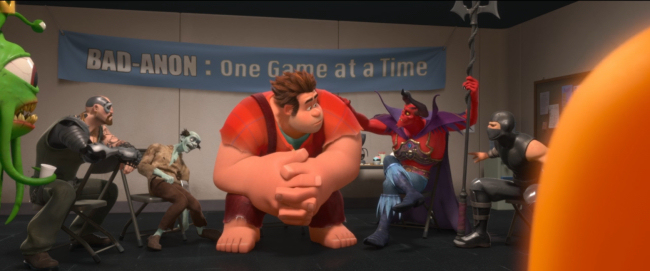
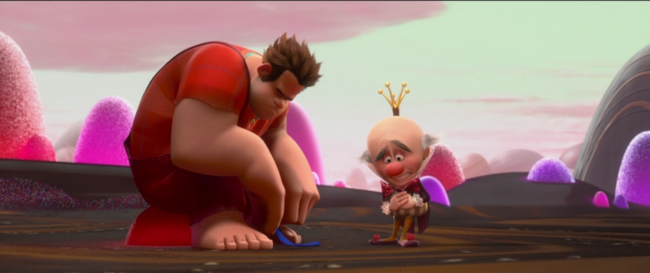
The whole internet is jeopardised by a villain from an '80s arcade game in 2018's Ralph Breaks the Internet. A sequel to Wreck-It Ralph, this one explores the relationship between Ralpha and Vanellope, and what a surprisingly strange one it is. By the film's climax, their relationship has taken on such strange dimensions that one wonders if the filmmakers were quite aware of what they were doing. In any case, it's fascinating.
The film picks up some time after the first film and Ralph (John C. Reilly) and Vanellope (Sarah Silverman) have settled into a comfortable life at the arcade. Every day after the arcade closes, they go to the tavern game for drinks and then indulge in some gaming themselves. So, they're friends. Really, really good friends. Who spend all their time together. A boy and a girl. So . . .

And what are you eating, Ralph?! Or is a gigantic cherry just a gigantic cherry?!
Yeah, I don't think this was intentional. At one point in the film, Ralph awkwardly calls her "Sis" and there's a moment at the end that feels a little bit like a father/daughter thing. Both moments feel artificial, like the filmmakers thought of the possible romantic interpretation for the relationship late in production and introduced some elements to contradict it. But the effort was futile because subtext is still there. And the more I think about it, the more I think it was a product of the writers' subconscious.
Why couldn't they have a romantic relationship? He's older than her but, considering Vanellope's game, Sugar Rush, was developed by a company we're told went out of business long ago, she's definitely lived enough years to be mentally an adult. Is she like Claudia from Interview with the Vampire, an adult trapped in a child's body, or is she kept mentally a child forever? Either one would be pretty sad. But, if we really wanted to, we could avoid thinking about it that way and just picture Ralph and Vanellope as adoptive father and daughter or siblings. Except the movie keeps introducing us to new elements that complicate that.
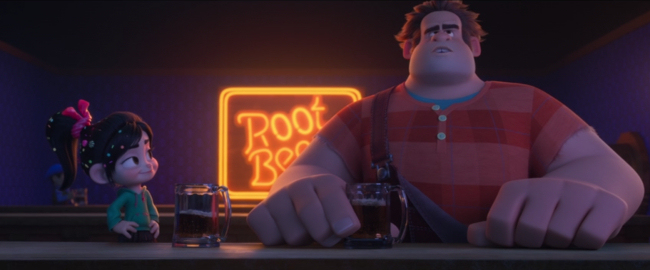
A lot of it is due to the film's internet setting. Ralph's obsession with keeping Vanellope in his life is directly referred to as "codependent". His scheme to keep her from running off to an MMORPG called Slaughter Race is to infect the game with a virus. When the virus gets out of hand, it creates thousands of dim-witted clones of Ralph, all of whom ruthlessly pursue Vanellope. Yeah, there are sibling relationships like this, but you don't often see them outside of Wagner's operas. The basic creepiness of the clones adds to the impression of dangerous passion--but then the film goes further and the thousands of squirming bodies of Ralphs combine to create a giant Ralph who captures the girl and climbs atop Google Tower like King Kong.
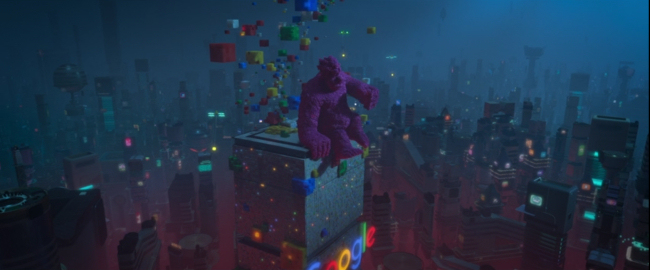
It's like something out of End of Evangelion and it's hard not to think about the fact that Ralph's distinguishing feature is his big fleshy hands. The giant Ralph also has no eyeballs which makes him reminiscent of the pink elephants from Dumbo.
This really is an appropriate story for a movie about the internet, though. What better place to have a strange, ambiguous, tormented relationship than a venue defined by unchecked passion, ambiguous protocols, and insubstantial identity?
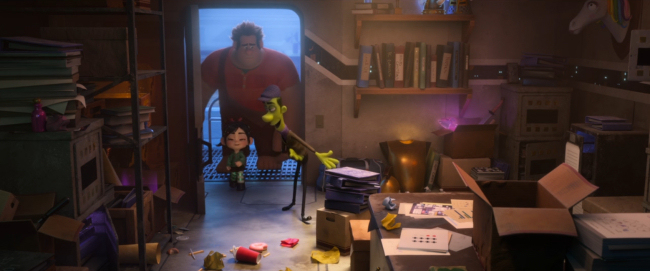
The internet jokes throughout the movie are mildly amusing. My favourite was the spam guy, J.P. Spamley, voiced by Bill Hader who, for reasons I can't guess, goes uncredited. I love how he comes off as a down on his luck 1950s door-to-door salesman.
The most heavily promoted aspect of the film, though, is Vanellope's encounter with a group of Disney Princesses, though this is one of the weakest parts of the film.

Mostly they're there to deliver rapid self-parody, but it's so awkward, just as it is in Moana with all of its winks at supposed Disney Princess conventions. It's like a really stoic man was told by his doctor to crack jokes about himself in the interest of cardiovascular health. Every joke feels carefully vetted and shyly researched.
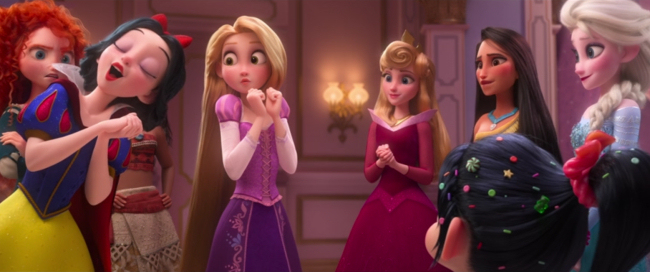
It's interesting seeing how odd the pre-cgi princesses look and realise that the newer characters all have proportionally larger heads, making them all seem more childlike. It's particularly noticeable on Pocahontas, who may have had the most human proportions of all the '90s princesses.
Although I find its weirdness fascinating, I don't think this film is quite as strong as its predecessor. But it was certainly well worth one viewing.
Ralph Breaks the Internet is available on Disney+.
...
This is part of a series of posts I'm writing on the Disney animated canon.
Snow White and the Seven Dwarfs
Pinocchio
Fantasia
Dumbo
Bambi
Saludos Amigos
The Three Caballeros
Make Mine Music
Fun and Fancy Free
Melody Time
The Adventures of Ichabod and Mr. Toad
Cinderella
Alice in Wonderland
Peter Pan
Lady and the Tramp
Sleeping Beauty
101 Dalmatians
The Sword in the Stone
The Jungle Book
The Aristocats
Robin Hood
The Many Adventures of Winnie the Pooh
The Rescuers
The Fox and the Hound
The Black Cauldron
The Great Mouse Detective
Oliver & Company
The Little Mermaid
The Rescuers Down Under
Beauty and the Beast
Aladdin
The Lion King
Pocahontas
The Hunchback of Notre Dame
Hercules
Mulan
Tarzan
Fantasia 2000
Dinosaur
The Emperor's New Groove
Atlantis: The Lost Empire
Lilo and Stitch
Treasure Planet
Brother Bear
Home on the Range
Chicken Little
Meet the Robinsons
Bolt
The Princess and the Frog
Tangled
Winnie the Pooh
Wreck-It Ralph
Frozen
Big Hero 6
Zootopia

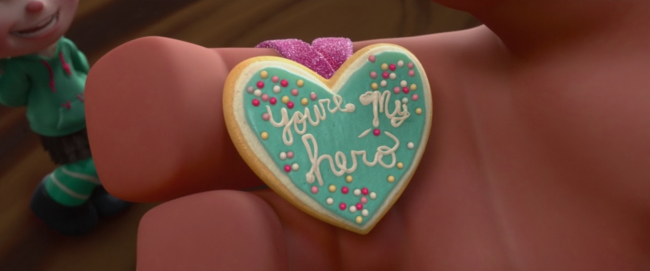
 But what about this story of a villain leaving his assigned role to become a hero? Is Ralph a Satanic Hero like Elsa? Not really.