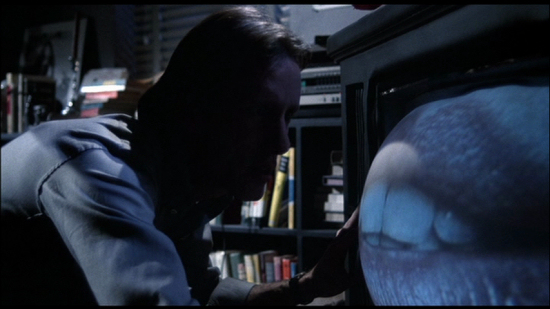
Between watching old movies and old TV shows, I do watch YouTube, the video spackle of our lives. For many people now, it's the exclusive theatre of video media. You can watch full movies, either those uploaded by users or available for rent via legitimate studios, but I suspect the bulk of the viewership goes to music videos and YouTubers. The latter comes in a wide variety of subcategories, including fashion vloggers, cooks, gamers, essayists, virtual YouTubers (very popular in Japan), and political pundits. Well, let's face it, in this day and age, all the categories are infected with politics. There are actually plenty of apolitical YouTubers but naturally they can't avoid occasionally saying something that would be construed as extreme from one political perspective or another and I find my brain has developed a sort of Videodrome tumour that gently vibrates whenever I hear someone say something remotely political.
And then there are YouTubers who consider themselves apolitical, and may honestly believe they are, but who can't help uploading content that constantly lines up with one faction. I remember a few months ago seeing some YouTubers, including anime YouTuber DannPhan and pop culture commentator ClownfishTV, incredulously responding to the same obscure leftwing website that had labelled them both right wing. I can sympathise with their desire not to be categorised--the left winger's article was obviously intended to discourage people from making their own judgements about the content of the channels. But on the other hand, those who watch ClownfishTV or DannPhan regularly are likely to hear them complain a lot about men being routinely demonised in media and the puritanical desexualisation of genre fiction. These are both real problems but an exclusive focus on them tends to define the speaker, especially in contrast to those who don't see these issues as problems.
It is easy to become the proverbial dog with a bone, though, especially if you feel like an insufficient number of minds were changed the first time you expressed an opinion or if a particular topic gets your channel more views. Sadly, many people roam YouTube looking to receive opinions they can claim as their own in a social setting. There have always been people who do this, of course, even before the newspaper was invented. Interestingly, lately I've run across people whose attempts to suss out my political allegiance takes the form of asking where I stand on the Star Wars sequels. People figure you can get a rough idea of someone's political loyalties based on whether or not they liked The Last Jedi or, for the more refined, whether they have particular problems with The Last Jedi or Rise of Skywalker. I spoke to someone a few days ago who asserted that having Palpatine return in Rise of Skywalker totally negated Vader's sacrifice in Return of the Jedi. Then, a few days later, I was watching Red Letter Media's review of Rise of Skywalker again and I heard Mike Stoklasa express the same opinion in exactly the same words.
I really like Red Letter Media. They are one of the rare apolitical, non-corporate, pop culture commentary channels (though I think some of their commentators lean left) and the tone of their rapport helps me relax. It helps that they're so often drinking beer. They're like more articulate versions of Hank Hill and his friends. I often disagree with their opinions (though their incidental commentary on COVID is extraordinary sharp for how baffled it is). I figure the point of Vader's sacrifice was not killing Palpatine but rescuing Luke and, anyway, in terms of character development, surely it's the thought that counts. I feel like Red Letter Media lends itself better to independently thinking viewers, though, because there's less stridency in their arguments. They're too easy going. But if viewers aren't in the habit of independent critical thought, RLM can function as much like propaganda as anything else.
In the past few months, the two most interesting YouTube videos I've seen are Jordan Peterson's interview with Stephen Fry and Lindsay Ellis' video about her cancellation.
Since Peterson returned from his strange and horrific medical crisis, he's come off as a bit fragile and fearful, and some of the claims he made in his earliest videos have seemed a little paranoid. But as he's regained his health, the integrity of his interviews and arguments have also improved. His interview with Stephen Fry ought to be a model of how two people of differing political perspectives have a discussion. It comes from the fact that neither man regards ad hominem attacks to be constructive, a perspective all too rare nowadays. I'd seen them together before in a debate about free speech, a two against two format in which Peterson and Fry were on the same team. Peterson and Fry decisively won the debate largely because one of their opponents, Michael Dyson, spent most of his time calling Peterson names and naturally came off badly. Peterson's interview with Fry is so lovely, it's such a pleasant discussion between two profoundly well read people on the topics of mythology and psychology, it's hard not to come away from it thinking you've heard the two smartest people on YouTube, not just for their extemporising but for the nature of their conversation strategies.
The Lindsay Ellis video is fascinating for different reasons. Writing about it now, I find myself thinking of a post Terry Gilliam made to his Facebook a few days ago, a cartoon criticising cancel culture. I was surprised by how many hundreds of comments Gilliam received from people condemning him either on the grounds that cancel culture doesn't exist or that it exists purely to hold corrupt, abusive men in positions of power accountable. It's hard to imagine how anyone could see Lindsay Ellis as a Harvey Weinstein, it feels absurd even writing the sentence. And, of course, most of the time the subjects of cancellation aren't Harvey Weinstein types but people from the ranks of progressives who have certain inauspicious opinions or ones who have done one or two questionable things. Things that don't line up with the amorphous but feverishly proselytised perspective of to-day's hard Left. Ellis herself points out in the video that hard right wingers like Ben Shapiro are essentially immune to cancellation because their audiences are in full agreement with their cancel worthy opinions. The left has a reputation for eating their own because, like the Donner Party, it's the only food in reach.
It seems like Ellis' video has been less well received than the similar video by her friend Contrapoints. Perhaps Ellis' apologies seem insincere or lack contrition, perhaps it's because she talked about a sexual assault she'd been the victim of. This may have reminded some people of how Kevin Spacey came out as gay around the same time allegations started coming out about him. Ellis was sharing the information partly as explanation for her supposed crime of participating in a joke "rape rap" video and partly as a way of garnering sympathy for herself--she may not concede having the latter motive. But why shouldn't she? If fans have become cruel, is it not human to want to show them that you are as human and vulnerable as they are? In any case, it's one of the most refreshingly candid moments I've seen in one of her recent videos, a moment when she finally stopped sounding bitter and like she constantly grinds her teeth. The fact that she ends the video with a "fuck you" to the mob who'd come for her probably didn't help the video to a positive reception, either, but she was certainly well within her rights to be spiteful.
When Contrapoints' video came out, it seemed like there was some epiphany on the left about the nature of the cancel culture beast, or at least a brief, honest glimpse in the mirror. Perhaps because the initial shock is over, the relentless stride of rhetoric arguing for the persistent need for and non-existence of cancel culture has gained dominance again. Oh, well.