Showing posts with label communism. Show all posts

Tuesday, October 24, 2023

The Wolves of the Revolution

I finished The Werewolf of Paris yesterday. It was pretty good although, despite what I said in my review of the first half of the book, the influences seemed less to be Jekyll and Hyde and Crime and Punishment. Author Guy Endore was clearly an admirer of Victor Hugo as the second half of Werewolf of Paris feels very much like The Hunchback of Notre Dame with a hefty dose of Les Miserables.

Guy Endore was born Samuel Goldstein and I wonder if he took the name Endore in order to sound more French. His novel covers the tumultuous period following the reign in Napoleon in France, Bertrand, the werewolf, a child of a priest's rape of a thirteen year old servant, grows to manhood in a France increasingly dominated by political radicalism, leading to the brief rule of the Commune in 1871. Endore isn't shy about pointing out for the reader the thematic connexion he sees between the left-wing radicals and werewolves:

Bertrand, it now seemed to Aymar, was but a mild case. What was a werewolf who had killed a couple of prostitutes, who had dug up a few corpses, compared with these bands of tigers slashing at each other with daily increasing ferocity! "And there'll be worse," he said, and again he had that marvelous rising of the heart. Instead of thousands, future ages will kill millions. It will go on, the figures will rise and the process will accelerate! Hurrah for the race of werewolves!

He spends a lot of time describing the Communards' desecration of churches and monasteries as well as the ridiculous, and hideous, show trials and courts martial. But after all that, he takes a moment to mention that the Capitalists killed even more people when they retook the city.

Bertrand, meanwhile, manages to control his lycanthropy with a sadomasochistic sexual relationship with a wealthy Jewish woman named Sophie. She allows him to bite and cut her and this helps him control his wolf side. I'm not sure how this is supposed to fit into Endore's political allegory, which makes me like it.

The final portion of the book suggests Bertrand may never have transformed at all, that the belief that he did may have been a shared madness of he and his uncle, Aymer. This becomes a conflict between faith and empiricism as Aymer finally decides to join the priesthood in the wake of his disillusionment with the Commune. Endore provides an interesting argument between Aymer and a doctor over whether Bertrand really is a werewolf and you really start to wonder if Aymer had been an unreliable narrator all this time.

I finally remembered why I had this book on my kindle--I put it there after watching Hammer's 1961 adaptation of the book starring Oliver Reed (here's my review from 2014). It's not a bad movie. Oliver Reed is perfectly cast.

Monday, March 13, 2023

The Short Road to the Party

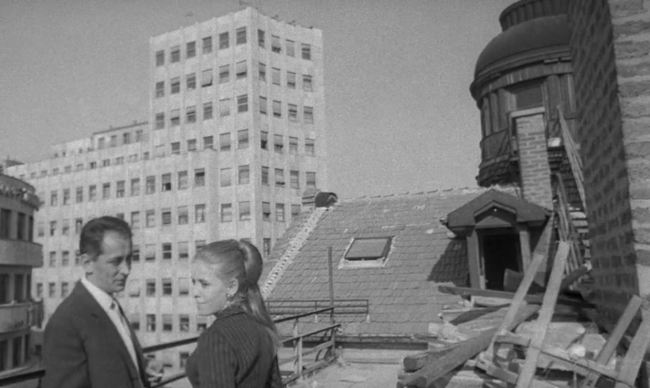
It's a nice day, everyone's having a good time, there's a picnic. Some strangers show up to play some "jokes" that seem suspiciously like an ideological coup in 1966's A Report on the Party and the Guests (O slavnosti a hostech). Banned in its home country of Czechoslovakia for many years due to its perceived criticism of Communism, the film is very simple but very sly.

A group of bourgeois friends are enjoying a lazy lunch in the grass when they spot a distant group of revellers. Thinking they're heading to the same banquet they are, the picnickers stumble towards the main road. One of them finds an aggressively smiling stranger (Jan Klusak) suddenly locking arms with him.

He's with a group of sullen faced young men in ties. The amiable picnickers are reluctantly ushered into lines hastily drawn in the dirt. They're told they're now in a room and two dashes on the ground mark the door. One man among the picnickers of a certain disposition encourages everyone to play along. Another becomes angry and marches straight through a "wall".

It's hard to say exactly what philosophy the interlopers espouse only that they're very keen on controlling everyone under a flagrantly false veneer of good fellowship. The film successfully boils down a large political phenomenon to a more personal situation. You see, quite credibly, the process through which authority establishes itself while constantly protesting that it isn't authority at all. And you can see how flagrant, unchallenged hypocrisy gives it infinite license.

A Report on the Part and the Guests is available on The Criterion Channel.

Monday, May 16, 2022

The Communist Wants in Your Bed

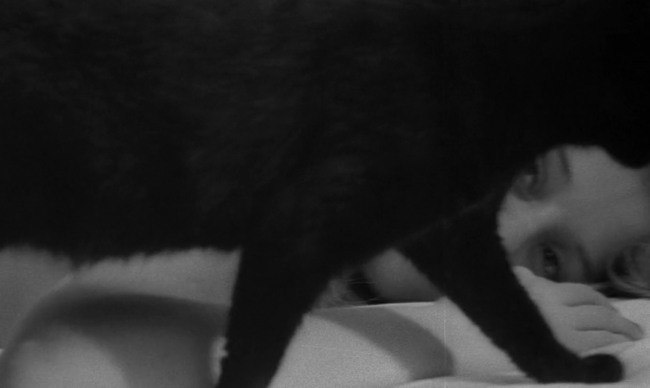
So you tear down religion and the old social order. Is it only the greedy fat cat who suffers? There's also the more casually sacred, like the beautiful young woman in 1967's Love Affair, or the Case of the Missing Switchboard Operator (Ljubavni slučaj ili tragedija službenice P.T.T.). Made in Yugoslavia when the country was controlled by a communist regime that took power after World War II, this anti-communist film really isn't much different from pro-communist propaganda. Such films also often exploit stories of young and innocent people being brutalised by the controlling order. But taken purely as a work of art, it's a pleasure to admire scenes of actress Eva Ras happily lounging in her apartment with her boyfriend and black cat.

She plays Izabela, a switchboard operator who falls in love with a party member named Ahmed (Slobadan Aligrudić). Scenes of the two happy in bed or around her apartment are intercut with real experts speaking to the camera, first a sexologist and then a criminologist. Shots of Izabela's naked body being prepped for an autopsy are also shown early on, so we know for most of the film that she'll eventually be murdered.

The film's political message is not subtly introduced. Shots of mobs toppling ancient churches and raising flags for the new regime are also inserted into the narrative abruptly. So while you're worrying about this poor young woman, think about the angry mob.

The point becomes one about the lack of the public morals or institutions that would have provided some safeguards to the violence Izabela eventually suffers from. It's a successful emotional argument but not a logical one when one considers that murders like this have occurred under all kinds of regimes and governments.

Eva Ras is physically beautiful but also gives a very sweet, unselfconscious performance. She's the real triumph here.

Love Affair, or the Case of the Missing Switchboard Operator is available on The Criterion Channel.

Thursday, July 04, 2019

On the United States and Dependence

Happy Independence Day, United States. Though Aladdin has now outgrossed Independence Day to become Will Smith's biggest hit of all time and the country is 22 trillion dollars in debt. I live in the United States, in southern California, where there was an earthquake this morning I didn't feel but know it happened because I read it on the internet. There's a massive homeless crisis here and property values are going up because anonymous buyers are purchasing lots of property with cash. What is independence? A state of mind? Hopefully.

I still haven't seen that Aladdin movie. I'd like to, I hear it's good and Aladdin was my favourite of the 90s Disney films when I was a kid (though it's lost some lustre now that I know how much it borrowed from the superior 1940 film The Thief of Bagdad). It's weird how no-one adjusts for inflation when talking about box office records. In article after article, from one record breaking film to the next, no-one seems to think it worth mentioning the ranking isn't adjusted for inflation. I guess it wouldn't be very interesting to keep saying, "And 1939's Gone with the Wind is still number 1." This wouldn't make money for anyone right now and it's a movie not reflective of current popular cultural values. Maybe. Though it's a little hard to tell when so many sites ping-pong back and forth between saying how regressive cultural attitudes are an ever present danger and acting like they don't exist.

I was reading The Communist Manifesto a few days ago after watching Property is No Longer a Theft. Not that I'm thinking of turning Communist--quite the opposite, really. I used to consider myself a Communist, or at least a Socialist, but I've changed my mind over the past few years. The way I used to look at it was to say even if it's true what some on the right say, worse case scenario, that people are fundamentally out for themselves and most people are selfish--even if it turns out that's true, surely it would be best to embrace the philosophy that says we can all work together one day in a single wonderful cooperative where everyone knows that we all need to work for each other. Where enough folks get up in the morning and think, by gum, society needs plumbers so I'm going to volunteer myself as a plumber. Surely, even if humanity isn't psychologically ready for that, it's best to believe it has a potential to be and to work toward that end. But I've already waited too long.

I've been really liking Robert Louis Stevenson lately. My mind goes back to an essay he wrote partly about his own shift from Socialist beliefs to Conservative called "Crabbed Age and Youth".

For my part, I look back to the time when I was a Socialist with something like regret. I have convinced myself (for the moment) that we had better leave these great changes to what we call great blind forces: their blindness being so much more perspicacious than the little, peering, partial eyesight of men.

But Stevenson, at the end of the essay, acknowledges some self-contradiction because at several points he also asserts that he is not "abashed" at having been Socialist and argues that it's good for young people to have strong opinions, even if they're wrong. "[I]f St. Paul had not been a very zealous Pharisee, he would have been a colder Christian." It's this magnanimous view Stevenson has towards mistakes, which I tend to sympathise with, that makes Socialism so unattractive to me now. When I see young and extreme leftists exercising the full strength of their ironic wit to make those who disagree with them seem the epitome of evil, when leftist journalists carefully massage stories to downplay inconvenient details or outright omit them, I feel, in a way, the most sorry for that commentator or writer. Sooner or later, these people will think or do something that will make themselves guilty in their own unforgiving rhetoric. Then they can either punish themselves, delude themselves, or change their minds. I've seen firsthand enough of the kind of perpetual terror some of the self-deluded live in that I prefer to be one who has a change of mind.

It is in vain to seek for consistency or expect clear and stable views in a medium so perturbed and fleeting. This is no cabinet science, in which things are tested to a scruple; we theorise with a pistol to our head; we are confronted with a new set of conditions on which we have not only to pass a judgement, but to take action, before the hour is at an end. And we cannot even regard ourselves as a constant; in this flux of things, our identity itself seems in a perpetual variation; and not infrequently we find our own disguise the strangest in the masquerade. - Robert Louis Stevenson

I'd still describe myself as a liberal. But I can see too much of the trouble caused by the "fairy tales of Socialism" as Louis Stevenson calls them, not only for the believers themselves but for everyone else who may have benefited from a more practical form of liberalism.

So I'll conclude this July 4th ramble by simply reminding my fellow liberals it might be constructive if the country thought electing someone other than Trump was a reasonable thing to do.

Twitter Sonnet #1252

Considered cups were left in dusty sun.
Reflected rooms return to mind at once.
As language drifts along the table run.
The ink evades what Word forever hunts.
The steady peel of paper bares the wall.
The drapes beneath a pallid film revive.
The figure beams of light obey a call.
With shadow paint the plan's at length contrived.
A blanket shroud conceals a shifting form.
The working clocks compel the frame to stand.
The chilled and rusty limbs again're warm.
A signal heart appears on ev'ry band.
Perspectives blurred beneath the bourbon tap.
The moving ground remained a single map.