Showing posts with label literature. Show all posts

Monday, September 09, 2024

Putting Aside the MacGuffin

I've been reading The Maltese Falcon lately, Dashiell Hammett's 1930 novel. I hadn't read it or The Thin Man despite having read all of Hammett's other novels. I suppose I figured the famous films made from both titles were perfectly fine substitutes. But I was jonsing for some Hammett so I started in on the Falcon. I'm enjoying it, of course.

The biggest difference from the 1941 film so far is a long story Sam tells Brigid about a man who abandoned his wife and kids to start over with another life with another name in another state. He does this after a near death experience when he's almost brained by a falling beam at a construction site.

Flitcraft had been a good citizen and a good husband and father, not by any outer compulsion, but simply because he was a man who was most comfortable in step with his surroundings. He had been raised that way. The people he knew were like that. The life he knew was a clean orderly sane responsible affair. Now a falling beam had shown him that life was fundamentally none of these things. He, the good citizen-husband-father, could be wiped out between office and restaurant by the accident of a falling beam. He knew then that men died at haphazard like that, and lived only while blind chance spared them.

It was not, primarily, the injustice of it that disturbed him: he accepted that after the first shock. What disturbed him was the discovery that in sensibly ordering his affairs he had got out of step, and not into step, with life. He said he knew before he had gone twenty feet from the fallen beam that he would never know peace again until he had adjusted himself to this new glimpse of life.

I should hope all of us would take such inspiration from nearly dying. He was kind enough to leave his first wife and kids with enough money to support them, so it's not like he completely shirked all responsibility--though Sam describes this as an act of love, just not "the sort that would make absence painful."

One thing I thought was especially relevant for young people to-day was the reaction of the man's first wife when she found out the truth behind his disappearance:

She thought it was silly. Maybe it was. Anyway, it came out all right. She didn't want any scandal, and, after the trick he had played on her--the way she looked at it--she didn't want him. So they were divorced on the quiet and everything was swell all around.

You see, ghosting is unattractive. I think some people do it under the theory that "absence makes the heart grow fonder" and see it as a way of wrapping a someone around their little finger. I'm happy to say that I've gotten to the point in my life where, if someone pulls that kind of thing, it has the effect of them espousing a love for Gallagher or Paul Haggis; I'm actively repulsed and I don't much sweat their lack of attention.

Thursday, August 22, 2024

Writing, Writers, and Artists

"WHOM THESE CHAINS BECOME NOT SO", by Caitlin R. Kiernan, is the new Sirenia Digest story I read to-day. It's good. It's a sort of mash-up of the ancient Greek Andromeda story, altered so that she can expect no rescue, and a vignette of an author for the story discussing it with a friend and sometimes lover. The imagery in the Andromeda story is lovely and horrific. Equally so is the friend/lover's description of a strange dream.

Whether or not the author in the story is meant to be Caitlin and the other person someone she happens to know is never clear. It did get me thinking about the community that surrounds a group of writers and artists, such as the Beats, the Pre-Raphaelites, and the group around Henry Miller and Anais Nin. There must be many such groups and many, even for some that contain successful and famous writers, that are beyond living memory. I was sort of thinking about the extended group of fantasy and horror authors that includes both Caitlin and Neil Gaiman. If the sexual assault allegations do spell the end for Gaiman, it's going to suck for a lot of the people he was routinely generous to. I shouldn't be but I kind of am surprised by how quickly some readers are ready to wipe their hands of Gaiman. I've been coming to the opinion, though, that the reason Gaiman and his close friends have been publicly silent is that he plans to sue. And I think he has a great case and the more people who swear him off, he better case he has. Tortoise Media has taken some very suspect accounts of ex-girlfriends and couched them in malicious language and put what little substance they have behind a pay-wall. Sadly, there are many people now willing to "cancel" at the first use of the word "allegation". So Gaiman has plenty of ammo to claim damages.

Speaking of writing, I was watching Willow a couple nights ago and it occurred to me it's really badly written. I realise that's hardly a revelation to most people but I loved that movie when I was a kid. I was even really stoked for the Disney+ series. Everyone was feigning shock when Disney recently cancelled The Acolyte but the Willow series was a much bloodier execution. Not only did they cancel it, they removed it from the streaming service. Do you know how many crappy movies and TV series are still on the service? Air Bud is still on Disney+. Remember the one about the dog that plays basketball?

Unlike The Acolyte, which seemed to be made up of people looking for paychecks and status, the Willow series seemed more like a labour of love. Warwick Davis had been wanting to come back to the character since forever and he really seemed to have bonded with new cast members--all of whom I thought were perfectly fine.

All that love and camaraderie and Disney didn't just cancel they show they insulted them with a removal from the service. TaleSpin can stay, Willow the series has to go. Willow the movie is still on, of course.

And yes, I know Disney is using legal fine print from the Disney+ subscription to get out of paying damages to the family of a woman who died in a Disney restaurant, so I know they've done worse. But art is the primary topic for this blog, okay?

Anyway, yeah, the Willow series was indeed badly written. Though I don't blame Jonathan Kasdan and Bob Dolman who wrote the first couple episodes which I still think were fine.

Bob Dolman was screenwriter on the original Willow. As I was dozing through it a couple nights ago, it occurred to me how much the story is dependent on coincidences. There's the coincidence of the baby coming to Willow on the river, the coincidence of the brownies flying over Willow on the hawk once again carrying the baby. The coincidence of running into Madmartigan the second time in that tavern, of Bavmorda's daughter being there to personally inspect the place moments later. That kind of thing makes a fantasy world seem small. I mean, that's what you say when you meet someone who coincidentally knows someone you know; "It's a small world." The more coincidences you pile on, the smaller the world gets.

Take Star Wars: A New Hope as an example of the opposite. Now, let's ignore the fact that Anakin built C3PO and owned R2D2 in the prequels. Ignore the fact that Anakin grew up on Tatooine. In fact, let's ignore the prequels entirely. There are otherwise no major coincidences propelling the plot forward in A New Hope. Leia's blockade runner was going to Tatooine specifically with the intention of seeing Obi-Wan Kenobi. The droids are just droids on the ship among many--we see another protocol droid in the background. Leia probably chose R2D2 because he was closest at hand. Now, it was improbably good luck that C3PO and R2D2 weren't shot when they walked across the corridor in the firefight but, in terms of the plot, that could just as well have happened as not have happened--it doesn't move the story forward, it's just a bit of garnish.

The two wander the desert and they're both picked up by Jawas. It's not clear how much time passes from the time they land on the planet to the time the Jawas picked them up but it's not unlikely that the Jawas, being scavengers that roam the wastes, would have spotted the two shiny mechanical beings sooner or later. It's a bit of a coincidence that both droids meet again on the same sandcrawler but not a huge coincidence.

It would be a big coincidence for the droids to wind up with Leia's brother, Luke Skywalker, but I suspect Lucas hadn't thought of that yet. At any rate, it was far from anyone's mind who first saw the movie. When the movie first came out, as far as anyone knew, Luke's father was a Jedi who was killed by Darth Vader. And Vader killed a lot of Jedi. So it's not a big coincidence. So this all contributes to making the fantasy world fill big, composed of various people with various motives which would usually only coincide due to intent or natural flow of circumstance, making everything feel more credible and therefore lifelike.

I do like the prequels but I think my biggest problem with them at this point is the inclusion of C3PO and R2D2. Lucas was originally inspired by Kurosawa's The Hidden Fortress which is told from the point of view of two peasants who are just trying to survive while the clans fight around them for reasons they don't comprehend. They have their own motives separate from those going on all around them. The first part of A New Hope is from the droids' point of view and it therefore makes sense we don't have much of a grasp of what motivates the parties at war. But the prequels are all about those politics--and, anyway, the way they're shot, they're clearly told from the points of view of the Jedi.

Anyway. I'm rambling a lot to-day. That probably means I'm procrastinating. By the way, here's a YouTube version of my Top 20 Pirate Movies post:

It took 24 hours to upload during which time I couldn't use the internet for anything else so do please watch it. Thank you.

X Sonnet #1874

Remember thirsty skulls control the woods.
So walking late, refuse to carry wine.
For ghosts recall the taste of spirit goods.
The afterlife a palate doth refine.
Contestants name a spotted cat as king.
The second bachelor brought a lively fish.
For singing pawns, the queen bestows a ring.
For swimming prawns, the princess grants a wish.
It's Pan whose appetite surrounds us all.
We know a film in truth is just a tree.
Remember words to make a stronger call.
A wasp is not a thin and longer bee.
You shouldn't tighten helmets through your brain.
A smaller skull is but a dodgy gain.

Wednesday, March 20, 2024

To Kill or To Have Never Killed

To-day I read what I think is the newest Sirenia Digest, number 214, containing "Night Fishing", a new Caitlin R. Kiernan story. It's a nice blurring of the line between a multiverse story and an unreliable memory story, centring on a narrator menaced by some entity that shifts shape and temporal location in his recollections. It put me in mind of Lost Highway, especially when the narrator talks about whether or not he's a murderer.

Last night I fell asleep watching To Kill a Mockingbird. It's included free on Japanese Amazon Prime with Japanese subtitles I can't turn off. The film's Japanese title is アラバマ物語, literally "Alabama Story". After lousy translated titles for Ghibli movies like "Spirited Away" and "The Boy and the Heron", I guess it's nice to see it cuts both ways. I was sorry I slept through Atticus' closing statement so I went back and watched the last half of the film this morning. I seem to be really sensitive lately because all of the strongest moments in the film hit me really hard. I almost cried when Scout first sees Boo Radley.

There's a movie about perspective. You have two instances of community taking justice into its own hands, first when the racist jury condemns the innocent Tom Robinson, then when the sheriff and Atticus decide they're going to protect Boo Radley. The truth was concealed, some might argue changed, first for a bad reason and then for a good reason.

While I was reading the Sirenia Digest story, I was surprised to find myself thinking of this lecture on Dragons from Gresham College I was also watching this morning. The lecturer, Ronald Hutton, discusses the possibility that some tales of dragons could have been based on actual encounters with snakes, crocodiles, or extraordinarily fearsome people. Perhaps it was the dragons that became snakes, crocodiles, and people?

A lot of the subtitles on To Kill a Mockingbird were wrong, I noticed. Unsurprisingly, there's no translation for "Nigger". "Nigger", "Negro", "Coloured", "Black", are all translated as "黒人", literally "black person". This renders totally different the dialogue in the scene where Atticus tells Scout, "Don't say 'niggers', Scout." This line is translated as "何て言い方だ", which roughly translates as "How can you talk that way?" There are two reasons I can see for this. One is to discourage the dissemination of bad English, the other is the fact that Japanese has no swear words, therefore, no Japanese viewer would understand why Atticus wouldn't want Scout to use any particular word. What the translator ought to have done is rendered the word faithfully and offered a brief note. Or they could have simply translated it directly. An intelligent viewer should be able to glean the cultural meaning from context. A willful mistranslation is symptomatic of the kind of cultural insulation that I believe more and more is at the heart of Japan's failure to learn English. Whatever the motive, though, poor translations like this help create a fantasy "Japanese America" that exists only in the Japanese collective imagination.

Tuesday, January 23, 2024

Nowhere to Look

Last night I read "Gorgon", the new Caitlin R. Kiernan story in the Sirenia Digest. It's a good story that combines several elements that tend to recur in Caitlin's work; there's dialogue with a possibly dead woman in a dream state, there's a reference to "The Lobster Quadrille", and palaeontology. That last one is not so common in Caitlin's work as you might expect given that she happens to be a palaeontologist but it always adds an appreciable extra layer of credibility whenever she does include it.

Like a lot of great horror fiction, it succeeds a lot by layers of suggestion rather than direct descriptions. I especially liked one character talking about a dream she had of a strange sea beast. It's a good story.

Speaking of dreams, last night I dreamt Maynard James Keenan had died. Some friends and I were trying to get to his funeral but we got stuck in an endless labyrinth of mall service corridors. Googling Keenan to-day, the headless I see are "Maynard James Keenan has been training in the popular mixed-martial art, known for its grappling technique", and "For the past 20 years, Maynard James Keenan has worked tirelessly to bring Arizona's burgeoning wine industry to international attention." Yes, the guy who wrote "Sober" is now in the wine business. I wonder how many people have made jokes about that.

Monday, December 11, 2023

Is Any Diary Safe?

Reading MR James has gotten to be a seasonal tradition with me. This year, my mother sent me a hardback collection of his ghost stories, which makes the experience of reading them even better. When you're reading stories about antiquarians poring over manuscripts and carvings and abnormal adornments in abandoned churches, it's nicer to do so on real pages instead of on an electronic screen.

Yesterday I read "The Diary of Mr Poynter", first published in 1910. A young man and his elderly aunt move into a new manor so the young man purchases a diary of someone who resided in the neighbourhood over a century earlier. Inside the diary, he finds a scrap of cloth with a pattern that enchants his aunt who insists that drapes be made from the pattern. Like all of James' stories, he finds ways of letting the horror elements subtly creep in while you read about a fairly normal, but slightly unstable, academic or domestic situation. This one ends up being a bit more explicit than usual and delightfully so. The ghost that manifests reminded me of Sadako from The Ring or any number of other Japanese movie ghosts with long hair veiling their faces. Or Cousin It, I suppose, but effectively eerie.

Previous to "The Diary of Mr Poynter" I read "The Residence at Whitminster", a story about a young Irish lord who comes to stay in England and brings some kind of shiny tablet with him he apparently procured from a witch. The story ends in a remarkable way with a housemaid, speaking with transcribed colloquial dialect, rattling off suggestive reminiscences. That one may have been too subtle but it was entertaining.

Tuesday, October 24, 2023

The Wolves of the Revolution

I finished The Werewolf of Paris yesterday. It was pretty good although, despite what I said in my review of the first half of the book, the influences seemed less to be Jekyll and Hyde and Crime and Punishment. Author Guy Endore was clearly an admirer of Victor Hugo as the second half of Werewolf of Paris feels very much like The Hunchback of Notre Dame with a hefty dose of Les Miserables.

Guy Endore was born Samuel Goldstein and I wonder if he took the name Endore in order to sound more French. His novel covers the tumultuous period following the reign in Napoleon in France, Bertrand, the werewolf, a child of a priest's rape of a thirteen year old servant, grows to manhood in a France increasingly dominated by political radicalism, leading to the brief rule of the Commune in 1871. Endore isn't shy about pointing out for the reader the thematic connexion he sees between the left-wing radicals and werewolves:

Bertrand, it now seemed to Aymar, was but a mild case. What was a werewolf who had killed a couple of prostitutes, who had dug up a few corpses, compared with these bands of tigers slashing at each other with daily increasing ferocity! "And there'll be worse," he said, and again he had that marvelous rising of the heart. Instead of thousands, future ages will kill millions. It will go on, the figures will rise and the process will accelerate! Hurrah for the race of werewolves!

He spends a lot of time describing the Communards' desecration of churches and monasteries as well as the ridiculous, and hideous, show trials and courts martial. But after all that, he takes a moment to mention that the Capitalists killed even more people when they retook the city.

Bertrand, meanwhile, manages to control his lycanthropy with a sadomasochistic sexual relationship with a wealthy Jewish woman named Sophie. She allows him to bite and cut her and this helps him control his wolf side. I'm not sure how this is supposed to fit into Endore's political allegory, which makes me like it.

The final portion of the book suggests Bertrand may never have transformed at all, that the belief that he did may have been a shared madness of he and his uncle, Aymer. This becomes a conflict between faith and empiricism as Aymer finally decides to join the priesthood in the wake of his disillusionment with the Commune. Endore provides an interesting argument between Aymer and a doctor over whether Bertrand really is a werewolf and you really start to wonder if Aymer had been an unreliable narrator all this time.

I finally remembered why I had this book on my kindle--I put it there after watching Hammer's 1961 adaptation of the book starring Oliver Reed (here's my review from 2014). It's not a bad movie. Oliver Reed is perfectly cast.

Tuesday, October 17, 2023

Wolves Amok

I figured I should read a horror novel for Halloween month so I'm about halfway through 1933's The Werewolf of Paris. I'm enjoying it. According to Wikipedia, some consider it the Dracula of werewolf stories. That may be so.

Its political commentary is a little more simplistic than Dracula's rumination on Victorian sexual psychology. It's easy to see author Guy Endore read Crime and Punishment and Jekyll and Hyde. A surprisingly large portion of the book focuses on the conception of the titular werewolf, going into detail on how his mother was raped by a priest and how his adoptive father, from whose third person POV much of the story is told, vacillated between a passionate commitment to socialism and a desire to join the priesthood. Endore's point about the disintegration of institutions of family, religion, and government are clear; without these things, the beast locked in the human heart cannot be ruled.

Considering it was written only 35 years after Dracula, it's surprising how sexually explicit it is. I like Bertrand's, the werewolf's, confusion as the horrible deeds he commits at first seem to be dreams. Yet he quickly starts to think pragmatically, wondering if he should save an arm or a leg of a recent kill to snack on later. Horror world problems.

Twitter Sonnet #1780

A traitor's speech was hidden under snow.
Beneath the blanket years, rebellion cooled.
And yet the roots and stones persist to know.
The branches cut could never yet be ruled.
A golden hour struck the heavy gate.
Decisions quick and grim compel the guard.
Deployed, the ranks of anxious archers wait.
The stranger strikes again her gauntlet hard.
A gaping pit awaits the spies and fools.
Rejection turns a wheel for water pipes.
Grotesque encounters fill the scrying pools.
The dungeon halls reverb with bootless gripes.
The moon intrudes with white and empty beams.
Forgotten places harbour howling dreams.

Monday, September 25, 2023

The Whig and the Jacobite

Have caution when accepting your sudden fabulous inheritance. David Balfour, the protagonist of Robert Louis Stevenson's 1886 novel Kidnapped, foolishly allows himself to be hoodwinked by his sinister uncle. David ends up packed up on a brig bound for America and slavery in this terrific novel that turns out to be mostly about Jacobites.

The first several chapters feel like a pirate adventure as Stevenson admirably describes life aboard that bad brig upon which David finds himself.

Here I lay for the space of many days a close prisoner, and not only got my health again, but came to know my companions. They were a rough lot indeed, as sailors mostly are: being men rooted out of all the kindly parts of life, and condemned to toss together on the rough seas, with masters no less cruel. There were some among them that had sailed with the pirates and seen things it would be a shame even to speak of; some were men that had run from the king’s ships, and went with a halter round their necks, of which they made no secret; and all, as the saying goes, were “at a word and a blow” with their best friends. Yet I had not been many days shut up with them before I began to be ashamed of my first judgment, when I had drawn away from them at the Ferry pier, as though they had been unclean beasts. No class of man is altogether bad, but each has its own faults and virtues; and these shipmates of mine were no exception to the rule. Rough they were, sure enough; and bad, I suppose; but they had many virtues. They were kind when it occurred to them, simple even beyond the simplicity of a country lad like me, and had some glimmerings of honesty.

Then they take on another prisoner; a prominent Jacobite called Alan Breck--a real person, despite this being a work of fiction. The novel is set in the aftermath of the Jacobite rising of 1745 and the bulk of the book follows Alan and David in a desperate journey across Scotland. Along the way, they run into other prominent, real life Jacobites. This is all despite the fact that David is a Whig, which makes his tumultuous friendship with Alan all the more endearing.

We were no sooner done eating than Cluny brought out an old, thumbed, greasy pack of cards, such as you may find in a mean inn; and his eyes brightened in his face as he proposed that we should fall to playing.

Now this was one of the things I had been brought up to eschew like disgrace; it being held by my father neither the part of a Christian nor yet of a gentleman to set his own livelihood and fish for that of others, on the cast of painted pasteboard. To be sure, I might have pleaded my fatigue, which was excuse enough; but I thought it behoved that I should bear a testimony. I must have got very red in the face, but I spoke steadily, and told them I had no call to be a judge of others, but for my own part, it was a matter in which I had no clearness.

Cluny stopped mingling the cards. “What in deil’s name is this?” says he. “What kind of Whiggish, canting talk is this, for the house of Cluny Macpherson?”

“I will put my hand in the fire for Mr. Balfour,” says Alan. “He is an honest and a mettle gentleman, and I would have ye bear in mind who says it. I bear a king’s name,” says he, cocking his hat; “and I and any that I call friend are company for the best. But the gentleman is tired, and should sleep; if he has no mind to the cartes, it will never hinder you and me. And I’m fit and willing, sir, to play ye any game that ye can name.”

Alan Breck is an attractive character but he's the least interesting of Stevenson's line of morally ambiguous men I've read so far. He doesn't have the enigmatic nature of Long John Silver or James Durie in The Master of Ballantrae. Or Doctor Jekyll. But there's enough to make Kidnapped an engaging road narrative with a satisfying conclusion.

Saturday, September 09, 2023

Where's the Fantasy?

I'm reading two books now, which I really don't like to do, especially since I don't have as much time to read anymore. But now that my summer vacation's over and I'm back at work I need something to read on the train that I actually enjoy. I'd started reading a book called Six of Crows by Leigh Bardugo and I'm finding it to be a real slog. So on the train I'm reading Robert Louis Stevenson's Kidnapped, which is just a pleasure.

I guess I'm not the audience for Six of Crows, a 2015 fantasy novel aimed at teenagers, but normally I think I'm able to enjoy anything of any genre. There's an unintended silliness to Six of Crows. I think it's aimed at teenagers. The characters aren't allowed to swear which I didn't notice until a character said "crap" when they really obviously should've said "shit". Yet characters are also gangsters, assassins, and prostitutes who talk about killing and having sex for money. And they all use a kind of 1920s gangster lingo.

It's set in a fantasy version of Amsterdam called Ketterdam and follows a group of preternaturally talented gangsters led by a guy named Kaz and his number two, an assassin called Inej, who can silently scale a building barefoot and is able to "melt into the shadows" at will. But for some reason, all these characters are just seventeen years old. With all the gangster lingo, I'm constantly picturing Bugsy Malone as I read.

I thought, okay, maybe if they've been training since they were two years old, they could be this skilled and this well positioned in the underworld. But both Kaz and Inej reminisce about coming to the city just three or four years earlier as completely naive bumpkins. My problem with this really crystallised when I read this line from the young narrator of Kidnapped:

But I was young and spirited, and like most lads that have been country-bred, I had a great opinion of my shrewdness.

The protagonist really feels like a young man of seventeen or eighteen. I don't understand why Leigh Bardugo didn't simply write the characters older except there's this new idea that everyone needs to "see themselves" in fiction. I know I should read Six of Crows as intentionally dumb escapism. It's the kind of thing I might enjoy if I had a lot of alcohol. You know, if I dumb myself down to its level. It's not just the kids who don't act like kids, there're all kinds of logical errors in its heist plot. Like, they're supposed to be trying to break into some impregnable ice fortress and a new member of the crew tells them there's a big regular event where people from the town's entertainment district are granted access. We'd been told Kaz was basically the most feared gangster in his part of town and others so why didn't he already know about this apparently well known thing that directly involves his industry?

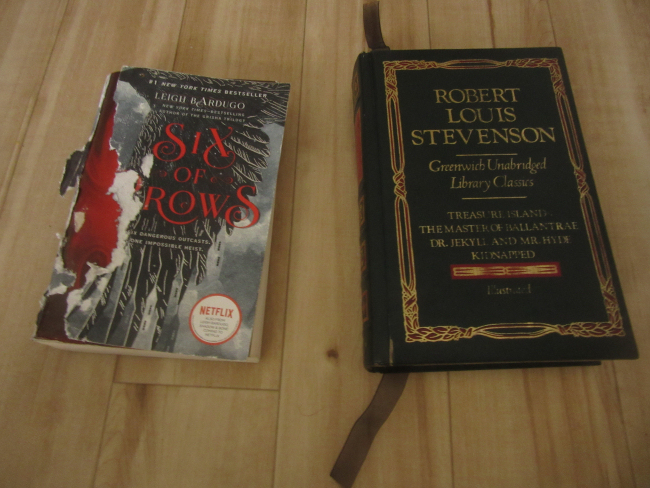
The book's filled with ill-considered stuff like that, not just in terms of plot but also character. It really feels like some role playing sessions I've had where, you know, everyone who's participating doesn't have the expertise or experience to play the characters they're playing, but you let it slide because none of this is going to be published and no-one's expected to enjoy any of it beyond the gratification of their own characters. But this book was published, for people to buy. And incidentally, I'm not sure the physical book is up to scratch. You see the tattered condition of the copy I have? This is not a used book, it's brand new. But I had it in my messenger bag when I went hiking a couple weeks ago and my sweat seems to have just dissolved the cover. In the space of just an hour or so. I've never seen anything like it.

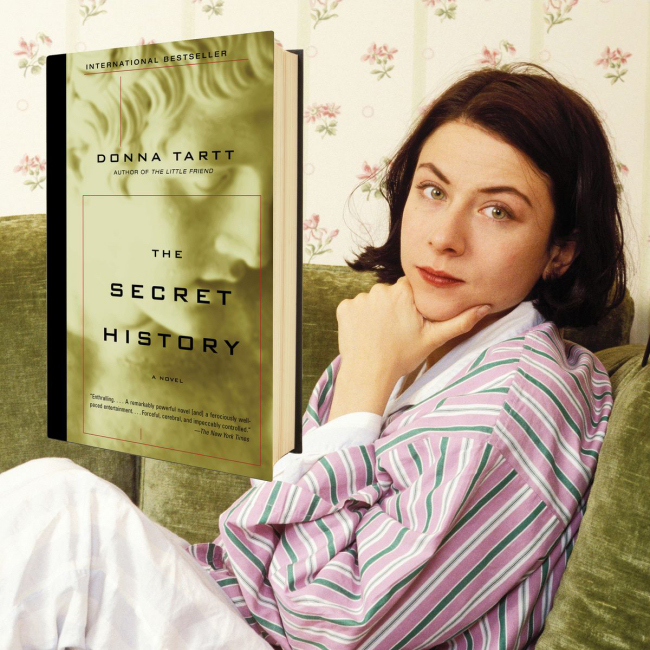
This is really terrible. I wanted to read Six of Crows because I was trying to get in touch with the modern literary fantasy culture. It's the same reason I read Secret History. I'm zero for two, as far as being able to dig this stuff. Am I wet blanket? Maybe I need to open my heart. I don't know.

Saturday, August 19, 2023

Ancient Secret History, Huh?

A group of college students conspire to murder one of their classmates in Donna Tartt's 1992 novel The Secret History. I never heard it mentioned in the '90s myself, though I was in high school and busy reading Anne Rice, Stephen King, JRR Tolkien, and Dungeons and Dragons books at the time. Nowadays people are talking about it as a forerunner of the Dark Academia genre that has cropped up in just the last four years or so. The Secret History lacks the gothic aesthetic which Wikipedia says is essential to the genre but I suspect people would rather not mention now that the Dark Academia genre really seems to have evolved from Harry Potter fandom. It reminds me of how Agnes Varda is suddenly being talked about as the high goddess of the French New Wave. I think people have been looking back to find women whose contributions weren't recognised due to suppression by the patriarchy. The only trouble is that hindsight is not really 20/20, especially when it's politically biased.

So The Secret History is overrated, as many people have said. I'd call it a decent pot-boiler, a Columbo episode without Columbo. The narrator, Richard, is the only one among the group of wealthy students who comes from a middle class background, which he tries to hide at first. He's a remarkably passive guy, which I think was deliberate on Tartt's part (at the end he describes himself as "so essentially" a "bystander"). He's in love with the only girl in the group, Camilla, but when he's wading with her at a lake and she cuts her foot, he does nothing to help her, just watching blood cloud the water distractedly. The leader of the group, Henry, rushes in to save the day.

I'm amused by how the term "dark" is used lately. I was watching The Butcher Boy again last night, the story of a young boy in an abusive household who has elaborate delusions, whose mother commits suicide listening to the folk song "The Butcher Boy", after which the lad lives up to that name in ways you might imagine. That, to me, is dark. But now people call Matt Reeves' Batman "dark" which, visually, yes, I guess so. But people seem to forget that Tim Burton's Joker committed mass murder by sabotaging the chemicals in common grooming products. Hardly anyone even dies in Reeves' movie.

And how is The Secret History supposed to be dark? The idea is that, by the end of the book, you're supposed to love Henry, the murderer. This book was written long after Interview with the Vampire or the episode of Columbo where Columbo sympathises with Johnny Cash playing a killer. Not to mention The Picture of Dorian Gray. Or Edgar Allan Poe. But okay.

In an interview at The Guardian, author Sadie Jones said she found The Secret History, "trite and derivative and I couldn’t work out what all the fuss was about. It felt very schematic to me." Schematic is a good word. Tartt's designs to manipulate the reader are so transparent, you can sense the outline she wrote before starting the novel. When Richard ends up nearly dying after staying the winter at a ridiculously ramshackle loft, he's rescued suddenly by Henry who takes him to the hospital and nurses him back to health. Okay, our sympathies are with Henry now. The murder victim, Bunny, is relentlessly painted as such a thoroughly obnoxious caricature of humanity that it's unintentionally hilarious when Richard adds, after some absurd anecdote, something like "but I did love Bunny."

Much of the novel feels like gossip, like the broadly telegraphed revelation that the twins, Camilla and Charles, were sleeping together. I started to wonder, since evidently many of the characters were based on Tartt's actual classmates and professors, if Bunny was based on an ex-boyfriend with whom Tartt had an intensely acrimonious breakup, after which she said, "I'm going to create a narrative where that bastard gets murdered and no-one reading the book even feels sorry about it!" There are two ways Bunny--his name is a nickname for Edmund--is portrayed in the book; obnoxious and pettily pathetic. Just the nickname Bunny in itself--and a scene later where Bunny is offended that Henry calls him "Rabbit" in Greek--feels like a cheap shot.

Bunny makes misogynist remarks to Camilla; he's vociferously homophobic, especially around the book's gay character; he demands people pay for his dinners, his clothes, and his hotel rooms. Tartt goes on to describe his whole family as crass and obnoxious. Sometimes it is kind of funny in a The Trouble with Harry kind of way but mostly, every time Tartt delivered another punchline at Bunny's expense, I started less and less to think, "What a jerk!" and more and more, "What's stuck in Tartt's craw exactly?"

Anyway. That's done.

Wednesday, August 16, 2023

Our Dreams are with Us

Yesterday I read the new Sirenia Digest which contained a new Caitlin R. Kiernan story called "A Buyer's Guide to Commonplace Bizarreness". It's a little excursion into Lovecraft's Dreamlands, to Dylath-Leen, as well as a dovetailed vision of our waking world. Or supposed waking world. It's the kind of disorienting blend Lovecraft touched on occasionally but may remind a reader more of movies like Videodrome or Inland Empire. It's lovely. Caitlin includes a phot of the basalt formation called the Giant's Causeway in Ireland that influenced Lovecraft's conception of Dylath-Leen.

I love Lovecraft. My nice hardback copies of his stories are among the books I miss the most back in storage in California. I've been resisting the temptation to buy them again. My resistance is aided by the fact that they seem to be much more expensive on Amazon now.

This month, the Criterion Channel has a playlist called "Grindhouse Gothic" featuring Roger Corman's film adaptations of Edgar Allan Poe. Included is The Haunted Palace, which is actually based on Lovecraft's The Case of Charles Dexter Ward, and contains only a couple references to Poe's "The Haunted Palace". In the '60s, Poe was the more bankable name. I wonder if that's quite reversed now. Anyway, I watched a bit of it again. Corman makes the plot a lot sillier but the production design is pretty and Vincent Price is always terrific.

Friday, August 11, 2023

Bowling Balls and Coffee Cups

Last night I dreamt I played this song for a class in Egypt at the base of a pyramid. I said, "And that's Kenny Rogers!" but none of them knew who that was. Then we investigated the pyramid, looking for a tomb.

I drank wine and watched The Big Lebowski last night. It was an end to a rambling day. It's summer break right now but I went to one of my schools looking for the groundskeeper I befriended so I could return some blu-rays and DVDs he lent me. But the school was closed. There was a baseball game going on there so I sat and watched them a while, letting the sunburns get worse on my arms. I left at around 11:30 and walked to a nearby McDonalds for lunch and had a big mac, large fries, and an orange juice. I don't really like fast food but I had a dream about McDonalds last week. It's much nicer in Japan, too. Cleaner and they bring the food to your table.

To complete my American nostalgia day, I walked to the Starbucks and drank coffee and read for two hours in the beautiful air conditioning. I had two cups of coffee, the second one at a discount because I kept my receipt. The cashier, when she saw me come back, told me to look for my receipt so she could give me the discount. That illustrates a key difference between Japan and the U.S. In the U.S., she wouldn't have mentioned the receipt, she'd have just given me the discount because obviously she'd seen me there the whole time and she'd rung up my first coffee. But nothing's real in Japan if there's no paperwork.

At Starbucks, I was reading The Secret History by Donna Tartt, a book that's getting talked about a lot lately and I realised I should try to live in the modern era sometimes, even if this particular book is thirty years old. It's time is now, though, and I'm developing theories as to why that is. I'll say more when I've finished (I'm about two thirds through). So far I feel it's a bit overrated. It's kind of like an episode of Columbo without Columbo. Parts of it benefit greatly if read with alcohol; such parts are kind of cosy.

Tuesday, June 27, 2023

Elfland, Whether You Will or No

One of the things I love about The Kind of Elfland's Daughter is that, for most of the book, none of the characters have any agency. It's not that I'm against characters having agency, but lazy critics so often tend to reach for it as a point of criticism nowadays that it's kind of glorious to read a novel in which all characters, mortal and faerie, are tumbled about in a world of sensory experience.

It is like a dream. Characters take action but the effects of those actions are so arbitrary and have such limited or unpredictable bearing on what follows, they may as well be rolling dice. The book begins with the kingdom of Erl deciding to have the young Prince Alveric marry a princess of Elfland in order to bring magic to the mortal realm. So he gets himself a magic sword, invades the magic realm, kills some antagonistic trees, and meets the beautiful princess. All that sounds like the plot of a novel but it's all dispensed with in the first few short chapters.

As pure luck would have it, the princess, Lirazel, is willing and able to abscond with a total stranger from a strange country. She's the title character and yet the novel spends perhaps the least amount of time with her--and she's also the character with the most agency. Of all the characters, she's the only one who's able to consistently achieve desired results from her chosen actions.

She has a child with Alveric whom they call Orion before she becomes bored with the human realm and her husband's desire that she honour their religious practices. She leaves for Elfland where time doesn't seem to pass. So the bulk of the novel, which is about Orion as a young man, learning to be a great hunter, and Alveric, wandering a wasteland with madmen as companions, takes place over the course of many years while virtually no time passes in Elfland.

Orion learns to hunt and kill unicorns. He enlists the aid of a band of trolls. Alveric is seeking Elfland, which the King of Elfland has caused to recede from Alveric's approach, leaving barren desolation in its wake. In your standard novel, this would all be building to something. Orion would prove himself to his parents and achieve something great for his people by hunting. Alveric would eventually enter and conquer Elfland, perhaps. But the novel's never about that. It's not the effects of their actions that matter but the experience of their actions.

It's a mighty feat for Orion to hunt and kill a unicorn but the achievement has little real meaning. Lord Dunsany beautifully describes the animal, paying particular attention to its powerful neck. But killing it doesn't take magic from the world or anything like that. It's just a really nice trophy. We never know if Lirazel appreciates Alveric's efforts to find her or even understands the sacrifices he makes. They just don't matter next to the glorious, arbitrary and sensual will of Elfland.

One gets the impression that Dunsany worshiped women as beautiful but distant and capricious beings. The only other female character in the book is a witch, also the only other character with real agency.

There's a minor plot about the parliament of Erl becoming suspicious of the magic they invited into their realm yet, like Alveric and Orion's stories, their desires and actions ultimately have little meaning. The book leaves you feeling this may be for the best.

Monday, June 19, 2023

He Can't Talk About Elfland

I'm about halfway through The King of Elfland's Daughter, a 1924 novel by Lord Dunsany. It's good. Like a lot of great fantasy literature, its author shows good instincts for what he should linger on and what he should breeze through quickly.

Alveric, essentially the protagonist, is a young man tasked with marrying the Elfland King's daughter of the title. A lot of time is spent describing his visit to a cottage on the edge of Elfland and the old man who deals there but is peculiarly unwilling to acknowledge the existence of Elfland. Comparatively little time is spent on Lirazel, the title character, herself. She kind of comes off as a jerk, actually. She willingly goes off with Alveric, has his child, but after decades can't be bothered to honour any of the most benign human customs. The intention may have been to make her seem like an innocent child of indigenous people but she comes off more like a rich woman who married a poor man who never understands why she can't buy expensive clothes anymore.

More interesting are the humans trying to comprehend the mysteries of Elfland. And that old man, a leather worker, is a really intriguing character and I like how Dunsany draws out the old man's silence on the topic of Elfland.

And Alveric pondered on many reasons for this. Had the old man been to Elfland in his youth and seen something he greatly feared, perhaps barely escaping from death or an age-long love? Was Elfland a mystery too great to be troubled by human voices? Did these folk dwelling there at the edge of our world know well the unearthly beauty of all the glories of Elfland, and fear that even to speak of them might be a lure to draw them whither their resolution, barely perhaps, held them back? Or might a word said of the magical land bring it nearer, to make fantastic and elvish the fields we know? To all these ponderings of Alveric there was no answer.

Saturday, June 17, 2023

Plastic and Memory

I read the new Sirenia Digest while eating lunch to-day. The new Caitlin R. Kiernan story, "The Moment Under the Moment", is a deliberately Lovecraftian tale, another nice exploration of the tangled psychological space, a portrait of human mental functioning fractured and frustrated by dreams and bizarre trauma. The first person narrator recalls a lover who spoke of the Bering strait land bridge and William Beebe. an American scientist and explorer. The narrator also describes the plastic pollution of the ocean in strikingly vivid and horrifying language, convincingly arguing the horror of this byproduct of scientific progress my equal or surpass that of the atomic bomb. It's a good story. Lunch was a sandwich with lettuce, Spam, and mayonnaise on bread I made yesterday. I've discovered I really like Spam. Another strange product of science.

Saturday, June 10, 2023

The Treacherous Lists

Is honour but "a mere scutcheon" as Falstaff would say, an inevitable road to hypocrisy and madness, or is it a manifestation of what's truly fine and beautiful in the human heart? Sir Walter Scott offers a balanced argument ultimately in favour of the latter in his 1819 book, Ivanhoe.

I've already talked about the love and care Scott took in conjuring a late 12th century England in his prose. There's tremendous, evident love in his descriptions of Rotherwood, a manor house, of the jousting tournament, of the characters, from swineherd to king to none other than Robin Hood himself.

Despite the title, the character called Ivanhoe plays a relatively minor role in the book. There are many characters and conflicts which are only loosely connected but if I were to name one plot as more prominent than the rest, I would say it's the relationship between the Templar knight, Brian de Bois-Guilbert, and the young Jewish woman, Rebecca.

Bois-Guilbert is portrayed as simultaneously zealously committed to knightly codes of conduct and habitually negligent of them. It's a fascinating contradiction that makes his character easily the most interesting in the book as well as likely being an insightful portrait of many hypocrites. Despite his vows of chastity and even his commitment to fighting or persecuting heretics, he develops an obsession with the beautiful Rebecca, whom he kidnaps with the intention of forcing her to become his lover. When he takes her to a Templar stronghold, he's surprised to find the head of his order present, a tyrannical enforcer of dogma with the harshest of interpretations. He wants to burn Rebecca at the stake as a witch because she's renowned for her healing abilities.

As a pure, innocent victim, Rebecca is a simple character and perhaps not an interesting one. Yet, her dialogue with Bois-Guilbert is captivating. As she awaits a champion to appear for her in a trial by combat, her arguments in the face of Bois-Guilbert's steadfast hypocrisy are exquisitely beautiful constructions of logic and poetic language. He is destined to appear as her opponent, required to do so by Templar rules, despite obviously not wishing her death. Rebecca is not reluctant to point out how the strictness of his adherence to Templar rules tends to vary.

". . . If I appear, then thou diest, even although thy charms should instigate some hot-headed youth to enter the lists in thy defence.”

“And what avails repeating this so often?” said Rebecca.

“Much,” replied the Templar; “for thou must learn to look at thy fate on every side.”

“Well, then, turn the tapestry,” said the Jewess, “and let me see the other side.”

“If I appear,” said Bois-Guilbert, “in the fatal lists, thou diest by a slow and cruel death, in pain such as they say is destined to the guilty hereafter. But if I appear not, then am I a degraded and dishonoured knight, accused of witchcraft and of communion with infidels—the illustrious name which has grown yet more so under my wearing, becomes a hissing and a reproach. I lose fame, I lose honour, I lose the prospect of such greatness as scarce emperors attain to—I sacrifice mighty ambition, I destroy schemes built as high as the mountains with which heathens say their heaven was once nearly scaled—and yet, Rebecca,” he added, throwing himself at her feet, “this greatness will I sacrifice, this fame will I renounce, this power will I forego, even now when it is half within my grasp, if thou wilt say, Bois-Guilbert, I receive thee for my lover.”

“Think not of such foolishness, Sir Knight,” answered Rebecca, “but hasten to the Regent, the Queen Mother, and to Prince John—they cannot, in honour to the English crown, allow of the proceedings of your Grand Master. So shall you give me protection without sacrifice on your part, or the pretext of requiring any requital from me.”

“With these I deal not,” he continued, holding the train of her robe—“it is thee only I address; and what can counterbalance thy choice? Bethink thee, were I a fiend, yet death is a worse, and it is death who is my rival.”

“I weigh not these evils,” said Rebecca, afraid to provoke the wild knight, yet equally determined neither to endure his passion, nor even feign to endure it. “Be a man, be a Christian! If indeed thy faith recommends that mercy which rather your tongues than your actions pretend, save me from this dreadful death, without seeking a requital which would change thy magnanimity into base barter.”

Bois-Guilbert piles his weak arguments higher and higher but with such conviction, augmented by the customs of his environment and companions, it's quite plausible that a thin, shaky foundation can be rationalised by him as firm and immutable. Yet, truth is truth, and Rebecca consistently shows his tangled rationalisations for what they are.

This conflict is the sharpest example of one Scott presents in various forms between different characters. The loose morals of Friar Tuck are presented as charming and to the advantage of the heroes, yet even he is ultimately not portrayed as a purely good man. King Richard is portrayed as a saviour and yet Scott is critical of Richard's lack of commitment again and again.

Scott gives the reader ample food for thought in a deeply pleasing package. It's a lovely book.

Tuesday, May 02, 2023

The Disinherited Knight Appears

I've been reading Walter Scott's 1820 novel Ivanhoe again lately. I read about half of it a year ago and got distracted reading other things so I started it again. I'm enjoying it much more, which I partially attribute to reading it in paperback instead of on my Kindle. The physical paper and ink somehow suits the dignity of the novel better. That dignity is certainly integral and part of the reason I found it difficult to read before.

Scott is clearly in love with The Canterbury Tales and The Faerie Queene among many other medieval and romantic works. Sometimes it prevents Ivanhoe from breathing its own life and even when I'm enjoying it it's certainly on a more nostalgic, distant level than I enjoy the more red-blooded Shakespeare plays Scott quotes from. Nonetheless, the jousting tournament Scott describes has many thrilling, even cinematic, moments.

The trumpets had no sooner given the signal, than the champions vanished from their posts with the speed of lightning, and closed in the centre of the lists with the shock of a thunderbolt. The lances burst into shivers up to the very grasp, and it seemed at the moment that both knights had fallen, for the shock had made each horse recoil backwards upon its haunches. The address of the riders recovered their steeds by use of the bridle and spur; and having glared on each other for an instant with eyes which seemed to flash fire through the bars of their visors, each made a demi-volte, and, retiring to the extremity of the lists, received a fresh lance from the attendants.

And I do share Scott's sentiment in moments where he drags the action to a halt just to muse on the things that have come and gone.

At length the barriers were opened, and five knights, chosen by lot, advanced slowly into the area; a single champion riding in front, and the other four following in pairs. All were splendidly armed, and my Saxon authority (in the Wardour Manuscript) records at great length their devices, their colours, and the embroidery of their horse trappings. It is unnecessary to be particular on these subjects. To borrow lines from a contemporary poet, who has written but too little:

“The knights are dust,
And their good swords are rust,
Their souls are with the saints, we trust.”
[Scott quotes from Samuel Taylor Coleridge]

Their escutcheons have long mouldered from the walls of their castles. Their castles themselves are but green mounds and shattered ruins—the place that once knew them, knows them no more—nay, many a race since theirs has died out and been forgotten in the very land which they occupied, with all the authority of feudal proprietors and feudal lords. What, then, would it avail the reader to know their names, or the evanescent symbols of their martial rank!

I also appreciate some of the extensive detail he goes into when describing clothing and faces, particularly in the early chapters. If you slow down and really work with him, you'll find he conjures some really vivid pictures. And some of it really conveys a unique sense of medieval places. I particularly liked this bit:

No fewer than four silver candelabras, holding great waxen torches, served to illuminate this apartment. Yet let not modern beauty envy the magnificence of a Saxon princess. The walls of the apartment were so ill finished and so full of crevices, that the rich hangings shook in the night blast, and, in despite of a sort of screen intended to protect them from the wind, the flame of the torches streamed sideways into the air, like the unfurled pennon of a chieftain. Magnificence there was, with some rude attempt at taste; but of comfort there was little, and, being unknown, it was unmissed.

Sunday, March 26, 2023

One Good Quatermain Deserves a Half

I finished reading Allan Quatermain (1887) yesterday, H. Rider Haggard's sequel to his own King Solomon's Mines. I think Alan Moore had the right idea when he essentially painted this second book as partially fabricated by the "real" Quatermain of King Solomon's Mines. This second book is a sometimes engaging, occasionally thrilling, but ultimately light adventure compared to the complex wonder at work in the first book.

As I wrote in an earlier entry, when I was about a third of the way through the book, the best part is the beginning when Quatermain and his friends, Curtis and Good, are just setting off into the wilds of Africa. Their skirmishes with a group of deadly Masai hunters are genuinely enthralling. But the book loses momentum it never quite regains after the silly kidnapping plot--I thought of it again watching The Mandalorian last week in which the plot around an alien dinosaur absconding with a child was remarkably similar. At least in Allan Quatermain, it really was a kidnapping for ransom.

The bulk of the novel, the main plot, concerns a lost civilisation of white people somewhere in Africa called the Zu Vendi. This story is somewhat reminiscent of She, particularly since the Zu Vendi are ruled by Queens--two Queens, unlike She. But the Zu Vendi, aside from the fact that all the women normally wear clothing that exposes one breast, aren't nearly as interesting as the Amahaggar and the relationship between the two Queens with the Zu Vendi is not nearly as fascinating as the one between Ayesha and the Amahagger. She presents really thoughtful scenarios exploring methods of rulership, which is one reason the character of Ayesha comes off as so complex. The Zu Vendi are mainly civilised and the two Queens are neatly divided into a Good Queen and an Evil Queen.

Quatermain's friends, Curtis and Good, are also less interesting than they are in King Solomon's Mines. Though Good is occasionally entertaining due to his vanity in Allan Quatermain, though the fact that he's able to change into a full naval dress uniform after the group has gone through a perilous boat ride through lava heated caverns was a bit silly.

The only really interesting character is Umslopogaas, the Zulu warrior with the peculiar axe, who made any scene better whenever he was involved. Haggard knew what he had, I think, because he made Umslopogaas the hero of the book's satisfying climax.

Monday, February 27, 2023

A Hunter's Return

I've started reading Allan Quatermain, H. Rider Haggard's 1887 sequel to his King Solomon's Mines. So far I'm finding Allan Quatermain to be a pulpier fare but not bad.

The book begins with Allan mourning the death of his son. He's joined by his old friends from King Solomon's Mines, John Good and Sir Henry Curtis, who entice him to go on an adventure seeking a lost civilisation in Africa. So far, the best parts of the novel were the scenes following Quatermain and his companions through the wilderness as they're stalked by Masai warriors. Following this, Quatermain and his friends find a lavish, European style home run by a Scottish missionary called McKenzie. The comforts Quatermain finds there, along with a cowardly French cook, feel a bit disappointingly cartoonish. We meet McKenzie's perfect, innocent teenage daughter, Flossie, who in short order becomes a hostage of the Masai, mainly to provide an excuse for a great, bloody battle sequence.

Surely one of the most distinguished features of the novel is the introduction of Umslopogaas, Quartermain's friend and deadly Zulu prince. The description of Umslopogaas' axe is memorable in itself.

By a piece of grim humour, he had named this axe “Inkosi-kaas”, which is the Zulu word for chieftainess. For a long while I could not make out why he gave it such a name, and at last I asked him, when he informed me that the axe was very evidently feminine, because of her womanly habit of prying very deep into things, and that she was clearly a chieftainess because all men fell down before her, struck dumb at the sight of her beauty and power. In the same way he would consult “Inkosi-kaas” if in any dilemma; and when I asked him why he did so, he informed me it was because she must needs be wise, having “looked into so many people’s brains”.

I took up the axe and closely examined this formidable weapon. It was, as I have said, of the nature of a pole-axe. The haft, made out of an enormous rhinoceros horn, was three feet three inches long, about an inch and a quarter thick, and with a knob at the end as large as a Maltese orange, left there to prevent the hand from slipping. This horn haft, though so massive, was as flexible as cane, and practically unbreakable; but, to make assurance doubly sure, it was whipped round at intervals of a few inches with copper wire—all the parts where the hands grip being thus treated. Just above where the haft entered the head were scored a number of little nicks, each nick representing a man killed in battle with the weapon. The axe itself was made of the most beautiful steel, and apparently of European manufacture, though Umslopogaas did not know where it came from, having taken it from the hand of a chief he had killed in battle many years before. It was not very heavy, the head weighing two and a half pounds, as nearly as I could judge. The cutting part was slightly concave in shape—not convex, as is generally the case with savage battle-axes—and sharp as a razor, measuring five and three-quarter inches across the widest part. From the back of the axe sprang a stout spike four inches long, for the last two of which it was hollow, and shaped like a leather punch, with an opening for anything forced into the hollow at the punch end to be pushed out above—in fact, in this respect it exactly resembled a butcher’s pole-axe. It was with this punch end, as we afterwards discovered, that Umslopogaas usually struck when fighting, driving a neat round hole in his adversary’s skull, and only using the broad cutting edge for a circular sweep, or sometimes in a mêlée. I think he considered the punch a neater and more sportsmanlike tool, and it was from his habit of pecking at his enemy with it that he got his name of “Woodpecker”. Certainly in his hands it was a terribly efficient one.

Such was Umslopogaas’ axe, Inkosi-kaas, the most remarkable and fatal hand-to-hand weapon that I ever saw, and one which he cherished as much as his own life. It scarcely ever left his hand except when he was eating, and then he always sat with it under his leg.

I still can't upload files to my webspace so here's Dizzy Gillepsie:

Saturday, February 11, 2023

The End of the Sausage

I finally did it, I finally finished reading The Life and Opinions of Tristram Shandy, Gentleman, originally published in segments from 1759 to 1767. I started reading this book back in 2019. I brought it on the plane with me to Japan. But, while I think it's undeniably brilliant, I found only sporadic pleasure in reading it.

It's not even especially long and in the three years since I started it I put it down to read much longer works many times. I read The Faerie Queene again, Paradise Lost twice, three Horatio Hornblower novels, two Robert Louis Stevenson novels, Moby Dick again, various Lovecraft and MR James stories, Interview with the Vampire, and I don't even remember what. 18th century English novels are known for their ridiculously excessive verbosity but I managed Swift, Smollett, Fielding, DaFoe, and even Richardson without too much trouble. But God. The jokes. Tristram Shandy does not let up with the goddamn jokes.

The novel is deliberately anti-narrative. The author, Tristram himself, proposes to write his autobiography but is continually prevented by his own lengthy digressions. Author Laurence Sterne sought continually to undermine any sense of awe or any impression of one person or situation deserving more attention than another. I think this is perhaps why Karl Marx was such a fan of the book. But it mostly made me think what valuable a thing stories are in giving us narrative respite from the impossible complexity of real life.

Tristram begins with the intention of describing his birth but he cannot justify focusing on it without thoroughly describing his father and Uncle Toby and the conversation they had that night. If the novel truly has a main character, it's Uncle Toby, whose genitals are continually hinted at as having been terribly wounded in battle. Of course, when Tristram sets out directly to discuss his uncle, he's immediately sidetracked by describing his own journeys through France. He even illustrates his tendency:

I am now beginning to get fairly into my work; and by the help of a vegetable diet, with a few of the cold seeds, I make no doubt but I shall be able to go on with my uncle Toby’s story, and my own, in a tolerable straight line. Now,

These were the four lines I moved in through my first, second, third, and fourth volumes——In the fifth volume I have been very good,——the precise line I have described in it being this:

By which it appears, that except at the curve, marked A. where I took a trip to Navarre,—and the indented curve B. which is the short airing when I was there with the Lady Baussiere and her page,—I have not taken the least frisk of a digression, till John de la Casse’s devils led me the round you see marked D.—for as for c c c c c they are nothing but parentheses, and the common ins and outs incident to the lives of the greatest ministers of state; and when compared with what men have done,—or with my own transgressions at the letters A B D—they vanish into nothing.

As I said, the jokes are non-stop. Some of them are funny, but most of them left me feeling exhausted quickly. The double entendre is constant. See this portion of a story told by a character called Trim:

As Tom perceived, an’ please your honour, that he gained ground, and that all he had said upon the subject of sausages was kindly taken, he went on to help her a little in making them.——First, by taking hold of the ring of the sausage whilst she stroked the forced meat down with her hand——then by cutting the strings into proper lengths, and holding them in his hand, whilst she took them out one by one——then, by putting them across her mouth, that she might take them out as she wanted them——and so on from little to more, till at last he adventured to tie the sausage himself, whilst she held the snout.——

——Now a widow, an’ please your honour, always chuses a second husband as unlike the first as she can: so the affair was more than half settled in her mind before Tom mentioned it.

She made a feint however of defending herself, by snatching up a sausage:——Tom instantly laid hold of another——

But seeing Tom’s had more gristle in it——

She signed the capitulation——and Tom sealed it; and there was an end of the matter.

Maybe I'd have enjoyed the book more as it was originally published, in short volumes. In any case, I'm glad I can finally move on.

Twitter Sonnet #1668

For half a minute games can play themselves.
In trouble's eyes, the ship's a bottle first.
With crowded thoughts we filled organic shelves.
Another crash occurs to prompt a thirst.
Absorbent table cloths could answer stains.
Resourceful spoons could serve a crimson punch.
Resentful ladles shake with metal pains.
Revolving legs convene to carry lunch.
Bananas range about the seventh yard.
Resulting heavy pictures build a thirst.
Concise as armies steal a science card.
Replies reveal a single talking burst.
With final pastes imposing pages sleep.
Ingenious jokes compel the board to keep.