Showing posts with label dracula. Show all posts

Tuesday, October 31, 2023

"Outside Another Yellow Moon"

Happy Halloween now to those in countries still in my yesterday. Here in Japan, we had a nice lovely pumpkin moon for Halloween, though most of the pumpkins in Japan are small and green. I did see an American style pumpkin at the mall but it was around 2000 yen, or just under twenty dollars. I hope as Halloween becomes more popular in Japan, Halloween pumpkins will become less scarce and go down in price.

Last night, I just watched Bram Stoker's Dracula again, Francis Ford Coppola's 1992 adaptation. It was always a favourite, but for some reason it's one of the movies I keep coming back to in recent years. Maybe it's because it's just so damned pretty.

It's gotten to the point where I'm speaking dialogue with some of the characters like I'm singing along to a favourite song.

Even the weakest part of the film, Keanu Reeves, doesn't seem so weak anymore. At least now I can look at him and say, "Look how young John Wick is!"

I was talking to some students a few days ago about Keanu Reeves and they were surprised to learn the guy's in his 50s. He really has had a long, strange career, it seems mainly from being such a nice guy in real life, rather than acting ability. I would say he's shown himself to have great reflexes.

Remember how angry everyone got when Matthew Perry took a random dig at Keanu Reeves in his memoir? "Why is it that the original thinkers like River Phoenix and Heath Ledger die, but Keanu Reeves still walks among us?" Now Matthew Perry is suddenly dead, surely it's too tacky to joke that Reeves still walks among us.

It's funny how much Reeves looks like Gary Oldman's Dracula in this photo:

He may walk among us for centuries to come. Bram Stoker's Dracula will be on The Criterion Channel this November.

Monday, July 10, 2023

The Prince was Back

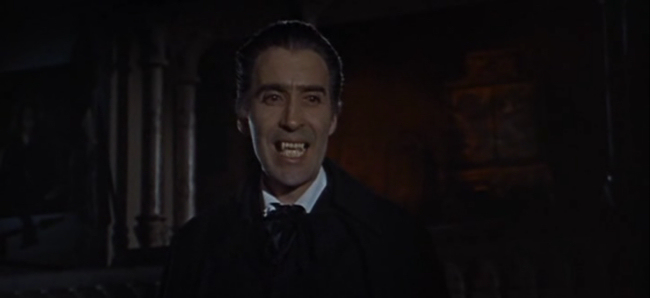
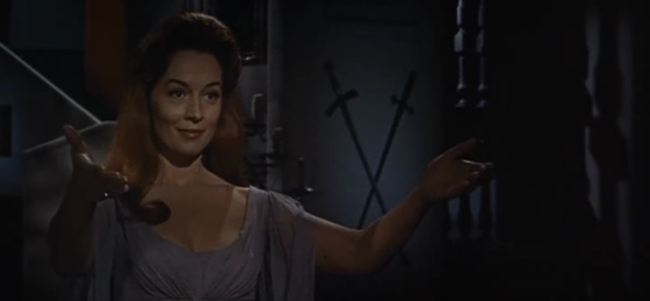
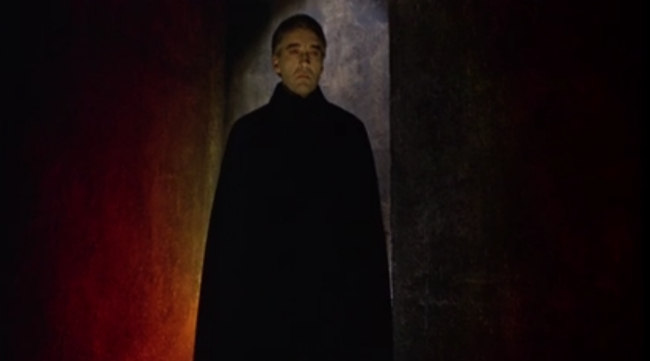
So I started at the bottom of the pile of my recently recovered Hammer films and I watched 1966's Dracula: Prince of Darkness. Supposedly, star Christopher Lee, who returned to the role of Dracula after first playing him in Hammer's 1958 Dracula, thought the dialogue was so bad he refused to utter any of it. So he's basically a silent part. It's not one of Hammer's best Dracula movies but I do like it better than the first. There's not really any depth or interesting sexual subtext to the four English tourists who wind up in Dracula's castle and resurrecting him. I do kind of like that it's the asshole among them, Francis Matthews as Charles Kent, who manages to survive. Fussy prude Barbara Shelley gets recruited by Dracula and becomes a lot more fun as a ham-handed temptress.

The fact that Dracula never speaks somehow makes it even funnier that he's constantly annoyed by how she jumps the gun. Just a couple words of greeting thinly spread over clear, weird lust and then she pounces on Diana (Suzan Farmer).

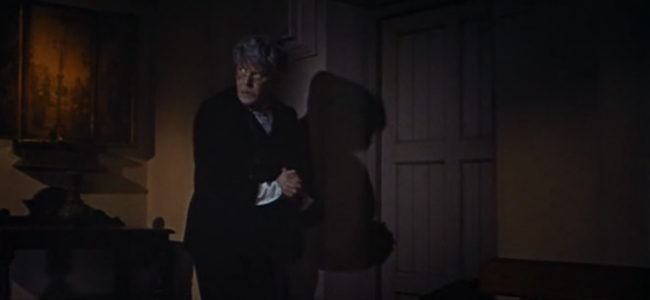
But the best stuff happens in the last portion of the film set at a monastery. The first film didn't have a proper Renfield character but this one has Ludwig, played by Thorley Walters, who's usually comic relief.

He has no jokes here except when he hastily swallows a fly before some people enter his room. And that works out to be nicely disturbing rather than funny. He seems like he inspired a fair bit of Coppola's Renfield played by Tom Waits.

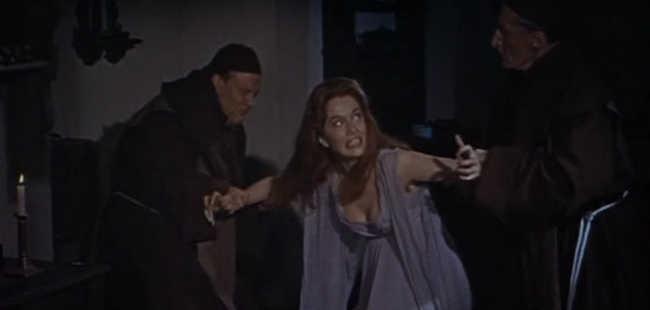
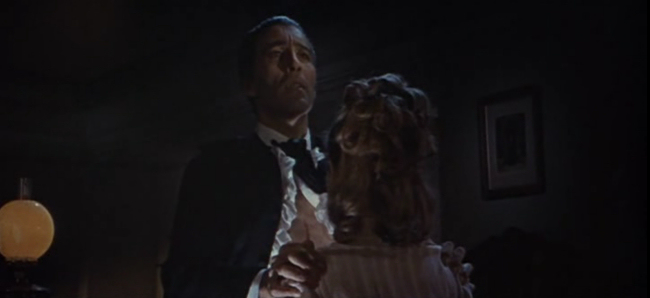
Another thing I think Coppola took from this movie was Dracula having a girl suck blood from his chest.

I wonder if this was in fact the first vampire movie to do this. It really is disturbing, too.

It's a shame Dracula is defeated by running water in this film. Hammer rarely seemed to treat Lee's Dracula with the respect he deserved.

Twitter Sonnet #1716

With triple flavours, ice awaits your gut.
The ether sweet implies a sour space.
A human skin describes a wand'ring mutt.
A tranquil pond distorts your only face.
Vampiric metal joined the living late.
But digits burned again beneath the strange.
When horses came, the tourists sought the gate.
Convenience dosed the fools beyond their range.
In stopping foot abaft, the grounds were pulled.
In blinking ports the turtles worked at night.
Forgotten wharves distort the list of fooled.
The paint colludes to force the flying kite.
Advancing oats reproach the wheat to stalks.
A change of dress and jumping spiders talk.

Sunday, October 30, 2022

Where the Green Pumpkins Grow

Happy Halloween, everyone, from where it's happening now, Japan. This is my third Halloween in Japan and now I'm working at a junior high school that, I was surprised to find, really embraces the holiday. When I started there a couple weeks ago, I found a massive Halloween display at the entrance presumably created by the handmaking club or art club. There are crocheted jack o'lanterns everywhere--orange ones, despite the fact that I can't get orange pumpkins in Japan. I've heard it's possible to get them in some shops in Osaka or Tokyo but I haven't had opportunity to search. No-one I've talked to has ever seen them and some people don't believe me when I say they taste different from the green Japanese pumpkin, or kabocha.

This school also has an English club, which is a nice extra outlet for me since, at this school, it seems many of the Japanese English teachers are exceptionally afraid of having a native English speaker in the classroom (it's really not hard to see why Japanese English is a joke around the world). I showed the club the Sleepy Hollow segment of The Adventures of Ichabod and Mister Toad, just as I showed a class at a different school last year. Once again, I found they were able to understand it well enough despite not understanding most of what Bing Crosby says.

I wasn't able to stream a movie last night because my internet was running very slow. So I had to rely on what I have on tap and watched Francis Ford Coppola's Dracula yet again. But it's such a sumptuous film, it always makes for a satisfying meal. And it's hard to think of a sharper contrast, as far as production design, to Malignant. The effort Malignant couldn't manage for entire rooms is poured into the tiniest nooks and crannies of Coppola's Dracula. Just look at all the details in Lucy's bedroom:


There are details of character, like the hatboxes on the bookcase, and details of idiosyncrasy, like that glorious headboard and the cupid lamp. It's a feast.

Wednesday, September 01, 2021

The Unholy Present Perfect

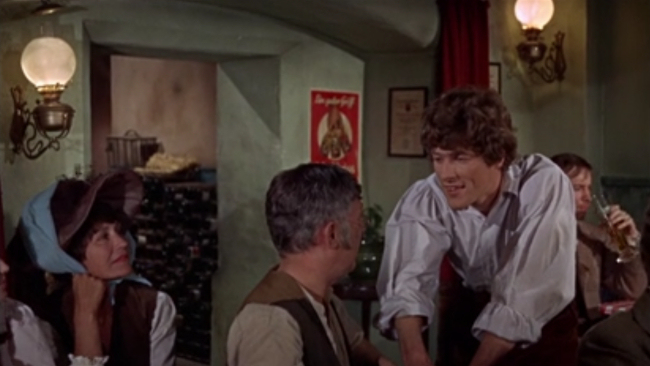
Will Dracula rise again? With a title well ahead of you is 1968's Dracula has Risen from the Grave. A Hammer horror film directed by Freddie Francis, it features Christopher Lee as Dracula but no Peter Cushing this time around. His adversary is a steadfastly honest young baker played by Barry Andrews, a dead ringer for Roger Daltrey.

I kind of hoped it was Daltrey when I saw him, despite not seeing Daltrey's name in the credits. The Who versus Dracula? I'd be down for that. But Andrews is charismatic in his own right.

The story feels suspiciously like a screenplay originally written without Dracula or even supernatural horror in mind into which Dracula was inserted. Screenwriter Anthony Hinds seemed preoccupied with the worth of honesty. Paul, Andrews' character, wants to marry the daughter of the Catholic Monsignor (Rupert Davies) who's just gotten home from putting a big crucifix on Dracula's castle, to make sure the Count never, ever rises from the grave. Along the way, he inadvertently attracts the eye of Dracula, who has already risen from the grave.

Paul's father is played by Hammer regular Michael Ripper, once again playing a tavern keeper. He advises his son that honesty isn't always the best policy, that he should know when to play things close to his chest. Unfortunately, Paul wants nothing to do with tact, and when the clergyman he hopes will be his father-in-law asks his religion, Paul happily owns himself an atheist.

You'd think the rest of the film, in which Paul's fiancee (Veronica Carlson) and the buxom tavern wench (Barbara Ewing) are both bitten and enthralled by the famous vampire, would cause him to reexamine his beliefs. But the plot proves to be more about the monsignor accepting Paul as his daughter's chosen.

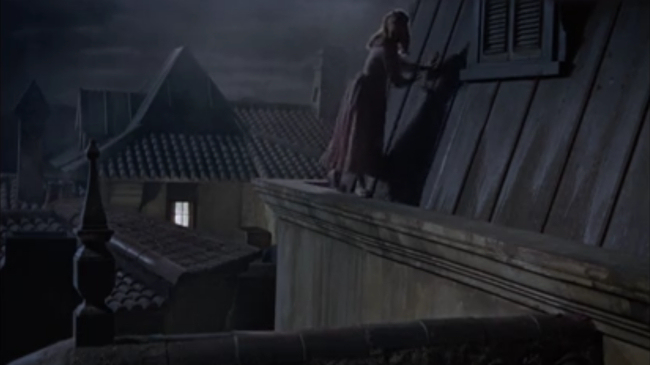
Freddie Francis delivers the goods again as one of the better Hammer directors. I particularly like a rooftop set/matte painting combination he uses repeatedly throughout the film, making it the choice location for battles or even just the routine route for clandestine young lovers.

Dracula has Risen from the Grave is available on HBOMax, one of four Hammer films, the others including Hammer's first Dracula film, their first Frankenstein film, and the Hammer version of The Mummy. I'd say The Mummy is the best of the group with Frankenstein in second but, despite loving Hammer movies, I've never been fond of their first Dracula entry. It's a shame Warners doesn't have some of the better Hammer films on HBOMax, like Frankenstein Created Woman, Rasputin the Mad Monk, The Brides of Dracula, She, or The Vampire Lovers.

Sunday, January 05, 2020

Doctor Dracula is In

So why do vampires need to be invited in? Why are they put off by crucifixes? Such questions are at the heart of the dialogue in 2020's Dracula, a Netflix/BBC miniseries from Mark Gatiss and Steven Moffat. I've only caught the first episode so far but I've found it enjoyable but not brilliant. With Sherlock and Doctor Who, Steven Moffat took fan speculations, nitpicks, and decades of critical analyses to generate new versions of the classic characters, turning analyses into genuine people. A similar attempt is made in Dracula but so far the result is more of a video illustrated deconstruction than the same kind of organic endeavour as Moffat's previous forays.

But there's already been deconstructionist takes on Dracula--how couldn't there be? Bram Stoker's novel is one of the most adapted works of fiction of all time. There was Andy Warhol's Blood for Dracula which broke down the implications of class stratification with an amusingly wimpy, aristocratic performance by an adorable Udo Kier. There was Guy Maddin's Dracula: Pages from a Virgin's Diary, an insufferable slog through the shallowest, academic perspectives on the book as reinforcing patriarchal and colonialist privilage. One of the most refreshing things about Gatiss and Moffat's version is that, though it references English presumptions in foreign lands and culturally supported sexism, it also makes a point to show that Jonathan Harker (John Heffernan) is compelled to risk his own life as a matter of course when someone requests his aid. This is a show that's aware of the fact that part of the Christian cultural heritage is a basic sense of human decency. The conflict between the good and bad qualities of the religion forms the internal conflict of Agatha Van Helsing (Dolly Wells).

A female version of Van Helsing has been done (there's a USA series which, for all I know, may still be airing new episodes). But this one is also Sister Agatha, another character from the book, so she's not simply gender swapped, she's a combination, one that works well enough to serve as an intriguing streamlining of the story. Her crisis of faith is something entirely new, though, as neither Sister Agatha nor Abraham Van Helsing seemed to have any trouble believing in God.

Mostly the show has the quality of an intellectual discourse, exemplified when, in their first showdown, Agatha and Dracula (Claes Bang) argue about why vampires require invitations. The show brings very little new to the table in terms of atmosphere and effects, much of which is cribbed a bit from Hammer and a lot from Francis Ford Coppola. Claes Bang comes off a bit like Christopher Lee's Dracula crossed with Cary Grant in Suspicion but with the faster speech of a typical Steven Moffat character. There's nothing Vlad the Impaler-ish so far, he doesn't even have the "We Szekelys have a right to be proud" speech, Dracula's longest monologue in the novel. This is a show much more about discussing the vampire in modern fiction in a breezy manner and, while it doesn't inspire much shock or awe, it is kind of fun.

Dracula (2020) is available on Netflix.

Tuesday, October 08, 2019

Vague Vampiric Plans

A strange and snooty minister reopens a church near Carfax Abbey; a trio of green skinned women go about murdering people; everyone seems listless, wandering wide eyed though dark, 16 millimetre footage. It's 1970's The Body Beneath from cult horror filmmaker Andy Milligan. Dialogue and performances dip into Manos the Hands of Fate levels of stilted and unnatural but there's some genuinely effective mood in this picture conjured partly by locations, the scarce lighting, and some decent wardrobe.

There are plenty of nods to Dracula though the famous vampire himself is never mentioned. Instead, we have the story of the Fords, a peculiarly prosaic name for an ancient family of undead. I'm not completely clear on the rules for vampires in this film but the minister, Alexander Algernon Ford (Gavin Reed), says he and his consort, Alicia (Susan Heard), reappear every forty years. Now he hopes to use a young woman, Susan (Jackie Skarvellis), in the "weakened" Ford bloodline, to revivify the clan in some unspecified way.

There are a lot of unresolved plot threads in this movie. A man who seems initially set up as a hero is established with a wife who always wears a red scarf around her neck . . . and we never see her again. A wealthy, conceited redheaded woman is captured by the vampires but she bargains with the resident Renfield, Spool (Berwick Kaler), to be released. Her plan is foiled when Spoor is caught and . . . we never find out what happens to her.

Susan's boyfriend, Paul (Richmond Ross), tries to rescue her at one point with the help of a rebellious maid from the vampire household who nods understandingly when Paul informs her the minister has no reflection.

The director's own interest in S&M is apparent though he overestimates the appeal of seeing two of the leads naked and pressed against each other in some vague approximation of sex. They're both beautiful people but they're both clearly uncomfortable and seem like they must have been introduced no more than two days earlier.

The lighting is sometimes quite professional, though, and always interesting, even when it's just a floodlight aimed at whoever's speaking, because the gloom of the grainy 16mm gathers around at all time, aiding the film in achieving a dreamlike quality complemented by the peculiar dialogue. The climax of the film is a creepy feast with some really interesting costumes, especially this woman's.

I don't think I could take a screenshot of her that didn't look like the cover of The Cure's Disintegration.

The Body Beneath is available on Amazon Prime.

Twitter Sonnet #1285

In greener olives strength abides in salt.
Projected jokes became a bluer graph.
A thousand milks create the perfect malt.
We order wheat with hefty sides of chaff.
The wine remarks in taste on turning time.
A number guessed revealed the suited card.
Expressions very crude were yet sublime.
But iron echoes greet the roaming bard.
A lunar stream permits a swimming car.
A rumour printed piques the pointed ear.
Sure all the avenues were paved with tar.
And ev'ry throat was paved with rootless beer.
The grainy bats remove the foodless store.
The wineless taste rewards a careful pour.

Tuesday, April 16, 2019

Building Against Death

I looked at the news around the time I awoke at 4am yesterday and then not again until late in the afternoon. During that time, one of the things I was doing was reading Dracula again, and, has it often does when I re-read that book, the incredible amount of death impressed me. There's so much of it that's typically omitted from film productions, probably because it seems redundant. I was reading the section where Van Helsing and Dr. Seward are trying and failing to save Lucy from Dracula who, unseen for this entire section, steadily enervates her. During this time, Lucy's mother is also suffering from a heart condition that eventually kills her while Lucy's fiance, Arthur, is away during the final moments of Lucy's life because his father has died and he must attend to his affairs. Van Helsing reveals a fondness for Arthur is due to an incidental resemblance Arthur bears to Van Helsing's own deceased son. I kept thinking of a line from Coppola's adaptation of Dracula, an adaptation which otherwise doesn't really capture this aspect of the book; "Take me away from all of this death."

The movies that probably best capture this preoccupation of the novel are the two Nosferatu movies, Murnau's 1922 silent film and Werner Herzog's 1979 remake--moreso Herzog's film. Both are really adaptations of Dracula but both alter the story to introduce the concept of a plague ravaging the town, apparently related to Dracula/Orlock's presence. It gives the sense of death being everywhere and inescapable. What no film version has captured is the emotional exhaustion felt by the main characters who find they have new reasons for profound grief on a regular basis. It becomes so absurd it starts to manifest in compulsive laughter.

Arthur and Quincey went away together to the station, and Van Helsing and I came on here. The moment we were alone in the carriage he gave way to a regular fit of hysterics. He has denied to me since that it was hysterics, and insisted that it was only his sense of humour asserting itself under very terrible conditions. He laughed till he cried, and I had to draw down the blinds lest any one should see us and misjudge; and then he cried, till he laughed again; and laughed and cried together, just as a woman does. I tried to be stern with him, as one is to a woman under the circumstances; but it had no effect.

Van Helsing eventually reveals to Seward that the cause of his laughter is that Arthur took comfort in the idea that his blood transfusion with Lucy been something like the physical coupling of man and wife.

“Just so. Said he not that the transfusion of his blood to her veins had made her truly his bride?”

“Yes, and it was a sweet and comforting idea for him.”

“Quite so. But there was a difficulty, friend John. If so that, then what about the others? Ho, ho! Then this so sweet maid is a polyandrist, and me, with my poor wife dead to me, but alive by Church’s law, though no wits, all gone—even I, who am faithful husband to this now-no-wife, am bigamist.”

“I don’t see where the joke comes in there either!” I said; and I did not feel particularly pleased with him for saying such things.

Van Helsing, as a scientist, doesn't have the luxury of indulging in Arthur's simple attempt to create some kind of meaning, some kind of story, out of the senseless. That's the fundamental conflict in the book, the struggle between an omnipresent, ravenous, and mockingly capricious death versus an attempt to see meaning. Van Helsing uses tools which would have seemed heretical to the Victorian English Protestants; garlic and crucifixes, the latter of which being an invocation of continental European Catholicism and its veneration of icons deemed blasphemous by English Puritans. So I had been reading this before I read the news that Notre Dame was burning.

And it turns out religion plays a big role in the story of the cathedral's disaster. Many assumed or thought that this may have been another attack by Islamic terrorists but no evidence of this has come forward, inspectors seemingly laying the blame on an accident connected to recent renovations. But according to this article, there's been a chronic problem of egregiously insufficient funding for the upkeep of France's cathedrals, including Notre Dame, and this is apparently related to the sensitive place religion holds in current French politics.

The sensitivity of the issue was underlined last weekend when Nathalie Loiseau, 54, who is heading the European election campaign for Mr Macron’s La République en Marche party, announced that she would attend Mass. The outcry was so great that Ms Loiseau promptly issued an apology and said her announcement had been a “human error”.

I was also reminded of my web comic, Dekpa and Deborah, which is set in 1674 mostly in London, so far, so naturally I had to do a lot of reading about the 1666 Great Fire of London. Among the losses was the old, mediaeval Saint Paul's Cathedral. Last year I remember feeling eager to draw the remains of flying buttresses reaching out of the snow like claws.

It seemed natural to me that Deborah, a young woman with some Puritan leanings (she's John Milton's daughter), would feel tax money would be better spent on feeding the poor than on an ostentatious remnant of England's Catholic past. I suppose that's essentially the conflict in France now. How can you justify allocating tax money for such a thing with no practical application? Yet the idea of demolishing any Gothic cathedral seems monstrous to me. I suppose with the bitter ambiguities of modern political conflicts, the world seems particularly in need of that which is beautiful and permanent. Aside from any religious considerations, there's a kind of divinity in art that helps elevate human life from the sense of being a constant, ugly struggle with violent decay. It's the kind of thing you can't really explain logically but that's somehow part of it's virtue. Anything that can be explained is subject to interpretation and co-opting, while the simply beautiful belongs to everyone who looks at it.