Showing posts with label erich von stroheim. Show all posts

Monday, June 06, 2022

The Disoriented Empress

A British tank crewman stumbles across the desert, delirious, and somehow makes it to a hotel in North Africa called the Empress of Britain. So begins Billy Wilder's 1943 American propaganda film Five Graves to Cairo. Like most of Wilder's movies, this one has a very sharp screenplay, in this case by Wilder and Charles Brackett. Stars Franchot Tone, Anne Baxter, and Erich von Stoheim put in good performances, too.

Baxter's is the most memorable. She plays a French chambermaid named Mouche who has somehow ended up working in this North African hotel. It later turns out she has resentment for the British for how they handled Dunkirk and, while she won't squeal on John (Tone) when Rommel (Von Stroheim) and his men take over the hotel, she still wants to find favour with someone in the German brass. She has a brother in a concentration camp and she's willing to do anything to get him out. The film, despite having been made during the era of the Hays Code, manages to make it clear that means sexual favours.
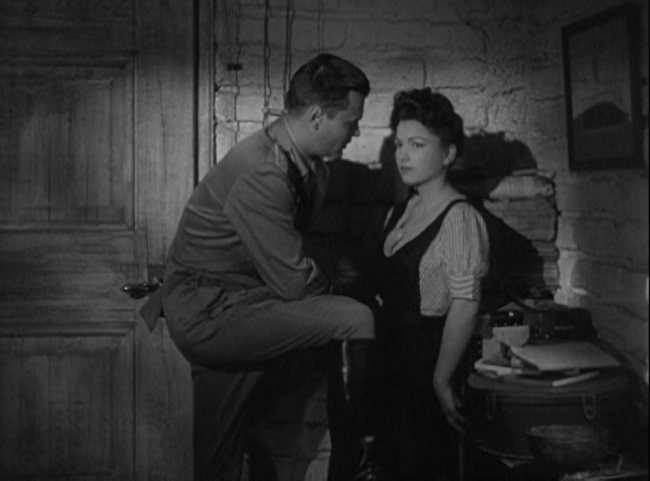
Her tragic story plays effectively alongside the more straightforward adventure tale of John's. He masquerades as a waiter who'd been killed in a bombardment before the Germans came. Then he finds out that waiter was a German agent. So he finds himself pretending to be a waiter pretending to be a Nazi spy.
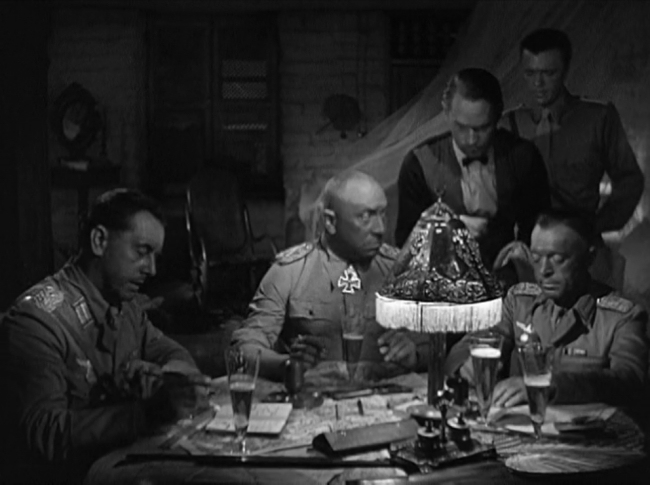
The film nicely keeps up the tension on his predicament. There's never any real chemistry between him and Baxter which is perhaps why this film hasn't garnered the same kind of veneration as Casablanca or other great wartime films. But it's still pretty good.

Five Graves to Cairo is available on The Criterion Channel as part of this month's collection of 1940s Billy Wilder movies.

Wednesday, May 11, 2022

The Length of an Escape Tunnel

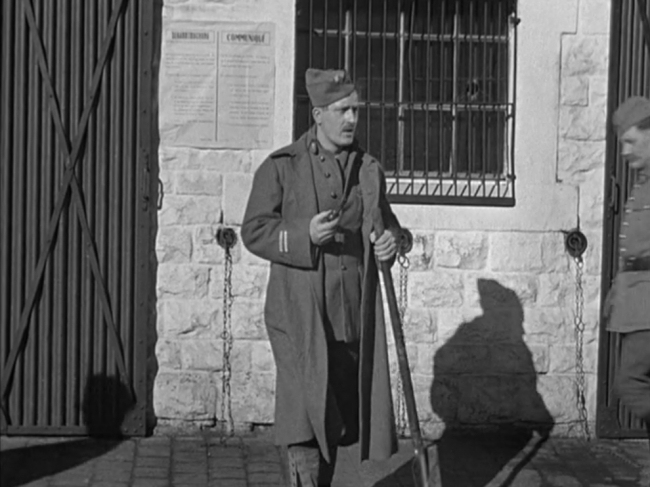
The logic of war tends to break down on the personal level. 1937's La Grande Illusion uses a German prisoner of war camp to illustrate this. It doesn't find it necessary to make some direct, impassioned argument about how all these people have their humanity in common, it seems to just let events play out along the natural lines of human sympathy. So it's quite subtle and lovely.

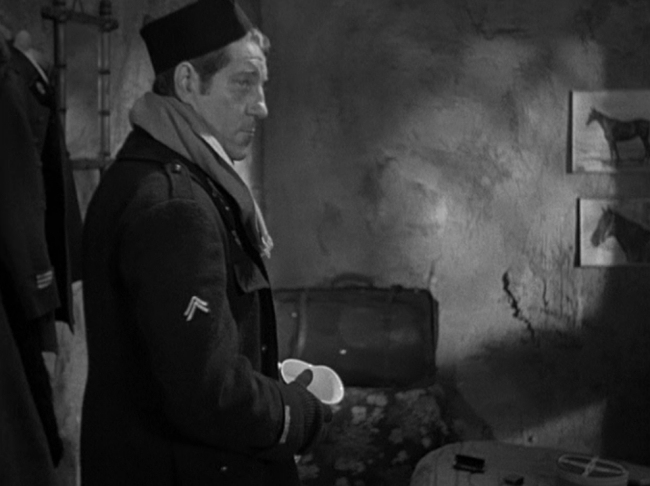
A lot of credit has to go to Jean Gabin. Although it's really an ensemble film, Gabin plays the closest thing the film has to a central lead, a French lieutenant called Marechal. His charisma makes him a focal point even when he isn't framed that way in a scene.

He has a sense of honour and decency but he's not a hero or a paragon. The film resists making any of its characters too pure. One of the central relationships of the film is between the prison commandant, Rauffenstein (Erich von Stroheim), and a captured French aristocrat, Boeldieu (Pierre Fresney). Rauffenstein, also an aristocrat, feels an immediate kinship with his French counterpart. In his courteous treatment of the prisoners and of Boeldieu in particular he expresses a belief that war is antithetical to the polite society of the ancient European ruling class. The camaraderie between some of the German prison guards and the prisoners shows a discord between the war and the lower classes as well. The motivation for war is almost totally invisible. One prisoner remarks on how he hates how the German newspapers exaggerate events in the war to which Marechal points out the French papers do the same.

The movie's set in World War I, a particularly useful war for this story as the motivations behind it are infamously vague and complicated contrasted with the real, visceral suffering endured by millions of people.

Marechal eventually plans an escape with a Jewish inmate called Rosenthal (Marcel Dalio), a character whom director Jean Renoir evidently included to argue against the rising antisemitism in Europe at the time. One wonders if Renoir could have made such a film about World War II in which war crimes made the purpose of military engagement much clearer. Though, of course, in Renoir's masterpiece, The Rules of the Game, he eloquently explored the differences in how that war came about.

Le Grande Illusion is available on The Criterion Channel.

Monday, May 25, 2020

Just How Much Good is a Gun?

Even for the most adept femmes fatale, it can be dangerous to break the heart of an expert marksman. But Mary Beth Hughes does it anyway in 1945's The Great Flamarion, a good low budget noir from Anthony Mann, a director more associated with Westerns.

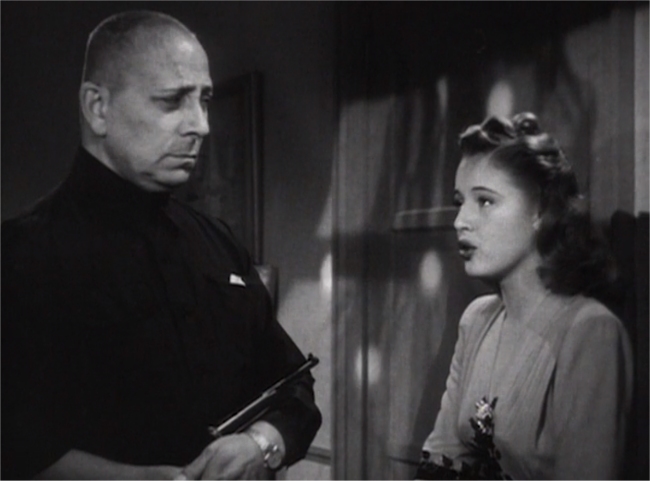
Erich von Stroheim plays Flamarion, a stoic trick shooter who we see performing onstage alongside husband and wife assistants played by Mary Beth Hughes and Dan Duryea. They play out a little scene where Flamarion pretends to be the husband who comes home to find his wife with her lover. He then precedes to shoot wine glasses, light bulbs, and pieces of Hughes' clothing, including parts of her garters.

Von Stroheim was a great film director as well as an actor and I feel like I've read somewhere analysis of the movie that discusses at length the symbolism of a director literally shooting at his starlet vis-a-vis male gaze or some such. Flamarion does turn out to be a bit repressed and afraid of women--we learn later he had his heart broken by someone named Alma but as far as we're told he's never actually committed acts of violence against women. He just wants to be alone.

That won't do for Connie (Hughes) who wants her husband, Al (Duryea), dead. Al is a drunk so it's not hard to come up with a feasible reason why Flamarion might "accidentally" shoot him during the act. The marksman's tendency to spend all his free time in his room, alone with his gun (make of that what you will), unsurprisingly does nothing to prepare him against Connie's charms. One kiss and he's smitten.

Connie, meanwhile, has her sights set on Eddie (Stephen Barclay). And who knows who else. Hughes is no Barbara Stanwyck or Jane Greer as far as performance goes--you might remember her from the Mystery Science Theatre 3000 classic I Accuse My Parents--but she is ravishing. Von Stroheim is not the best actor but his rigidity works very well to convey Flamarion's repression. Dan Duryea, of course, is always great.

The Great Flamarion is available on Amazon Prime and probably a lot of other places since it's public domain.

And Happy Birthday to-day to the creator of Dancy Flammarion (relation unknown), Caitlin R. Kiernan.

Twitter Sonnet #1358

The wooden saucer holds a spoon of drink.
A tankard thought surpassed supplies of gin.
For all the wine in mind could never sink.
And all the cans could never crack the bin.
Embedded thoughts create a normal voice.
It's time to walk to ev'ry job at once.
Imbued in ev'ry brain's a wavy choice.
It's time to start the weekly freezer hunts.
Confection ferries bring the heavy goods.
The path of candy changed from mint to cream.
Remembrance makes the yearly mental woods.
A settled loop incites the churning dream.
The counted worlds were suns and stars abroad.
A burning land belies the name of sod.