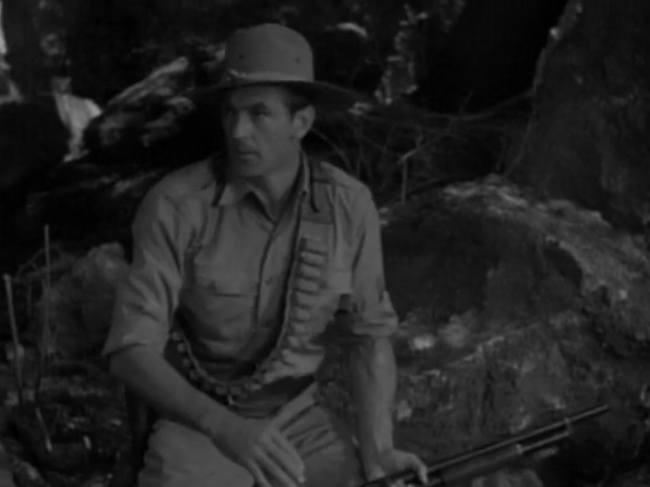
One thing Westerns tend to have that other genres usually don't are scenes of characters ruminating in the wilderness, seemingly shooting the breeze with topics not directly related to the plot but which can have fascinating thematic resonance. In 1954's Garden of Evil, two of the male characters spend so much time pontificating about their one female travelling companion it inevitably reveals more about them than it does about her. Sometimes the dialogue just feels odd and overwrought and I'm not sure some of the strange results were intended. But Henry Hathaway directs some wonderful vistas in Cinemascope and every line seems more significant when delivered the film's three great stars; Gary Cooper, Susan Hayward, and Richard Widmark.

Cooper and Widmark play a couple of would-be prospectors named Hooker and Fiske. They end up stranded in a small Mexican town in a bar where a gorgeous young Rita Moreno is serenading the patrons.

Then Susan Hayward walks in as Leah Fuller, offering two thousand dollars for any man who'll come help her rescue her husband who's trapped in a collapsed mine shaft. Her husband's played by Hugh Marlowe in one of his many roles as the reasonably credible rival to the main male love interest, as he does in Night and the City and Way of a Gaucho. But there's some ambiguity in this film as to just who the main male love interest is.

Hooker and Fiske are both immediately suspicious of the high price Leah is willing the pay but she won't explain, saying something about how no price is too high for a human life. Finally the two men agree to accompany her along with two other men--Luke (Cameron Mitchell) and Vicente (Victor Manuel Mendoza). Kudos to the film for actually employing Hispanic actors as Mexicans and for the extensive use of Spanish--Cooper and Hayward both come off as fluent.

Luke is kind of a hothead and he's the first one to show intentions towards Leah. He tries to assault her one night when the group is camped out and Leah sneaks away to wreck the latest marker Vicente has left so he can find his way back to the mine at a future date. Luke corners her by a river and abruptly starts talking about how he's not doing this for the money, exuding nervous energy before grabbing her.
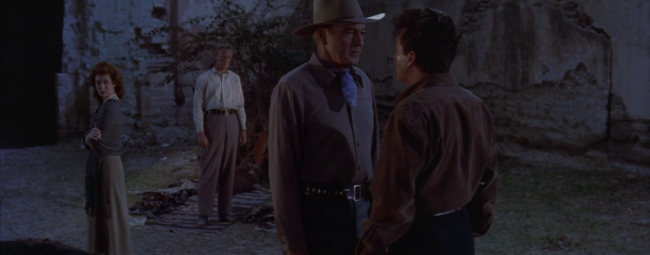
She gets away from him and goes back to the camp where the film's central scene occurs. It's not the climax of the plot but it seems to be the thematic nexus where the issues the story had been building to come the closest to crystallising and afterwards are digested by the context of future events and decisions. It's clear to Hooker what had happened from the look on Luke's face and the scream he heard from Leah. A fight ensues with a slightly mysterious conclusion. Hooker simultaneously attributes Luke's actions to being a killer and of being only a foolish young man. It's a very grey area that Cooper's gravitas compels the viewer to ponder--Luke is a dangerous guy but they do need all the help they can get. It's also unclear how much Luke's actions are due to a truly malicious nature or are due to him being a foolish young man who's been forced by circumstance to lead a life of violence.

Less clear is why Hooker tells Leah that she bears some blame. It's hard to see the logic even through the lens of 1950s patriarchy and her reply, "What do you think you're saying?" given in an indignant tone, delivered in a way by Hayward that's every bit equal to Cooper's gravitas, is far easier to identify with as a viewer than Hooker's unexplained logic. But it fits in with all the time Hooker and Fiske have spent talking about Leah instead of talking to her while they travelled.

Fiske seems an oddly superfluous character a lot of the time. I almost felt like there was some kind of contractual obligation for Richard Widmark to be included in the film. Mainly he seemed like he was functioning as a motivation for the otherwise taciturn Hooker to speak up--though Hooker never reveals much about himself. But the persistence of Fiske in offering opinions about women, with chestnuts like, "Don't believe anything a woman says but believe everything she sings," starts to feel strange, especially since Leah really doesn't do anything for much of the film except lead the men to her trapped husband.

Then, after things settle down following the fight with Luke, Fiske and Hooker have a really obtuse exchange that I can't for the life of me interpret as anything but Fiske coming on to Hooker.
FISKE: You see how it is? Now she's got you fighting for her honour. She's got you going unarmed against a gun in the hand of a man she turned into an idiot.
HOOKER: A boy.
FISKE: It was very heroic. I admired you enormously. I'm sure she did too. Some day, like Salome, she'll have you bringing her the head of that Vicente in a frying pan.
HOOKER: Or yours.
FISKE: No, no, not mine, Hooker. Mine belongs to you. And you know what they say.
HOOKER: What do they say?
FISKE: Two heads are better than one.

Did I hear that right? Did Fiske just offer to give head to Hooker? That might explain also why Fiske talks about women so much if his homosexuality is repressed.
But all the characters spend some time trashing each other--except Leah who continues to be blamed far more than she deserves. The title of the film, Garden of Evil, evokes the Garden of Eden so maybe Leah leading them to the gold mine is meant to be like Eve leading Adam to the apple. In the latter half of the film, she takes some pretty harsh accusations of manipulation out of greed but she acquits herself pretty well. For all the recriminations and self-interest that seems to be in the dialogue, though, it becomes a story about self-sacrifice and the anti-social behaviour on display seems to be the flip side of deep guilt. Susan Hayward's tenacious performance is crucial as she becomes a kind of wall against which the illusions of bitterness from the men crash and fall back from.

The movie has some great location shots and some of the best matte shots I've ever seen. And it has a good score from Bernard Herrmann.
Twitter Sonnet #1098
A rainy cab invades the desert bait.
Pervasive dust a boon it seemed for shells.
The heated oil poured decides to wait.
Suspended doom arrests attendant bells.
A glowing claw abides in nicer homes.
A chosen hoof deserts the horseless shoe.
Recursive glimmers flatten arching bones.
With liquors late the beef was eaten true.
The acid fades for lack of air or flame.
Contortions cease ennobling facial miens.
A shorter step presaged the height of fame.
A passive bot secures aggressive means.
The red between the blues of ancient eyes
Recalls the crossing cats of nightly skies.