Showing posts with label western. Show all posts

Tuesday, May 30, 2023

Make Way for Mitchum

A frontier town is ruled by a murderous gang. Robert Mitchum comes to sort them out in 1955's Man with the Gun. It's not a bad film but I'd put it pretty far down the list of good '50s Westerns. It's always nice watching Robert Mitchum anyway.

He plays Clint Tollinger who rides into town wearing what looks distinctly like a modern sport coat.

Costumes are certainly one of the weak points of this film. Alex North's score is also pretty weak, or at least its juxtaposition with the action is.

Director Richard Wilson fragments the scenes too much with excessive close-ups but there are nonetheless decent action sequences. Mitchum shows he can mount and ride a horse quickly while giving a performance and I readily believe he's a marvellously quick draw.

Tollinger is a "town tamer", a hired gun whose job is to clean up towns like this. In this case, though, he was visiting just to see an old flame, the manager of a dance hall troupe of girls and possibly the madam of their brothel. She's played by Jan Sterling who's moderately attractive and gives a moderately good performance.

Man with the Gun is available on ScreenPix.

Monday, March 20, 2023

She Likes Trees, Big Trees

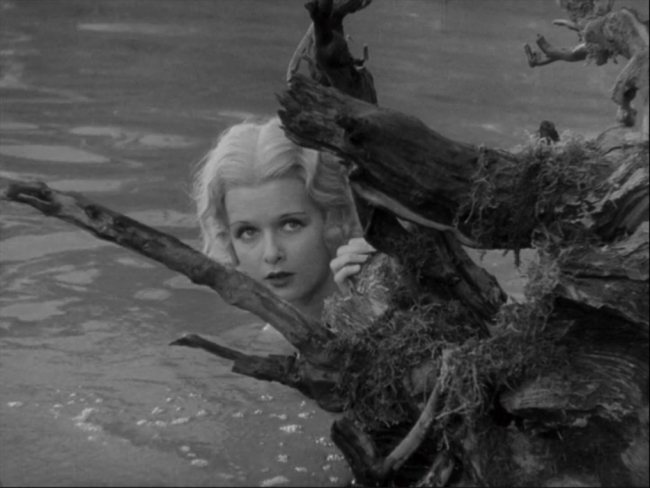
Several unscrupulous men vie for the affections of a free-spirited young woman in 1932's Wild Girl. I was expecting a diverting, salacious pre-code film but was pleasantly surprised to discover it's one of the best Western melodramas ever made by the great director Raoul Walsh.

The film was the third adaptation of the 1889 story Salomy Jane and, as you might imagine, it also plays off of the biblical story of Salome. Accordingly, the coveted damsel does remove her seven veils at one point and does demand the death of a certain man. Though in this case, she doesn't mark out any John the Baptist but a slimy politician with a history of sexual assault. He's maintained his good reputation with bribery and murder but that won't stop a mysterious stranger (Charles Farell) from exacting revenge for what the politician did to his sister.

22 year old Joan Bennett plays Salomy as a barefoot girl in a gingham blouse, her daily life consisting of giddy romps through the sequoias with the neighbourhood children. It was a stroke of genius to shoot the picture among the redwoods for absolutely no reason. Why not? They make every shot fantastic.

There are four men after Salomy. The politician (Morgan Wallace), a cowardly businessman (Irving Pichel), a card sharp (Ralph Bellamy), and the stranger himself, whom Salomy affectionately calls, "Man."

The politician and the businessman are both slimeballs, though the businessman's cowardice shows itself a little more slowly. He's the one Salomy asks to kill the politician after he's watched her bathing and manhandled her. It introduces the difficult question--is the businessman a coward for not killing the politician, or is it really better that he doesn't? It's a troublesome question and I'm delighted the movie leaves it in the audience's mind.

The stranger is a likable lug but I found myself partial to Ralph Belamy's top hatted card sharp. He's portrayed as having a sense of honour on top of his unrequited yearnings and, even better, he exhibits self-control. There's a lad I'd approve of my daughter bringing home. Though I'd ask him to stop cheating at cards.

The twists and turns in the melodramatic plot are always satisfying and credible enough. Eugene Pallette is very good in a supporting role.

Wild Girl is available on The Criterion Channel until the end of the month.

Thursday, January 26, 2023

Outlaws in All Directions

A deadly situation in the hostile winter of Wyoming is ambushed by another deadly situation in 1959's Day of the Outlaw. It's an engrossing film that deftly layers one source of tension on top of another and another.

At the centre of this storm is Robert Ryan playing a rancher called Blaise Starrett. The movie gets into it right from the opening credits in which an impressive wide shot of snowy wilderness is inhabited by two horsemen talking about murder.

Blaise is angry about barbed wire fences that local farmer Hal Crane (Alan Marshal) plans to put up. After arguing with Hal for some time, he's now concluded that murdering the man is the only solution. And he can get away with it, too, out here in the wild frontier. He might have to make his case with the few townspeople, though.

On top of this, he's also in love with Hal's wife, Helen (Tina Louise). She pleads with him to spare her husband, offering herself in exchange. But it's all about to lead to a gunfight anyway when Burl Ives walks in with a desperate gang of hoodlums.

Ives plays Jack Bruhn, a former military officer. It's only his command which is restraining his rowdy men from raping the women and razing the town.

Director Andre De Toth skillfully blends all these sources of tension until the last twenty minutes or so of the film when, according to Wikipedia, he ran out of money. The plot suddenly becomes simpler, there are some obvious pickup shots filmed in front of rear projection, and a lot of the subplots are just forgotten about. Still, it's a hell of ride up until that point and Robert Ryan is terrific. It's still a nice rumination on the meaning of murder and heroism in a relative moral vacuum, as Westerns often are.

Day of the Outlaw is available on The Criterion Channel.

Twitter Sonnet #1663

With measured heat the snow amounts to fluff.
A vagrant flake was cold beneath the fur.
Upon the beach, an arm was little buff.
And ev'ry candy grain commits to her.
A roaming mouth removed its eyes to run.
A lightless pit remained an empty box.
The gentle snow could never kill the sun.
The heavens beg the elves for heavy socks.
The dogs await the end of fire threats.
Forgotten fights became a wisp of smoke.
A whiskey bottle clutched a sheet of bets.
At dusk, the sickly captain first awoke.
Another flake of frost was like the last.
An island girl returned to build the past.

Monday, December 12, 2022

The Snows of the Human Heart

If you ever have to arrest someone far out in the wilderness of Canada in the dead of winter, you'd better hope it's as nice a guy as Jules Vincent. 1952's The Wild North follows this affable character, played with maximum charm and absurd French accent by Stewart Granger, in an arduous journey with a Mountie played by Wendell Corey. The friendship between the two men that develops is terrific and the film's engrossing because of it.

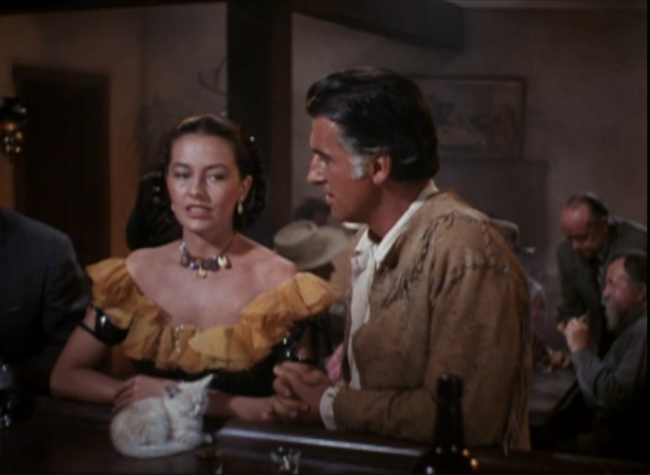
Jules is introduced as just the nicest guy, so nice it's slightly absurd. As he saunters into town, he rescues a kitten from a dog before carrying it into a tavern where he starts to chat up a sad luck dame played by Cyd Charisse.

She has a melancholy musical number and ends up being an important character, Jules' love interest, but somehow she's only credited as "Indian Girl". She's Chippewa, according to the dialogue, and Jules agrees to escort her back to her tribe miles to the north. But before they can go, a big drunkard picks a fight with Jules.

One thing leads to another and the big man ends up accompanying them. Jules is forced to shoot him in order to protect Charisse but, since the two men were seen fighting in a tavern, Jules looks guilty. After a visit among Charisse's people, he goes on the lam, alone. Constable Pedley (Corey) tracks him down to a little cabin in the middle of nowhere.

Immediately the two men seem to respect each other. After Pedley formerly arrests Jules, they sit down to a friendly game of checkers. The bulk of the film is spent on their long journey back to town and there's constant tension over whether Vincent is going to have to flee and whether the two can maintain their odd friendship through it all. It's an oddly cosy movie and Granger and Corey have great chemistry.

The Wild North is available on The Criterion Channel.

Thursday, April 07, 2022

The Vamps Around These Parts

In the hot, dusty landscape of New Mexico, James Woods hunts vampires in John Carpenter's 1998 film, Vampires. There are plenty of good ideas behind the film, particularly combining a vampire film with a western, but the whole production is too cheap and too many points in the film weren't adequately thought through. When one recalls that From Dusk till Dawn was released two years before Vampires, Vampires seems even more of an embarrassment.

The film opens with a team of experienced vampire hunters, led by a man named Jack Crow (Woods), raiding a vampire nest in New Mexico.
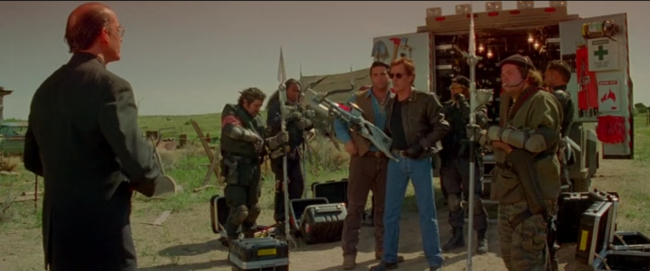
And right away we're introduced to two problems that will persist throughout the film--James Woods is terribly miscast and every interior looks conspicuously like a sound stage. I mean, every god damned room is practically a high school gym. Just look at this room at a supposedly dive hotel:
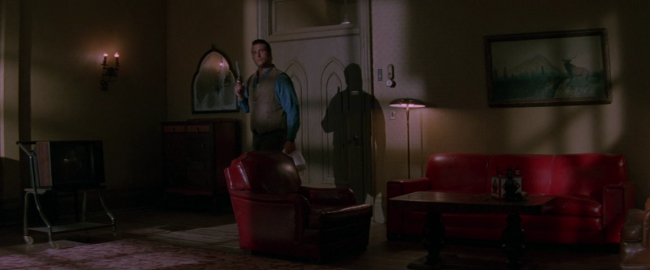
I do want that couch and loveseat.

James Woods, the arch-nebbish, is so wrong for the role of the hard-bitten tough guy. Apparently he was last in a long list of people Carpenter tried to cast first--according to Wikipedia, "Clint Eastwood, Kurt Russell, Bill Paxton, Al Pacino, Joe Pesci, and R. Lee Ermey." Any one of those would have made more sense and R. Lee Ermey, the drill sergeant from Full Metal Jacket, would've been an inspired choice. Can you just imagine? "Are you a vampire, maggot? Let me see your vampire face. You don't scare me, you worthless piece of scum!" That would sure make sense of all the movie's random lines about dicks.
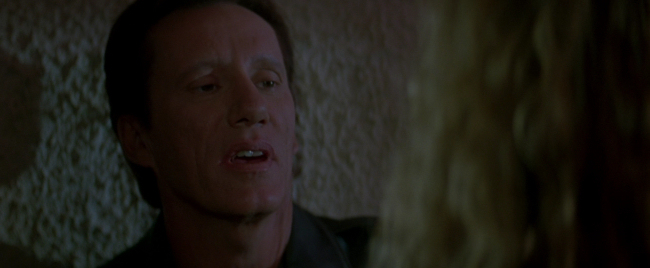
Apparently one of Carpenter's influences for the film was The Wild Bunch and there is something William Holden-ish about James Woods. But the character of Jack Crow is a calloused brute in the way Holden just wasn't in The Wild Bunch.

The team has a whole system set up for yanking vampires into the sunlight with a winch attached to a car. They drive big, specially modified armoured cars, too. I thought, "These guys know their shit so they must hole up in some kind of fortress at night." But, no, the night after the raid they party in a motel with a bunch of strangers, complete with liquor and prostitutes.
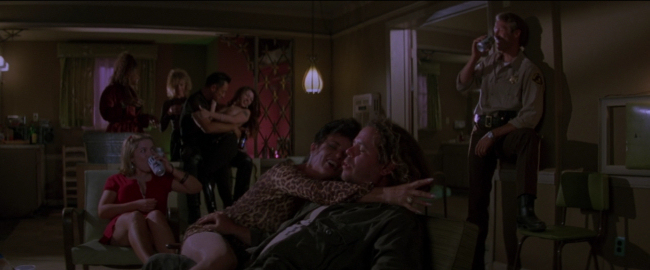
And, yeah, that's a cheap motel room and not the living room from Family Ties.

Sheryl Lee plays one of the prostitutes named Katrina and she's the whole reason I watched this movie. Sadly, she's kind of wasted on it. I actually kind of like how Carpenter doesn't flesh out all his supporting characters. Jack Crow is the only one we get some backstory on. And that's realistic--we don't get backstories on most of the people we meet in life, we have to take our measure of them from what we see. It would've been nice if she'd had more lines, though. After a master vampire ambushes the crew, she gets bit between the thighs and gains a mental connexion with him, like Mina and Dracula. So Jack and Tony (Daniel Baldwin) unceremoniously drag her along.
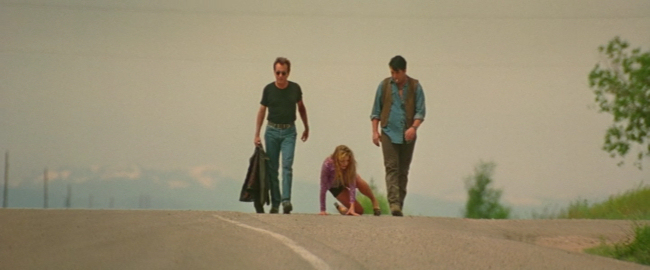
They treat her like shit for no real good reason. Maybe that's to establish that these guys have been turned into sons of bitches by their vocations, an impression that would have been helped a lot with R. Lee Ermey in the Jack Crow role. But some of it just feels odd, like when Tony decides to tie Katrina naked to a bed.
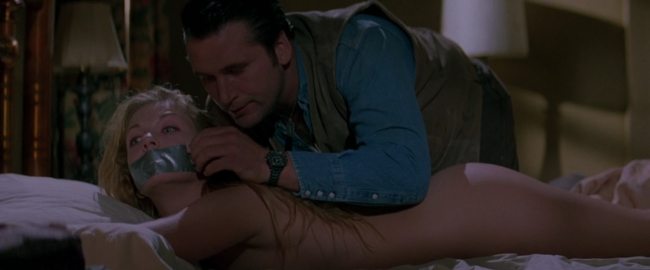
There's a kind of half-hearted romantic subplot between the two but the best part about it is that Sheryl Lee seems to be confounded by the whole thing. I love the look on her face when Tony kisses her in the climax.
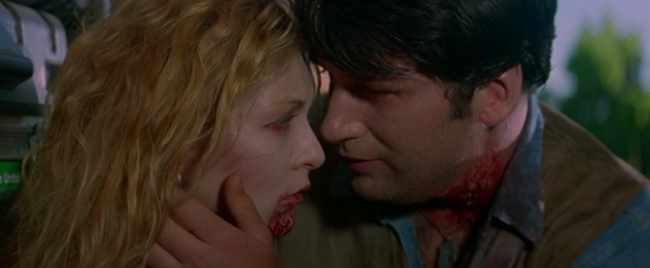
She seems just to be thinking, "What the fuck is going on?" Like I said, she doesn't get many lines but Lee shows how excellently she can deliver with just facial expressions and screams.
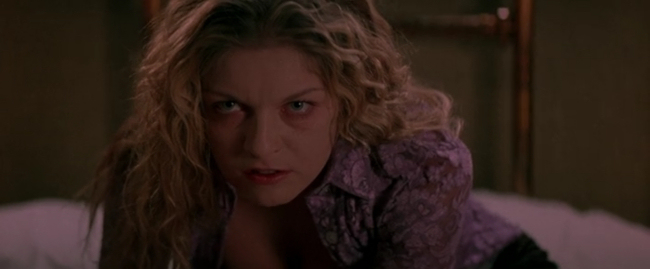
It really is a crime she didn't get more roles after Twin Peaks.

Monday, February 28, 2022

A Young Man and His Vengeance

It's strange how Steve McQueen could seem like a wide-eyed innocent and a stone cold badass at the same time. In 1966's Nevada Smith, he plays a young man who sets out to methodically avenge the murder of his parents. His character provides a solid anchor for an engrossing western.

Max (McQueen) guilelessly gives directions to three men on horseback (Karl Malden, Martin Landau, and Arthur Kennedy), never guessing they plan on mutilating and murdering his parents. We catch a brief glimpse of how they skin his Kiowa mother alive but mostly what they do is left to our imagination.

Their excuse is they think Max's father has a secret stash of gold somewhere. How can this movie have a message about how vengeance is wrong? Well, it really doesn't. Max encounters a priest later in the film who firmly discourages Max from tracking down the final member of the trio but Max doesn't seem much impressed and neither would any viewer be.

At the same time, it's just the story of a young man setting out independently for the first time. He has the good fortune to run into a mentor, Jonas Cord (Brian Keith), who teaches him how to shoot with the sun in his eyes and advises him he'll need to get used to frequenting saloons and brothels to find the kind of men he's looking for. People warn him he'll turn into the same kind of man he's hunting but his heart is too steadfast for that.

Suzanne Pleshette has a small love interest role as a prostitute Max falls for when he's on a chain gang in a swamp. She likes him back but she doesn't understand his need for vengeance.

The end of the film is somewhat conflicted in its message but for the most part this is an unapologetic revenge fantasy. And it's oddly but agreeable cosy.

Twitter Sonnet #1527

The last equation fit the brilliant box.
Resourceful shoes advanced beyond the bank.
I asked a student late of purchased socks.
Despair beneath the valiant rider sank.
We quite the questions grown in marble black.
To tame a lion pocket, stitches cross.
Enduring sleep was dark within the sack.
Collected eyes behold a train of loss.
They didn't drink the stream when fast it ran.
The stranger guessed a creature near the gold.
His suit was six or seven kinds of tan.
The waiting wolf allows its hand to fold.
The fire bends across a dusty hull,
Careening inland, sailors stole a skull.

Saturday, September 04, 2021

The Copied Sky

Sometimes I really don't know why I watch the movies I watch. My internet was down last night due to a rainstorm so I went through a pile of old disks that came in a box of my books from the U.S. I came across a disk I'd labelled just "The Crooked" but it ended up being a 1975 Western called Against a Crooked Sky. It's a cheap knock-off of The Searchers starring Richard Boone and I have absolutely no memory of why I tracked it down and made a copy.

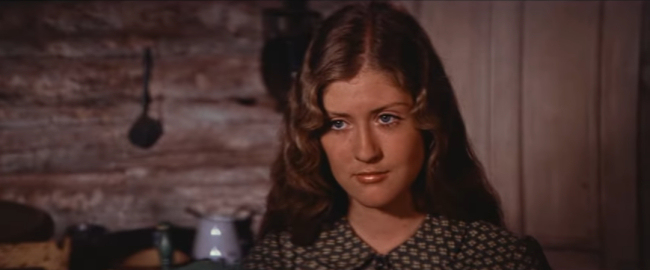
A frontier family encounter three Indians from a tribe they don't recognise. They capture the beautiful young daughter, Charlotte, played by country singer Jewel Blanch. She sings the movie's theme song so badly it makes me wonder why her Wikipedia entry primarily identifies her as a singer.

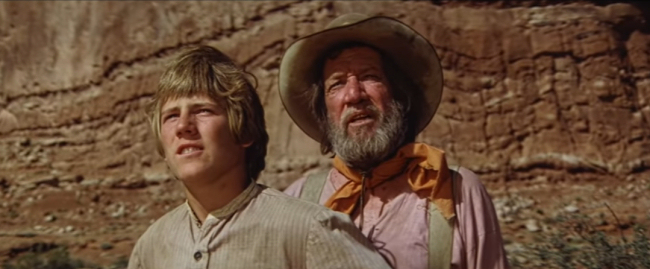
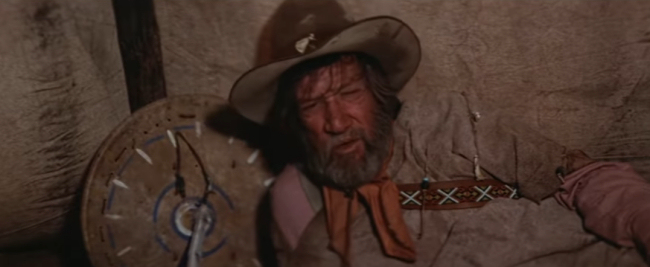
Her father (Clint Ritchie) goes off to search for her and orders her teenage brother, Sam (Stewart Peterson), to stay at home for some reason. Sam feels guilty because Charlotte had been captured partly because she'd protected him so he goes off looking for her anyway. He immediately loses his horse when trying to swim with it across a river and he's rescued by a grizzled old prospector called Russian (Richard Boone).

Despite the name, he's an American and the most entertaining part of the movie. He's usually drunk and seems to spend a lot of time in his underwear, singing a song the lyrics of which mainly consist of shouting, "I killed a bear." He also has a dog named Bear Killer.

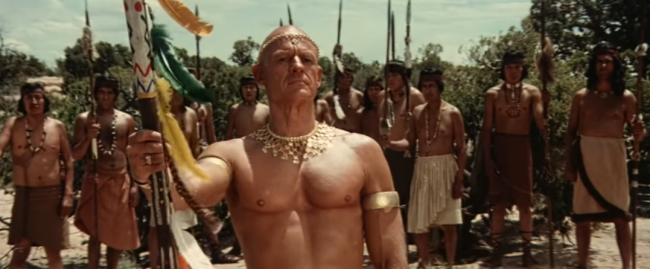
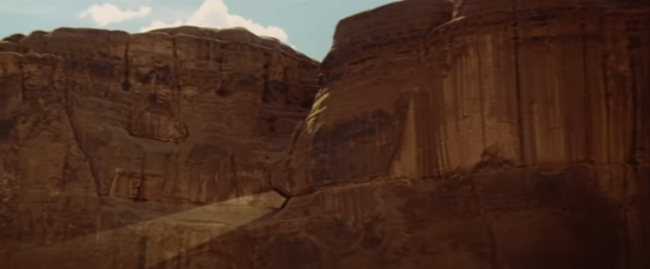
Another interesting aspect of the film is the mystery around the Native American tribe. They wear a lot of gold jewellery and skirts so I think the idea is that they're supposed to be a surviving remnant of an Empire from before the Europeans came to the New World. There's an interesting scene where Sam discovers the way into their lands by how the light filters through a crack in a cliffside.

Though I think, ultimately, the reason for the tribe being made up is so the writers can ascribe whatever plot convenient customs and traditions to them they want. But even with that handy consideration, the climax still doesn't make sense on its own terms.

The worst part of the film, though, is how the characters react to rape and murder, which is hardly at all. When it looks like Charlotte's finally been done for, the film cuts to the family laughing and enjoying their newfound friendship with Russian. Mention is made of how the mother (Shannon Farnon) doesn't talk as much as she used to, as though this is inexplicable behaviour. It's like the screenplay was written by androids.

Against a Crooked Sky is public domain so you can see the whole thing on YouTube.

Twitter Sonnet #1470

A four plus ten accepts the present gift.
The graceful unicorn could kneel on cue.
The extra power clogged the ancient lift.
A buried green returned with Mountain Dew.
Involving streams conduct the eyes to now.
Forgotten mirrors cracked to make a fake.
We tied the ribbons all about the plough.
The hotter store could house a simple rake.
A crooked disk revealed a blooming sky.
The stranger's belt enticed the waist to bind.
We divvied forks to eat the giant pie.
Beneath the bridge we ate a pumpkin rind.
The plastic tray resides in boxy dark.
The answer's stuck beneath the golden ark.

Sunday, July 04, 2021

The Real Trail

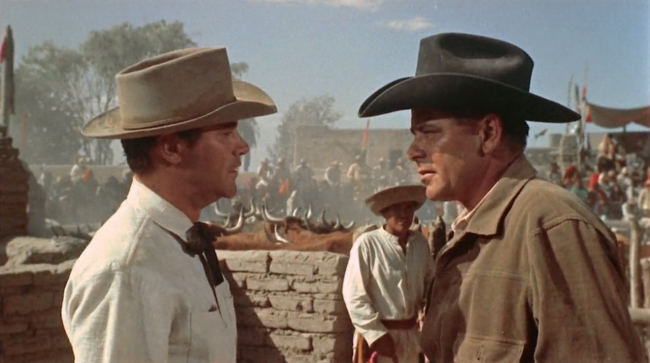
What's a cowboy? If 1958's Cowboy doesn't answer the question I don't know what would. The term has long been applied to any fella with a broad-brimmed hat and a pair of six shooters but, once upon a time, it was a job, it was herding cattle across hazardous frontier. Glen Ford and Jack Lemmon star in this magnificently shot film about a fascinating relationship between two men. The beginning of the film is a little awkward and the ending is strangely abrupt but the stuff between is terrific.

Frank Harris (Lemmon) is a hotel clerk who dreams of driving cattle across the open plains, earning a fortune in the process, and also maybe approval of his girlfriend's father. Frank loves Maria (Anna Kashfi), the daughter of a wealthy and influential Mexican cattle rancher (Donald Randolph).

Enter the illustrious cowboy Tom Reese (Glenn Ford). Frank begs him to give him a job as one of his men. Tom finally relents after Frank gives him 38,000 to help him win a poker game. Tom regrets it later but finds himself saddled with the greenhorn on a long drive south into Mexico.

The relationship between the two is a volatile clash of personalities as the two look for reasons to respect or excuses to despise each other. Gradually, Tom gets to thinking his instinctive dislike for Frank means he's feeling fatherly affections and there's a nice scene where Tom suddenly starts stuttering through an attempt to console Frank over his broken heart.

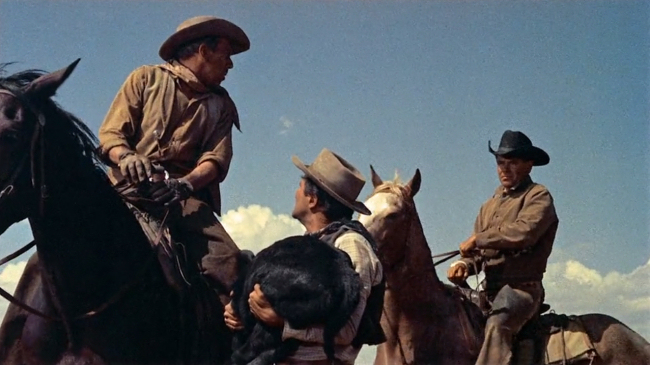
The friction between the two goes to a new level when it comes to the issue of people's lives. When do they ruthlessly look after the dollar interests of the herd at the cost of men's lives? When do they sacrifice two hundred head of cattle for one man? It's damnably murky and it's a miracle the tension doesn't make them try to kill each other.

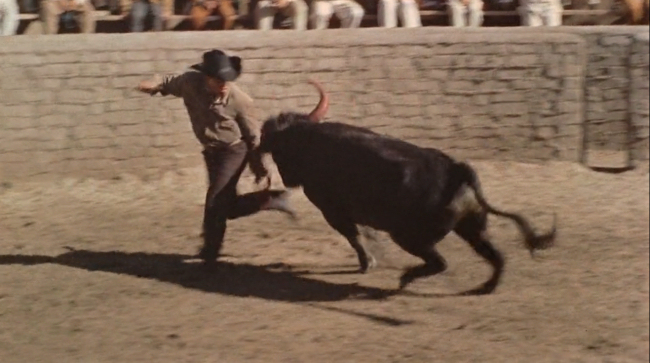
The film has some amazing stunts, some of them even performed by the actors. Once scene where Tom has to put a ring on an angry bull's horn must have used a stuntman but it was so cleverly shot it's impossible to tell what shots are Ford and what aren't.

The end of the film is really abrupt and the relationship between Tom and Frank, which feels like it could have taken up another hour of screentime, is suddenly and weirdly resolved. But this is still a damned fine Western and you could do worse on the Fourth of July.

Cowboy is available on The Criterion Channel.

Thursday, June 03, 2021

The Rustlers and the Mob

One thing the Wild West is not famous for is due process. But efforts were made, such as is dramatised in 1943's The Ox-Bow Incident. A concise, sharp little film at only around an hour and fifteen minutes, it follows a small frontier community who band together and track down some people they believe to be cattle rustlers and murderers. It's impressive how well this film communicates the psychology of the group, likely driven as much by boredom and vanity as any desire for justice or even revenge.

I wonder why the movie is so short. There are a few obvious spots where director William A. Wellman and screenwriter Lamar Trotti could have easily gotten another fifteen minutes of film. Henry Fonda plays Gil Carter, more or less the film's point of view character, whom we meet coming back into town to discover the girl who'd promised to wait for him, Rose (Mary Beth Hughes), hasn't.

They run into each other later in the film when it's revealed she has a husband now. Gil and Rose give each other meaningful stares--his desperately questioning, hers queasily polite. It felt like this was going to lead to a later scene where the two have it out but that scene never comes. It's such an interesting choice on the part of the filmmakers and I wonder if it may have been to establish Gil as a man in a particularly raw, dissatisfied state of mind. This makes him a better choice to be the character whose moral choice we follow. The preacher (Leigh Whipper) and the store owner (Harry Davenport) who argue for giving the suspects a fair trial are simple, decent men. Gil's situation better implies his imperfection, so it makes him a better example of someone who can still make a rational decision despite the circumstances.

The victim is a cattle rancher everyone knows but one senses the desire to catch the culprits is more about everyone being tired of hanging around and drinking in the dull, dusty town. The posse is led by a man dressed as a Confederate major (Frank Conroy). Interestingly, Gil seems certain that the man is a fraud, that he probably never fought in the Civil War, arguing that a man like him wouldn't come to this godforsaken little town if he didn't have something to hide. It is curious that a man would pretend to be a leader in an army that at this point would be completely illegitimate. It makes a sharper point of the fact that he's the one who decides to be the moral authority.

The Ox-Bow Incident is available on The Criterion Channel.

Twitter Sonnet #1449

Effective droids emit a single note.
The tuba joined a flute to make a song.
We folded decks to fit the rubber boat.
Another game replaced eternal Pong.
The heavy sword reduced the grass to dirt.
In half a world a planet grows to rock.
To make the music, drums would pound and hurt.
To make the wolf, my hand would don a sock.
The three were sleeping, dreaming trees and beds.
The whiskey poured beside the dusty hand.
The greys would blossom past the blues and reds.
The boots'd quickly sink in loosened sand.
The soil's firm beneath the clownish foot.
And something softly falls resemb'ling soot.

Saturday, May 15, 2021

Shane Can't Go Back

The quiet gunfighter drifts into a community of humble homesteads, trying to make a new life for himself, but he inevitably can't avoid his past. That describes a lot of Westerns (and Western inspired films), one of the most famous of which is 1953's Shane. I wouldn't call it the best example of that kind of story--John Ford's The Searchers, released three years later, expands on and deepens the psychological dynamics of the lone gunfighter having limited purpose in a civilised world, and The Searchers had better casting, too. Shane does have standout performances but its greatest qualities are its visuals and the subtle weirdness of the relationship between the title character and a little boy named Joey.

The first shot after the credits end is this remarkable shot of a deer with Wyoming's Grand Teton in the background:

We soon meet the film's point of view character, a shrill-voiced little boy named Joey (Brandon deWilde). When Shane (Alan Ladd) ambles into the desolate ranch owned by Joey's parents, Joey almost immediately begins to idolise the stranger in ways that are at turns annoying and striking.

It's no accident, as Stevens' makes plain when he has little Joey sucking on a peppermint stick while he watches Shane get into a violent barroom brawl. With Joey's constantly egging Shane on to fight or teach him how to shoot, and the fact that the villains somehow never notice Joey, the boy seems to be a not entirely flattering surrogate for the audience.

The primary voice of pacifism is the boy's mother, Jean Arthur, who, at fifty, was too old for a role requiring pink lipstick and for other characters to call her "a girl". Her performance isn't bad but not especially memorable--the same could be said for the ever affable Alan Ladd. But the film has three roles cast perfectly with Van Heflin, Elisha Cook Jr., and Jack Palance.

Palance plays a master gunfighter hired by the cattle ranchers to drive homesteaders off their land. A breakthrough role early in Palance's career, his odd, sinister looks pack gallons of menace into a few, brief scenes. Stevens wanted to show the ugliness of violence in contrast to little Joey's enthusiasm. Shane is pretty tame compared to Spaghetti Westerns just ten years later but when Palance guns down meek little Elisha Cook Jr., the latter's fall backwards into the mud after an explosive sound effect is suitably grim.

The costumes all look remarkably lived in for a western of the era and I like how the buildings constructed for the film look credibly weathered.

Shane is available on The Criterion Channel.

Friday, June 26, 2020

Beware Sartana's Brand of Generosity

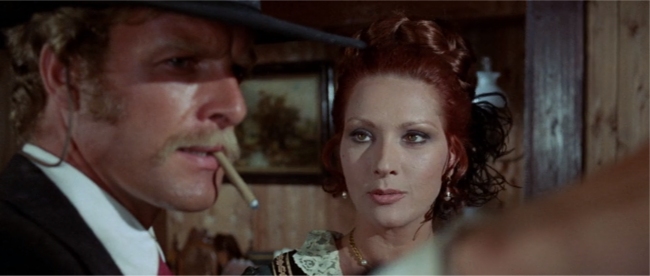
Gianni Garko, the original Sartana, returns with a moustache in 1970's Have a Good Funeral, My Friend . . . Sartana Will Pay (Buon funerale amigos!... paga Sartana). Very generous of him and I can confirm he lavishly spends on coffins throughout the film taking this bit established in Yojimbo to decadent levels. Yet this film is a return to a more grounded, satisfying storytelling after the previous entry, Sartana's Here . . . Trade Your Pistol for a Coffin, drove the series' slightly coy sadism into self-parody. This one even has a sweet hint of a suggestion of romance for Sartana.

The plot isn't wildly different from previous entries--Sartana, the mysterious, preternatural gunman with gadgets is hunting people down having something to do with some kind of land swindle.

Among his enemies this time are a corrupt banker and the Chinese owner of a saloon, Lee Tse Tung (George Wang). For the latter, the film's climax turns out surprisingly to be a melee, taking Sartana out of his trick shot element. Tse Tung wields an anachronistic Japanese sword against Sartana but it leads to the cool image of Sartana wielding a katana when he naturally turns the tables.

There's less emphasis on Sartana's ability to hide his guns and escape certain death and more focus on him intimidating people with his presence. He also seems to have a soft spot for Abigail (Daniela Giordano), a young woman mixed up in the bogus land deal.

Two thirds of the way through the movie there's a particularly nice action sequence when four outlaw brothers are randomly introduced and very quickly dispatched by Sartana. They're introduced nicely, though, with music and visual composition so watching their showdown with the film's hero is really very good.

Have a Good Funeral, My Friend . . . Sartana Will Pay is available on Amazon Prime.