
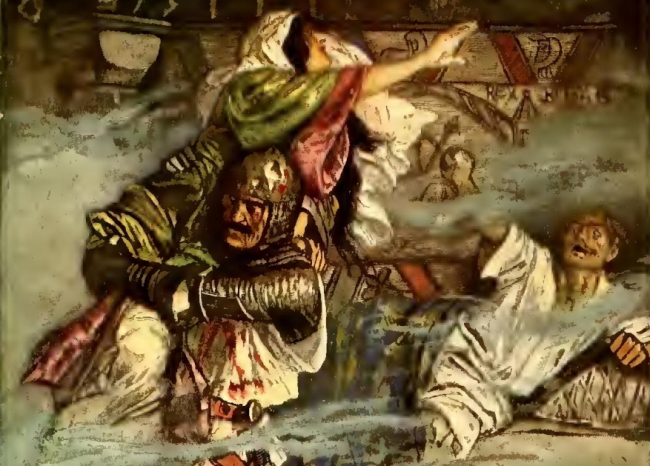
Is honour but "a mere scutcheon" as Falstaff would say, an inevitable road to hypocrisy and madness, or is it a manifestation of what's truly fine and beautiful in the human heart? Sir Walter Scott offers a balanced argument ultimately in favour of the latter in his 1819 book, Ivanhoe.
I've already talked about the love and care Scott took in conjuring a late 12th century England in his prose. There's tremendous, evident love in his descriptions of Rotherwood, a manor house, of the jousting tournament, of the characters, from swineherd to king to none other than Robin Hood himself.
Despite the title, the character called Ivanhoe plays a relatively minor role in the book. There are many characters and conflicts which are only loosely connected but if I were to name one plot as more prominent than the rest, I would say it's the relationship between the Templar knight, Brian de Bois-Guilbert, and the young Jewish woman, Rebecca.
Bois-Guilbert is portrayed as simultaneously zealously committed to knightly codes of conduct and habitually negligent of them. It's a fascinating contradiction that makes his character easily the most interesting in the book as well as likely being an insightful portrait of many hypocrites. Despite his vows of chastity and even his commitment to fighting or persecuting heretics, he develops an obsession with the beautiful Rebecca, whom he kidnaps with the intention of forcing her to become his lover. When he takes her to a Templar stronghold, he's surprised to find the head of his order present, a tyrannical enforcer of dogma with the harshest of interpretations. He wants to burn Rebecca at the stake as a witch because she's renowned for her healing abilities.
As a pure, innocent victim, Rebecca is a simple character and perhaps not an interesting one. Yet, her dialogue with Bois-Guilbert is captivating. As she awaits a champion to appear for her in a trial by combat, her arguments in the face of Bois-Guilbert's steadfast hypocrisy are exquisitely beautiful constructions of logic and poetic language. He is destined to appear as her opponent, required to do so by Templar rules, despite obviously not wishing her death. Rebecca is not reluctant to point out how the strictness of his adherence to Templar rules tends to vary.
". . . If I appear, then thou diest, even although thy charms should instigate some hot-headed youth to enter the lists in thy defence.”
“And what avails repeating this so often?” said Rebecca.
“Much,” replied the Templar; “for thou must learn to look at thy fate on every side.”
“Well, then, turn the tapestry,” said the Jewess, “and let me see the other side.”
“If I appear,” said Bois-Guilbert, “in the fatal lists, thou diest by a slow and cruel death, in pain such as they say is destined to the guilty hereafter. But if I appear not, then am I a degraded and dishonoured knight, accused of witchcraft and of communion with infidels—the illustrious name which has grown yet more so under my wearing, becomes a hissing and a reproach. I lose fame, I lose honour, I lose the prospect of such greatness as scarce emperors attain to—I sacrifice mighty ambition, I destroy schemes built as high as the mountains with which heathens say their heaven was once nearly scaled—and yet, Rebecca,” he added, throwing himself at her feet, “this greatness will I sacrifice, this fame will I renounce, this power will I forego, even now when it is half within my grasp, if thou wilt say, Bois-Guilbert, I receive thee for my lover.”
“Think not of such foolishness, Sir Knight,” answered Rebecca, “but hasten to the Regent, the Queen Mother, and to Prince John—they cannot, in honour to the English crown, allow of the proceedings of your Grand Master. So shall you give me protection without sacrifice on your part, or the pretext of requiring any requital from me.”
“With these I deal not,” he continued, holding the train of her robe—“it is thee only I address; and what can counterbalance thy choice? Bethink thee, were I a fiend, yet death is a worse, and it is death who is my rival.”
“I weigh not these evils,” said Rebecca, afraid to provoke the wild knight, yet equally determined neither to endure his passion, nor even feign to endure it. “Be a man, be a Christian! If indeed thy faith recommends that mercy which rather your tongues than your actions pretend, save me from this dreadful death, without seeking a requital which would change thy magnanimity into base barter.”
Bois-Guilbert piles his weak arguments higher and higher but with such conviction, augmented by the customs of his environment and companions, it's quite plausible that a thin, shaky foundation can be rationalised by him as firm and immutable. Yet, truth is truth, and Rebecca consistently shows his tangled rationalisations for what they are.
This conflict is the sharpest example of one Scott presents in various forms between different characters. The loose morals of Friar Tuck are presented as charming and to the advantage of the heroes, yet even he is ultimately not portrayed as a purely good man. King Richard is portrayed as a saviour and yet Scott is critical of Richard's lack of commitment again and again.
Scott gives the reader ample food for thought in a deeply pleasing package. It's a lovely book.
