Showing posts with label joan bennett. Show all posts

Monday, March 20, 2023

She Likes Trees, Big Trees

Several unscrupulous men vie for the affections of a free-spirited young woman in 1932's Wild Girl. I was expecting a diverting, salacious pre-code film but was pleasantly surprised to discover it's one of the best Western melodramas ever made by the great director Raoul Walsh.

The film was the third adaptation of the 1889 story Salomy Jane and, as you might imagine, it also plays off of the biblical story of Salome. Accordingly, the coveted damsel does remove her seven veils at one point and does demand the death of a certain man. Though in this case, she doesn't mark out any John the Baptist but a slimy politician with a history of sexual assault. He's maintained his good reputation with bribery and murder but that won't stop a mysterious stranger (Charles Farell) from exacting revenge for what the politician did to his sister.

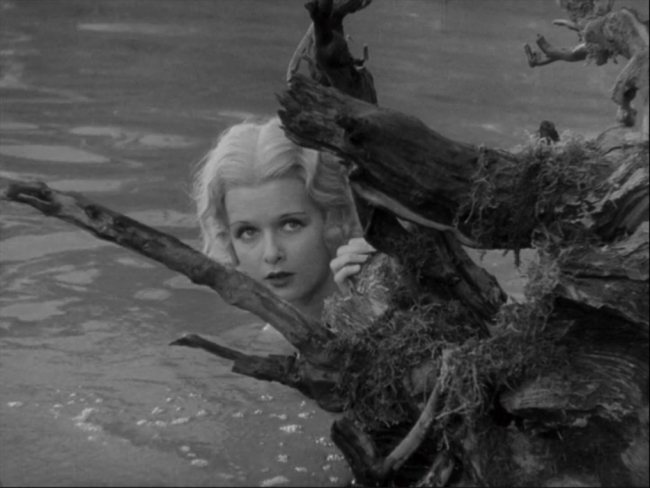
22 year old Joan Bennett plays Salomy as a barefoot girl in a gingham blouse, her daily life consisting of giddy romps through the sequoias with the neighbourhood children. It was a stroke of genius to shoot the picture among the redwoods for absolutely no reason. Why not? They make every shot fantastic.

There are four men after Salomy. The politician (Morgan Wallace), a cowardly businessman (Irving Pichel), a card sharp (Ralph Bellamy), and the stranger himself, whom Salomy affectionately calls, "Man."

The politician and the businessman are both slimeballs, though the businessman's cowardice shows itself a little more slowly. He's the one Salomy asks to kill the politician after he's watched her bathing and manhandled her. It introduces the difficult question--is the businessman a coward for not killing the politician, or is it really better that he doesn't? It's a troublesome question and I'm delighted the movie leaves it in the audience's mind.

The stranger is a likable lug but I found myself partial to Ralph Belamy's top hatted card sharp. He's portrayed as having a sense of honour on top of his unrequited yearnings and, even better, he exhibits self-control. There's a lad I'd approve of my daughter bringing home. Though I'd ask him to stop cheating at cards.

The twists and turns in the melodramatic plot are always satisfying and credible enough. Eugene Pallette is very good in a supporting role.

Wild Girl is available on The Criterion Channel until the end of the month.

Monday, May 04, 2020

The Prison of a Familiar Face

Trying to make his own fate ironically traps a man in an inescapable doom in 1948's Hollow Triumph (a.k.a. The Scar). A hard bitten, underrated film noir, this is a sterling example of the genre's existential preoccupations. It's tragic, darkly comic, oddly sweet, and, above all, a nightmare.

Paul Henreid stars as John Muller, a mastermind gangster just released from prison. Henreid is well cast here, his accent and reserved performance giving him an air of sinister mystery even when he's an open book as the film's anti-hero. Immediately, he wants to knock over an underground gambling joint, one his cohorts tells him is a million to one odds and, even if they succeed, the gang will hunt them down. But, such is the esteem commanded by John's intelligence, everyone reluctantly agrees to go along.

Bone white faces in charcoal shadows, the gambling den has quintessential film noir lighting. The plan partly succeeds--they get the money but two of Paul's gang are caught. Knowing the mobsters are on his trail, John leaves for another town where he finds out there happens to be a psychoanalyst called Bartok who looks exactly like him, apart from a scar.

Already there'd been a few conspicuous lines about how John is the kind of guy who gets his own way, "Still think you got the world by the tail, hey, Johnny?" says one of his cohorts. In the new town, John starts to make time with his look-alike's secretary, Evelyn (Joan Bennett), who's cautious about having a relationship with him and says, "If you think I'm going to get myself mixed up with you, you're crazy. You're one of those egotistical smart-alecs with big ideas. You think you got a right to get away with murder."

But she does get mixed up with him, despite her better judgement. Often in films noir, women are innocent lambs or femmes fatale but Joan Bennett in this movie is too worldly for the former and too nice for the latter. She knows when John's going to break up with her before he says a word about it so she saves him the trouble and seems ready to leave with no more trouble than tired feet. But then she realises she really has it for this sinister stranger.

She's smart and experienced but, like John, who's also smart and experienced, this just isn't good enough. Inevitably, John bumps off Bartok and takes his place, carefully giving himself a scar in the mirror. Only, as fate would have it, the photonegative from the picture he surreptitiously took of Bartok for reference was reversed in the lab so John scars himself on the wrong side.* He's furious but he has to go ahead, hoping no-one notices. This detail adds terrific tension but results in one of the most fascinating things about the movie. Earlier in the film, when planning the heist, John's cohorts protested that people in the casino would notice what they're doing but John, a student of psychology himself, laughs them off; "People, they never noticed. They're all wrapped up in themselves."

And so it proves with that scar! Even Bartok's sweetheart (Leslie Brooks) tells him he looks great to-night while she stares at her own nose in a mirror. It's amusing but it also adds to the weight of existential anxiety. Once everyone takes him for Bartok, what meaning does "John" have?

There's a fascinating dialogue between John and Evelyn where they start talking about the value of being smart and trying to take what they want from life instead of . . . It's not specified but one assumes doing the normal thing, accepting you can't get what you want. But who would they be if they couldn't make their own choices?

Hollow Triumph is available on Amazon Prime.

Twitter Sonnet #1351

The embers glow for seasons once again.
A paper harvest kept away from pans.
To all the stars were vision's suns akin.
Behind the cart we tied the choicest cans.
A pony swam beneath a sea of trees.
The drops of leaves were stars about its charge.
A liquid beam bespoke the Martian bees.
A town of birds observed the small and large.
The choppy stream could carry strangled light.
A shifting scar could move from north to south.
A balanced weight could move the ship aright.
Preceding words create the talking mouth.
An aching peace usurps a windless heath.
Another dream recalled the whitened teeth.

*Due to an error on the filmmakers' part, forgetting that a mirror reflection reverses one's image, John actually scars himself on the correct side. It's best not to notice this and enjoy the movie for what it intends to say but I thought I'd mention it for anyone who thought I might be too caught up in myself.

Sunday, July 15, 2018

Many Windows with Many Women

I recently watched 1944's The Woman in the Window again and then I was surprised to see another movie by that name is currently in development starring Amy Adams and directed by Joe Wright. I assume it has some connexion to the 1944 film--the Wright film features a woman who stays in a lot and watches classic movies, I assume one of them being the old film noir. Though the concept of Wright's movie sounds much closer to Rear Window as it features Adams spying on neighbours and eventually witnessing some kind of crime.

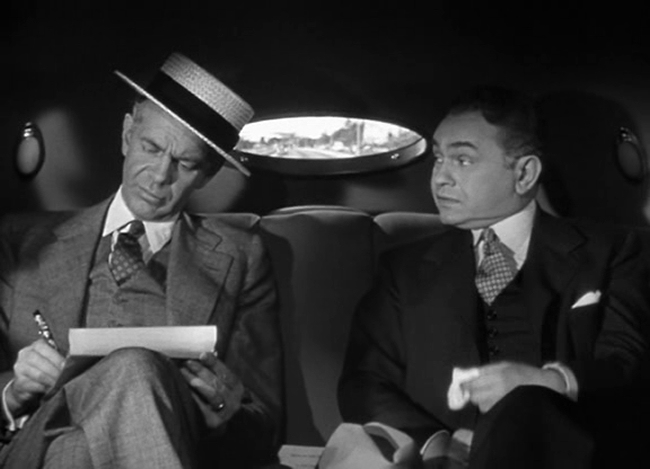
The original Woman in the Window seems like it was tailor made for theorists to analyse decades later. It's about a middle aged, mild mannered psychology professor played by Edward G. Robinson who is captivated by a portrait of a woman in a window whom he eventually meets, this meeting having disastrous consequences.

There are many potential routes for discussion on art within art, the difference between fantasy and reality, and the ambiguous levels of responsibility the protagonist bears for what occurs. It's all fertile ground for talking about existentialism, gender, class, all the goodies.

It's also fascinating for being both the very model of a film noir and for being also the anti-model. It has a femme fatale played by Joan Bennett who's not really a femme fatale. It has a crime that's not really a crime--it has one of the most innocent and clumsy protagonists of any noir I've seen.

Robinson's Professor Wanley is first introduced lecturing a class on the difference between killing in self-defence and killing out of malice, explaining how the law distinguishes between the two and doesn't punish the former like the latter. But when he actually finds himself in a situation where he's killed someone in self-defence he feels compelled to hide the body. After all, if it comes out that he, a married man, was discovered in the apartment of a beautiful young woman, his reputation and probably his career would be ruined.

The film blends the dichotomy of fantasy and reality--the portrait of Bennett's character and the actual woman--with the dichotomy of theory and practice--what the law says about a situation and how that situation might play out in reality.

At the same time, though, everything about the "real" situation is dreamlike. Why would Joan Bennett, seeing Edward G. Robinson drooling over her portrait, invite him back to her apartment? Cary Grant he's not. How likely is it that Wanley could've killed the guy attacking him with a little pair of scissors? The film's "it was all a dream" ending was added by director Fritz Lang to conform to the demands of the censors but the film is actually credibly like a dream. Despite Wanley's education, I can kind of believe he's a total klutz when it comes to hiding a body. How many mistakes does he make? Trying to speed past the toll booth, tossing a dime to the guy, but actually stopping to talk when the guy can't find the dime; cutting his arm on barbed wire where he dumped the body; giving constant verbal cues to the police detective investigating the murder, whom Wanley just happens to know. Wanley may be an expert but he's not a field expert--an expert on Vikings isn't necessarily ready to jump in a long boat and raid the coast of England. But he has such bad luck it seems exceedingly improbably and the fact that he doesn't get caught almost immediately is incredibly improbable. Every step seems designed more as a torment for him than anything else.

It's a world tailored to his anxieties, to punish him for going home with a pretty woman while his wife and kids are out of town. Part of me actually likes the ending, the movie would almost be over the top without it. But if it's Wanley's dream, how do we account for the sequences where he's not present? The scenes shot from Joan Bennett's perspective when the murder victim's body guard, played by Dan Duryea, tries to extort her, first for cash, then for sex? Not only does she stop being a femme fatale, she becomes the protagonist--it's as though Wanley becomes her.

This is emphasised by the fact that every single trick Bennett tries to play on Duryea is immediately seen through by Duryea, no matter how unlikely it is that he could. When she says she only has 2500 dollars, he's absolutely confident she has the full 5000. Every attempt she makes to distract him immediately leads to him going directly for what she was afraid he'd find. Is Wanley transgender? Or is it a comment on the nature of the viewer's relationship with a work of art? The feelings inspired by a great work might be so personal that in a sense we are what we see.

Twitter Sonnet #1134

A calling club for diamonds lists a jack.
A knave repaid the bill before the deuce.
A diff'rent card replaced the Hoyle pack.
To cut the deck's to hack an elder spruce.
Surprising empty cards emerged to hand.
Were hearts discerned behind the paper mist?
A flush announced became a triple band.
A royal hides beside a waiting wrist.
A poker game became a Solitaire.
Or Patience--takes the night in ghostly round.
But dreams of player shapes were thinnest air.
The whisper slap of cards the only sound.
The dust recycles digits for the suits.
A sleepy light illumines numbered roots.