Showing posts with label joe shishido. Show all posts

Tuesday, May 18, 2021

A Gun Story Told with Fists

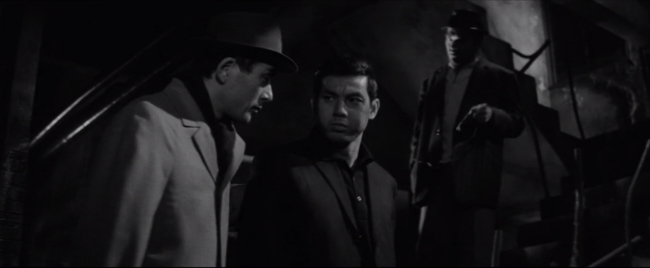
I think someone had a theory that any average yakuza movie could be punched up a lot with a lot of punches. And so we have 1964's Cruel Gun Story (拳銃残酷物語). One of the most bare-bones plots, that yet manages to have plenty of holes, I've seen from this era of Nikkatsu, the whole thing works because of how delightfully over the top it gets with the fisticuffs.

Togawa (Joe Shishido) has just been released from prison where he was doing time for murdering the truck driver who paralyzed his pretty sister (Chieko Matsubara). He's been sprung early by a big operator who's putting together a heist. Togawa will lead a team of hand picked crooks to hijack an armoured car transporting cash from the race track. Togawa visits his team one by one and tests them by punching them a lot. He even uses this technique with the boxer they're hiring specifically for his muscle (Shobun Inoue).

Once the weak links have been weeded out, Togawa goes over the plan and the deal, but is obliged to stop and start punching one member of the crew (Yuji Odaka), a gambler and heroin addict who can't stop interrupting. Then Togawa has to start punching him again because it turns out the guy's girlfriend, Keiko (Minako Kazuki), had been listening at the door.

She and Togawa abruptly fall in love in one scene and it's never mentioned again.

Once the heist is finally pulled off, there are a lot of the usual double crosses and misunderstandings, many of them not making any sense if you think about them, like how the boss (Hiroshi Nihonyanagi) gives up his spy before he betrays everyone. Somehow the excessive punching makes the absurdity seem natural.

Cruel Gun Story is available on The Criterion Channel.

Thursday, September 26, 2019

Maturity of the Beast

When I first saw Seijun Suzuki's experimental 1967 film Branded to Kill (殺しの烙印), I hadn't seen any of the typical yakuza movies of the 50s and 60s it was riffing off of. Now I've seen more than I can count so I decided to revisit this New Wave landmark of Japanese cinema.

In my 2014 review, I talked primarily about the film's postmodernism and how its commentary on action and suspense films functioned as a reflection of Western films of the genres. The same love triangle system, for example, is apparent--the male protagonist torn between the pretty available girl and the mysterious femme fatale.

This time it struck me how much this triangle supports the central idea of human nature being a conflict between the bestial and the sublime. It reminds me of Vertigo more than anything--where Midge is the more familiar, talking frankly with Scottie about bras like sex has all the glamour of feeding chickens and pigs, versus the dreamlike Madeleine representing an ideal of beauty.

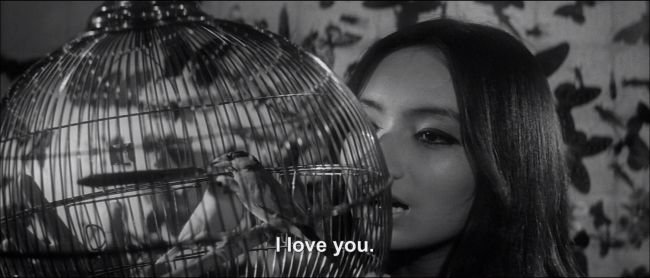
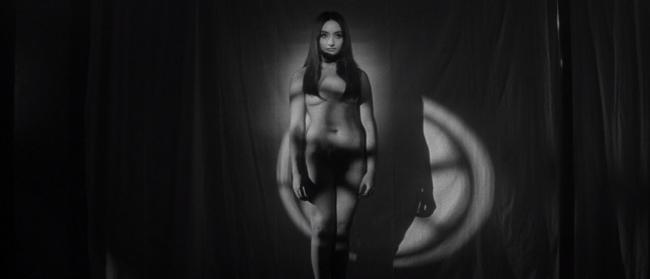
The protagonist's wife in Branded to Kill, Mami (Mariko Ogawa), is almost always naked, or in one scene wearing only fur and heels, and is always energetically rushing about their house. She tells her husband over and over that the two of them are merely beasts. Misako (Annu Mari), on the other hand, the mysterious woman who hires him for a contract killing, is rigorously stylised--a raincloud follows her most of the time and the screen becomes littered with butterflies reflecting the dead little beasts she keeps pinned to the wall.

And she almost never moves, unlike the constantly scampering Mami. Joe Shishido as the protagonist, Goro, is perfect in the role, his trademark, weirdly artificial cheeks implying the attempt to effect a triumph of ideal aesthetics over nature.

What does it mean that he's the number two hitman in the world? It's a mark of professionalism, something that should elevate him above the mere animal, but it's in a fundamentally savage field. There's also his absurd obsession with rice. When Misako is quietly seducing him, he weirdly starts begging her to give him rice, his fundamental animal appetite somehow aroused by her careful artificiality. Of course he keeps asking her to undress but, cruelly, he doesn't see her naked until she's seemingly captured by the enemy.

Although she wears a cool smirk the whole time, he immediately proclaims she's been raped, yelling the claim over and over as he kneels before the footage of her. As though he compulsively construes the situation as loss in a fundamental struggle.

Watching the movie now, I feel much more a sense of it as dreamlike than subversive. All of those yakuza movies Suzuki made for Nikkatsu at a breakneck pace, churning out multiple movies in the same year, with many of the same plot elements, sets, and actors mandated again and again. It must have become ritualistic and I certainly wouldn't be surprised to learn the career did very strange things to his dreams.

Branded to Kill is available on The Criterion Channel.

Twitter Sonnet #1281

A severed fraction turned divided whole.
The present cat controls arithmetic.
Entire worlds could fill the magnet bowl.
The sneezing sun expels the turmeric.
A finished film rewards reflected shows.
Another cat replaced the merry girl.
At home, the book became a list of rows.
A pebble sure was swapped for rarest pearl.
The amber push enclosed a winding tree.
Electric tracks conduct the music slow.
The empty hive admits the captain bee.
An island rock begins to softly glow.
Diverting paths convert the space to blue.
A paper swamp arrests the flowing glue.

Thursday, September 05, 2019

Leaving What You Can't Leave

Why does any gangster think it's possible to leave the life, after so many works of fiction have clearly demonstrated to the contrary? I don't think the central character of 1967's Massacre Gun (みな殺しの拳銃) ever truly believes he'll escape, though. But his life, in this stylish and effective film noir, has been whittled down to only two bad alternatives--continue working for the outfit that orders him to murder his friends and lovers or join with his brothers in a hopeless battle against that outfit.

Joe Shishido plays Kuroda with a grim weariness. The first part of the film has no audible dialogue as he drives into the night with a beautiful woman who seems to adore him--right up until he executes her by order of his boss, Azakawa (Takashi Kanda).

The film has a nice jazz score by Naozumi Yamamoto and the next scene is set in the bar run by Kuroda's brother, Eiji (Tatsuya Fuji), where we see a black piano player named Chico (Ken Sanders). His performance is striking--generally any Westerner in a Japanese film in the 60s is a little odd considering the limited pool casting had to draw from. Sanders gives one of the best performances I've seen from any of these bit players, his mannerisms quick and feminine and his singing voice deep and soulful.

Kuroda's youngest brother, Saburo (Jiro Okazaki), is a boxer. When Saburo is roughed up in retaliation for beating up one of the gang's favoured boxers, Kuroda's finally pushed over the edge and tenders his resignation. It's a polite and calm scene when he does so, as though it's something you can just do--decide to quit being a yakuza one day. He stands respectfully in front of his boss and bows. He doesn't for a moment seem like he has any hope for the future, though.

He has this same quality of numb hopelessness later when he confronts his boss in a restaurant Kuroda and his brothers have taken over. As the territorial war escalates, he never seems surprised, right up to the inevitable end.

Director Yasuharu Hasebe always makes the film visually interesting. A scene where one of the brothers is gunned down by a group of men with machine guns is amazingly similar to Sonny Corleone's famous death scene a few years later. Eiji's apartment is filled with Expressionist paintings that oddly complement his sadomasochistic love scenes with Azakawa's girlfriend.

But it's primarily the music and performances, particularly from Shishido that make this film worth watching. Massacre Gun is available on Amazon Prime.

Twitter Sonnet #1274

Hawaiian shirts arise from closets deep.
Selected ears were peeled for music late.
From lungs the song'll make a giant leap.
It all began around a second date.
For any price a certain hound's misled.
A group of four await a group of five.
Another group of four arrives instead.
The team distribute ties throughout the hive.
Another suit retreats from favoured view.
A mirror lane contained another knife.
A coiled wire thirsts for something new.
An endless shelf restrains a single life.
A bowl of sweat conveys ideas of heat.
A melted shirt assumed the human seat.

Wednesday, September 04, 2019

Humans are Tougher than Fish

It's hard for me to pin down one specific genre for 1965's Murder Unincorporated (大日本殺し屋伝, "Super Japanese Killers"). A story about a yakuza outfit who hire a series of ridiculous hitmen with ridiculous gadgets and gimmicks--all to kill a character played by Joe Shishido who seems to be starring in a serious gangster film grafted onto this one. Sometimes it's a funny movie, mostly it's just impressively bizarre.

At one point, the head of the yakuza outfit is asked by one of his sons why he doesn't just dispatch one of his own vastly more competent men to kill Joe. The gang boss replies simply with a mysterious, "Wait and see." And picks his nose.

First he hires four hitmen. When they don't succeed, he hires eight more. One hitman is obsessed with baseball, particularly the Giants. One is an aspiring chef whose backstory we see in flashback--unable to bring himself to kill a fish lying helplessly on his cutting board, he decides to become a killer of men to toughen himself up. If he can learn to kill a man, he can learn to kill a fish.

One hitman is a poet whose gun is hidden in the book he carries around, another is a little kid who dresses like Oddjob. This is followed by the appearance of a man who calls himself 006, or "007's boss". His only tactic is a briefcase he carries around that occasionally releases toxic gas.

The most prominent killer is Konmatsu (Kon Omura), who behaves a lot like Jerry Lewis. His gimmick is that he takes out an abacus before he kills--and throws it in the air while drawing his gun, killing his target before the abacus can hit the ground. He also, for some reason, demands to be paid or expects to pay 10 yen for just about everything. Even when he's unconscious and tied up, he demands to be paid 10 yen for his own murder.

All of these buffoons are supposed to kill "Joe of Spades" (Joe Shishido) but it's only Konmatsu who's so incompetent he actually befriends Joe without realising it. He even moves in with him.

Shishido plays his character straight--he seems to be caught up in a doomed romance with the yakuza boss' daughter, Emi (Yoko Yamamoto) (she's also an assassin--she likes to poison people). But we only get glimpses of this story between the elaborately goofy hijinks of the Super Killers. Murder Unincorporated is available on Amazon Prime.

Monday, August 12, 2019

The Best Play for Real Money, the Remarkable Play for Forgeries

Sometimes the most hazardous path is the most profitable. But sometimes that profit comes in the form of counterfeit bills as in 1962's Danger Pays (危いことなら銭になる), a gangster comedy from Studio Nikkatsu. From a film starring Joe Shishido, I was hoping for a more straightforward gangster film but I grew to really like the injection of screwball comedy to the format, coming out something like Too Many Crooks, a real comedy instead of a postmodern parody.

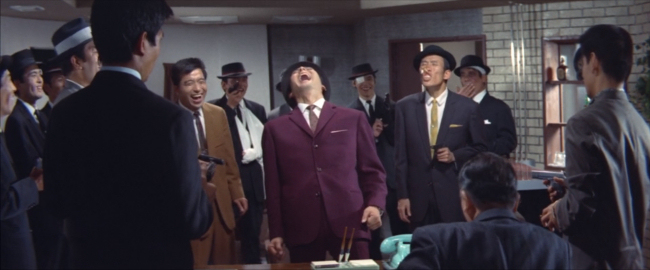
Joe plays "Glass Joe", one of three goofballs, three low-level yakuza trying to find their way into a big outfit. Each one has a name reflecting some weird personality trait--Slide Rule (Hiroyuki Nagato) is obsessed with measuring the statistical probabilities of every decision, Dump Truck (Kojiro Kusanagi) is a heavy, and Glass Joe has a mental break every time anyone scratches glass to make a squeaking sound. As you can imagine, this comes into play more than once.
The trio sometimes work together, more often they're hustling against each other. When they catch wind of a counterfeiting scheme by one of the big outfits they all rush to the airport to be the first to pretend to be the grandson or son of the elderly, master money forger who turns out to be none other than Bokuzen Hidari.

Fans of Akira Kurosawa will recognise him from several of that great filmmaker's best movies, including Seven Samurai, Ikiru, and The Lower Depths. But in Japan at the time, Hidari was primarily known as a comedic actor and appeared in a wide range of genre films. With all the young gangsters rushing around and chattering at lightspeed as a befits a screwball comedy, the slow-talking Hidari with his permanent Weary Willie expression is a perfect counterpoint as he pours forth his wisdom on what makes a great counterfeit bill.

It's weird to see Shishido playing such a goofball. Normally he played badasses. Here he comically runs down the street at the sight of two pieces of glass rubbed against each-other, wearing a burgundy suit in contrast to everyone else's grey, and a trilby that looks two sizes too small.

He finds an ally in another of the film's great assets, the adorable Ruriko Asaoka as Tomoko, receptionist for the big yakuza outfit. His first question when he sees her is an incredulous, "How old are you?" She, mistaking him for a salesman, replies, "Young enough. I don't need any cosmetics, thank you."

JOE: Who raised you? I want to talk to them.

TOMOKO: You can't! They're six feet under.

JOE: Not every man is a salesman, you know.

When Joe answers the phone for her it turns out to be her boss on the line who immediately fires her. She angrily tosses Joe against the wall, revealing that she just so happens to be an expert in Judo. She informs him her dream is to one day teach Judo in Paris.
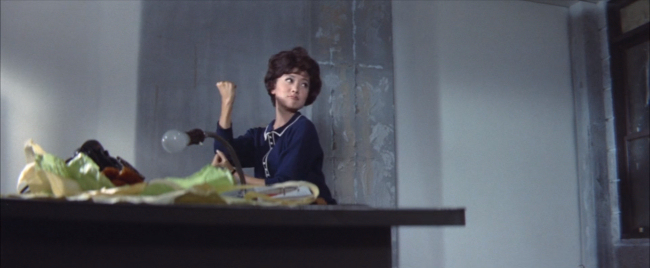
Despite this rocky start, they become allies and they work together to raid the club Acapulco where the big gang has set up Hidari with his requested erotic working environment--under the glass floor stage where women dance in lingerie.

Every second of the film seems to have twelve gags and mostly it all works--especially since the characters take hold really well, particularly Joe and Tomoko. Danger Pays is available on Amazon Prime.

Twitter Sonnet #1266

Elusive leaves procure a summer fall.
A season time remits the watching hand.
Concealing phones in trees prolongs the call.
A million voices spoke along the band.
A greenish blue dispersed between the oaks.
Diverted paths arrive at sep'rate feet.
A wobbly wheel removed its crooked spokes.
The wooden cart collapsed upon the street.
A crooning chorus drowns repeated games.
A crystal glass contains a whisky shot.
A winning race becomes the horse it lames.
A boiled pepper bloats within the pot.
A solar cake collected worlds in books.
No diners came for all professed were cooks.

Friday, June 28, 2019

The Guitar and the Gangster

A troubled young man drifts into a seaside town and almost immediately is offered a cushy position in the local organised crime outfit. In 1959's The Rambling Guitarist, (ギターを持った渡り鳥), Akira "Mighty Guy" Kobayashi stars as the handsome, vulnerable lad with a tough exterior. This is one of the many formulaic yakuza movies pumped out by Nikkatsu in the late 50s and 60s but it's a particularly good one. Kobayashi's musical numbers justify putting the guitar in the title and exciting location shots fill the film with energy, particularly several scenes shot on a cargo boat in genuinely rough waters.

Watching Kobayashi and Joe Shishido maintain cheeky gangster poise in their meticulous suits and coats on deck while the whole world bobs up and down behind them is enough to make the film worth watching.

Both of those actors have fantastic entrances in the film. Especially Shishido because I didn't know he was in the movie. Taki (Kobayashi) is in his boss's office when suddenly a rumpled coat on the couch starts to laugh. The man beneath it, George (Shishido), throws it off to reveal he'd been there the whole time. "Ah, you're awake," says Akitsu (Nobuo Kaneko), the boss.

Kobayashi of course makes an entrance at the beginning of the film, waking up in the back of a farm truck, but he has a better one later in the film when another gangster walks on stage, terrifying everyone, including the sexy mambo dancer who impulsively stops to stare in horror. Then a whistled tune presages Taki as it's revealed the other mobster has a fatal knife in the back.

Things get less interesting toward the end of the film but there're plenty of great moments to make up for it. The Rambling Guitarist is available on Amazon Prime.

Twitter Sonnet #1250

A sketch of glowing eyes observed the school.
The marching trees divert from castle grounds.
The planet curled in massive heaps of wool.
The gathered dreams've paused to hear the sounds.
Discussions spread from bourbon bottle glass.
A yellow car's obtained amidst the crowds.
A thousand souls traverse the metal pass.
A millions shows project on canvas clouds.
A garden's planted late for sandwich needs.
The fleet of marks upon the wall were snails.
A mark of time was writ by counting beads.
Among the columns swam a pod of whales.
A paper flutters round the fingertips.
Ideas became a scattershot of clips.