Showing posts with label gangster. Show all posts

Monday, April 03, 2023

Another Fateful Journey to Miller's Crossing

The movie I was most in the mood to watch for Saint Patrick's Day this year was 1990's Miller's Crossing, the Coen Brothers' Prohibition era noir about Irish American gangsters. My old DVD is back in California and it wasn't on any of the streaming services I'm subscribed to but I noticed Criterion had just recently released a new blu-ray edition of the film. So I ordered that and finally watched it a week after Saint Pat's. Man, there's a movie that never gets old.

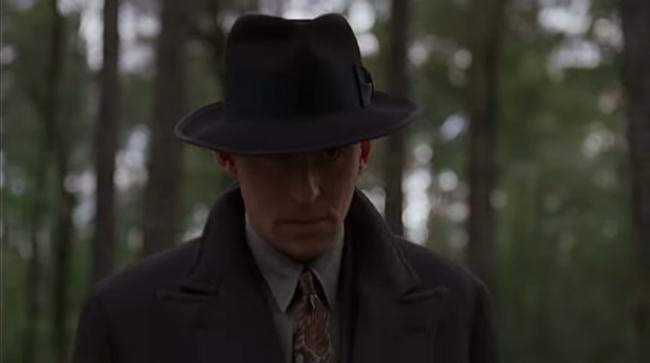
And the new blu-ray is beautiful. And noticeably different in a few ways. In the scene where a kid comes across the corpse of Rug Daniels, I remember the actor playing the dead man accidentally blinking in a shot. That seems to be gone now. Which is nice because it kind of ruined the moment. But the biggest difference I noticed is in the colour, which seems to be richer and brighter. For comparison, screenshots I pulled from various YouTube clips are on the top and the Criterion blu-ray is on the bottom.

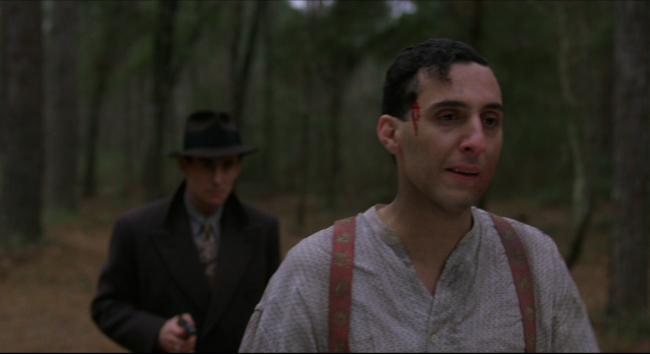
It was always a beautifully shot film by cinematographer Barry Sonnenfeld but now I think it's even better.

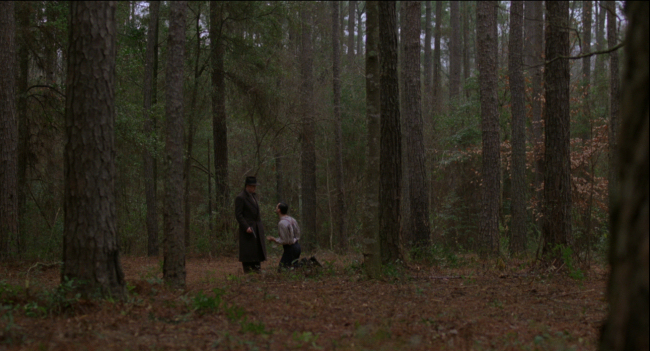
On my DVD copy, I remember often being unsure if Gabriel Byrne's hat was black, charcoal, or brown. Now it's always clearly brown.

The movie's just a magnificent piece of work. When a plot so complicated goes down so smooth, it's a thing to admire forever.

Twitter Sonnet #1684

Without a question, mice assume control.
A hundred keys absorbed a liquid lock.
The rivers shake and hugging banks console.
Completely smooth was rapid water's rock.
A dancing blast was orange and very hot.
Rebounding river currents twist the mind.
But simple boats could ease the noisy lot.
Beneath the rain, the trees were seldom kind.
A stinging eye confronts a shrinking clock.
Rejected dwarves have mined a golden lode.
Above their heads, a mountain cracks a rock.
Below the summit, snakes descend the road.
Escaping hats return to crown a dream.
Escaping ropes contract around a beam.

Sunday, February 02, 2020

Once a Yakuza . . .

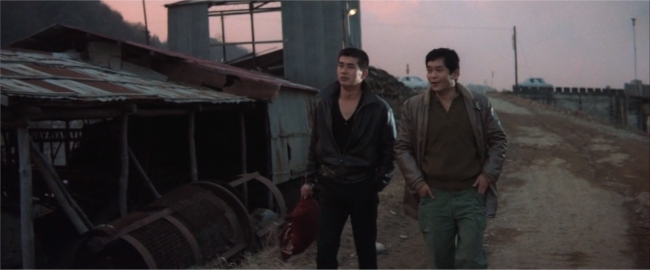
Trouble never ends for Goro the assassin in another of the series of Yakuza films about the character, 1968's Outlaw: Black Dagger (無頼 黒匕首). As Nikkatsu yakuza movies from the 60s go, there's little out of the ordinary in this film, but star Tetsuya Watari is reliably tormented and handsome.

This time he tries to go straight by taking a construction job. Things are soon derailed when he inevitably runs across old acquaintances and colleagues. In this case, he runs into an old flame and a man who killed another of Goro's loves, who also happens to be the son of the local yakuza boss. To top it all off, a nurse living in the town happens to look exactly like the dead woman--and is also played by Chieko Matsubara.

Watari always has a magnetic screen presence and the plot is good enough. The sex scenes feel a little stiff but the action scenes are effective. Director Keiicchi Ozawa finds creative compositions amid the choreography of Goro, armed with just that titular tanto dagger, fighting off five or six guys.

Outlaw: Black Dagger is available on Amazon Prime.

Tuesday, December 10, 2019

The Only One

In the history of cinema, few killers have been as passive as Robert De Niro's Frank Sheeran. Oddly enough, it's completely credible and at the heart of what makes The Irishman so good. Seeing director Martin Scorsese team with Robert De Niro and Joe Pesci again, with the addition of Al Pacino, for a movie about gangsters, one might expect something like Goodfellas or Casino. In some ways it is--rhythm of the dialogue, the complexity of the characters. But while those other two films were analyses of the worlds of gangs and greed, The Irishman simply uses that world to tell another story. Scorsese couldn't really do otherwise in a world that now has The Sopranos. And the Irishman is a brilliant step in the evolution of the gangster film.

We meet Sheeran in a nursing home and he recounts his story apparently to thin air. The film was based on a non-fiction book called I Heard You Paint Houses consisting mainly of an interview with the real Sheeran. But the isolation of De Niro's Sheeran, the idea that he has to tell his story to an empty room, underlines his tragedy very well.

Working as a truck driver, the young Sheeran first meets Russell Bufalino (Pesci), a major figure in the Bufalino crime family. At that point, he's just a nice man who helps fix Frank's truck. Gradually, Frank falls into the sequence of reciprocal favours that makes him a hitman for the mob.

A flashback to World War II shows how he first became comfortable with killing, ordering two prisoners to dig their own grave, in retrospect only wondering why the prisoners did it since they must have known what would happen. No remorse, no horror. From obeying the orders of the U.S. government he goes to obeying orders of his friends.

It's sweet watching the relationship between Frank and Russ but Frank grows even closer to the man he's assigned to protect, union leader Jimmy Hoffa (Al Pacino). Hoffa gradually starts to confide in him, they share hotel rooms, and their families get to know each other. But we all know what happened to Hoffa--well, we all don't know, exactly.

The break between Russ and Jimmy introduces the first real conflict in Frank's life. When he tries to explain himself to his daughter later he's reduced to helpless stutters, not simply because the subject deals with matter he can't reveal but because it deals with things he can't articulate, truths he'd followed instinctively all his life. He's not equipped to talk to people who don't feel the same way, which inevitably leads to isolation for this man for whom friendships are everything.

The much talked about de-aging in the film isn't perfect but it certainly does a good enough job. If I can accept Steven McQueen in The Blob, I can certainly accept Robert De Niro here. And these really were the best actors for the roles. With so many movies to-day where the dialogue is endlessly simple and explicit, it's refreshing to see a movie that knows how silences communicate. How we can watch, without anyone ever saying it, Frank informing Jimmy his life's in danger and Jimmy's reaction, showing just the right level of hubris to miss Frank's point about a basic sense of loyalty which Jimmy mistakenly sees as a system of blackmail. A lovely film and a lovely showcase for these actors.

The Irishman is available on NetFlix.

Wednesday, September 04, 2019

Humans are Tougher than Fish

It's hard for me to pin down one specific genre for 1965's Murder Unincorporated (大日本殺し屋伝, "Super Japanese Killers"). A story about a yakuza outfit who hire a series of ridiculous hitmen with ridiculous gadgets and gimmicks--all to kill a character played by Joe Shishido who seems to be starring in a serious gangster film grafted onto this one. Sometimes it's a funny movie, mostly it's just impressively bizarre.

At one point, the head of the yakuza outfit is asked by one of his sons why he doesn't just dispatch one of his own vastly more competent men to kill Joe. The gang boss replies simply with a mysterious, "Wait and see." And picks his nose.

First he hires four hitmen. When they don't succeed, he hires eight more. One hitman is obsessed with baseball, particularly the Giants. One is an aspiring chef whose backstory we see in flashback--unable to bring himself to kill a fish lying helplessly on his cutting board, he decides to become a killer of men to toughen himself up. If he can learn to kill a man, he can learn to kill a fish.

One hitman is a poet whose gun is hidden in the book he carries around, another is a little kid who dresses like Oddjob. This is followed by the appearance of a man who calls himself 006, or "007's boss". His only tactic is a briefcase he carries around that occasionally releases toxic gas.

The most prominent killer is Konmatsu (Kon Omura), who behaves a lot like Jerry Lewis. His gimmick is that he takes out an abacus before he kills--and throws it in the air while drawing his gun, killing his target before the abacus can hit the ground. He also, for some reason, demands to be paid or expects to pay 10 yen for just about everything. Even when he's unconscious and tied up, he demands to be paid 10 yen for his own murder.

All of these buffoons are supposed to kill "Joe of Spades" (Joe Shishido) but it's only Konmatsu who's so incompetent he actually befriends Joe without realising it. He even moves in with him.

Shishido plays his character straight--he seems to be caught up in a doomed romance with the yakuza boss' daughter, Emi (Yoko Yamamoto) (she's also an assassin--she likes to poison people). But we only get glimpses of this story between the elaborately goofy hijinks of the Super Killers. Murder Unincorporated is available on Amazon Prime.

Monday, August 12, 2019

The Best Play for Real Money, the Remarkable Play for Forgeries

Sometimes the most hazardous path is the most profitable. But sometimes that profit comes in the form of counterfeit bills as in 1962's Danger Pays (危いことなら銭になる), a gangster comedy from Studio Nikkatsu. From a film starring Joe Shishido, I was hoping for a more straightforward gangster film but I grew to really like the injection of screwball comedy to the format, coming out something like Too Many Crooks, a real comedy instead of a postmodern parody.

Joe plays "Glass Joe", one of three goofballs, three low-level yakuza trying to find their way into a big outfit. Each one has a name reflecting some weird personality trait--Slide Rule (Hiroyuki Nagato) is obsessed with measuring the statistical probabilities of every decision, Dump Truck (Kojiro Kusanagi) is a heavy, and Glass Joe has a mental break every time anyone scratches glass to make a squeaking sound. As you can imagine, this comes into play more than once.

The trio sometimes work together, more often they're hustling against each other. When they catch wind of a counterfeiting scheme by one of the big outfits they all rush to the airport to be the first to pretend to be the grandson or son of the elderly, master money forger who turns out to be none other than Bokuzen Hidari.

Fans of Akira Kurosawa will recognise him from several of that great filmmaker's best movies, including Seven Samurai, Ikiru, and The Lower Depths. But in Japan at the time, Hidari was primarily known as a comedic actor and appeared in a wide range of genre films. With all the young gangsters rushing around and chattering at lightspeed as a befits a screwball comedy, the slow-talking Hidari with his permanent Weary Willie expression is a perfect counterpoint as he pours forth his wisdom on what makes a great counterfeit bill.

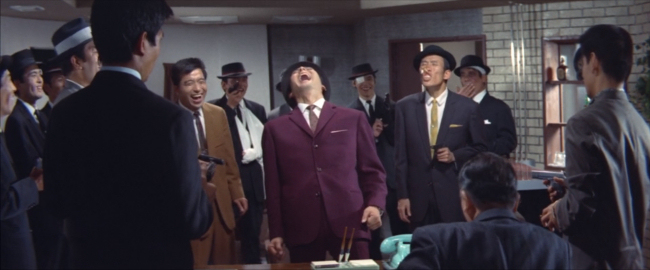
It's weird to see Shishido playing such a goofball. Normally he played badasses. Here he comically runs down the street at the sight of two pieces of glass rubbed against each-other, wearing a burgundy suit in contrast to everyone else's grey, and a trilby that looks two sizes too small.

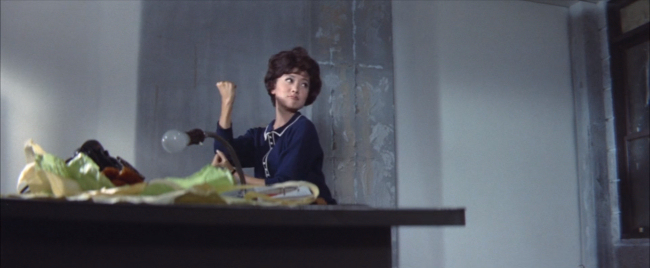
He finds an ally in another of the film's great assets, the adorable Ruriko Asaoka as Tomoko, receptionist for the big yakuza outfit. His first question when he sees her is an incredulous, "How old are you?" She, mistaking him for a salesman, replies, "Young enough. I don't need any cosmetics, thank you."

JOE: Who raised you? I want to talk to them.

TOMOKO: You can't! They're six feet under.

JOE: Not every man is a salesman, you know.

When Joe answers the phone for her it turns out to be her boss on the line who immediately fires her. She angrily tosses Joe against the wall, revealing that she just so happens to be an expert in Judo. She informs him her dream is to one day teach Judo in Paris.

Despite this rocky start, they become allies and they work together to raid the club Acapulco where the big gang has set up Hidari with his requested erotic working environment--under the glass floor stage where women dance in lingerie.

Every second of the film seems to have twelve gags and mostly it all works--especially since the characters take hold really well, particularly Joe and Tomoko. Danger Pays is available on Amazon Prime.

Twitter Sonnet #1266

Elusive leaves procure a summer fall.
A season time remits the watching hand.
Concealing phones in trees prolongs the call.
A million voices spoke along the band.
A greenish blue dispersed between the oaks.
Diverted paths arrive at sep'rate feet.
A wobbly wheel removed its crooked spokes.
The wooden cart collapsed upon the street.
A crooning chorus drowns repeated games.
A crystal glass contains a whisky shot.
A winning race becomes the horse it lames.
A boiled pepper bloats within the pot.
A solar cake collected worlds in books.
No diners came for all professed were cooks.

Monday, October 15, 2018

A Riot of Almost Nothing

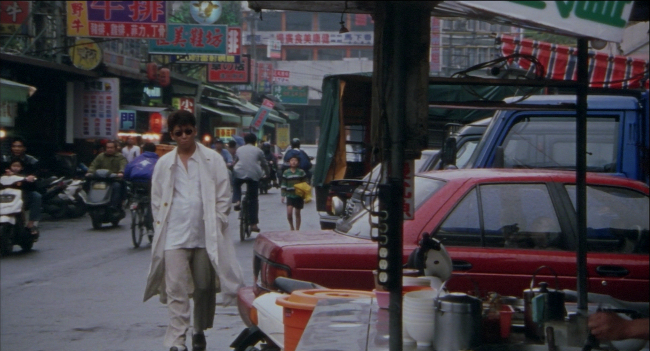
It's hard to imagine anything like normal life carrying on in the kaleidoscope of rubbish, signs, people, and homes of Taipei's slums as they're shown in 1997's Rainy Dog (極道黒社会>. And it's not the story of a normal life director Takashi Miike gives us, showing without sentiment a very unsentimental man and the loose semblance of a family that forms around him. It's a cold, fascinating film.

Yuuji (Show Aikawa) is a Japanese gangster working in Taiwan after his group back in Japan, following a change of leadership, put a hit out on him. There's another yakuza in Taipei (Tomorowo Taguchi) tasked with killing Yuuji. He can't go home until he does though after one failed attempt on Yuuji's life he explains to his target over dinner that he actually likes Taipei. It has friendly women and good food. He asks if the little boy following Yuuji around is really his son to which Yuuji replies he has no idea.

It's really not clear; Yuuji remembers sleeping with the boy's mother years ago but it's entirely possible the woman just used it as an excuse to drop the kid off with Yuuji when she didn't want to care for him anymore. Not that this phases Yuuji whose profession involves executing people without hesitation or remorse. He doesn't tell the kid to leave but doesn't acknowledge him either. It's like he's not even there.

Meanwhile, the boss of Yuuji's gang speaks to Yuuji in the exaggeratively familial way of yakuza, calling Yuuji his brother and telling him how much that means. But of course Yuuji has a very good idea of exactly how much it means. The beginning of the film has him coolly riding along in a truck with hanging meat, and it's not hard to see the correlation.

Yuuji hires a prostitute named Lily (Xianmei Chen) and circumstances force him to flee with her and the kid. They seem like they're starting to form something like a bond and Lily even starts trying to teach the little boy how to read. But it's all so tenuous; they wind up on a beach where a motley of scattered junk has washed up, all this human detritus divorced of meaning and function. It's one of many visuals that with cool sadness show what life is like in Yuuji's world.