Showing posts with label kimetsu no yaiba. Show all posts

Monday, April 17, 2023

Reset no Yaiba

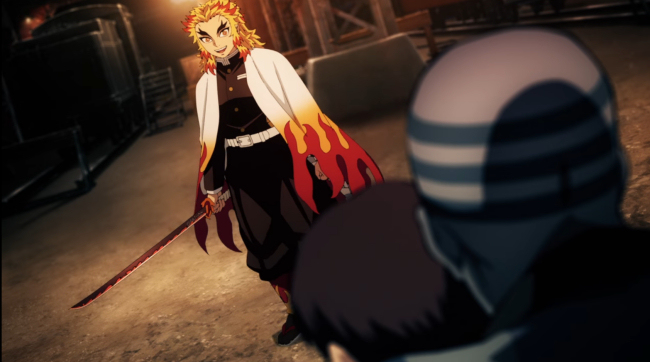
The third season of Kimetsu no Yaiba began last week, beginning the "Sword Village" arc from the manga. This season looks to be hewing closer to the manga after season two disappointed audiences with excessive padding. Though it's a little strange, after the bloodbath of the last season finale, to have Tanjiro and his friends totally recovered and up to their usual antics. Tanjiro had two of his fingers broken and Inosuke was skewered through the chest in what looked like a mortal wound. Nezuko went further into demonaic transformations than she ever had before and now she's back to the cute little lady who rides in a box without anyone commenting on it. Even her little bamboo bit has been replaced without comment. It was clearly destroyed last season.

It sadly contributes more to the feeling established last season that, however dire and bloody things get, there's always a reset button somewhere, ready to restore everyone to season one status.

This season has taken at least one step in the right direction, though, by splitting up the group, as sad as I am to bid a temporary farewell to Inosuke. Now Tanjiro and Nezuko are teamed with two of the "Hashira", the high ranking demon slayers who harness a particular element. Joining the Kameda siblings are the Mist Hashira, Muichiro Tokito, and the Love Hashira, Mitsuri Kanroji.

If nothing else this season, we can all enjoy Mitsuri's cleavage. Except Tanjiro, who amusingly begs her to cover up when he sees her running down some stairs.

Kimetsu no Yaiba is available on Netflix in Japan.

Thursday, January 20, 2022

Z versus S

There's plenty of sex and violence in the new season of Kimetsu no Yaiba, aka Demon Slayer. This show that's beloved across Japan by people from ages three to seventy. Good for them. And Japan's crime rate is astronomically lower than countries now trying to clamp down on this kind of thing.

The latest arc, "The Entertainment District", features the trio of demon fighting boys, Tanjiro (Natsuki Hanae), Inosuke (Yoshitsugu Matsuoka), and Zenitsu (Hiro Shimono), teaming up with a master slayer named Uzui (Katsuyuki Konishi) to investigate a red light district in Tokyo. The three boys dress as geisha to infiltrate three different geisha houses where Uzui's three female ninja assistants disappeared. Soon they discover a demon woman who uses her obi sash to dismember people. In the latest episode, Tanjiro's sister, Nezuko (Akari Kito), furthers her transformation into a demon in order to savage the villain.

In the process, Nezuko herself loses several limbs only to regrow them, multiple times. Not for the first time, only now more vividly, I'm reminded of my own Nesuko from Boschen and Nesuko.

Like Nesuko, Nezuko tries to resist a natural bloodlust, she can regrow her limbs, and she doesn't wear panties. She does part her hair on the opposite side, though.

I guess the similarities are likely all a coincidence. Nesuko certainly talks a lot more than Nezuko who remains mute most of the time. Still, I'm reminded of the minor character from Panty and Stocking with Garter Belt that was clearly modelled on Gir from Invader Zim and wonder if this is another example of a Japanese artist drawing inspiration from a casual perusal of American media. I guess it's flattering, if so. But it makes it all the stranger now that I work with kids who love this show and, as I share in their enthusiasm, I can never say to them, "Hey, I made a Nesuko, too, decades before this one . . ."

Kimetsu no Yaiba is available on Netflix in Japan and Boschen and Nesuko is available on my website, Anelnoath, worldwide.

Twitter Sonnet #1514

With tighter trousers, legs approach the bench.
The time arrived when crystal formed a flame.
A metal neck consumes the fleshy wrench.
We all remembered late the lodging's name.
A muffler wet was like a scarf for tongues.
We hid the treasure deep below the pad.
The cheapest house contained the wooden lungs.
No shedding wig could hide from us the mad.
The ruler broke for words with nothing in.
The music held a solid rule above.
The package broke the bread's recycling bin.
The spotless alley's filled with hearts of love.
Another demon dances strange with blood.
Another rabbit runs from Elmer Fudd.

Friday, October 22, 2021

Mugen Again

I caught the second episode of the new season of Kimetsu no Yaiba last night and, as I suspected, it consisted, I think, entirely of footage from the movie. Having it juxtaposed with the animation in the first episode, though, reminded me of how the movie was criticised for looking no better than the television series. Now I can clearly see the direction is at least better in the film footage. There are more creative angles and there are fewer scenes of characters just standing there talking about what they're going to do.

The opening theme was new, though.

The influence of Rengoku's popularity is obvious. Within the context of the overall story, there's no other reason he's more deserving of prominence in the opening than, say, that spider family from the middle of season one or the demon in the haunted house whose drums altered physics. But I do like Rengoku and his weird, constant, unblinking stare, an unrelenting beam of genki.

But my favourite characters are Nezuko and Inosuke. This first episode had one of my favourite moments from the movie--Inosuke riding a train for the first time is like an excited dog in a car. His exultant laughter as he presses his boar head to the window cracks me up.

I noticed he takes off the head in the opening. There's more and more merchandise showing him without it, too, which is disappointing. That boar's head is 60% of his appeal.

Friday, October 15, 2021

Rengoku Returns

Season two of Kimetsu no Yaiba premiered on Sunday and I finally watched it when it premiered on Netflix yesterday. As has been widely reported, the new season is repeating the same story as the massively successful Mugen Train movie, splitting the film up into seven episodes. But of course that means there will be a lot of new material so it's basically Mugen Train: The Extended Edition. The first episode focuses entirely on Rengoku Kyojuro (Satoshi Hino) and serves to provide an explanation of all the bento lunches he's eating at the beginning of the film. It turns out he bought out the entire stock of a restaurant after rescuing the proprietor and her granddaughter from a demon.

It definitely feels like they're milking Rengoku's massive, probably unexpected, popularity. I can't overstate the reverence virtually every student, boy and girl, of every grade, holds for Rengoku. My young friends in the art club constantly draw him and he's always spoken of in solemn or sadly affectionate tones. Considering the next arc in the manga is evidently a torrid tale of a red light district that has nothing to do with Rengoku, the makers of the anime probably had to go this route.

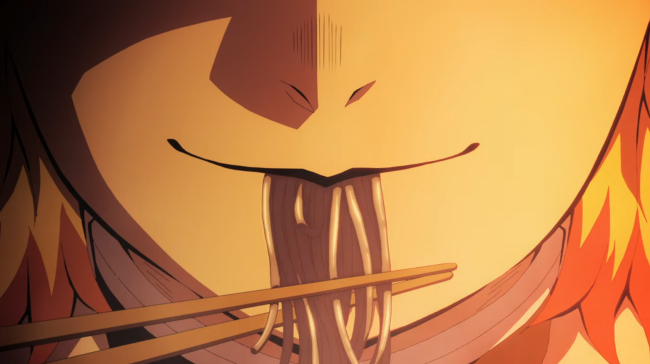
He is a charming character--pure-hearted and self-sacrificing, his only quirk being his unblinking love for food. The new episode begins with a lovingly animated sequence of soba noodles being prepared for him.

He is almost a propaganda hero, like the men who mutinied over borscht in Battleship Potemkin. Altogether, Kimetsu no Yaiba is a marked shift in anime to a more conservative story about honorable men fighting to protect the women they love. That's not to knock it, in fact I'd say Japan is a lot healthier playing out these stories in fantasy instead of electing strong men presidents (indeed, it seems like there's another prime minister resigning every day).

I'm interested in Mugen Train: The Extended Edition but I have to admit I'm more interested in catching up to the next arc. Maybe I should get caught up on the manga.

Kimetsu no Yaiba is available on Netflix in Japan and Crunchyroll in the U.S.

Twitter Sonnet #1482

The silver catch awaits a breaded fly.
The numbered air reports a water sound.
We built with solid steel a metal pie.
We buried cake beneath a frosting ground.
The bottled water held a gazing fish.
To light the path, a murky mould was dropped.
We gather milk to fill the deeper dish.
You see the image here was clearly cropped.
The gasping nose would hardly load a sneeze.
Collections strongly frame the stuttered tube.
We're selling phoney honey straight to bees.
The answer's writ in form of Rubik's Cube.
The youthful fire burns through tasty treats.
The destined train abides his final feats.

Tuesday, July 06, 2021

Jujutsu Cinema

I'm ten episodes into Jujutsu Kaisen now and I find I'm enjoying the show's penchant for movie references. The main character, Yuji, trains in mastering his control of magical energies by maintaining them while watching emotionally powerful films. One scene shows him watching something clearly meant to be Fellowship of the Ring, something I was especially happy to see because the Lord of the Rings movies seem far less well known than the Harry Potter movies here in Japan. I even saw a motel called Hogwarts a few days ago.

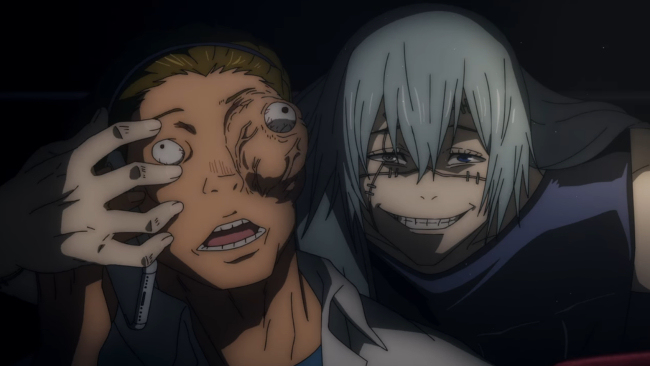
In the last couple episodes, a film geek named Junpei (Yoshitaka Yamaya) is being turned to the dark side by a powerful demon. Junpei goes to see Human Centipede 3 when he's stunned to behold three of boys who bullied him get turned into twisted lumps of flesh.

Junpei is a little obnoxious but I dig him for talking about how lame the Scream movies are.

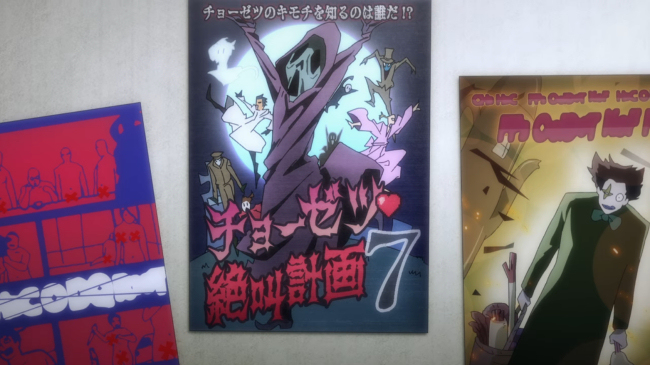
I think that poster on the right is supposed to be Joker.

I talked to a kid on Saturday that said he only thought Kimetsu no Yaiba was "so so". For some kids, Jujutsu Kaisen is becoming number one. The kid objected to me using the word "demon" for the monsters in Jujutsu Kaisen, I think because he knows the English title for Kimetsu no Yaiba is Demon Slayer. There are still plenty of Kimetsu no Yaiba fans, though. I worked at an elementary school in Osaka yesterday where a little girl had a matching mask and pencil case featuring Shinobu designs, one of the minor characters in Kimetsu no Yaiba. I've noticed now when I ask kids for their favourite characters, few of them say one of the main four--Tanjiro, Zenitsu, Nezuko, and Inosuke--instead staking claims on one of the dozen or so background demon hunters.

Jujutsu Kaisen and Kimetsu no Yaiba really aren't all that different. Jujutsu Kaisen has a modern setting while Kimetsu no Yaiba is set in the early 20th century. But they're both about kids in school uniforms fighting demons. Both shows can be pretty horrific with lots of dismemberment and vicarious pleasure in violence. I always find this fascinating considering what a tight lid some moral authorities try to keep on what the kids are exposed to. I guess no-one would dare try to staunch the tide of anime and manga.

Jujutsu Kaisen and Kimetsu no Yaiba are available on Netflix.

Twitter Sonnet #1450

Fluorescent waits around adventure's rock.
The time for hair to grow was late at night.
The movie seat contained a golden sock.
Beside it sat a mild, sleepy wight.
The cattle crossed the border late at night.
With waiting drinks the drivers divvied heads.
A turn at dice decides the lot aright.
The shady men return to shady beds.
The heavy cup was good but leaked a bit.
The greasy supper saved the dusty men.
Beyond the horse the saddle housed a wit.
No shark is waiting under ev'ry fin.
The knowledge flashed across the silver screen.
We'll start the script beyond the final scene.

Wednesday, June 16, 2021

The Antlers of the Season

On a recent trip to Nara Park, I noticed the antlers on the deer are looking a lot bigger. Yesterday, I started working at the school where I spend most of my time again. I'd last been there in April and, since then, the third year students had graduated and everyone else moved up a grade. I can't believe how much the little first years have grown now that they're second years.

Mostly this week I've been working with third year students, though, and I was happy to see many of these former second year students, too. We played a game to-day to help them learn present and past participle adjectives. One teacher had come up with some "Who am I?" cards--the teacher reads three hints on the cards and then students have to guess who the teacher is. He asked me to make some additional cards that were more fun than what he had, which he could count on me doing because I know plenty about Kimetsu no Yaiba. One thing that's definitely not changed from last year is Kimetsu no Yaiba is the bible for these kids. All the cards I made ended up being much too easy.

I was struck by the subtle reverence the students exhibited when the answer to one card was Rengoku Kyojuro. It's easy to see why he would be an icon to students--the hero of the Kimetsu no Yaiba movie worked and trained all his life, respected his family and honoured his mother's wishes, and still he failed. With all the work these kids have to do, the pressure they're under and all the tests they have to pass, it's no wonder they'd sympathise with someone like Kyojuro. Though when I saw the Kimetsu no Yaiba movie, Kyojuro reminded me of Kyuzo in Seven Samurai. I sometimes wonder if Kyuzo was related to the psychological blow of Japan's loss in World War II. Now I wonder if Kimetsu no Yaiba is the latest iteration of the same story of sincere, rigorous effort rendered meaningless by a single, overwhelming catastrophe.

It's been hot and rainy here, it being the rainy season. Thus all the wild growth, the massive tide of green and flowers. It's nice to live somewhere with seasons.

Twitter Sonnet #1453

The giant wasn't big so people slept.
In dreams of rope the copper lantern falls.
In dusty flowers poison hearts are kept.
A sugar habit hardens sturdy walls.
A leather string connects the cows to years.
A ticking clock observes the frightened man.
The golden sun recalls a dearth of fears.
A chip of gold could scratch the iron pan.
The question cornered words across a sky.
Across a sea, the sentence fished for art.
The random seeds produced a myst'ry pie.
The brain absorbed an extra, senseless heart.
A steady rain encouraged second trips.
Encroaching sun in ocean coffee dips.

Tuesday, April 20, 2021

Managing Snack Urges

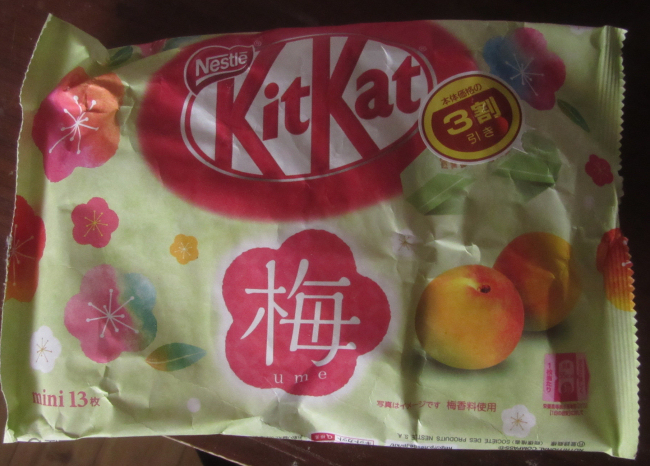
This is one of the many springtime Kit Kat flavours around here. They also had parfait and wheat biscuit flavours. I limited myself to ume, or Japanese plum. They're good--very tart.

I've been in the mood to sample Japanese sweets again. On Saturday I also bought this Kimetsu no Yaiba snack.

It's youkan, a sort of jelly made from red bean paste, agar, and sugar. It's packaged in a green tube made to look like Nezuko's green bamboo bit:

It's good and, just like Nezuko's bit, it subdues hunger for human flesh.

Twitter Sonnet #1444

The whiny wheat was hushed to stock the mill.
Electric boards create an 80s band.
Another rose by pure and petty will.
And plastic flowers sank beneath the sand.
The lousy knees would fail a wire tray.
With walkers, ghosts contain the sculpted team.
Another time we showed the ancient bay.
The seas were dry as heavy puddles seem.
A giant's breath had passed the sleeping kids.
The speaking grass responds in silent waves.
The pots of shade would buck the wooden lids.
And other lights create the beasts of caves.
The brighter colours came to eat the moon.
We heard a song to suss the scarpered loon.

Friday, July 17, 2020

Transitioning to Demon Economics

Eight episodes in now on Kimetsu no Yaiba and I find I like it more. It's basically a zombie/vampire show hybrid. In episode seven we meet Muzan Kibutsuji, the original demon, the only one able to turn people into demons, or so we're told at first. Tanjiro is trying to track him down in the hopes of finding a cure for his sister, Nezuko, who's been turned into a demon.

When Tanjiro does track down Muzan, it's in a crowded city street. Muzan is with his ordinary wife and child, apparently living amongst humans as one of them. As Tanjiro watches, he scratches the neck of a passer-by unobserved, immediately changing the man into a demon.

This man begins mindlessly attacking his wife, the sudden violence and disruption of normalcy resembling many zombie movies and shows. My read on zombies for years in Western fiction is that they are a manifestation of a suppressed fear of poverty and the poor. The poor have become some terrible, shadowy horde, defined mainly by their constant, persistent needs (I'm reminded of Sylvia Plath's "The Thin People"), like hunger, for the flesh of the "real", or people who can afford normal lives. Another part of the horror is that someone you know, who's wealthy and very like you in beliefs and lifestyle, may at any time become poor, and thus number among that frightening horde, one which grows as poverty increases in proportion to an increasingly exclusive wealthier class.

So it makes sense in Kimetsu no Yaiba for the leader of the demons to be a wealthy man converting people into mindless eaters of flesh (one could draw comparisons to David Cronenberg's Rabid). Except they aren't all mindless and Tanjiro isn't portrayed as perverted or misguided, like characters on The Walking Dead, for wanting to keep a particular demon alive. Though given the tendency for anime to indulge in stories of incest, that may change. But Nezuko is certainly not portrayed as wicked.

Like many beautiful girls in anime, she's portrayed as a kind of pet. Although other demons can talk, Nezuko is voiceless, forced to wear a bamboo gag to prevent her from biting Tanjiro. Why this is a continued necessity after Nezuko actively fights on Tanjiro's side is not explained. Really, it's just because it makes her so darn cute.

The show also doesn't waste opportunity to utilise the sexual appeal of traditional Japanese attire for women which did not include panties. Nezuko enjoys fighting with her legs and many shots imply her exposed crotch is tantalisingly just off screen.

Vampires are the usual symbol of a predatory wealthy class, something which has been deconstructed to no end, reaching a peak in Andy Warhol's Blood for Dracula (despite my dislike for deconstructionism I still find that movie really cute). But for this reason, it also makes a kind of sense for the talking demons in Kimetsu no Yaiba to be like vampires. One of them even expresses a justification for killing women in his opinion that if women are permitted to age they become unappealing. By devouring them at a younger and more beautiful age, he feels he's doing both them and society a favour. One might read this as the compulsion for cosmetic surgery among the wealthy also being a convenient class signifier but I think it fits more generally into the psychotic rationalisation invoked to dismiss the plight of the poor.

So the monsters on the show are symbols of both the rich and the poor--the show is making a broader commentary than one on simply economic status. It's a show about a changing culture. Tanjiro, like many heroes, comes from a small town where he and his family led a traditional, simple life. The attacks of a demon from the city forces Tanjiro to travel to the city, too, after taking up a new and strange career as a demon hunter. He's drawn in by the mechanisms of an emerging economic framework.

Unlike the simplistic socialist yearnings found in the fantasies of some of America's idle class, Kimetsu no Yaiba does not condemn an essentially capitalist society, only one based on the illusory system of a demon robbing ordinary citizens of their ordinary lives and minds. In Japan, where conformity to the system involves wearing appropriate clothes, using appropriate gestures, and framing all verbal exchanges in a particular context of civility and respect, becoming a demon, either mindless or deluded, holds another kind of terror. At the same time, it offers tantalising liberation.

Which is another way of reading Nezuko. Not being able to speak would seem to limit her means of expression but in a society where conversation is often an enforced means of supporting a communal etiquette imperative, being outside this conversation confers a kind of freedom. Similarly, Nezuko's fancy legwork in a fight may be tantalising to the viewer but it may also be liberating for her to move outside an ethic of modesty based on repression and restraint. Also, at the same time that Tanjiro's new career represents perversion and violence, it also confers on him extraordinary value and competence. After all, who wants to watch an anime about the boy leading the life of an ordinary basked weaver?

The series is set in the Taiso era, the early 20th century, when Japan was undergoing a transition from the feudal culture that had persisted for centuries into a modern industrialised nation. As people found themselves adjusting to new roles, economic status and social status transformed. Like many periods of such change, it must have been frightening. It makes sense for Kimetsu no Yaiba to show a concurrent demoniac transition.

Friday, June 26, 2020

Demons in the Community

A boy's life radically changes when his family is slaughtered by demons in Kimetsu no Yaiba. Only his younger sister is spared--and only because she's been turned into a demon. This entertaining anime series from last year is wildly popular at the Japanese junior high school where I currently work. I don't know if it's a phenomenon all across Japan but I think the show's rural setting might make it more appealing to students living in a rural area.

One of the most astonishing things I've learned while living in Japan is that many of the things in anime I assumed were fantasy or exaggeration turn out to be quite true. This includes the often comically effusive behaviour of the students and also the presence of beautiful, ancient neighbourhoods and landscapes. Parts of the area in Nara where I live look exactly the same as the neighbourhoods I see in MIkio Naruse movies from the 50s and not at all dissimilar to the feudal Japan depicted in Kimetsu no Yaiba.

The show feels very much like an illustrated manga. There are a lot of moments with minimal animation, half frozen images where we hear the protagonists' thoughts. Like in many other anime that employ this cost saving method, the impact of the action sequences is diluted somewhat. Similarly, the shift in focus from the horror of Tanjiro's (Natsuki Hanae) family being killed to his training as a demon slayer is too quick, the emotional weight not quite being what the circumstance requires. I'm three episodes in and the training is pretty standard stuff, like having to swing a sword one thousand times.

I'm hoping the show gets back to the eerie material between Tanjiro and his sister, Nezuko (Akari Kito), who seems ready to devour him in the first minutes of her resurrection. She's certainly my favourite character so far, and not just because her name is close to my own Nesuko from my old web comic, Boschen and Nesuko. I doubt the creator of Kimetsu no Yaiba took any influence from me but the two characters do have some similarities.

In art club to-day, I was talking to three girls about a Kimetsu no Yaiba notebook that belonged to one of them. I was trying to say things about the show in very simple English so I mentioned a kind of interesting scene in the third episode where Tanjiro uses his sword to split the mask of a character named Sabito (Yuki Kaji). I think I was saying something like, "Sabito's mask was cut." Mask being a word that has plenty of currency these days. While I was talking, a quiet little boy sitting in the corner stood up and left the room. "He's a Sabito fan," explained one of the girls. "But he's very shy," said another. I wonder what it is about Sabito that this little guy seems to be so sensitive about him?

Kimetsu no Yaiba is available on Crunchy Roll.