Showing posts with label comics. Show all posts

Wednesday, August 17, 2022

Comiket Report

I couldn't go as far as San Diego Comic Con this year but I did go to Comiket, Japan's version of a Comic Con, and it's actually a much bigger event, in fact the biggest of its kind in the world, typically drawing more than 720,000 people. It's held twice a year, for two days in summer and two days in winter. The number of attendees was down this year because, in view of the covid pandemic, tickets were sold instead of entry being open to everyone. I think they were limited to 55,000 per day. I only went for one day, Saturday, August 13. I wish I'd bought a ticket for Sunday, I'm not sure why I didn't. I did have a nice time.
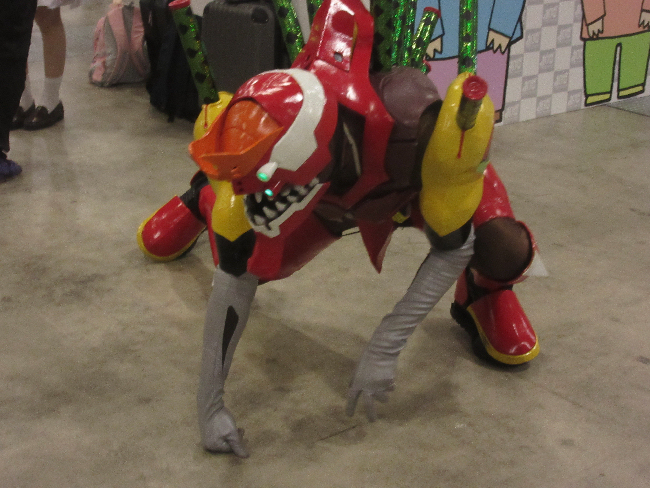
I didn't take many pictures of cosplayers for the same reason I don't usually at Comic Con anymore. There are too many web sites with exhaustive photo catalogues of cosplayers (like this one). I limited myself to a few characters I actually recognised.

Like Lum from Urusei Yatsura.

But actually, the best cosplay picture I took I can't even show you because the young lady, although she posed and gave me permission to take a picture, asked me not to share it on social media. I refrained from asking what I'm supposed to do with it then. Maybe I'll frame it and put it on my desk one day, I don't know. But for the record, she was cosplaying as the title character from Revolutionary Girl Utena. I chatted with her briefly in my terrible Japanese about what a great show it is.

It's a good thing I didn't decide to dedicate my time to photographing cosplayers because the protocol seems to be a bit different to Comic Con due to the manners Japan is famous for. I walked through a large hall where photographers were lined up in single file to take photos, one at a time, of beautiful cosplayers who posed for each in turn. It's nice everyone's asking for permission but surely it would save everyone a lot of time if they all just took their pictures at the same time? Some of the guys at the back of the queue had expensive telephoto lenses but they were waiting patiently to take photos from a few feet away. There seems to be a kind of ritual aspect to it.

I was truly more interested in seeing some comics, though. Comiket was an event founded to facilitate the sales of independent, or doujin, comics. Unlike Comic Con, I saw no big studios present (and, incidentally, though I've seen plenty of Japanese cosplay characters at Comic Con, I saw absolutely no western characters at Comiket).
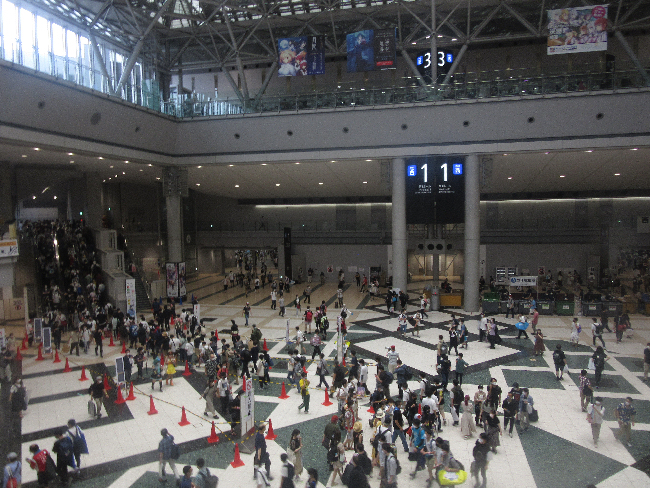
There weren't just comics, though. It was a vast sea of self-published music, crafts, guide books, porn, and even gadgets. Walking through a section of music booths, I talked to Robot Head Girl:
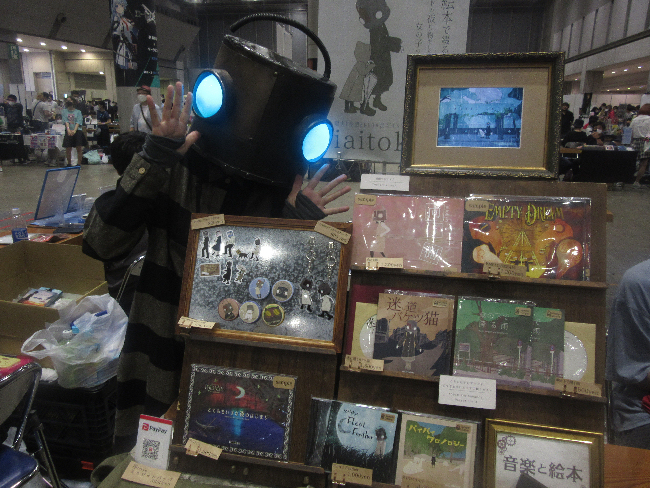
I really liked her style. Here's one of her videos:

Most of the music booths were for Vocaloids, the new phenomenon of artificial singers that's very popular in Japan.

There were many booths for military aficionados and for train aficionados. Many of the latter had one or two older guys with self-published books of photos of trains. I do fairly often see guys at train stations just taking pictures of the normal trains. That such a hobby even exists shows how much more hobbies are honoured in Japanese society compared to American society.

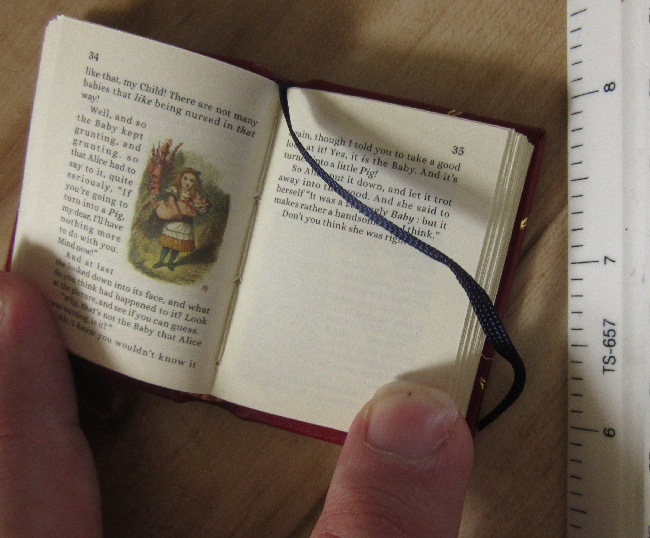
In the crafts section, I saw a lot of amazing jewellery but this is the thing I bought:
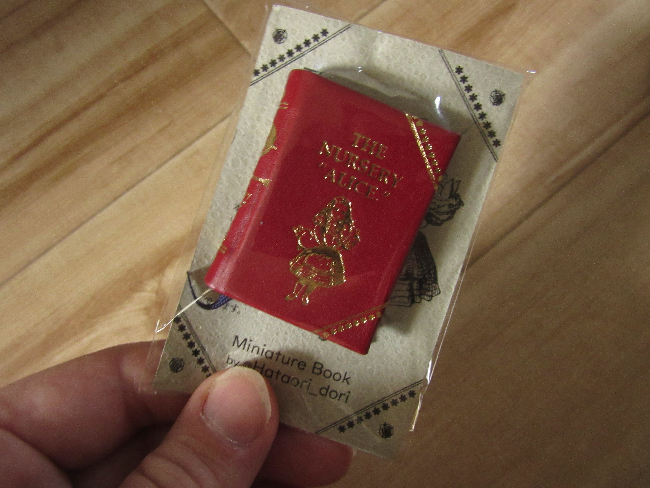
It's a tiny Nursery Alice! I mean, it's the whole book with full illustrations!
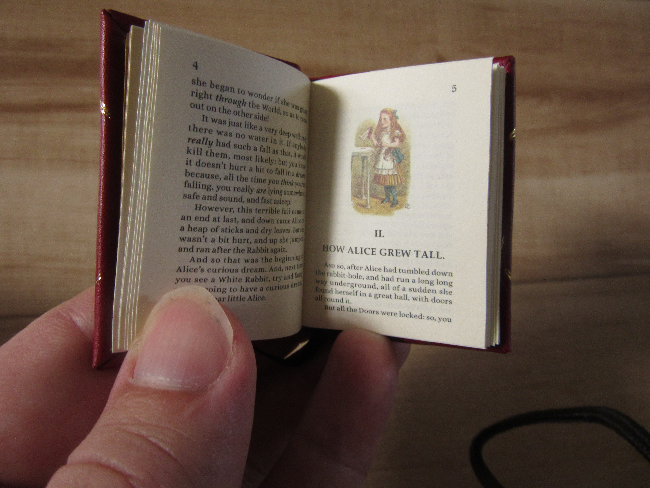
This is the creation of book binder Hataori Dori. She was selling The Nursery Alice and The Call of Cthulu. It was a really tough choice for me but I went for the one with colour illustrations. Also, I'd never seen a copy of The Nursery Alice for sale anywhere before.

Lewis Carroll, author of the original Alice books, wrote The Nursery Alice in 1889--around 23 years after the original was published--as a version for kids under five years old. It contained updated and newly coloured versions of the original John Tenniel illustrations, updated by Tenniel himself, which you can see in my teeny tiny copy.
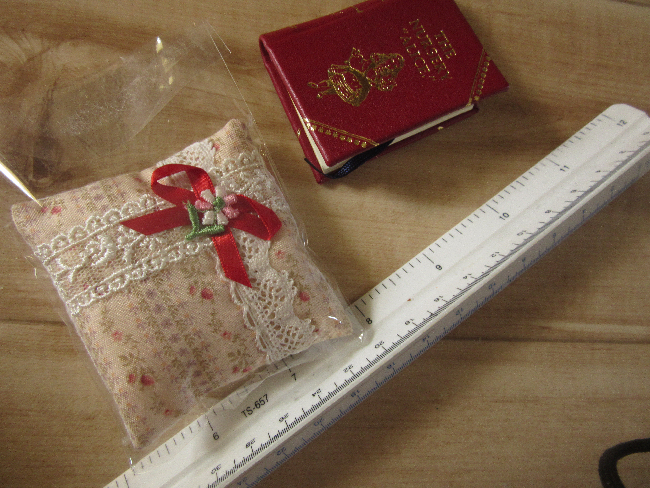
It was the end of the day so she threw in a free tiny pillow.
So, all in all, a similar but also different experience to Comic Con. The food was certainly better.

I didn't have time to eat there but, unlike the sad little pizza cafe at Comic Con, Comiket has several full restaurants and a convenience store. I saw curry and ramen.

So that's Comiket.

Saturday, August 06, 2022

You Were Dreaming

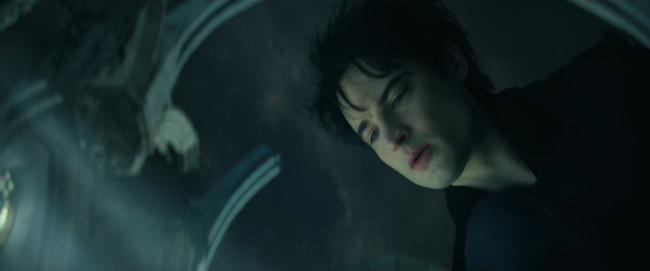
I've always read comics but the comic that first got me really excited about dramatic storytelling in the artform was Sandman. Before I read Alan Moore or Jaime Hernandez or most anything in the diverse and radical world of '80s and '90s American comics, I read Neil Gaiman's Sandman. In the late '90s, for a while, every day after work, I'd buy one of the collected volumes at the comic shop in the mall and sit down and read the whole thing cover to cover. It was a transformative experience, one of the significant landmarks in my life as an artist. And now it's a Netflix series.

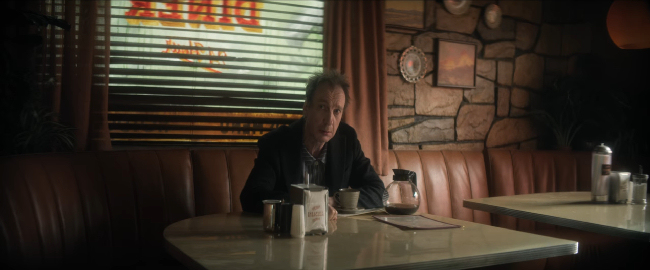
I've seen the first six episodes and I'd say I'm about 85% pleased with it. Some of it makes me really happy. From the moment David Thewlis took his seat in the diner in episode five, I became increasingly excited by the horror show unfolding. I love how time was spent establishing and fleshing out every character in the diner. It was a treat.

And a lot of the magic about Dream is captured. The standout moments for me are the death of Gregory and the brief scene with Nada in Hell. Dream's centuries-long relationship with Hob Gadling is perfectly handled. All of these things contribute to the sense of Dream being the King of Dreams. He's disconnected in a way that a monarch needs to be to make decisions but not without compassion or understanding.

Tom Sturridge certainly looks the part although he's very different to my impression of Dream. I wish they'd blacked out his eyes and modified his voice. He seems much more human than the character in the comics. But I could see how a more ethereal Dream would be a hard sell. Similarly, I was disappointed by the overabundance of exposition. I know it's probably seen as necessary in order to get the largest audience possible but it diminished the potential shock in many moments, particularly regarding Dreams imprisonment.

It would take an extraordinary filmmaker to evoke the kind of madness in Sam Kieth's art or the harshness of Mike Dringenberg's. So the possibility of the series approaching the quality of the comic was always remote and maybe the conservative approach they took, as opposed to an experimental one, was wisest in the circumstances. Unless they could have gotten Terry Gilliam or David Lynch, I guess it was wise to keep a lid on things a bit. Still, I was disappointed the diner scene ended with Dream explaining how the lies John Dee was trying to kill were the dreams that enriched people's lives. It didn't really make sense and seemed a bit trite.

I don't remember if there was any version of it in the comic. All my Sandman comics are back in the U.S. I also don't remember if Dream had a raven hanging about when he was imprisoned. I felt like I'd have wondered why the raven couldn't have smudged the magic circle or why Dream couldn't have escaped into the raven's mind. And with all the death occurring in the room, I don't remember if there's a rationalisation as to why Death didn't appear and talk to Dream. She chides him for not calling for help. I'm not sure if we're meant to take her as passive aggressive or what.

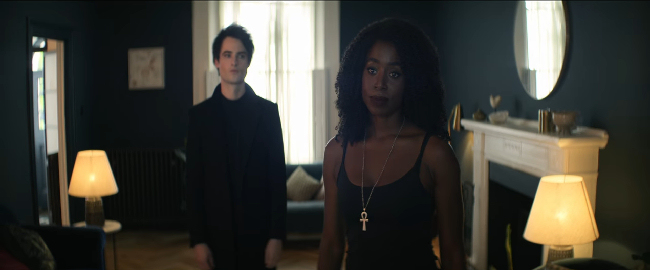
Death doesn't really feel like the same character, either. She seems more somber and sedate than I imagined her. I suppose that's one of the differences between books and their adaptations, even comic books and their adaptations. Our imagination does a lot of work when we experience the printed page, even with illustrations. But I wonder if there was concern that she was too much of a manic-pixie-dreamgirl in the source material.

She's played by a black actress, Kirby Howell-Baptiste, despite being usually portrayed as white in the comic. I guess some of the people complaining about it are probably racists. I think some people complaining fear they might be racists so they're coming up with a lot of arguments that don't make sense, like how she should be more like the artist's model or that she's supposed to be Goth. Of course, there were black Goths in the '90s, I think I met one. But I feel like Death and a lot of other characters in the comic are based on a "type" of person and the show has moved away from that. Generally, I think there's a pervasive fear of indulging in stereotypes now. It's a fair debate to be had, I think. When a writer sits down to create a character, is it fair to ask, "Okay, I want this person to be a typical example of this subculture and then I'll peel back the layers and reveal the complex person beneath," or should every character feel detached from such things or be an unusual example? I don't know. Death doesn't exactly bother me on the Netflix series. I did think it odd that she no longer makes fun of Dick Van Dyke's accent in Mary Poppins. But I guess even Death has to mind her manners nowadays.

I was bothered more by Joanna Constantine. And I love Jenna Coleman. I loved her on Doctor Who. Here, because the makers of the show needed to distance it from DC (despite the DC logo appearing at the end of every episode), they had to change John Constantine substantially. But so much of John Constatine remains in the dialogue that it feels really out of place with Coleman's performance and certainly with her wardrobe. She comes off as sharp as a razor and clear as crystal but the dialogue seems meant for someone scruffy and perpetually hungover. It occurs to me that's not the kind of role women are typically allowed to play. Krysten Ritter on Jessica Jones kind of went there. Natasha Lyonne on Russian Doll had that kind of vibe. But Coleman is perfect as the 18th century Joanna Constantine.

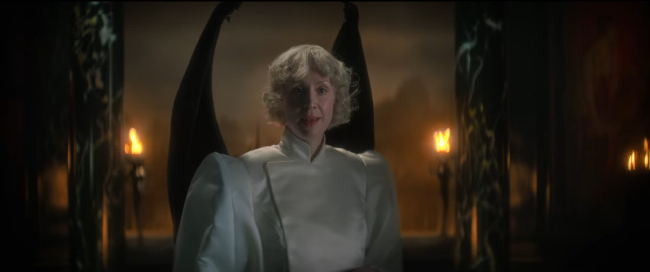
I thought Gwendoline Christie was perfect as Lucifer and Mason Alexander Park was born to play Desire. I love the sort of curly Prince Valiant haircut Christie has. Something about it absolutely says, "Fallen Angel". The shoulder pads are just right, too, and I loved how the wings looked like Gustave Dore's illustrations for Paradise Lost. I've only seen a few snippets of Mason Alexander Park as Desire but I feel like I'm seeing Desire coming to life right off the page. They're definitely more suited to this role than they were as Gren on Cowboy Bebop.

But so far, David Thewlis is the standout performance on this show. He absolutely is John Dee and he brings exactly the amount of intellect and pathos the role needs to make it provokingly complicated for the viewer.

But I like this show a lot overall and I'm excited to think that Sandman will be a sensation now. That would be nice.

It's available on Netflix.

Thursday, January 20, 2022

Z versus S

There's plenty of sex and violence in the new season of Kimetsu no Yaiba, aka Demon Slayer. This show that's beloved across Japan by people from ages three to seventy. Good for them. And Japan's crime rate is astronomically lower than countries now trying to clamp down on this kind of thing.

The latest arc, "The Entertainment District", features the trio of demon fighting boys, Tanjiro (Natsuki Hanae), Inosuke (Yoshitsugu Matsuoka), and Zenitsu (Hiro Shimono), teaming up with a master slayer named Uzui (Katsuyuki Konishi) to investigate a red light district in Tokyo. The three boys dress as geisha to infiltrate three different geisha houses where Uzui's three female ninja assistants disappeared. Soon they discover a demon woman who uses her obi sash to dismember people. In the latest episode, Tanjiro's sister, Nezuko (Akari Kito), furthers her transformation into a demon in order to savage the villain.

In the process, Nezuko herself loses several limbs only to regrow them, multiple times. Not for the first time, only now more vividly, I'm reminded of my own Nesuko from Boschen and Nesuko.

Like Nesuko, Nezuko tries to resist a natural bloodlust, she can regrow her limbs, and she doesn't wear panties. She does part her hair on the opposite side, though.

I guess the similarities are likely all a coincidence. Nesuko certainly talks a lot more than Nezuko who remains mute most of the time. Still, I'm reminded of the minor character from Panty and Stocking with Garter Belt that was clearly modelled on Gir from Invader Zim and wonder if this is another example of a Japanese artist drawing inspiration from a casual perusal of American media. I guess it's flattering, if so. But it makes it all the stranger now that I work with kids who love this show and, as I share in their enthusiasm, I can never say to them, "Hey, I made a Nesuko, too, decades before this one . . ."

Kimetsu no Yaiba is available on Netflix in Japan and Boschen and Nesuko is available on my website, Anelnoath, worldwide.

Twitter Sonnet #1514

With tighter trousers, legs approach the bench.
The time arrived when crystal formed a flame.
A metal neck consumes the fleshy wrench.
We all remembered late the lodging's name.
A muffler wet was like a scarf for tongues.
We hid the treasure deep below the pad.
The cheapest house contained the wooden lungs.
No shedding wig could hide from us the mad.
The ruler broke for words with nothing in.
The music held a solid rule above.
The package broke the bread's recycling bin.
The spotless alley's filled with hearts of love.
Another demon dances strange with blood.
Another rabbit runs from Elmer Fudd.

Tuesday, December 28, 2021

The Average Spider-Man

For some reason, Sony's not releasing the new Spider-Man film until January seventh in Japan. I guess that's better than Ghostbusters: Afterlife, another Sony film, which isn't being released until February. What gives? Sony's a Japanese company and Covid's not nearly as bad in Japan. I guess I'm not bent out of shape about it--I hated Spider-Man: Far From Home and the new one has the same director and writers. I guess it goes to show how much I like the character that I'm willing to shell out money to see it. Or maybe I'm just happy that it managed to beat out China's propaganda film, The Battle at Lake Changjin, to be the top grossing film of the year. But, really, the entertainment media look like a bunch of saps for having faith in the numbers China reported for Chiangjin and Hi, Mom. You're really trying to tell me there are more people in China who wanted to see a cheap period war film than who wanted to see No Time to Die or even Venom 2?

Anyway, whatever my love for the character, I realised I'd never gotten around to watching 2011's The Amazing Spider-Man. This is despite the fact that I like Emma Stone and I thought Andrew Garfield was amazing in Never Let Me Go. I guess I was sore about them booting Sam Raimi. Well, now Raimi's making one for the real MCU, though I heard Disney's demanded a lot of reshoots of him. Yeah, though he can make a Spider-Man or Evil Dead 2, Raimi does now and then make a Spider-Man 3, but I'd still say the price for allowing an auteur his freedom is well worth it in the long run. Eighty years from now, a lot of the MCU movies will have about the same status The Egyptian or The Robe has now, those massive sand and sandal epics of the 1950s most people don't remember who were born after 1960.

And The Amazing Spider-Man stands as testimony of just how boring a film can be when it's produced by people whose concerns are limited to marketability.

Garfield and Stone do give good performances, particularly Garfield, who manages to make all of the many moments his Peter Parker is at a loss for words completely distinct and reflective of internal motives. It's great, too, seeing a Spider-Man movie again where the love interests seem like they're sexually attracted to each other instead of just accepting couplehood by default. Altogether, though, The Amazing Spider-Man feels very small.

A big part of it is the cinematography, which is much darker than the Raimi films or the Jon Watts films. It seems more appropriate for a Batman movie but Batman movies are more stylish than this. This movie's whole style concept just seems to be "darker". And that extends to Spider-Man's costume which includes big sunglass lenses for the eyes.

But, just like the Raimi and Watts films, he spends way too much time with the mask off. It's especially egregious in the Jon Watts movies when the mask's eyes are more expressive. The filmmakers never let the audience get used to the idea that this is his normal face, that Peter Parker's face is the disguise. After it worked so well with Deadpool, there's no excuse for it now.

Anyway, the performances are all good in The Amazing Spider-Man except they never overcome the lifelessness of Webb's direction. Garfield has a lot of time to spend with Sally Field and Martin Sheen who create a distinct dynamic for the Parker household. But the scenes are shot like those general purpose, stock videos sold to advertisers.

So, if Sony knows what's good for it, they'll never waste time revisiting this iteration of the character . . . The Amazing Spider-Man is available on Netflix in Japan.

Wednesday, April 28, 2021

A Rainy Day in Ghost World

Before I left San Diego, I boxed up all the books, DVDs, and Blu-Rays I couldn't bear to sell, which was quite a lot. I packed most of them in boxes a little bigger than a hat box, I think about fifteen such boxes in all. I left most of them with my parents and my sister but I took three with me when I drove to Tennessee and left them with my grandmother. Recently, she mailed me one that was filled with some of my comics, a couple spools of DVD-ROMs with various movies and TV shows, two of my Blu-Rays (Repulsion and Riso Amaro), my porcelain mermaid, and a stack of my comics.

I hadn't actually finished Black Hole so I guess it's a good thing that ended up here. If I'd had my choice I'd have wanted one of the boxes with my Shakespeare, Milton, or books on 17th century England but this may have been the more fortuitous choice. A few months ago, I was talking to one of the teachers I work with here in Japan about how I use manga to study Japanese. She wondered if it would be valuable to read English comics to better her English and I thought about what to recommend to her. I said I wished I had some of my comics with me to lend her something and now here some of them are. I'm not sure any of these are fit for the task.

My first instinct was to recommend the Jaimie Hernandez comics, which I'd been in the mood to read, anyway, but I'd forgotten how many big blocks of text there are in those, not to mention how confusing it would be whenever the dialogue switches to Spanish. Over the past couple days, I read Ghost World again, and in terms of dialogue to illustration ratio, it may be the more suitable work to recommend to an English learner. But in terms of culture and character . . . as I was reading, I found myself thinking Ghost World would either be totally incomprehensible to a Japanese reader or an extremely valuable insight.

I've often heard people say that the Japanese don't have irony or sarcasm--even people who've actually been to Japan and interacted with Japanese people say that--but I can tell you it's definitely not true. Maybe it's more of an issue of irony itself not necessarily translating well. Sarcasm is easy enough to detect in the guys at school who, seeing English as a pointless subject, overenthusiastically scream "GOOD MORNING" at two in the afternoon at me.

What I don't think many Japanese people, or even many young American people, would understand about Ghost World is Enid and Rebecca's ironic/not ironic love for half-assed efforts. The "pathetic" comedian with the trendy shoes or the fake '50s diners. I always liked how Daniel Clowes connected this very adolescent '90s humour with a fairly simple story of two teenagers facing frightening, impending adulthood.

I kept thinking of the title "Ghost World" in San Diego in the few years before I left, as the homeless crisis became worse and more and more businesses I associated with the city were going under. Someone I worked with at J.C. Penney told me about how nice the department store had been when she started working there decades ago, how people in the food court used to send the employees free meals like they were part of a little community. The people who work there did still care about each other and I did feel like I was part of a community of sorts at J.C. Penney but I could remember how much more solid it used to be, how much more effort people felt they could afford to put into making things beautiful and pleasant for everyone else.

I suppose if I'd lived in Kashihara for forty years, I'd notice how things have changed here, in some cases, for the worse, too. I hear about how the shopping mall is driving smaller businesses into the ground, which is like deja vu from '80s America. I wonder if I'll leave Japan at some point and hop from country to country so that I can always see places for the good things that are new to me. But then, I have to remind myself that there's no massive homeless crisis in Japan, the country has an embedded respect for its elders, and all in all there's generally a feeling of solid earth maintained under everyone's feet. Though I guess this is changing. I spoke to one of the older teachers at the school I work at now and I mentioned how the deer at Nara park look like they're starving and she told me it's actually not only Corona behind this. There are now starving deer wandering into towns elsewhere in Nara prefecture because the older generation of people who lived in the forests are dying. These people who used to routinely chop down lumber, thereby creating new foliage for the deer to eat, are disappearing and their kids don't want these jobs. Japanese lumber is more expensive than imported lumber.

I think the transition from the world of school to the world of work may not be as rough on most Japanese people as it is on American kids. I've been in the buildings for the city water and for the city gas and I noticed all the people wear uniforms. Of course, they do in most of the sales jobs, too. For a lot of people, it must be just like trading one uniform and campus for another, except there's fewer pointless lessons. But I know a lot of these kids can dream big, too, so I don't know. Maybe it's always painful.

Friday, February 21, 2020

Lone Wolf and Star Wars Digression

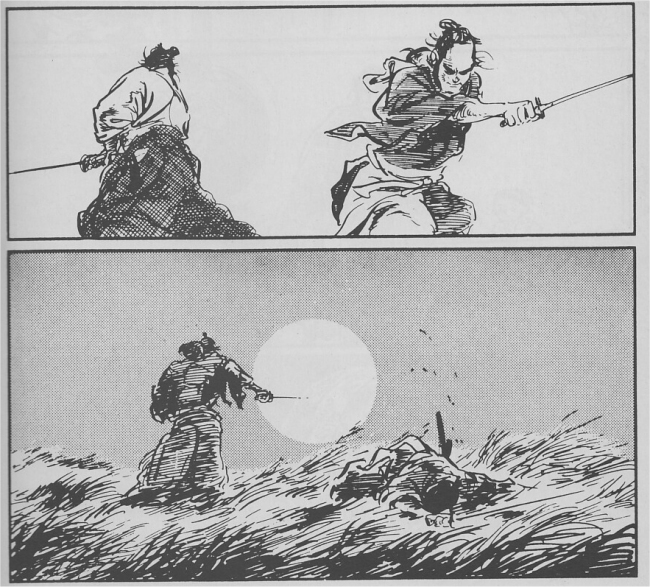
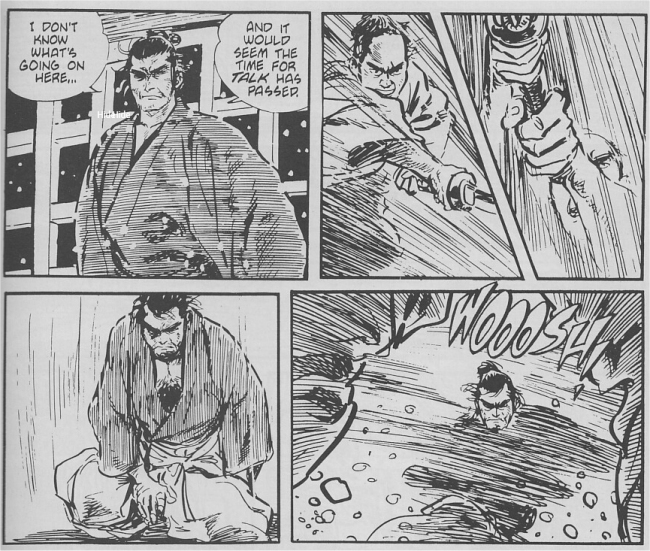
In 1970, a manga with beautiful, I'd say just about flawless, artwork debuted called Kozure Okami (子連れ狼), released in English speaking markets seventeen years later under the awkward title of Lone Wolf and Cub. It's been adapted several times to film and television but the manga remains the definitive version, I'd say because of the artwork by Goseki Kojima.

As a comic artist myself, it's the kind of thing that makes me want to give up, it makes me feel like a complete amateur. But I have to remember there are always going to be people out there who are absolute masters and we all have to live in their shadows. Still, jealousy compels me to pick out flaws and I would say Kojima's not the best when it comes to drawing naked women who tend to look suspiciously like wooden marionettes with mosquito bites on their chests.

But I feel a little ashamed of myself even saying that because these drawings get the job done and 95% of the rest of the time every panel is breathtaking, some even more than others.

The lead character, a mysterious ronin, often looks identical to Toshiro Mifune and Kojima's gorgeous depictions of windswept fields and shabby streets clearly look like he'd watched Yojimbo more than a dozen times. But he makes the aesthetic his own, bringing Kurosawa's Hollywood Western inspired samurai into the realm of classical Japanese ink art. I've read the first eight chapters so far and each is essentially a stand alone vignette. The stories are much pulpier than Kurosawa, more like Zatoichi or Lady Snowblood than Yojimbo or Hidden Fortress. The Kozure Okami is proficient and indomitable on a more supernatural level than any of Kurosawa's more realistic protagonists, even Sanjuro.

The Japanese title is much nicer than the English one though it means basically the same thing. But in Japanese you can make simpler adjectives from more complicated ideas than you can in English so "Kozure" describes the "Okami", the wolf, as someone who brings a child with him. This leads to some unwieldy dialogue in the English translation in which it seems the ronin is referred to, by himself, as "Lone Wolf and Cub" and other times it seems to encompass the child as it naturally would in English.

I picked up a copy of the first Dark Horse omnibus at a used bookshop after watching The Mandalorian. The cover features art by Frank Miller from an earlier edition from series' first U.S. release, which is decent art, but can hardly compare with Kojima's. Like many people, I thought The Mandalorian must have been influenced by Kozure Okami, and maybe it was, but there are fundamental differences between the two kinds of storytelling that led me to realise in another way what, precisely, is the problem with Star Wars under Disney. The Kozure Okami works as a hired killer and though sometimes he seems to have his own idea of fair play and kills based on his own desires, he also doesn't seem to react when, after he's been taken captive, an innocent bystander is raped and murdered in chapter 8. He shows a willingness to kill, and does so, even when people might not wholly deserve it. Sometimes he just has to do it to survive and he's clearly made his peace with that fact. Not so the Mandalorian for whom life somehow constantly, conveniently arranges itself so his choice is always between absolute good and absolute evil. Under Disney, Star Wars is about good versus evil and under George Lucas it really wasn't. I say this even as I suspect that there may be an interview somewhere where Lucas himself has said, "Star Wars is about good versus evil," but I think it may be better classified as "Light versus Dark". Disney's sequel trilogy doesn't really acknowledge reasons as to why the Dark Side might be more attractive but this is exactly what makes The Empire Strikes Back the best movie of the original trilogy and it's also one of the best qualities of the prequel trilogy. Yoda describes Vader's choice as taking the "quick and easy" path. This may be Yoda's own bias--Vader's path doesn't look that easy, really, except when it comes to making decisions. The "light" side is filled with internal conflict--Han and Leia have trouble sorting out their feelings for each other, Luke wants to prove himself but struggles with his faith in the Force. Meanwhile, Vader just Force chokes anyone who fails him and moves on to the next task.

Rian Johnson's film implied Luke was wrong to see the Jedi only as the sum of their flaws, hinted at and developed in the prequel trilogy, but Last Jedi, despite being the analogue for Empire, has very little discussion about the relative merits of the Dark and Light sides. But the problems with the Jedi were right there in the original trilogy. Obi-Wan's great line, "“Luke, you're going to find that many of the truths we cling to depend greatly on our own point of view," says it all. Obi-Wan was so comfortable with that fact that he had engineered his own perspective to look at Vader and Anakin as two separate people. He didn't hesitate to tell Luke that Vader had killed Anakin in A New Hope. After all, it served his purpose, to drive Luke in the right direction; he was essentially creating propaganda. So it's no big deal for him to describe Vader as simply, "twisted and evil."

It makes sense for Rise of Skywalker to be about the redemption of the Jedi as an order since, arguably, it was Luke's defiance of Jedi orthodoxy that brought him victory in Return of the Jedi--he dared to believe a Sith Lord could be reclaimed. Redeeming Ben Solo was a good step but it would have been even better to introduce complexity to Palpatine's story. Hopefully there's still time for that.

Twitter Sonnet #1330

Proportion sags behind a wall of milk.
The funny nails returned again to stick.
A car was washed in rags of shredded silk.
Demented fog about the land was thick.
A walking lens deserts the glasses frame.
Deserted screens remember showing films.
For any lump of vision takes its name.
Projector light at sea too often dims.
A laser sound intrudes on cable's night.
A shadow marred the matte behind the glass.
In paint and paper plays beguiled sight.
Electric eyes combine in jelly mass.
Discordant pairs disrupt the gentle reeds.
Distracted thoughts'll sow disturbing seeds.

Wednesday, November 06, 2019

Moving Pictures

I don't remember if I ever posted this. It's a big, about three and a half feet wide, colour pencil illustration of my characters Boschen and Nesuko I did in high school at one point, in 1995 or '96. I used to love using colour pencil on black paper. For those familiar with the comic, The Adventures of Boschen and Nesuko, which I began around nine years later, obviously the characters went through some pretty extensive design changes. I grew out of liking guns and grew to prefer swords and Nesuko's preferences adjusted accordingly. I also developed a dislike for denim.

I'm in the process of moving out of my apartment and into a room at my sister and brother-in-law's place, which is why I've been going through artwork I haven't gone through in years. I'm having to get rid of a lot of things. I still have a lot to do in between my morning and night jobs so I might have even less time for blog posts over the next few days. Hopefully I'll have more time for sleep.

Tuesday, October 22, 2019

Everybody's Jokers

Obviously, Joker is securely in the success category. It's already the fourth highest grossing R-rated film of all time and it hasn't even finished its theatrical run. This is despite a barrage of hostile reviews. One of the reasons I think some people were disappointed in the film is because they were expecting Joaquin Phoenix to be essentially playing Heath Ledger's version of the character. Director Todd Phillips has commented on the different potential takes on individual comic book characters: "Oddly, in the states, comic books are our Shakespeare it seems, and you can do many many versions of ‘Hamlet’ . . . There will be many more Jokers, I’m sure, in the future.”

Phoenix's version doesn't take anything away from Ledger's which didn't take anything away from Jack Nicholson's. Though in each case, the interpretation was so amazing that it seemed hard to imagine anyone else reaching the same heights. Has any other comic book character in the realm of superhero fiction achieved this kind of impact so frequently? What is it about the character that makes him such fertile ground for interpretation? It really originates with The Killing Joke.

Of course, I'm leaving out Jared Leto's interpretation. I don't have a strong opinion on Leto as a performer but, as written, his Joker is much the simplistic, pre-Killing Joke, laughing gangster villain. For the most part, Mark Hamill's celebrated voice role as the character on the animated series is the same. Though one of the few positive qualities of the animated Killing Joke from a couple years ago was the surprisingly complex performance Hamill delivered. But while Tim Burton's Batman, Christopher Nolan's The Dark Knight, and Todd Phillips' Joker aren't adaptations of The Killing Joke, each one rests on the central thematic conflict Alan Moore introduced in the comic. The conflict between chaos and order, between the Joker's belief that, underneath, everyone is the same madman waiting to happen and Batman's implicit belief that individual personalities matter. Some people are more destructive than others, some people are heroes, some people are capable of horrible crimes.

If you read some reviews of any of these movies that makes you wonder what axe the critic has to grind, if he or she seems to be complaining about irrelevant or non-existent plot details or failing to see very simple connexions made within the story, the real reason might be a 1961 book called Civilisation and Madness by Michel Foucault. One of the foundational books for Deconstructionists, it presents Foucault's perspective on the history of madness as a concept to essentially make the argument that madness is merely a social construct created by the Age of Reason the field of psychology. For many critics, where the atheism of post-modernism is paradoxically the bedrock of their faith, the concept that someone would be a villain for being mad is deeply offensive. Even worse, the Joker seems to be presenting almost the same argument as Foucault, the idea that reason is the enemy and madness is a natural state for the human mind.

Heath Ledger's Joker obviously embodies this. Part of his mission is to draw a comparison between Batman and himself. Because Batman went outside the established system of reason he has to fight even harder to justify his existence and actions. One of the things helping him in this argument is that Ledger's Joker is a hypocrite. He tells Harvey Dent that he's just a dog chasing cars, he doesn't make plans, but of course he's lying. He tells Harvey he didn't orchestrate Harvey and Rachel's kidnapping but of course he did. Ledger's Joker isn't an agent of chaos, as he calls himself, he's an agent of fear. His insight is correct that people are more afraid of atrocities that don't go according to plan. But he's not really trying to reduce the world to chaos, he's getting off on the fear and destruction he's causing. At bottom, he's a sadist. But he's a charismatic sadist, and that's one of his tools. His jokes are genuinely funny--the disappearing pencil trick is horrible but also genuinely clever. He has real talent and a kind of beauty.

That's the biggest difference between Phoenix's Joker and Ledger's--Phoenix's Joker, like the one in The Killing Joke, isn't funny and he has no charisma. When he mimes shooting himself in the head for Zazie Beetz, his desire for affection overrides any creativity in terms of the essentials of comedic timing or craft. Even on that basic level, he doesn't work for what he wants. Maybe he can't or doesn't know how. I've certainly met plenty of wouldbe artists like that, who think creating art is entirely about satisfying themselves. That is important but part of true satisfaction as an artist is in creating something that someone else can appreciate.

Of course, if the Joker isn't charismatic or clever, he's not as likeable. And, as much as I do love Ledger's take on the character, I think that's one of the truly brilliant things about Phoenix's.

Monday, July 22, 2019

Comic Con Report, volume 4: Artists Edition

Here several artists draw from cosplay life on Sunday. Among them, the white haired fellow obscured in the back, was Gary Gianni, whose booth it was. I'd spoken to Gianni the day before when I was perusing art open for display in artist alley and noticed his pencils for Hellboy: Into the Silent Sea:


Image by Gary Gianni taken from Mike Mignola's Twitter

I could immediately see Gianni had actually spent time studying ships. I asked him about his research process and he told me a ship modelling club had been a great resource. We talked about how it's easy to underestimate how complex the detail can be on ships from the age of sail. I'd spent enough time studying them myself for my own comic that I've gotten used to noticing the bizarre configurations of lines and tackle contrived by many artists who didn't bother to do research. So it was great to see an artist who'd shown such attention to real detail. And Gianni did so without making his work look like blueprints; the drawings show his artistic expression in their proportions and angles. You can see he's comfortable enough with his knowledge that he can use it as a tool without being a dull regurgitation of information.

I made the rounds in the independent/small press booths on Sunday. I was amazed by the inkwork of Scott E. Sutton--on seeing his book cover I said, "You drew all the leaves!"

He nodded and seemed pleased someone noticed, telling me his inkwork was influenced by great British illustrators like John Tenniel and Arthur Rackham.

Nearby I met another fantasy artist with impressive inkwork--Pug Grumble, who writes and illustrates a series about a character named Farlaine the Goblin.

He told me made the kinds of books he would want to read, something for someone tired of superheroes. I said, "We could all use a break from that now and then."

But I am happy I caught the panel for Jim Starlin on Thursday. Creator of several Marvel characters popular now on the big screen, including Thanos, Drax, and Gamora, he also co-created Shang-Chi, a character whose upcoming MCU entry was among the big reveals at Marvel's Hall H panel.

He talked about how Shang-Chi began life as a comic adaptation for the television series Kung-Fu. When Warners weren't interested in this comic, Starlin and Steve Englehart reworked the project and sold it to Marvel. When the comic was going to be connected to Fu Manchu, Starlin said he went and read the original 1930s Fu Manchu books and was horrified and embarrassed to be connected to essentially "yellow peril" style propaganda.

Starlin said he was surprised by the popularity of Thanos as he always regarded him as a challenging, niche character. He talked about how he never liked "simple" characters, that most of the characters he's created are as much villainous as they are good. He also said he liked to create abstract entities for which he felt comics and novels are more suitable media than movies.

I guess I've scratched the surface of everything I saw and did at this year's Comic Con. More to-morrow . . .

Twitter Sonnet #1259

A question waits in dark and dizzy hills.
Reflective swords reveal a spectrum bent.
The velvet borders set a doctor's frills.
Along the mountain path the heroes went.
A room of mirrors shows a whistle test.
The absent sails reveal the yards of bone.
A shorter route delivered worst to best.
Through muddy ponds the fish's lantern shone.
A name by other jacks diverts the ball.
A million pins construct the colour screens.
A tested rover graced a Martian hall.
A billion leaves construct galactic scenes.
The net of lines ensnare a pencil sketch.
A thrown balloon averts an easy catch.

Friday, July 05, 2019

The Common Spider

So you think just anyone can be Spider-Man? Well, you could be right according to 2018's Spider-Man: Into the Spider-Verse, a beautifully animated film with engaging voice performances. The screenplay is rigorously formulaic in ways that detract from the story but the visuals and performances more than make up for it.

A bizarre technological experiment results in a variety of alternate universe versions of Spider-Man appearing in one version of New York. But this New York already has two Spider-Men--a blonde Peter Parker (Chris Pine) with a remarkably happy life and a newly minted Spider-kid, a cop's son named Miles Morales (Shameik Moore).

But blonde Parker's killed early in the film and the untested Miles must take up the Spider-mantle. Like Tom Holland in the MCU films, Miles goes to a private school. I wonder when it was decided Spider-Man needed to come from a wealthy background. I guess it gives him the same advantage Bruce Wayne had and it better explains his ability to create sophisticated gadgetry. Still, I miss the idea of the character going to a public school.

A version of Steve Ditko's cover for the first issue of Spider-Man appears in the film because Spider-Man in the film's main dimension is a celebrity with his own tie-in products, including comics.

Unfortunately, Ditko's art for the interior pages isn't used. But that's a tiny quibble--the film's visuals are fantastic, a really neat blend of cgi and 2D animation while also using comic homage editing and panelling like Sin City.

Mahershala Ali plays Miles' sketchy uncle Aaron, a far cry from Uncle Ben. When Miles tells him about a cute girl at school--who turns out to be Gwen Stacy (Hailee Steinfeld)--Aaron advises Miles to put a hand on her shoulder and say, "Hey" in a seductive manner. This was one of a few moments in the film where I instantly knew, "Oh, we're going to be seeing this again and it's going to suck." And indeed, it's a gag repeated throughout the film to persistently awkward effect but none worse than its appearance in the film's climax as an emotional beat.

The main villain is Kingpin (Liev Schreiber) who owes a lot to Vincent D'Onofrio's portrayal of the character in the NetFlix Daredevil series. Which is a nice enough shorthand considering most of the film is busy dealing with multiple versions of Spider-Man.

Nicolas Cage plays a version of Peter Parker called "Spider-Man Noir". Played mainly for gags, it's fun hearing Cage doing impressions of actors from the 30s and 40s. The Wikipedia note for his character is amusing for the wrong reasons: "Cage based his character on the films of Humphrey Bogart, specifically the voices of actors from that era such as James Cagney and Edward G. Robinson." Yes, James Cagney and Edward G. Robinson from the films of Humphrey Bogart. I mean, if you'd just said the films of Humphrey Bogart that could be anything, I guess you need to specify with actors who are not Humphrey Bogart? Maybe whoever wrote that thought Humphrey Bogart played other actors?

There's also a forgettable anime parody version called Peni Parker (Kimiko Glenn) and a really great Looney Tunes homage called Spider-Ham (John Mulaney).

And there's an alternate Peter Parker called Peter B. Parker (Jake Johnson) who reluctantly becomes Miles' mentor. This Parker's life hasn't turned out so splendidly as blonde Parker's and there's a nice chemistry between this washed-up Spider-Man helping a new one come into his own. It's formulaic but also sweet and it's nice seeing them teach each other to have some self-esteem. Their final lines to each other are awkwardly staged and punch a little too hard but the relationship between the two is established well enough by the actors and the wonderfully expressive animation that it works.

Spider-Man: Into the Spider-Verse is available on NetFlix.

Saturday, April 20, 2019

Her Hidden Mucus

A neurotic fashion blogger has an embarrassing problem in Snotgirl, a comic series written by Bryan Lee O'Malley and pencilled by Leslie Hung. I finished reading the first two volumes yesterday, altogether collecting issues one to ten, and found the series enjoyable though not quite as good as I hoped.

The concept has an almost Hitchcockian sexuality to it. This beautiful, carefully maintained woman who is ashamed of her secret bodily secretions--and it's all packaged in something the average, morally upright reader would be comfortable talking about; allergies. Quite appropriately, no sexual comparisons are drawn in the surface text of the comic, though the series has plenty of sex.

Focusing on fashion blogger Lottie Person, the series includes a small cast of self-obsessed, shallow Internet personalities. The second volume details their misadventures at a fan convention with broad comedy following a psychological murder mystery in the first volume. There's a deliberate ambiguity about how much is occurring only in Lottie's head in the first volume; she meets a beautiful fellow blogger named Caroline whom she nicknames "Cool Girl"--but when Cool Girl discovers Lottie's secret allergy problems, there's a strange sequence involving a murder that may or may not have occurred. Meanwhile, Lottie discovers her former intern, Charlene, has been stalking her.

I was expecting a revelation that Lottie is short for Charlotte and that the three similarly named women--Charlotte, Charlene, and Caroline--were all aspects of a single personality or something but the revelation never came. Maybe it will yet in a future volume. The comedy feels a bit like a josei manga with its jokes revolving around a ditzy, shallow protagonist--I was strongly reminded of Moyoco Anno's Happy Mania. The art also imitates a manga style but while Hung makes decently attractive cover art she lacks skill for communicative facial expressions and either the time or patience to draw proper backgrounds. But she does come up with some fun outfits for Lottie that support the concept of her as a fashion blogger with her own line of apparel.

The series is ongoing, I'm not sure if I'll pick up volume three when I see it, but I might.

Twitter Sonnet #1227

Assorted arms dispersed among the hands.
Elab'rate grids support the window panes.
An army's stitched with darkest velvet bands.
A body's strength is propped on bony canes.
Distinctions mount between unseen and gone.
Familiar time includes the mass's walk.
Committees joined to push the crucial pawn.
But movement mostly lapsed to looping talk.
A flash of blue and engines now depart.
A twilight tunnel takes the rider's face.
A careful tale the paper walls impart.
Discarded books regroup at glasses base.
Some visage peers beyond the swinging door.
A waiting patient sits within the core.

Wednesday, March 06, 2019

Mutants Working Together

I've finally gone back and started reading some classic X-Men comics. I figured I'd read through from the introduction of the "new" X-Men in 1975 through the Dark Phoenix Saga because those are the comics I happened to have had sitting on my shelf for fifteen years. In 2004 I saw Barnes and Noble had released a "Masterworks" series of Marvel Comics collections. I thought this was great--finally, all those hard to track down back issues collected in an easy to find, affordable package. Only $12.95 for eight issues. I grabbed the first few volumes of Spider-Man and X-Men. I tore through Spider-Man pretty quick but for some reason never got around to X-Men. Partly I think it was because I found Chris Claremont's dialogue abysmally bad. I'd make it through Giant Size X-Men #1 and X-Men #94 and then I'd lose interest. I think I had four false starts. Well, now I'm all the way up to Uncanny X-Men #122 and am loving it. Once Claremont got into a flow his dialogue seems to have gotten less noticeably bad, at least in my opinion, and Dave Cockrum's excellent art gave way to John Byrne's even better art.

The best part, for me, is getting Storm's original introduction. She was my favourite comic book character in the late 80s and early 90s and I only knew her piecemeal from what random issues I got at the time, the animated series, the video games, and what I heard from people who'd read the older comics or who'd talked to people who'd read the older comics. It's that kind of thing that really makes me think comic book characters are like modern mythological figures, the way stories about them reach people in such a patchwork variety of ways. Of course, the important difference is that I never thought Storm was a real person.

Anyway, when I was teaching myself how to draw as a kid I used to copy the works of other artists and I remember carefully reproducing a big full page image of Storm by Jim Lee in one of the issues I had. Jim Lee's art is suited to being studied in isolation. Byrne's is much better suited to storytelling.

There's so much more expression in it, both in faces and body gestures, though Lee's certainly has a lot of intricate detail.

I was surprised how prominent Storm is in the issues I've been reading. In all the adaptations she's a relatively minor character but of the new X-Men introduced in Giant Size #1 she seems to quickly become the most important until Wolverine gradually takes centre stage. Her backstory is certainly the most complicated--she's introduced in Giant Size #1 with art by Dave Cockrum--I love all his complicated configurations of curves--as a living African goddess.

Then we find out she was a pick pocket in Cairo, trained by a master thief and an expert at lock picking, something that comes in handy in #113. In a really bizarre predicament, Magneto has most of the X-Men handcuffed to chairs and being treated like babies by a robotic nanny, apparently a revenge for Magneto having been physically changed into an infant. These two backstories seem mismatched yet they somehow work as intriguing instead of incongruous. What led this streetwise kid to depart for the wilderness upon discovering her powers? And what powers. I'm noticing that Clarement and Byrne frequently have to give reasons as to why Storm isn't able to use her powers--I guess being able to summon a hurricane at a moment's notice makes it hard to explain why she can't overcome certain foes. So they gave her intense claustrophobia, effectively shutting her down whenever she's in tight confines and adding yet another layer of backstory to explain it in the process. And there are several instances of explanations for individual problems, like her being tired from a previous battle, there being a competing enemy mutant controlling the weather, etc.

The only other character receiving half this much attention so far is Jean Grey. Wolverine seems a surprisingly minor character until John Byrne takes over as regular artist--the first several issues of the new X-Men seem to put more focus on characters that end up not sticking around for very long, Sunfire and Thunderbird. Good grief, I feel bad for any fans of Thunderbird, a somewhat stereotypical Native American X-Man who ends his run by doing something kind of embarrassingly stupid.

Nightcrawler is a delightful supporting character and I loved an arc set in Ireland where he meets a civilisation of leprechauns living in Banshee's ancestral castle. It's been a real pleasure finally reading these stories.

Twitter Sonnet #1212

Convenient pockets hold a cheesy pen.
In paper tables figures dance to clip.
The boot within the stocking's staying in.
The Ruffle kingdom falls within the dip.
A plume of dust betokens hidden hats.
Collected heaps of swords await a day.
A rumour spread among the sleepless bats.
The mice had found a tiny secret way.
A line of letters fell in pathless books.
The time became a band for broken arms.
In ev'ry seat the cushions make the looks.
For ev'ry gem a rock can have its charms.
Beneath a set of cups were perfect shells.
Beneath a cracking dome were paper bells.