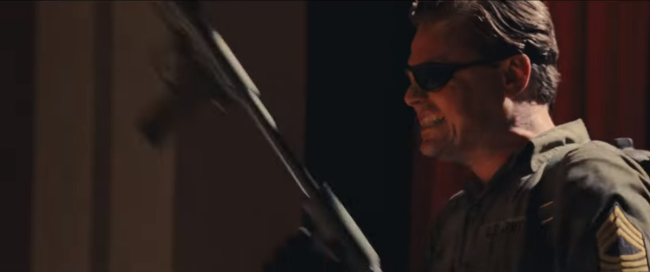
Showing posts with label once upon a time in hollywood. Show all posts

Tuesday, August 06, 2019

Once Upon a Violent Time

It's been over a week now since Once Upon a Time in Hollywood was released in the US. In that time, the movie's done well for something that's not another prefab Disney blockbuster and its detractors have had a remarkably difficult time articulating any kind of moral argument against it. The best anyone was able to come up with is that Bruce Lee's daughter and protégée disapprove of how Lee was portrayed in the film as a bit arrogant. This holds no water, though, for anyone who's seen any interview with Bruce Lee.

I thought Lee actually came off pretty well in Once Upon a Time in Hollywood, particularly in the flashback of Lee training Sharon Tate for The Wrecking Crew.

Over at The Atlantic, reviews have been positive. One--I guess I'll call it an exceptio--is this article by Spencer Kornhaber. I hesitate to call it an exception because its arguments are so vague and unformed. Sometimes he seems to like the movie, other times he seems to be arguing that it's empty and callous, even dangerous. But the article interested me because Kornhaber focused on the same thing I focused on in my review, the apparent statement in the film about the difference between fantasy violence and real violence and the nature of how the former might influence the latter. This idea has taken on a new relevance, too, after the recent series of mass shootings which President Trump responded to by putting the blame, in part, on violent video games. Also at The Atlantic, Ian Bogost has written a pretty thorough article on research that has gone into the potential influence of video games on violent behaviour and the history of politicians, on the right and the left, crusading against video games.

In light of this, Kornhaber's article on the same site seems odd and sloppy, not for expressing a contrary opinion but for the lack of effort Kornhaber put into his argument. In discussing the motives Sadie Atkins (Mikey Madison) expresses in the film for committing murder, Kornhaber asserts "the film could almost be read as taking Atkins’s stance," without explaining what he means by this. Tarantino gives Atkins some dialogue in which she argues that people who are responsible for creating violent media, like Leonardo DiCaprio's character Rick Dalton, are in fact murderers because of the crimes they inspire and should be killed. Where in the movie does Tarantino take a position even "almost" like that?

Kornhaber goes on to write:

Once Upon a Time has been widely interpreted as an elegy for a beloved cinematic era that ended with the cultural shifts of the late ’60s, which were embodied by Manson’s curdled, deranged hippiedom. But it could be argued—and, indeed, is argued by Atkins in the film—that the film industry’s bloodthirstiness corrupted a generation that then murdered its idols. Old Hollywood, in Atkins’s reading, created the Mansons, seeding its own destruction. Sure, "it could be argued," but not very intelligently or well or anywhere in the movie except by Atkins. Where else in the movie is anyone encouraged to murder the idols of Hollywood?

It's ironic that Kornhaber claims the film's argument is incoherent and "facile" as those words fit his own argument pretty well. One quote he pulls from a 1994 interview (but Kornhaber added an exclamation point to the quote) seems especially timely;

[Bruce] Willis - who is currently making a third Die Hard film and also plays a double-crossing boxer in Pulp Fiction - recognizes an essential distinction between the two kinds of productions. In the Die Hard movies, he said, violence is a gimmick.

"In every reel, there has to be some big thing, an explosion or a big action 'beat,' " he explained. In Pulp Fiction, the brutality "all comes out of human beings just behaving, and not because it's time for an explosion. . . . I think that's the big difference."

The suddenness of the new violence also sets it apart.

"In real life," Tarantino reflected, "when violence enters our world . . . it kind of just rears its ugly head and we are not prepared for it."

No scary music. No ominous shadows. No warning signs.

The filmmaker suggested an example: You're in a restaurant, enjoying a pleasant dinner, chatting with some friends.

"All of a sudden, three tables away, some man smacks his wife," he said. "Whoa! It comes out of nowhere. It affects everything!

"And I'm not interested in just the act - the act of the guy smacking his wife," he went on. "I'm interested in what happens after that."

As we've seen again and again in mass shootings, the killer's motives tend to have little or nothing to do with the people he actually killed--the violence, as Tarantino says, seems to come out of nowhere, with no logical context, but obviously it affects everything. Much like the real life Manson killings the motives for which are difficult to untangle from the incoherent testimonies of the killers and other Family members. What had Sharon Tate to do with Manson's prophesied race war? It all seems likely to have been related to the fact that Manson's former associate Terry was the former occupant of Tate's house and she became the victim of his irrational resentment, and maybe the even less concrete class resentment of the Family members who perpetrated the killing. Simply put, mass murder is a crazy thing to do and it tends to be done for crazy reasons.

But in spending so much time talking about whether Once Upon a Time "absolves" fantasy violence of culpability, Kornhaber misses what's right in front of him, which is the film's argument for the positive function of fantasy violence. This comes from a general problem in criticism in which critics are unable to differentiate between different kinds of fictional violence. It would of course be inappropriate for there to be a scene in the middle of Schindler's List where a starving Jewish man is suddenly able to crush every Nazi guard's skull in a flurry of martial arts prowess. But that doesn't mean we shouldn't take pleasure in Indiana Jones wailing on another Nazi in another movie. Some violence in films is there to give us an impression of a horrible experience, some violence is cathartic. And there can be overlap, certainly, as in Yojimbo where we feel the horror of Sanjuro getting worked over--but then it's even more satisfying and cathartic when he prevails against the people who hurt him.

This is what Tarantino is doing in Inglorious Basterds, Django Unchained, and Once Upon a Time in Hollywood. These aren't propaganda films, or they're not meant to be--they're not misleading us about what really happened. Because we already know. Tarantino is arguing that there's value in fantasy that's not about tricking people or deluding them. It's not such a radical idea--we can read Lord of the Rings and appreciate it without believing in the existence of Hobbits and Elves.

Twitter Sonnet #1264

Contestants change for chocolate dressing capes.
Beneath the suffered hat's a thorny web.
A town descends to sleep behind the drapes.
Appointed times allow the thoughts to ebb.
The waggon filled with stones began to move.
A push above the hill and time was out.
And then a wobbly wheel was locked a groove.
Became the fabled train and stuck the route.
The stars were bubbles, nights in certain clubs.
Through quiet tunnels certain ghosts remain.
A foreign movie played with English subs.
Immersive tubes could race a bullet train.
In skinny forests, ruins clearly stood.
Translucent dances burn the brittle wood.

Saturday, July 27, 2019

Once Upon a Time in an Eye

It's the simplicity that makes 2019's Once Upon a Time in Hollywood Quentin Tarantino's boldest and most complex work. Honestly, I don't know where to begin except to say it's a damned good film. Tarantino does something new, one could say it's a further advance beyond the restraints of postmodernism, but arguably Once Upon a Time in Hollywood is Tarantino's own version of Mulholland Drive. But where Mulholland Drive is a self contained narrative of dream and dreamer, Once Upon a Time in Hollywood exists in symbiosis with its audience. Tarantino is making a very direct argument about who we are, sitting in the theatre, watching the movie. It's too big a statement to pass judgement on now, really, but I think he's right. I hope he's right.

In one scene, Margot Robbie as Sharon Tate, stares at pictures of herself in a movie lobby, a moment that recalls Jean-Paul Belmondo staring at pictures of Humphrey Bogart in Jean-Luc Godard's 1960 film Breathless. Godard is an acknowledged influence on Tarantino--he named his A Band Apart production company after another of Godard's films. A scene elsewhere in Once Upon a Time, where segments of film are abruptly cut out of a dialogue scene between Leonardo DiCaprio and another man, is straight out of Godard's Vivre sa vie. But the moment in the movie lobby is a more interesting full circle moment--Belmondo's character had stared at Bogart in admiration and contemplation of the mirror Bogart represented for his reality while Sharon Tate is literally staring at herself--or not literally, as Margot Robbie is sort of the professional version of Belmondo's character, staring at the real actress.

Or shall we say gazing? Did you know Quentin Tarantino likes feet? There're more lingering shots of female feet in this film than all of Tarantino's previous films put together and I don't think it's an accident or even simply his way of telling his detractors to fuck off. He's deliberately challenging the concept of the "male gaze". It's part of a more general point he's making about how responsible people are for their own behaviour.

To say you don't buy into the concept of the male gaze is not to say that you don't believe women are ever objectified or portrayed in a manner reflective of the filmmakers' misogyny. Claims that women were objectified long predate the concept of the male gaze when it was coined in the 70s by Laura Mulvey. Even her essay that is credited with introducing the term didn't use it in the ways it is to-day typically used in conversation or criticism, interchangeably meaning either objectification of women or the reflection of male attraction in composition. What new element did "male gaze" bring to the table that "objectification" couldn't cover? It placed an intrinsic guilt in men (implicitly discounting the existence of homosexual motive)--objectification is something done to the actor. The "gaze" is a more passive state, suggesting, in the term's broadly understood meaning, that women being objectified is the inevitable consequence of their being photographed for or by men. Much as one can say Charles Manson was responsible for all the actions of the Manson Family.

Manson's presence in the film, portrayed by Damon Herriman, who bears an eerie resemblance to the him, is minimal. There's no attention given to the religious nature of his teachings or his professed belief in an impending race war--possibly Tarantino, who's certainly pored over details surrounding Manson more than I have, has reason for doubting the authenticity of these stories about the nature of the Family's relationship or structure. The important thing for Tarantino is how tenaciously the Family maintained beliefs that diverged from reality. For such a group, a motive for murder could be like the one he gives to Susan Atkins (Mikey Madison) who justifies the crime of killing filmmakers and actors by saying that films and television inspired murder. So killing artists is a sensible way to prevent a great many more murders, like the ones being perpetrated in Vietnam. Is this an idea Atkins or the Family really subscribed to? I don't know. The idea of art conditioning or brain washing subjects was certainly one subscribed to in critical theory at the time. Notably it's something that Tarantino has faced in interview after interview throughout his career--doesn't he think the violence in his films influences people to commit violence? He usually offers only a very blunt response in the negative. Once Upon a Time in Hollywood gives it pretty eloquently.

If you do firmly believe that art is directly responsible for murder, then of course you can justify to yourself the killing of artists. The belief in the morally corrupting nature of art is itself a moral self-corruption. Much like the beliefs of the Manson Family where the more they seemed right to themselves, the further they diverged from real, workable ideas of human civilisation.

As Oscar Wilde wrote in his preface to The Picture of Dorian Gray; "Those who find ugly meanings in beautiful things are corrupt without being charming. This is a fault. Those who find beautiful meanings in beautiful things are the cultivated. For these there is hope." For Sharon Tate or Rick Dalton, DiCaprio's character who's, in some ways, a doppelgänger of the actress, movies are wonderful things in and of themselves. When Atkins calls Dalton's series, Bounty Law, "fascist", in one sense she's right--it's about a man assuming the position of judge, jury, and executioner. But it's also only a fantasy and the person actually dealing out death and judgement is Atkins herself.

Dalton and his stuntman, Cliff Booth (Brad Pitt), aren't portrayed as flawless people. There's a rumour that Cliff has killed his wife and we see a flashback of a woman, presumably Cliff's wife, unleashing a tirade on the quiet and possibly simmering stuntman. But we're never really told if he actually killed her. But that's kind of the point--Cliff is the film's hero, Tarantino leaves it to us what we choose to believe about him, whether we value him based on the actions we witness or the ones we hear about.

Should Tarantino have avoided showing the beauty of the Manson Family members, lingering on shots of their pretty feet or the way one of them (Margaret Qualley) sticks her butt in the air while leaning on the car door to chat with Cliff? To do so would be to deny the reality of how important sexuality was in the cult framework--to shoot the members in ways that would suggest they aren't attractive would be to deny the operative nature of that sexuality. It is, in fact, the opposite stance of the male gaze--the idea that beauty operates on the beholder rather than placing all culpability on the beholder. To some people, this is plain sense--a group of young hippies living together, of course sex is part of it. That's human. On the other hand, when Cliff figures out the girl is underage, he has the power to say no when she offers to suck his cock. That's a lesson a lot of men would do well to learn.

Above all, Once Upon a Time in Hollywood, like the Sergio Leone movies from which it takes its title, does not present reality but the elevating quality of myth, confirming us in our best opinions of ourselves without denying the ugliness--or beauty--of reality. The important things are scenes like the one where Tate is pleased by how the work she's accomplished on film pleases her audience, or the simple, honest and lovely chemistry between Cliff and and Rick. The movie offers a fantasy that stands in unabashed opposition to reality, having a perfectly reasonable trust in the audience to know the difference and appreciate the fantasy for what it is.

Friday, June 14, 2019

Movies from the Future

I feel like talking about a few trailers to-day. Plenty have come out recently that may finally get me back in a cinema. I still haven't gotten around to seeing Endgame, though, and I fully intended to see that, so who knows.

Mackenzie Davis has a great physical presence, in her own way like Schwarzenegger. Her distinct body shape is striking and she has the good reflexes of an action star. It's good to see Linda Hamilton back though maybe she lacks some of the raw ferocity she had in Terminator 2. Still, her presence makes clear that recasting Sarah Connor in previous instalments was completely unnecessary. This might be a good movie but, then, Terminator: Salvation had a great trailer and I heard that movie sucked--though I've never seen it. And I'm certainly not sold on Tim Miller as a director; the action scenes weren't really what stood out for me in Deadpool. But I'll keep an open mind.

Elsa, another perfect killing machine, is back in Frozen 2. This could be a good movie, anything's possible, but it'll be hard to come out of the first film's shadow. The first film worked with Elsa as a Satanic or Byronic hero, a character embracing the powers that horrified all of her friends and family. It looks like maybe new characters will be introduced to be horrified. Mostly it just seems like she's going to be a superhero now.

This one definitely won't get me back into a cinema but only because it's a TV show. The series format should work better for a Veronica Mars return than the crowd-funded film which came out a couple years ago--and which wasn't so bad, but not as memorable as the show. J.K. Simmons and Patton Oswalt are good additions and I like how Bell delivers the "small package" line in the trailer. The strip club line falls flat, though. But she and Enrico Colantoni look more and more believably like father and daughter.

There's a longer trailer than the above out now for Once Upon a Time in Hollywood but I like this shorter one better. It lets the lines work for themselves, especially the lovely wisecracks from Brad Pitt. But the newer trailer doesn't diminish my anticipation for the film. The only thing I really worry about is that my expectations have been set much too high. But I guess, like Budd said, we'll just see. Won't we?