Showing posts with label fantasy. Show all posts

Monday, April 01, 2024

The End of Nemo

American Civil War prisoners escape in a balloon only to find themselves stranded on an island populated by fantastic monsters in 1961's Mysterious Island, based on the Jules Verne novel. Among lively and lusty adventure films of the '50s and early '60s, this one has a strangely gloomy, sepulchral tone I really liked.

The biggest star in the film is Herbert Lom, playing Captain Nemo, but the true star power is in the special effects and score, courtesy of Ray Harryhausen and Bernard Herrmann, respectively. The most memorable scene, to my mind, is an underwater fight with a gigantic ammonite, its inexorable tentacles striking to Herrmann's mercilessly doleful score.

It's a patently fun yet archly grim movie, a tone appropriate for an adventure film that's about the fatal end of one adventurer. But that's no reason not to put the most attractive young stars in skimpy goat skin attire.

Sorry, no screenshots to-day. Turbify's (my web space provider) upload utility routinely malfunctions. I'd complain but according to the web site the issue has been resolved and therefore I'm not truly experiencing it.

It's lucky she brought along her frequently visible 1960s undergarments.

I also liked the tough guy camaraderie of the soldiers which isn't far off from the chemistry between the ensembles of The Guns of Navarone or Dark of the Sun. It makes it all the more fun watching them deal with a gigantic crab.

Saturday, March 02, 2024

Forever Vanilla

For a sheltered young woman, meeting a handsome, supernatural boy can be the beginning of a passionate adventure, lasting beyond a lifetime. For others, like the heroine of 2002's Tuck Everlasting, such an encounter may be a chaste and pleasant diversion for a few weeks, or even months, but, well, there's never any reason to become too terribly excited. This anemic fantasy romance will make you feel that it's not worth pondering whether your most fantastic wishes may come true.

In the early 1900s, a pretty young woman named Winnie (Alexis Bledel) chafes somewhat against the strict outline her parents have imposed on her future. One day, she escapes into the forest where she means a nice, clean family who became immortal after drinking from a magic spring.

She strikes up a friendship with the good-looking Jesse Tuck (Jonathan Jackson). The two find each other very pleasant and even dance and swim together. Finally, one day the Tuck patriarch (William Hurt) explains that immortality can be a curse. This sets up a conflict between her desire to share a life with Jesse and her preference to avoid becoming an eternal being cut off from human society in some vague, abstract, intellectual way. Whatever her decision, this movie is always ready to gently remind you that nothing is worth getting excited about.

As Roger Ebert aptly put it, "The movie is too impressed with its own solemn insights to work up much entertainment value," it's a movie burdened with "feather-brained sentimentality." Oh, Roger Ebert, I miss you. I know you'd know how to use eternal life. Indeed, he said so; "I know what I'd do: Spend 10 years apiece in the world's most interesting places." Think of all the things you could learn, all the skills, all the experiences you could have. It hardly seems to require that much imagination, which makes it all the more incredible all of the characters in this movie are completely lacking it.

Tuck Everlasting is available on Disney+.

Thursday, December 07, 2023

The Supernatural Power of Regret

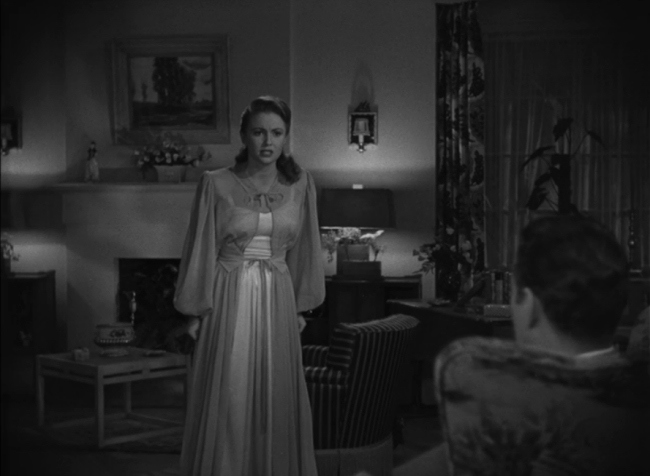
The beautiful Joan Leslie regrets killing her husband but then has the good fortune to travel back in time in 1947's noir fantasy Repeat Performance. This one is really charming.

After pulling the trigger, Sheila (Leslie) rushes off to a New Year's Eve party where she finds her droll but affectionate friend William Williams (Richard Baseheart) recently escaped from a mental institution.

She asks him if she should go to the police to which he replies, "They'd only arrest you for murder. They've got such one track minds." There are lots of cute lines like that in the film.

Sheila puts the blame for everything that went wrong on a trip to London she and her husband, Barney (Louis Hayward), made the previous January. If only she could travel one year back in time! And then, inexplicably, she does.

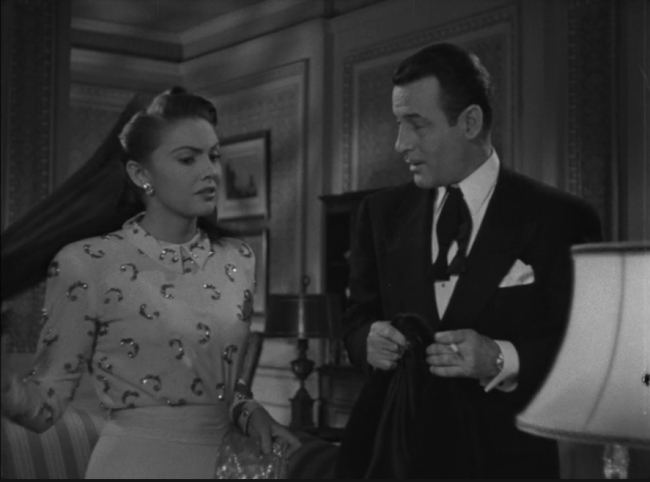
Someone at Wikipedia categorised this as a time loop movie like Groundhog Day but it's really not, it only features the single trip back in time. But like Groundhog Day, it's left unexplained. Sheila is walking up to her producer's apartment (she's a famous actress) with William when William disappears and her outfit under her fur coat changes. She doesn't realise what's happened until she's talking to her producer, John (Tom Conway).

She sets out trying to make the year different from the first time she lived it but finds destiny to be a stubborn thing--or, as this is a noir, let's say fate. Joan Leslie is gorgeous in this and a great pleasure for a point of view character.

Repeat Performance is available on The Criterion Channel as part of their Holiday Noir collection.

Saturday, September 23, 2023

Closer to Turtles

Well, I've lived to see the day that Trent Reznor scored a Ninja Turtles movie. At least 2023's Teenage Mutant Ninja Turtles: Mutant Mayhem is a good movie. It has the best, most natural, dialogue of any Ninja Turtles incarnation I've seen.

It seems like Nickelodeon reboots Ninja Turtles almost annually. In fact, there was another movie released straight to Netflix just last year, based on the most recent animated TV series that began in 2018, following the end of another incarnation that ran from 2012 to 2017 (that 2012 series was really good, by the way). That series came out after a four year gap from the previous one. Then there's the various films, the live action Michael Bay movies, the well liked standalone 2007 animated film, the live action films from the '90s with Jim Henson puppet costumes. Somehow, none of this has diluted the brand.

I guess it may be because the characters are always recognisable. Leonardo's always the leader, Donatello's always the nerd, Raphael's always the hardass, and Michelangelo is always the laid back slacker. This time, Seth Rogen is leading the team of screenwriters and they've made the most believably teenage version of the team. The visible insecurity as they rib each other, the inexperience they display in fights, their struggle to find purpose and moral guidance, all make them feel like real teenagers (unlike the characters in that Six of Crows book I talked about last week).

This is aided by the casting of real teenagers in the roles, kids who have few or no previous credits to their names. The supporting cast is loaded with recognisable names, though. Jackie Chan plays their adoptive father, a mutant rat called Splinter, and I really liked the way he was written, too. He tells the story of his and the turtles' origins in flashback and I loved how he thought it important to mention that, when transformed, he and the turtles remained the same age they were before. It has that authentic feeling of a batty, inexperienced storyteller misunderstanding the importance of different pieces of information.

Rogen casts himself as Bebop, the mutant warthog, alongside John Cena as the mutant rhinoceros, Rocksteady. Both are perfectly cast, though the characters don't really get a chance to shine (this is the second animated role this year in which Rogen was perfectly cast, following his turn as Donkey Kong in Super Mario Brothers).

The story in this film seems to draw a lot of inspiration from X-Men, focusing on different factions of mutants arguing over whether humans should be befriended or obliterated. Ice Cube plays the lead villain, an enhanced fly amusingly called Superfly. I was a little disappointed with the ending that felt more like it belonged in a Marvel movie but, with so many incarnations of this franchise, I certainly can't fault the filmmakers for experimenting.

Teenage Mutant Ninja Turtles: Mutant Mayhem is available on Paramount+.

Saturday, September 09, 2023

Where's the Fantasy?

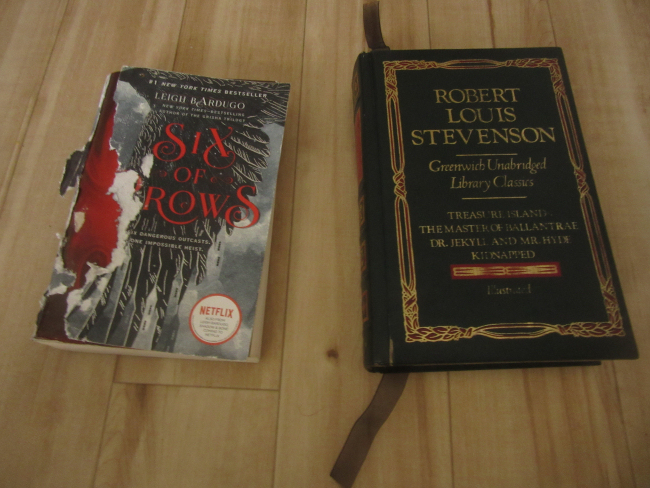
I'm reading two books now, which I really don't like to do, especially since I don't have as much time to read anymore. But now that my summer vacation's over and I'm back at work I need something to read on the train that I actually enjoy. I'd started reading a book called Six of Crows by Leigh Bardugo and I'm finding it to be a real slog. So on the train I'm reading Robert Louis Stevenson's Kidnapped, which is just a pleasure.

I guess I'm not the audience for Six of Crows, a 2015 fantasy novel aimed at teenagers, but normally I think I'm able to enjoy anything of any genre. There's an unintended silliness to Six of Crows. I think it's aimed at teenagers. The characters aren't allowed to swear which I didn't notice until a character said "crap" when they really obviously should've said "shit". Yet characters are also gangsters, assassins, and prostitutes who talk about killing and having sex for money. And they all use a kind of 1920s gangster lingo.

It's set in a fantasy version of Amsterdam called Ketterdam and follows a group of preternaturally talented gangsters led by a guy named Kaz and his number two, an assassin called Inej, who can silently scale a building barefoot and is able to "melt into the shadows" at will. But for some reason, all these characters are just seventeen years old. With all the gangster lingo, I'm constantly picturing Bugsy Malone as I read.

I thought, okay, maybe if they've been training since they were two years old, they could be this skilled and this well positioned in the underworld. But both Kaz and Inej reminisce about coming to the city just three or four years earlier as completely naive bumpkins. My problem with this really crystallised when I read this line from the young narrator of Kidnapped:

But I was young and spirited, and like most lads that have been country-bred, I had a great opinion of my shrewdness.

The protagonist really feels like a young man of seventeen or eighteen. I don't understand why Leigh Bardugo didn't simply write the characters older except there's this new idea that everyone needs to "see themselves" in fiction. I know I should read Six of Crows as intentionally dumb escapism. It's the kind of thing I might enjoy if I had a lot of alcohol. You know, if I dumb myself down to its level. It's not just the kids who don't act like kids, there're all kinds of logical errors in its heist plot. Like, they're supposed to be trying to break into some impregnable ice fortress and a new member of the crew tells them there's a big regular event where people from the town's entertainment district are granted access. We'd been told Kaz was basically the most feared gangster in his part of town and others so why didn't he already know about this apparently well known thing that directly involves his industry?

The book's filled with ill-considered stuff like that, not just in terms of plot but also character. It really feels like some role playing sessions I've had where, you know, everyone who's participating doesn't have the expertise or experience to play the characters they're playing, but you let it slide because none of this is going to be published and no-one's expected to enjoy any of it beyond the gratification of their own characters. But this book was published, for people to buy. And incidentally, I'm not sure the physical book is up to scratch. You see the tattered condition of the copy I have? This is not a used book, it's brand new. But I had it in my messenger bag when I went hiking a couple weeks ago and my sweat seems to have just dissolved the cover. In the space of just an hour or so. I've never seen anything like it.

This is really terrible. I wanted to read Six of Crows because I was trying to get in touch with the modern literary fantasy culture. It's the same reason I read Secret History. I'm zero for two, as far as being able to dig this stuff. Am I wet blanket? Maybe I need to open my heart. I don't know.

Monday, August 28, 2023

Core Align

A little girl frustrated at the lack of attention given her by her parents is at first delighted to find a more accommodating Mom and Dad with button eyes. 2009's Coraline Is Henry Selick's adaptation of Neil Gaiman's 2002 novella, capturing some of the eeriness of its source material and adding a lot of cartoonish charm.

I was feeling a little sorry I didn't like Good Omens 2 and wanted to watch something to reaffirm my fondness for Neil Gaiman. I read Coraline when it came out. I was such a Gaiman fan then, I bought the hardcover book and the audiobook read by Gaiman himself. I remember sitting in my car, listening to it, in a mall parking garage where I liked to go to be alone. I would say, outside of Sandman, Coraline is his best work, that I've read.

It's a simple concept with a suggestion of old-fashioned morality pushed to a slightly sadistic level. It feels like Hansel and Gretel or The Snow Queen, something from Hans Christian Anderson or the Grimm Brothers where you can clearly see the moral instruction but the story fills out with strange or frightening ideas in a pleasingly gratuitous way.

I kind of wish the character designs had learned closer to realistic. It's harder to appreciate the strangeness of the other world when Coraline herself already has a massive head with a flat top. But Selick's stop motion is the perfect medium. I believe these button eyed people can coexist with these people who have eyeballs. In live action with makeup or cgi buttons, it would have felt more clearly demarcated. The stiff, jerkiness of the stop motion adds to the sense of nightmare.

Coraline is available on Netflix in Japan.

Tuesday, June 27, 2023

Elfland, Whether You Will or No

One of the things I love about The Kind of Elfland's Daughter is that, for most of the book, none of the characters have any agency. It's not that I'm against characters having agency, but lazy critics so often tend to reach for it as a point of criticism nowadays that it's kind of glorious to read a novel in which all characters, mortal and faerie, are tumbled about in a world of sensory experience.

It is like a dream. Characters take action but the effects of those actions are so arbitrary and have such limited or unpredictable bearing on what follows, they may as well be rolling dice. The book begins with the kingdom of Erl deciding to have the young Prince Alveric marry a princess of Elfland in order to bring magic to the mortal realm. So he gets himself a magic sword, invades the magic realm, kills some antagonistic trees, and meets the beautiful princess. All that sounds like the plot of a novel but it's all dispensed with in the first few short chapters.

As pure luck would have it, the princess, Lirazel, is willing and able to abscond with a total stranger from a strange country. She's the title character and yet the novel spends perhaps the least amount of time with her--and she's also the character with the most agency. Of all the characters, she's the only one who's able to consistently achieve desired results from her chosen actions.

She has a child with Alveric whom they call Orion before she becomes bored with the human realm and her husband's desire that she honour their religious practices. She leaves for Elfland where time doesn't seem to pass. So the bulk of the novel, which is about Orion as a young man, learning to be a great hunter, and Alveric, wandering a wasteland with madmen as companions, takes place over the course of many years while virtually no time passes in Elfland.

Orion learns to hunt and kill unicorns. He enlists the aid of a band of trolls. Alveric is seeking Elfland, which the King of Elfland has caused to recede from Alveric's approach, leaving barren desolation in its wake. In your standard novel, this would all be building to something. Orion would prove himself to his parents and achieve something great for his people by hunting. Alveric would eventually enter and conquer Elfland, perhaps. But the novel's never about that. It's not the effects of their actions that matter but the experience of their actions.

It's a mighty feat for Orion to hunt and kill a unicorn but the achievement has little real meaning. Lord Dunsany beautifully describes the animal, paying particular attention to its powerful neck. But killing it doesn't take magic from the world or anything like that. It's just a really nice trophy. We never know if Lirazel appreciates Alveric's efforts to find her or even understands the sacrifices he makes. They just don't matter next to the glorious, arbitrary and sensual will of Elfland.

One gets the impression that Dunsany worshiped women as beautiful but distant and capricious beings. The only other female character in the book is a witch, also the only other character with real agency.

There's a minor plot about the parliament of Erl becoming suspicious of the magic they invited into their realm yet, like Alveric and Orion's stories, their desires and actions ultimately have little meaning. The book leaves you feeling this may be for the best.

Sunday, June 04, 2023

Animals are Worthy Musicians

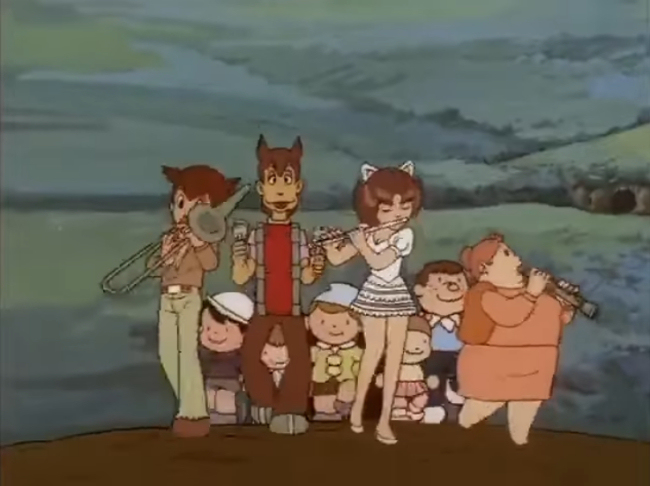
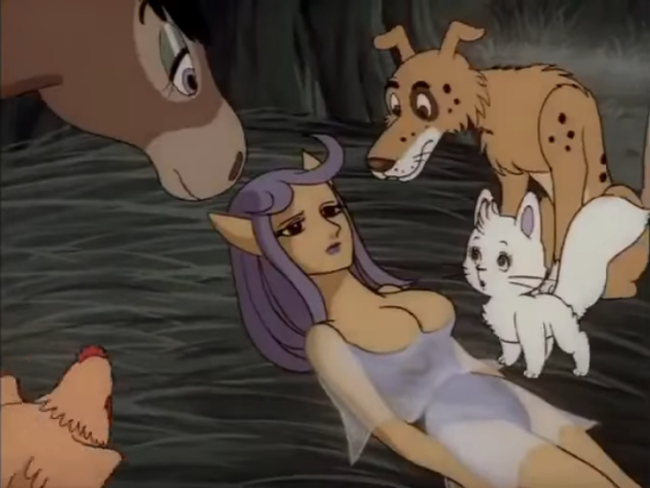
Japanese animation used to be famous for being astonishingly weird. An example from those good old days is 1981's Bremen 4, a feature length TV special from legendary creator Osamu Tezuka (Astroboy, Kimba the White Lion). For this fascinating piece of work, Tezuka takes a Brothers Grimm story about four travelling animals and adds in an alien, a robot war, and a whole lot of violence to make an engrossing, dreamlike spectacle.

An alien woman who looks like a deer with antennae on her nose and puffy round nipples contemplates an image of a human woman with puffy round nipples. She transforms into a human woman with no nipples.

She learns one word, the English word, "Peace", before landing in an Earth forest. The animals she encounters are peaceful enough but she's just so happened to have arrived in Germany while a handsome robotic general is conducting a campaign to exterminate the populace. Men, women, and children are slaughtered and the alien is cast into a river. A little boy's mother is killed and he's separated from his beloved cat.

The cat eventually meets a donkey, a dog, and a chicken and then the four of them rescue the alien from the river. As a reward, she transforms them into humans and they continue their adventures across a war-torn, sci-fi fantasy Germany.

This is one of those rare movies that's liable to make a child of any open-minded viewer as you sit there wide-eyed, wondering just what the hell could happen next. By the end, you've been through so much with the animal heroes, they feel like your friends. I can imagine many children watching this movie repeatedly.

Monday, May 15, 2023

All the World's a Song

Criterion has a David Lynch playlist currently streaming so last night I watched Mulholland Drive again. Not for the first time, I found myself comparing and contrasting the Club Silencio scene with Jean-Luc Godard. I suspect a lot of people who watch Mulholland Drive take the Club Silencio scene as a commentary on movies and art in general. I'd say it's more of a commentary on a commentary, specifically the kind of postmodernist deconstruction Godard made.

In Mulholland Drive, the two protagonists visit an avante-garde stage performance in which a sinister man maliciously reminds the audience that all of the music they hear is not truly live, that it's just a recording.

This reminds me of the musical number in Godard's Une femme est une femme in which Godard repeatedly removes the music from the soundtrack.

Godard's point, as it was in similar moments in Vivre sa vie and Pierrot le fou, is to show audiences how they're being manipulated by the music. The key difference is that Lynch argues there's something sinister about it, that it clearly disturbs Betty, who experiences a seizure. As I was saying in my recent Vertigo analysis, fantasy seems a necessity for maintaining sanity. One could argue Betty/Diane shares some blame in making her fantasy so precarious as to lead to her own destruction. But the ambiguity of just how much control she has over herself is fundamental to the tragedy.

Saturday, May 06, 2023

There's More than Castles in the Clouds

It's time for the annual Fantasy Faire in Second Life again. Second Life is the oldest and biggest virtual world on the Internet still up and running (it started in 2003). It's also easily the most beautiful and complex, though I suppose Zuckerberg's Metaverse isn't much competition.

Fantasy Faire is an event to raise funds for the American Cancer Society in which some of the best creators in Second Life create hundreds of square kilometers of fantasy environments housing temporary shops and providing venues for fundraising. As I write, this year's Fantasy Faire has so far raised around $75,000 U.S. dollars.

Here's a map of this year's Fantasy Faire:
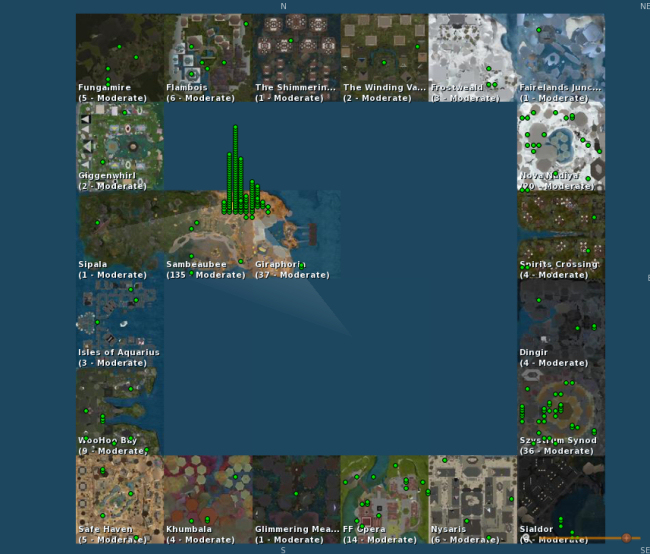
Each green dot is a person. I took this picture while I was attending the party you can see represented by the tower of green dots in the middle. This was at a place called the Akipelago designed by Haveit Neox, Lilia Artis, and Gidgette Adagio.
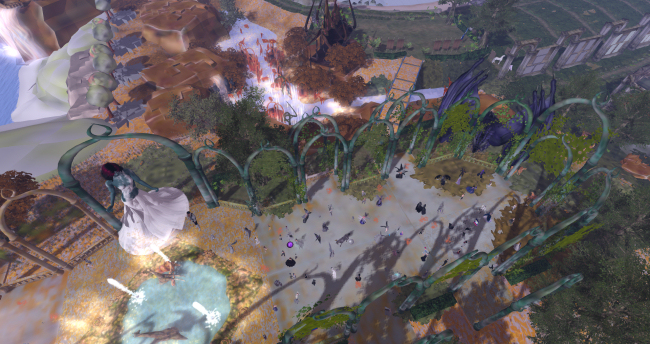
I'd stumbled on the party while wandering. I'd started my tour of Fantasy Faire this year at Spirits' Crossing, designed by Marcus Inkpen and Sharni Azalee, and started working my way south and clockwise.
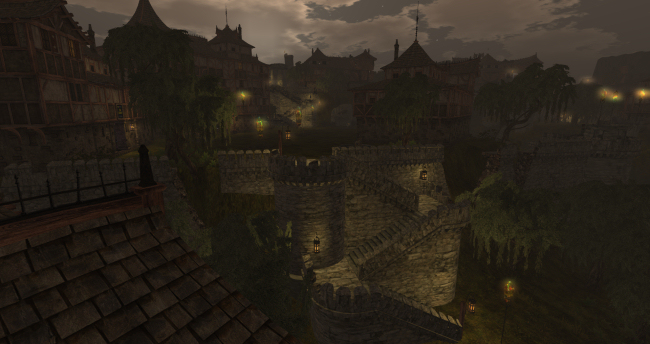
This was a nice, gloomy mediaeval town.
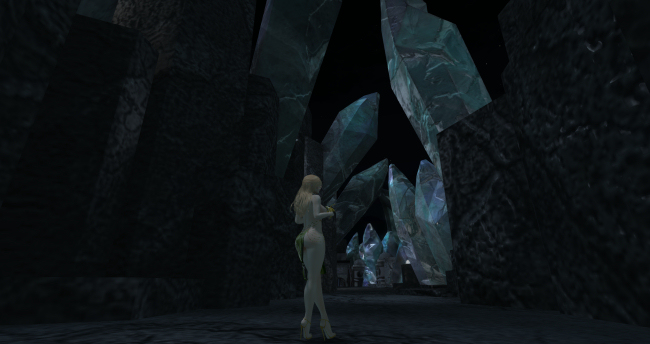
Next I visited a dark, crystalline valley called Dingir, designed by What88 Zond.
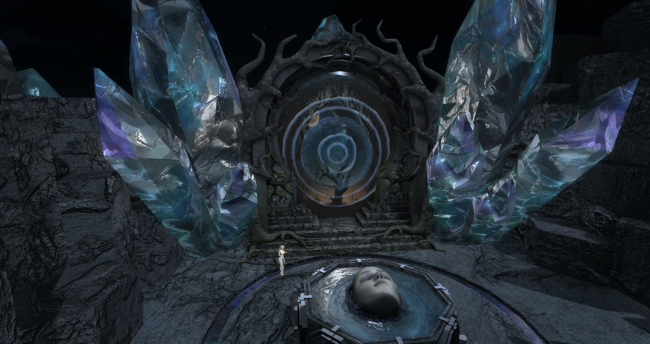
My avatar had bananas.

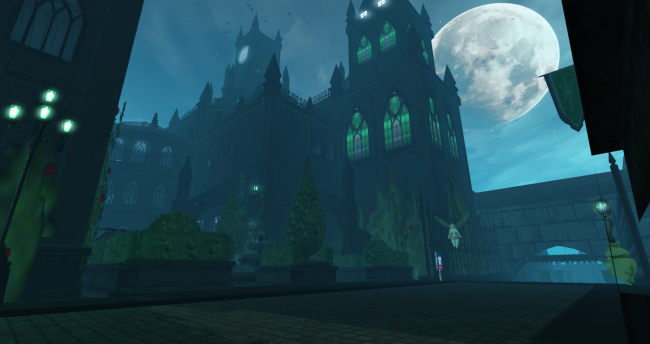
I had to hop past Szystrum Synod because it seemed always to be packed with people. So next I visited the gothic town of Sialdor by Dacien and Marcel Blackwood.
From there I finally found some sun in Nysaris by Kadaj Yoshikawa and Janire Coba.

Next to this ancient Rome land was one called Opera, designed by Alia Baroque and Garvie Garzo, seemingly meant to evoke Rome in another sense.
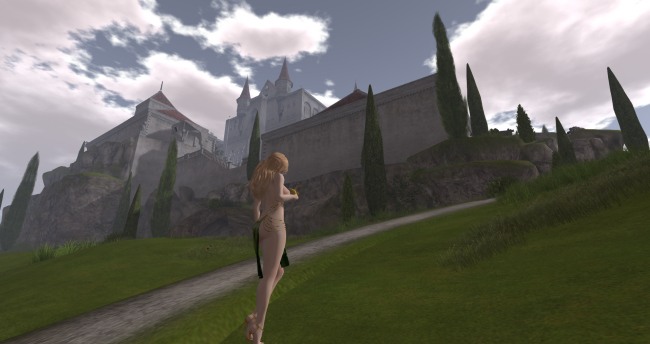
Who wants some wine?

Looks like a good spot for my aria.
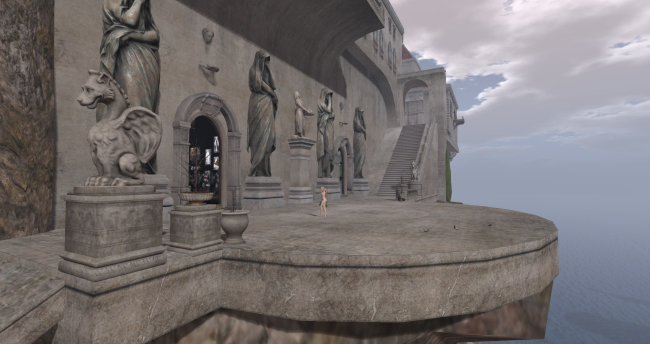
I noticed a familiar harpsichord:

I first saw this harpsichord over ten years ago. Its creator abruptly disappeared one day, eight or nine years ago. He didn't update his profile, he didn't properly close his store so it just vanished when he stopped paying rent. I can only assume he met with some terrible tragedy. But his works live on.

Next I visited a tent city called Glimmering Meadows by Julala Demina and Lil Cinnamon.

And then a sort of maraca tree town called Khumbala by Ketsui Naidoo, Robynredhead, and Ghosted.

Further west was the middle eastern style Safe Haven by Sweetgwendoline Bailey and Mondi Beaumont.

After that, I headed north for the volcano town populated by alligator people called WooHoo Bay by Lrriven.
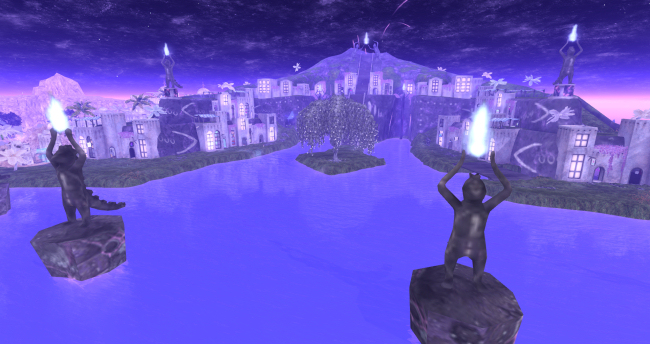
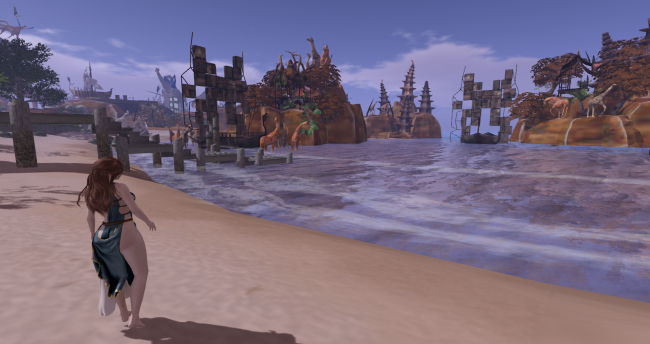
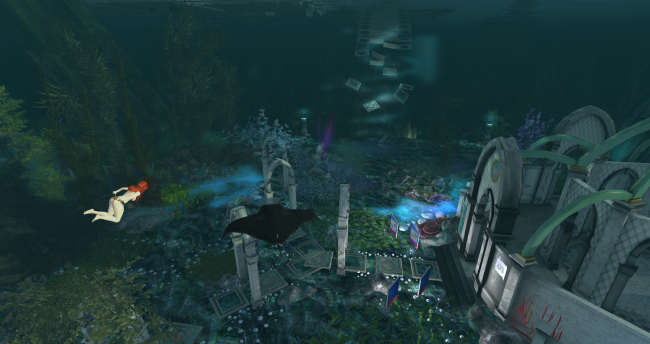
There's always a water themed area at Fantasy Faire and this year it was Isles of Aquarius by EchoRayne Ayashi and Liz Corryong.

This area was the most difficult for my computer to process but I fought my way through a pleasant swim.
After this was a pretty standard, but very pretty, fantasy forest called Sipala by Gidgette Adagio.

North of Sipala was the playfully gaudy Giggenwhirl by Allie Munro, Krystali Rabeni, Peter Locke, and Lunar Tripsa.
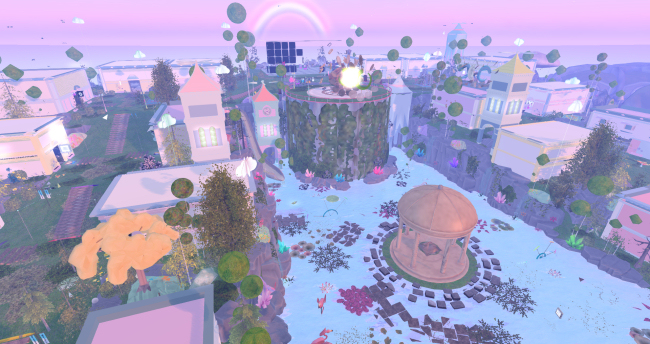
Not my cup of tea. But after that I walked into the wonderful land called Fungalmire by DaveOSaurus (really, it's not what it sounds like).
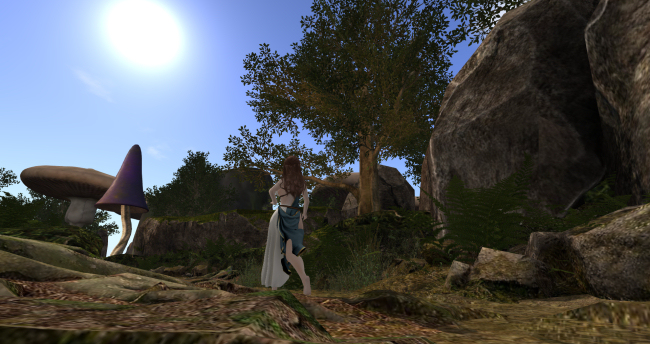
They got mushrooms, and how.

Heading east, I visited a mysterious town called Flambois by Beq Janus and Elizabeth Jarvinen.
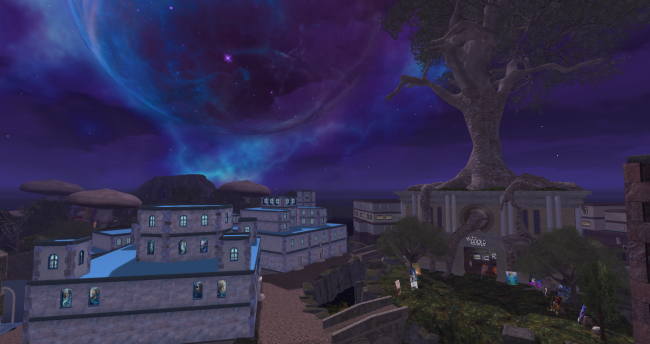
And then the very beautiful The Shimmering Fen by Elicio Ember.
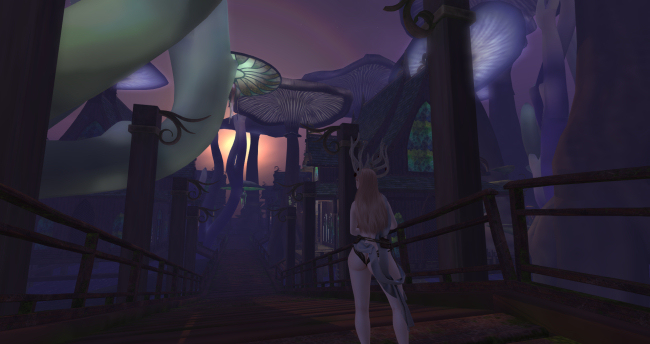
Again, mushrooms, but the lighting distinguished this place nicely.

After this was a lovely, sort of Nordic themed land called The Winding Valley by Eldowyn Inshan.
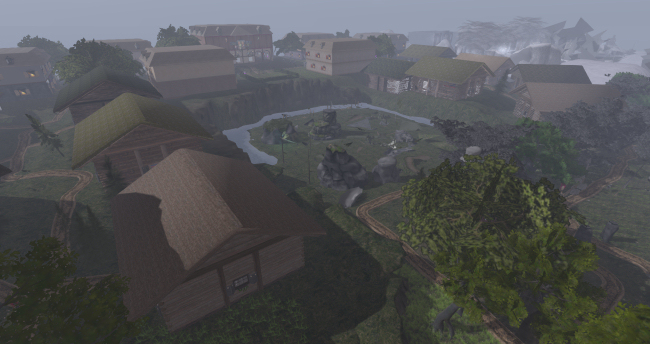
It kind of reminded me of Skyrim.

After this there were three winter themed lands, starting with Frostweald by Searlait Nitzschke.

Then Fairelands Junction by Saiyge Lotus.

And Nova Nadiya by Elizabeth Tinsley and Garvie Garzo.
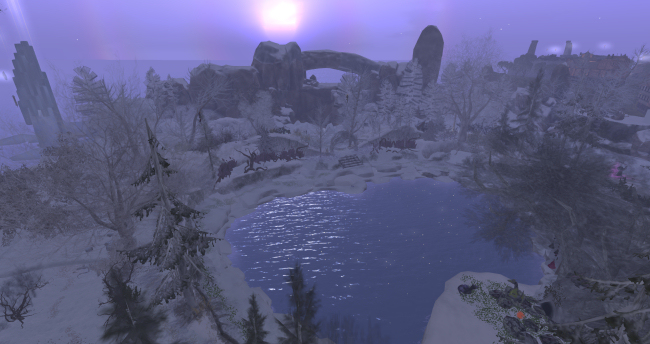
And then I was back where I started at Spirits' Crossing--but I had one more place to visit. I was finally able to enter Szystrum Synod by Walton F. Wainwright and Victor Eton.
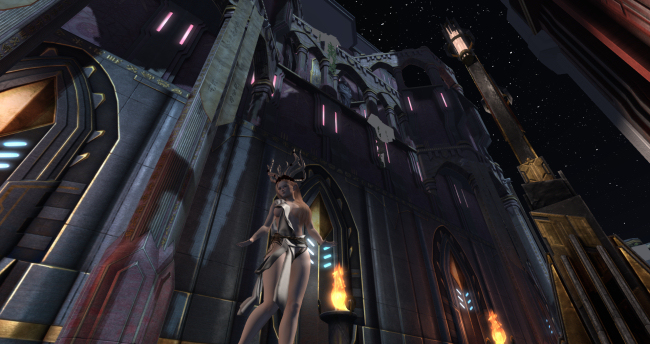
I could see why it was always so crowded. It looked like Coruscant, in a very good way.
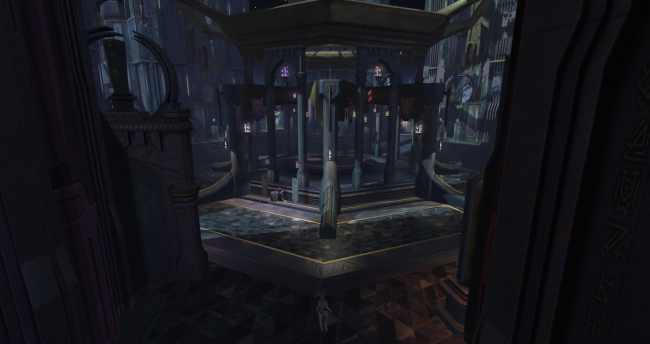
I only wish I had time to explore it more thoroughly.
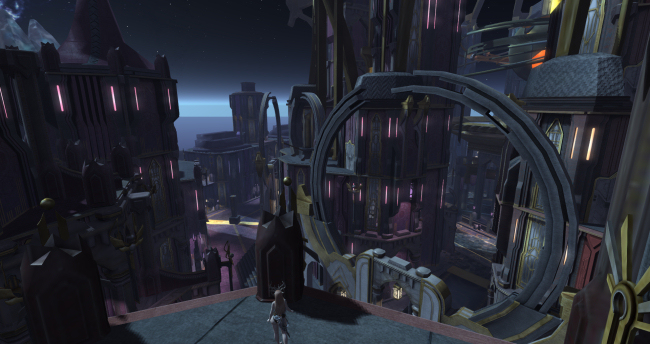
I believe there's about 24 hours left of Fantasy Faire. If you want to see it, Second Life is free to use so have at it.

Twitter Sonnet #1695

Beneath the mud a human shape abides.
Electric life begins to claw below.
If to awake a forest shade decides.
And on the root a spirit doth bestow.
Familiar songs barrage the beating head.
In time, the tune's repeated many ways.
But wait, a single note is never dead.
Affixed to sonic space, the number stays.
A wicker rabbit grabs a couple dreams.
But sketchy grass would scratch the lucky feet.
Suspicious moons were packing cheese and beams.
Foreboding came the steady lunar beat.
Electric teeth divide and shape air.
The stars combine to show a bloody bear.

Thursday, February 02, 2023

Put Your Cat Clothes On

You never can tell when a secret undersea empire will show itself. Africa's most powerful secret utopia contends with such a problem in 2022's Black Panther: Wakanda Forever. The most solidly written MCU movie of 2022, it's blessedly free of the drunken silliness increasingly turning the franchise into an embarrassing bore. It's better than the first Black Panther as well.

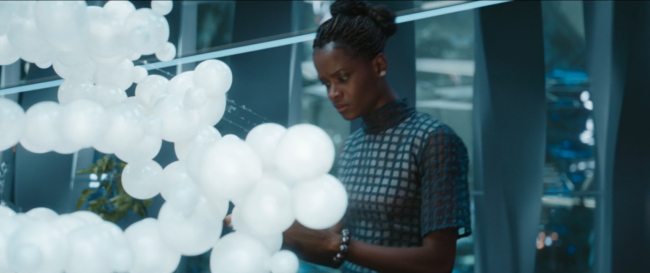
Actor Chadwick Boseman passed away in real life so the movie begins with the Black Panther himself passing away off screen. This means the standout character from the first film, Letitia Wright's Princess Shuri, takes centre stage.

I never would have wished for Boseman's death but, as I said in my review for the first film, I thought his performance was the weakest part of it. Without him, the incredible supporting cast can take the spotlight. In addition to Wright, Angela Bassett, Danai Gurira, and Lupita Nyong'o are all given space to shine.

Once again, Disney didn't have the guts to shoot in Africa and the cgi Wakanda still looks like a computer simulation of Dubai mixed with Coruscant. At least the stars and director went to Lagos for a premiere this time. Even so, this is definitely an American fantasy of Africa.

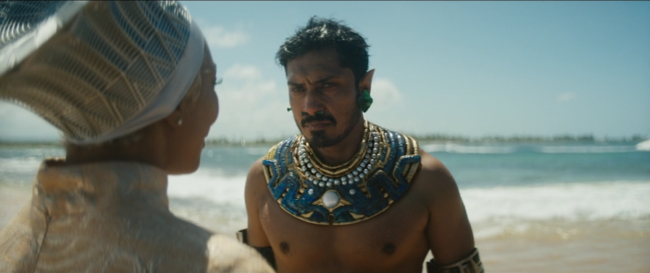
The best parts of the film have to do with the villain, for once, one of Marvel's oldest characters, Namor (Tenoch Huerta Mejía). While the first film mostly repeated the plot from the first Thor film, this one feels less plot driven and the best parts are when it focuses on just how creepy and ruthless Namor and his people are.

I thought Dominique Thorne as Riri Williams, Iron Man: The Next Generation, was charming, as much as I don't like the general idea of everyone being slowly replaced by spunky young folks.

Black Panther: Wakanda Forever is available on Disney+.