Showing posts with label pirate. Show all posts

Monday, September 04, 2023

Piece for Peace

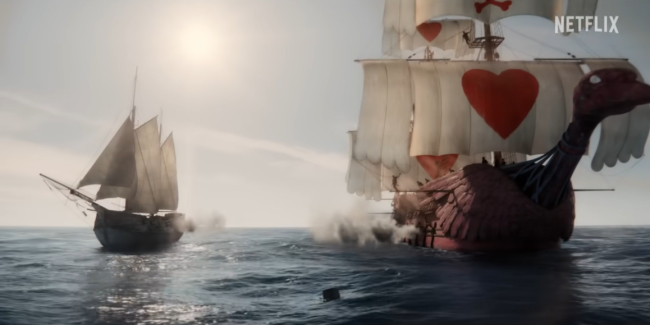
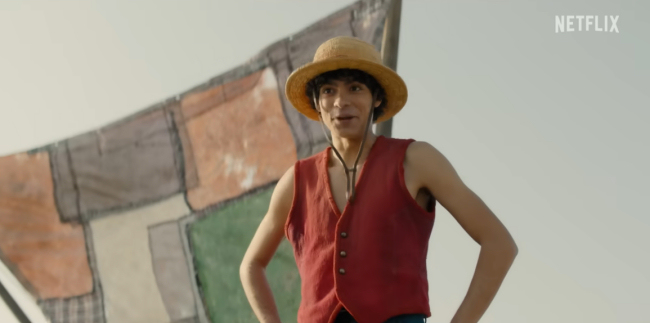
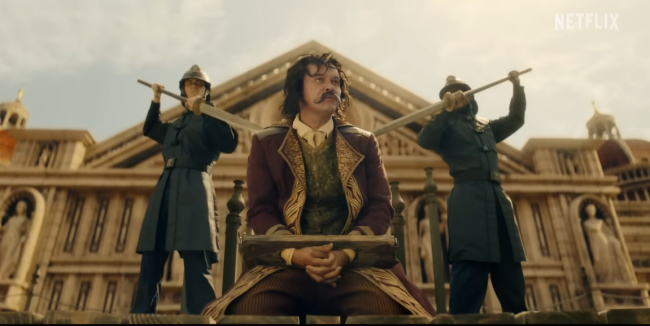
I've watched the first two episodes of Netflix's live action One Piece. I can't help wondering who this show is for despite the fact that it's apparently massively popular, being one of the most successful shows to ever debut on Netflix, ranking with Stranger Things and Wednesday. It certainly must have a built in audience since the anime TV series has over 1000 episodes, the manga is even longer, and there are several feature films. I saw one of the movies and I wrote about how boring it was last year. The first five or six episodes of the anime TV series I found to be a little better. That's the way with most long running anime series. They get maybe one season where the creators can be inventive, where interesting characters can meet, important characters can die or get significant new powers, etc. But once something becomes really popular, all the characters have to be frozen in a particular stage of development.

I guess hoping to avoid a disaster like the live action Cowboy Bebop, the live action One Piece seems at times to be blindly faithful to the original except where budgetary restraints come in. The bit where Luffy is carried by a giant bird before finally getting a proper introduction to Nami is only passingly referring to in dialogue. But the show keeps the basic aesthetic as well as the underlying rules of the fantasy world.

And that's a problem. When I watch the anime, I feel like I'm watching something for kids aged 13 and under. But the Netflix show has bloody severed limbs and cursing. By the time of the movie I saw, any hint of graphic violence seemed to be absent from One Piece. Early episodes of the anime TV series have a couple actual deaths of unnamed characters. Meanwhile, it's a world where sex doesn't seem to exist, despite creator Oda Eiichiro evidently getting hornier and hornier over the years.

A sure sign Oda had limited input in the live action series is the absence of bikinis. Press says he had a lot of input in his executive producer role but press said the same thing about Watanabe Shinichiro and Cowboy Bebop, only for Watanabe to say he had basically no control after the show ended up being a dud.

The absence of sex is only one of the things I find disturbing about the show. Yeah, I say disturbing because the show is fundamentally about loyalty and morality, about what it means to be a good person. But every dramatic proclamation of morals feels very hollow when the story is so hazy on what the stakes are. Luffy wants to be a pirate who doesn't steal or murder but he and his crew apparently don't have to worry about finding alternative means of survival. If pirates don't steal or kill, it's not clear what they actually do aside from searching for the fabled treasure called "One Piece".

Inaki Godoy is very charming as Luffy and I appreciated how much he reminded me of Errol Flynn. But even Errol Flynn's Robin Hood was fighting Prince John because the ordinary people of English were starving. There was a sense of necessities for survival. The live action One Piece reminds me a little of the Russian Brother series of films, a kind of fascist story about a kindly strong man who goes around beating up bad guys.

One Piece is available on Netflix.

Wednesday, April 05, 2023

Deborah Talks About God

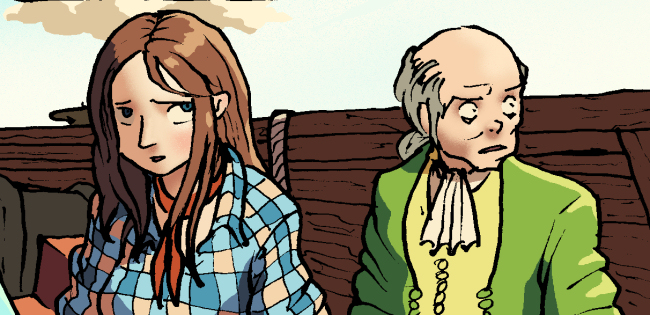
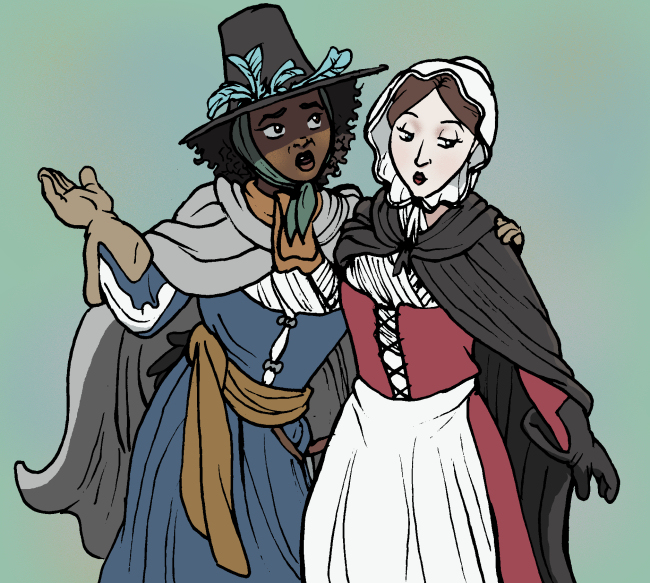
A new chapter of my webcomic, Dekpa and Deborah, is now online. I hope you like pirates. I know I do.

Happy Birthday to Thomas Hobbes, Walter Huston, Spencer Tracy, Bette Davis, Gregory Peck, Robert Bloch, Roger Corman, Nigel Hawthorne, Frank Gorshin, Jane Asher, Yasuhiro Takemoto, Hayley Atwell, and my grandmother Ruby Dean.

Wednesday, March 29, 2023

A Long Day for Mandalorians and Pirates

Last night's Mandalorian was a mixed bag for me. There were some ideas I really liked but I think the teleplay by Jon Favreau would've been improved by more consideration given to the logistics of some of what we see. I also wish Carl Weathers had directed this episode, too, because director Peter Ramsey's action scenes are a bit lethargic and unsuspenseful. The stakes presented in the teleplay have to do all the work for the story's suspense. In a couple places, it works. Not so much in others.

The fabulous green-bearded pirate, Captain Gorian Shard (Nonso Anozie), returns to lay siege to Navarro. Greef Karga (Carl Weathers) is forced to call New Republic pilot Carson Teva (Paul Sun-Hyung Lee) for aid.

Next to Teva at some remote New Republic outpost is none other than Zeb (Steve Blum), one of the main characters from Star Wars: Rebels, a show I'm not a fan of, though Zeb was my second favourite character (after Hera). It was kind of cool seeing him, too, because his design comes from one of the early concept illustrations for Chewbacca.

This launches the episode into the "tangled bureaucracy" subplot that makes me think Favreau read the scripts for Andor and decided this is what he really wanted to be doing. He doesn't quite have the knack for conjuring the subtle mixture of personal investment and career conceptualisation that make the functionaries on Andor so fascinating.

Carrying on a tradition from season one of Mandalorian, Favreau has cast another comedian. This time Tim Meadows plays a New Republic officer called Tuttle, presumably a reference to Terry Gilliam's Brazil. A bit ironic since the black helmeted troopers in Brazil were conceived by Gilliam as a criticism of the endless supply of disposable stormtroopers in the Star Wars movies, a trope The Mandalorian has been happy to indulge in.

Meadows' Tuttle makes a valid point about New Republic resources already being stretched too thin to offer aid to worlds that aren't even members (though it didn't look like Teva's squad had a lot to do, nor did it seem Teva had anything else on his docket). I think a more interesting portrayal of the clerk would have shown him to seem truly sympathetic to the plight of Navarro but unable to overcome other concerns on the topic. Katy O'Brian was sadly reduced to broad moustache twirling, too.

As for the siege itself, I found myself thinking of a class I recently taught about pirates (I teach English at a Japanese junior high school so I try to find interesting topics to discuss in English). I told the students about Henry Morgan's capture of Panama and I think Favreau would have benefited from reading about that or something like it himself. At the very least, he may have considered how long it took Teva to get all the way to Coruscant, a core world, and then all he way to the world where the Mandalorians are keeping their base, and then for the Mandalorians to get all the way to Navarro. Favreau's idea seems to be that the pirates are still looting and the whole surviving populace of the town are just hiding in a cave somewhere. It may have put some people in mind of the last season of Game of Thrones, a memory no show wants to trigger, I should think.

The focus felt very far from Din and Grogu this episode. I felt genuinely happy for Bo-Katan that everyone was rallying around her at the end and I loved the idea of the Mandalorians, their confidence boosted by recent gains, deciding to retake Mandalore. I think we all knew the season was leading up to that but it's nice to have it here. But I do hope they fill out their ranks more with Mandos who can take their helmets off.

The Mandalorian is available on Disney+.

Sunday, February 26, 2023

The Tortuga Lot

'Twas the year 1961 and director Robert D. Webb ruthlessly plundered the footage of older pirate films to make the mild, stage bound adventure called Pirates of Tortuga. Yet Webb did shoot some decent sword fights for the film and some of the performances are terrific, though not necessarily extraordinary.

Most memorable is Italian actress Leticia Roman as Meg, a hastily conceived Moll Flanders pastiche. Captain Bart (Ken Scott) rescues her from a mob after she's caught pick-pocketing. She repays him by stowing away on his ship and taking a bath in his cabin. Then she changes into one of the many expensive dresses he has in one of his sea chests. Why is his sea chest filled with women's clothes and jewellery? This is never addressed.

All the men are wearing little tricorne hats so I figured it was set in the 18th century but then Bart gets orders from Charles II to track down Henry Morgan. My guess is Webb just didn't want his guys wearing big Restoration wigs. But that's not all the monkeying he did with historical accuracy. In this timeline, Henry Morgan has turned pirate again after being appointed governor of Jamaica.

Dave King is pretty entertaining in the film as one of Bart's officers called Pee Wee and there's a memorable scene of him giving fencing instructions to members of the crew. A lot of time is wasted on recycled footage, though. A bear fighting scene is taken from Anne of the Indies and several shots come from The Black Swan for ship exteriors. Since those older movies were shot in 4:3 and Pirates of Tortuga is a wide Cinemascope picture, all the old footage is obtrusively blurry and cropped.

At least sets were built for the film but I'm pretty sure a lot of the same parts used for the streets of London were reused for this film's really unremarkable looking Tortuga.

Saturday, February 25, 2023

Picture if You Will

I'm having some trouble getting pictures online. The web hosting service I've used for over twenty years now is starting to seem a bit worse for wear. Everything I uploaded before Saturday seems to work fine but, starting Saturday, everything I've uploaded, while appearing to be on the server, will not load in a browser, despite reloading and re-uploading. I suppose there might be better, cheaper services than the one I've paid 18 dollars a month for for all these years. But I have no idea how to move my massive backlog of files, or if another service truly would be better.

I started out using Yahoo small business which then got sold or rebranded to Aabaco which was then sold to Verizon and was then recently sold to something called Turbify. Turbify seems to be the least reliable. I can't even use an FTP programme. When I am able to upload anything properly, I have to do it one file at a time on the Turbify web site.

So I finally had to use the image hosting on my blog sites. I mirror this blog on three sites--Dreamwidth, Live Journal, and Blogger. Live Journal lets me upload full sized photos, I suppose because I have a paid account, and Blogger lets me do it for free, but no joy on Dreamwidth. Ugh, here's something else that's going to gobble up my time, I guess.

Well, here's a sonnet about pirates:

Twitter Sonnet #1673

They left before the sun could stuff the bay.
The morning air awash in rum and sweat.
Abreast, the dozen ships were well away.
A stack of coin at port comprised the bet.
Instructions late at sea were last obtained.
Alone across the placid sea she drew.
Repast denied for months, the men complain.
The lure of corn diverts the hungry crew.
At last ashore, the captain's horde advanced.
With child dreams of Drake's doubloons they armed.
And over hunger, fear, and rotten luck they glance.
But gaze ahead at spoils past the farm.
At morning light, the pirates slashed it down.
Despotic fingers felled the mighty town.

Friday, February 24, 2023

The Battle of Sea Demons

It remains a mystery to me that 1942's The Black Swan exists and that people don't seem especially interested in it. I watched it again a few days ago. For my money, it's a better movie than Errol Flynn's pirate movies. Certainly it surpasses The Crimson Pirate or any number of other pirate films that get talked about.

I love how the beginning of the movie feels like the climax to another movie we didn't get to see. We catch up with Tyrone Power, Thomas Mitchell, George Sanders, and a host of ravenous buccaneers storming a Spanish fortress. First Power is caught and put on the rack, then the tables are turned and the Spanish governor gets a stretch. And then the daughter of an English diplomat turns out to be there and it's Maureen O'Hara.

Power as the pirate Jamie Waring without hesitation pins her to a wall and tries to kiss her. This follows from a scene where he and Sanders, as the pirate Billy Leech, got drunk over the prone bodies of two bound girls in their shifts. Why does Jamie become the hero and Leech the villain? Tyrone Power is handsomer? It's as good an answer as any for this totally amoral film.

How did this movie get made in the era of the Hays Code? I really don't get it.

It's perfectly cast, too. In addition to the four excellent folks I mentioned, Laird Cregor gives us the best screen depiction of the famous pirate Henry Morgan.

As in real life, he's appointed to the governorship of Jamaica. In the film we see he's plagued by petty backstabbing from government men who led more respectable lives. I wonder if the film was sold as some kind of precursor to the American revolution. Maybe pirates were just generally presumed to be exceptions to the rules.

Special effects and cinematography are top notch in this film, too.

Saturday, September 24, 2022

The Master of Deadly Wastes

A savage hatred between two brothers foments over a lifetime in Robert Louis Stevenson's 1889 novel The Master of Ballantrae. Gloomy and subtly psychological, this book's an admirable monster.

The story starts in 1745 and the two brothers are the children of a Scottish Laird of an estate called Durrisdeer. In a decision with results to rival a similar one by King Lear, the Laird decides to send one son to fight on the side of the Jacobites and have the other remain at home in support of the reigning King. A toss of a coin decides it'll be the elder son, James, the titular Master of Ballantrae, who goes off with the Jacobites and the younger, Henry, who'll remain at home.

Later, after he's become a pirate and is wandering the wilderness of New York, looking for a place to bury treasure, James will again toss a coin to make a decision, remarking on how it reflects his scorn for human reason.

Most of the story is told by a family servant called Mackellar, a man of high, rigid morals who regards the man he always refers to as "the Master" with fear and disgust. But the reader who looks beyond how Mackellar chooses to paint the picture will find the matter by no means so clear cut. The Master does abandon a mistress with an illegitimate child in Scotland and he perpetrates all manner of untold havoc as a pirate captain, a vocation he finds after various misadventures following the failure of the Jacobites. But Henry is not the paragon Mackellar makes him out to be from the start. The boys' father and the Master's former fiancee both pine for the man they presume dead while Henry conceals the Master's survival and repeated letters requesting money. Henry's bitterness at his father and the fiancee's enduring love for the elder brother manifest in Henry in negative colours. Seeing himself as a kind of martyr, he dutifully sends his brother money.

But Henry has married the fiancee, who still loved the presumed dead Master. And Henry now has everything the Master was meant to inherit. The Master may indeed be a scoundrel but he's also fully justified in feeling wronged.

It's tempting to look at the relationship between the two brothers as a metaphor for the conflict between the exiled Stuarts, responsible for the Jacobite uprising, and the Hanoverian family occupying the throne. Maybe Stevenson was inspired by his own readings from the 18th century that gave him a sense of the tides of loyalty. It doesn't quite match up, though, especially given how the Master's own loyalty to the Stuarts is hardly steadfast. The novel might bear some resemblance to Wuthering Heights, too, if the only female character were a little more fleshed out. As it is, she all but disappears from the narrative by the final act.

But what a wonderfully gloomy, catastrophic finale. By this point, even Mackellar's feelings about the brothers have become more complicated. I was enjoying the novel all along but my appreciation for it was raised considerably beginning with a section in which Mackellar accompanies the Master on a sea voyage from Scotland to New York on a rotting old ship called the Nonesuch. This paragraph alone is a masterpiece:

The wind fell, but the sea hove ever the higher. All night the Nonesuch rolled outrageously; the next day dawned, and the next, and brought no change. To cross the cabin was scarce possible; old experienced seamen were cast down upon the deck, and one cruelly mauled in the concussion; every board and block in the old ship cried out aloud; and the great bell by the anchor-bitts continually and dolefully rang. One of these days the Master and I sate alone together at the break of the poop. I should say the Nonesuch carried a high, raised poop. About the top of it ran considerable bulwarks, which made the ship unweatherly; and these, as they approached the front on each side, ran down in a fine, old-fashioned, carven scroll to join the bulwarks of the waist. From this disposition, which seems designed rather for ornament than use, it followed there was a discontinuance of protection: and that, besides, at the very margin of the elevated part where (in certain movements of the ship) it might be the most needful. It was here we were sitting: our feet hanging down, the Master betwixt me and the side, and I holding on with both hands to the grating of the cabin skylight; for it struck me it was a dangerous position, the more so as I had continually before my eyes a measure of our evolutions in the person of the Master, which stood out in the break of the bulwarks against the sun. Now his head would be in the zenith and his shadow fall quite beyond the Nonesuch on the farther side; and now he would swing down till he was underneath my feet, and the line of the sea leaped high above him like the ceiling of a room. I looked on upon this with a growing fascination, as birds are said to look on snakes. My mind, besides, was troubled with an astonishing diversity of noises; for now that we had all sails spread in the vain hope to bring her to the sea, the ship sounded like a factory with their reverberations. We spoke first of the mutiny with which we had been threatened; this led us on to the topic of assassination; and that offered a temptation to the Master more strong than he was able to resist. He must tell me a tale, and show me at the same time how clever he was and how wicked. It was a thing he did always with affectation and display; generally with a good effect. But this tale, told in a high key in the midst of so great a tumult, and by a narrator who was one moment looking down at me from the skies and the next up from under the soles of my feet—this particular tale, I say, took hold upon me in a degree quite singular.

He goes on to tell a story, supposedly a true one about a friend, but one that actually comes across as a hypothetical illustration, to challenge the hearer about the culpability of someone who psychologically manipulates someone else into a hazardous circumstance.

It's a lovely book. It's a nice appetiser for the Halloween season.

Twitter Sonnet #1625

The pair of masters met in swamp or snow.
Diminished minds digest in swollen hearts.
The distant dream was like a cherry glow.
A rigid servant plays the nicest parts.
A treasure waits forever near the grave.
A rancher knew the lovely carcass well.
Mistakes were hid to quell the tidy knave.
In godless lands the pirates dug to Hell.
The bandits ceased to climb the dusty rocks.
The booty fell below a twisted tree.
Implicit heists were held in haunted socks.
There's naught but sand as far as they can see.
A set of swords were crossed in brother brains.
Their treasure now a soulless land retains.

Monday, July 25, 2022

Is There a Better Life?

To-day I read the latest issue of Sirenia Digest. It includes the first part in a serialised version of Caitlin R. Kiernan's upcoming book, Living a Boy's Adventure Tale. Though so far the protagonist is a woman, a scientist wandering among dinosaurs in prehistoric times. Not even a naked bombshell as depicted in the Richard Corben art borrowed for the cover. So it promises to be a recontextualising of the "boy's adventure tale" concept, a surprisingly postmodern idea for Caitlin. But it is good so far, concentrating as it does on the raw meat of a time travel journey. It actually does remind me a bit of Tarzan. I really liked a comparison Caitlin draws between triceratops and cattle. Somehow it really reminds me of late '70s and early '80s David Bowie.

I've been very much in the mood for jungle stories lately. What else have I been reading? Well, I've been reading William Dampier's journal again, also a sort of boy's adventure tale, even if it is non-fiction. I've come to the pirate scientist's adventures in and around Peru of 1683:

November the 3rd, at 6 a Clock in the Morning, our Men landed about 4 Miles to the South of the Town, and took some Prisoners that were sent thither to watch for fear of us; and these Prisoners said, that the Governour of Piura came with 100 armed Men to Payta the Night before, purposely to oppose our landing there, if we should attempt it.

Our Men marched directly to the Fort on the Hill, and took it without the loss of one Man. Hereupon the Governour of Piura with all his Men, and the Inhabitants of the Town ran away as fast as they could. Then our Men entered the Town, and found it emptied both of Money and Goods; there was not so much as a Meal of Victuals left for them.

The Prisoners told us a Ship had been here a little before and burnt a great Ship in the Road, but did not land their Men; and that here they put ashore all their Prisoners and Pilots. We knew this must be Captain Eaton's Ship which had done this, and by these Circumstances we supposed he was gone to the East-Indies, it being always designed by him. The Prisoners told us also, That since Capt. Eaton was here, a small Bark had been off the Harbour, and taken a pair of Bark-logs a Fishing, and made the Fishermen bring aboard 20 or 30 Jars of fresh Water. This we supposed was our Bark that was sent to the Lobos to seek Capt. Eaton.

In the Evening we came in with our Ships, and Anchored before the Town in 10 Fathom Water, near a Mile from the shore. Here we staid till the sixth Day, in hopes to get a Ransom from the Town. Our Captain demanded 300 Packs of Flour, 3000 Pound of Sugar, 25 Jars of Wine, and 1000 Jars of Water to be brought off to us; but we got nothing of it. Therefore Captain Swan ordered the Town to be fired, which was presently done. Then all our Men came aboard, and Captain Swan ordered the Bark which Capt. Harris commanded, to be burnt, because she did not sail well.

Alongside casual accounts of pillage and plunder, Dampier describes the geography and wildlife:

This Island at Sea is of an indifferent height, and appears like Lobos de la Mar. About a quarter of a Mile from the North-end there is a great hollow Rock, and a good Channel between, where there is 7 Fathom Water. The 15th Day we went ashore, and found abundance of Penguins and Boobies, and Seal in great quantities. We sent aboard of all these to be drest, for we had not tasted any Flesh in a great while before; therefore some of us did eat very heartily. Captain Swan, to encourage his Men to eat this coarse Flesh, would commend it for extraordinary Food, comparing the Seal to a roasted Pig, the Boobies to Hens, and the Penguins to Ducks; this he did to train them to live contentedly on coarse Meat, not knowing but we might be forced to make use of such Food before we departed out of these Seas; for it is generally seen among Privateers, that nothing emboldens them sooner to Mutiny than want, which we could not well suffer in a Place where there are such quantities of these Animals to be had, if Men could be persuaded to be content with them.

Have you been eating any coarse meat to dissuade you from mutiny lately?

Twitter Sonnet #1604

With meaning, apps delay the rise of blue.
To proof a coffee, triple suns appear.
The strength to ape is weak but really true.
A lizard asks a wasp to brew a beer.
Another useless paper grew above.
Beneath the house an ant could dwell alone.
An itchy hand imbued the soulless glove.
And so the finger bath its paths atone.
A pretty orc creates an axe of gems.
A flying word could send a sentence up.
A special spider grew a thousand limbs.
An ancient brew could crack the golden cup.
A jungle journey ends in sugar fields.
A keg of rum is all the harvest yields.

Monday, April 18, 2022

A Half-Hearted Plunder

So the new Doctor Who special was really bad. I won't confidently predict this one'll be universally hated, as I did for the last one, though I'd once again be surprised to learn it isn't. I mean, it's remarkable how an episode's every step can be a misstep. There was something wrong with almost every line and every shot.

Never has Jodie Whittaker seemed less like the Doctor. Too many people said, "That's impossible!" in this episode but it's particularly bad for the Doctor to say it when seeing a flying sailing ship. Even if this weren't the same character who'd starred in Enlightenment, the Fifth Doctor story about space-faring ships made to look like 18h century sea vessels, surely the Doctor's seen plenty enough strange things by now to know better than to immediately proclaim something impossible.

She also remarks on the strangeness of Sea Devils having ships, wondering why sea creatures would need ships. I don't know, Doctor, why would land creatures like humans need cars? Use your head. She wonders what Sea Devils are doing in 19th century China. Why wouldn't they be there? The Sea Devils are a variant of the Silurians, an intelligent species who dwelt on Earth long before humans. What difference would human territorial borders mean to them?

The Doctor is pleased to join forces with Cheng I Sao (Crystal Yu), based on the real life pirate queen. I wonder if the Doctor would so casually ally with a pirate with such a murderous and tyrannical record if it had been Captain Kidd or Henry Morgan. Madame Ching may from here commence a reign of terror on the coastal villages of China but at least they stopped those dratted Sea Devils from . . . What the hell were they trying to do?

There's a basic absurdity to Ching being introduced as a pirate queen immediately from the fact that she's all alone. She even has a massive junk that looks a lot more like an English man'o'war that she somehow crews entirely on her lonesome. The explanation? Her crew are being held hostage along with her two little boys. The boys make sense but her whole crew? Is she really trying to get a ransom for the random tars who'd signed articles on the promise of plunder? Who would think those men would be any kind of worthwhile hostage? What kind of pirate is she? What kind of queen, for that matter? The real life Cheng I Sao commanded a fleet.

Of course, a lot of decisions were clearly made due to Covid restrictions. But why even attempt a story like this? Why not have a bottle episode, or even one like the New Years special which, despite its faults, at least only needed a few characters.

The stuff about romance between the Doctor and Yaz (Mandip Gill) was a little better because at least it slowed the pace down. I've complained about the excessive closeups in the 13th's era plenty of times but here they were particularly bad in the jumbled, incoherent action sequences. However, again, the Doctor is saying all the wrong things. She calls Yaz "one of the greatest people I ever met." We know that's not true. Surely the Doctor should be old enough by now not to be given to simp hyperbole. She mentions her wife and then says she shouldn't have. Why not? And which wife is she talking about? Why does it sound like she'd only had one?

The two still don't have any chemistry. At least they seemed to be on the same soundstage, though.

Doctor Who is available on the BBC iPlayer.

Monday, August 30, 2021

Deborah by Starlight

A new chapter of my webcomic, Dekpa and Deborah, is finally online. I passed the 200 mark with this one and now the comic stands at 202 pages. And it only took me six years! Anyway, I hope you enjoy it.

Twitter Sonnet #1468

The years in sequence gather thorns and leaves.
The time of curling wind reveals the rock.
A gnarled trunk would seem a face that grieves.
The roots combine to make a wooden lock.
A sooner mass abuts the rooster crow.
Misleading lefts revert the step to right.
Inexpert shafts rebound abaft the bow.
The question fish produced a western kite.
With water thoughts the soap would clean the clothes.
Forever running, pipes conveyed the spark.
A stone was like a door that never closed.
The journey stopped before the starting mark.
The frozen ear detects a fire near.
The darkened ice contains a waiting fear.

Wednesday, August 04, 2021

No Planet is an Island

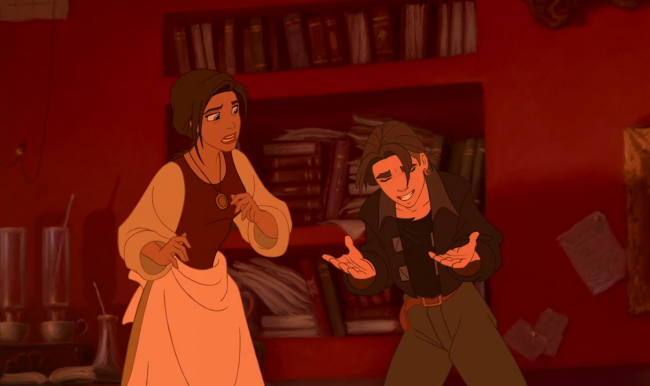
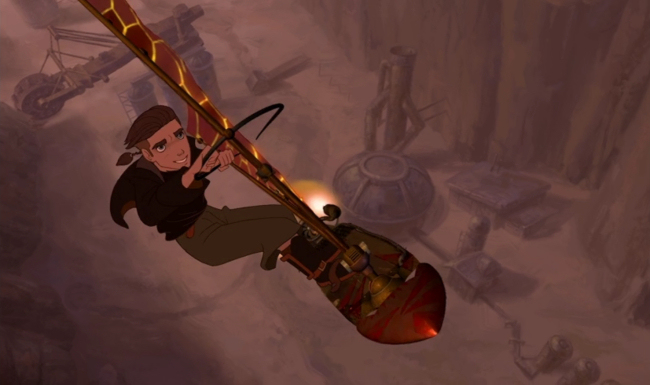
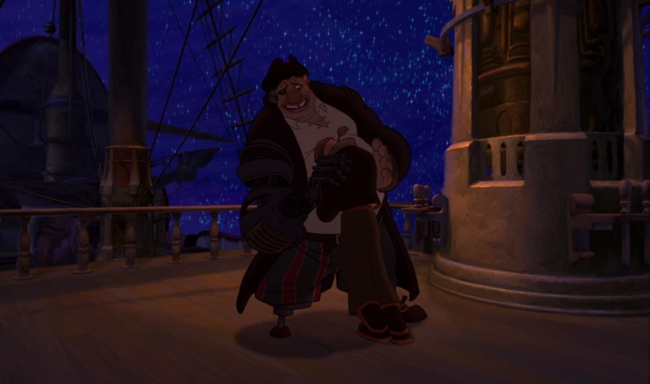
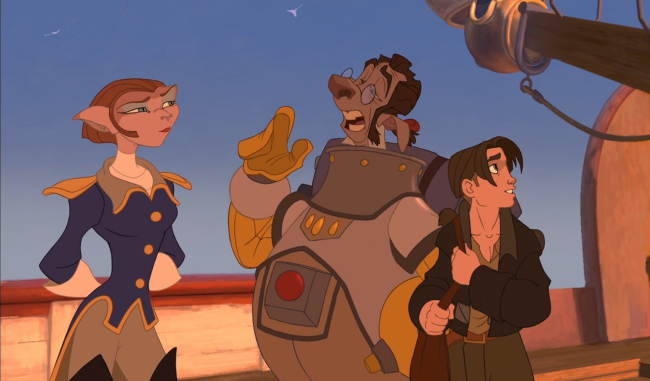
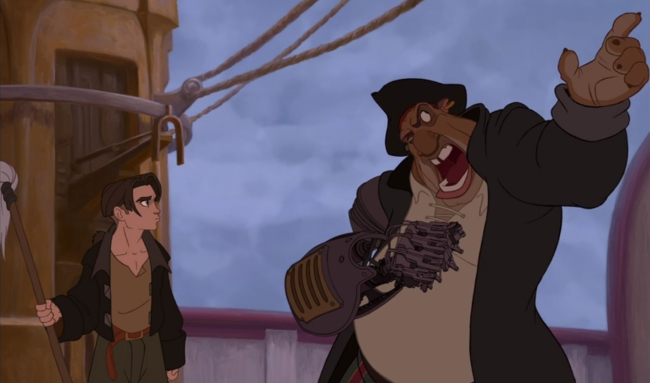
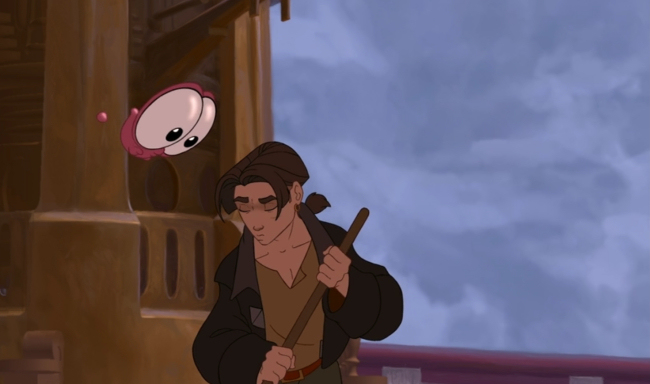
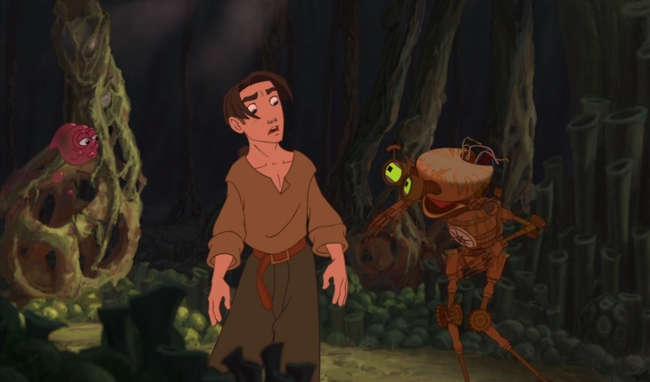
What would happen if you set Treasure Island in space? Well, that's a question that's been answered no less than three times in film, the latest being Disney's 2002 animated Treasure Planet. By far the most successful of all the films to use this concept, it was nonetheless a box office bomb and remains one of the least popular films in the Disney canon. Why do people keep coming back to this concept, then? The inherent postmodernism of it likely appeals more to college graduate filmmakers than to general audiences. Most people looking for a good movie don't go especially wild over the observation that sea adventure films are at heart the same kinds of stories as space operas. So all the correlation does, like postmodernism often does, is potentially frustrate attempts to suspend disbelief. It's a shame because the voice acting and the 2D animation are firing on all cylinders. The mix of cgi and hand drawn animation doesn't come off and seems dated, as you might expect, but the characters all have that classic Disney expressiveness. Glen Keane's animation for John Silver, along with Brian Murray's voice, create one of the best iterations of the famous character. The relationship between Silver and Jim Hawkins is slightly overdone but still very sweet. Yet, altogether, the film isn't the solid success of Lilo and Stitch and does nothing to eclipse Disney's own 1950 live action version of Treasure Island.

In some ways, Treasure Planet is more faithful to the novel than the 1950 film. The character of Jim's mother, voiced by Laurie Metcalf, is as prominent as she is in the book, though Treasure Planet makes her oddly sexy, looking almost about the same age as her son.

Jim's parents are totally absent from the 1950 film and Bobby Driscoll improbably seems to be running The Admiral Benbow by himself (though his mother is mentioned as being off in town). Both Jim's parents are present at the beginning of the book though his father dies a few chapters in, something which contributes to the lad's weakened nerves when Billy Bones dies almost immediately after. Treasure Planet hints that Jim's father abandoned Jim and his mother.

Jim's a decent, hardworking young man in the book and the 1950 film but Treasure Planet makes him a misfit who likes to ride a flying surf board at illegal speeds. Once again, Disney was evidently trying to capture the surfing or skate boarding crowd, as they did with Tarzan and Lilo and Stitch, but there's a healthy dose of Luke Skywalker here, too. Even with The Little Mermaid, Disney was imitating Star Wars a little, so it makes sense they would bring this character type finally to a male youth in a space opera. It's kind of funny that by the time Disney finally owned Star Wars they'd lost interest in rebellious youth, though of course Rey's parents also abandoned her.

Jim as a misfit instead of a straight arrow is one of the ways Treasure Planet redirects the focus of the original story, away from mystery and excitement, and toward irony and relationship drama.

So John Silver becomes Jim's surrogate father figure. This is something one can see in the 1950 film, more or less by default. Robert Newton as Long John Silver is so warm and charismatic, even as he's sinister and mysterious, all qualities that make his take definitive. The book really doesn't have that kind of relationship between the two characters, if anything the boy's father figure is Doctor Livesey. Treasure Planet gives an emasculated combination of Livesey and Trelawney called Doppler, voiced by David Hyde Pierce.

Jim is voiced by Joseph Gordon-Levitt, who's much better than Bobby Driscoll, and makes Jim the best male protagonist of a Disney film since Aladdin, being a more solidly established and developed character than Disney's Tarzan, Quasimodo, or Hercules. But it's really John Silver who steals the film. Keane's animation flows well with the character's cybernetic parts and the big and powerful frame of the man recalls Beast from Beauty and the Beast, animation also supervised by Glen Keane.

The film is less successful with its supporting characters, most of whom are either saddled with too much irony to support a sense of credibility in the events, or are outright annoying, like Morph. Morph is a shapshifting blob that replaces Silver's parrot. You can see the idea there--instead of just imitating voices, he imitates people's shapes. Morph appears to have animal level intelligence, which makes it creepy when he turns into tiny versions of the characters, something I don't think Disney intended.

And the film lacks the effective creepiness of the book and 1950 film. There's no Black Spot, there's nothing ominous about how the map's discovered, none of the phantasmagorical poetry of the book's dialogue and description. Instead the ironic jokes and the cgi undermine the atmosphere at every turn.

Somehow this formula worked much better in Lilo and Stitch. Maybe because there's something much subtler about the relationships between Lilo, Stitch, and Lilo's sister. It could be just that Treasure Planet has some god awful songs by John Rzeznik of The Goo Goo Dolls. Maybe it's that Lilo and Stitch was never really meant to be a story with a feeling of real stakes.

So concludes my coverage of Disney's sci-fi trilogy that consists of Atlantis: The Lost Empire, Lilo and Stitch, and Treasure Planet.

Treasure Planet is available on Disney+.

...

This is part of a series of posts I'm writing on the Disney animated canon.

Snow White and the Seven Dwarfs
Pinocchio
Fantasia
Dumbo
Bambi
Saludos Amigos
The Three Caballeros
Make Mine Music
Fun and Fancy Free
Melody Time
The Adventures of Ichabod and Mr. Toad
Cinderella
Alice in Wonderland
Peter Pan
Lady and the Tramp
Sleeping Beauty
101 Dalmatians
The Sword in the Stone
The Jungle Book
The Aristocats
Robin Hood
The Many Adventures of Winnie the Pooh
The Rescuers
The Fox and the Hound
The Black Cauldron
The Great Mouse Detective
Oliver & Company
The Little Mermaid
The Rescuers Down Under
Beauty and the Beast
Aladdin
The Lion King
Pocahontas
The Hunchback of Notre Dame
Hercules
Mulan
Tarzan
Fantasia 2000
Dinosaur
The Emperor's New Groove
Atlantis: The Lost Empire
Lilo and Stitch

Wednesday, January 13, 2021

One Out of Seven

Despite the popularity of pirate films in the mid-20th century, there were surprisingly few made about the infamous Barbary pirates. 1953's Raiders of the Seven Seas takes one of the first and most successful of the Barbary pirates, Barbarossa, and changes nearly everything about him. A pirate whose exploits occurred primarily in the Mediterranean is depicted as a menace of the Caribbean and as a liberator of slaves instead of a procurer. For a low budget pirate film with a B list cast, it was better than I expected but not by much.

Nearly everyone was miscast, including John Payne as Barbarossa. The real life Turk is portrayed as a Spaniard (in the service of Morocco) by an American actor who makes no attempt to do anything with his accent. The stilted dialogue comes out like a type writer from him and other Americans in the cast but Payne at least had some star quality and roguish charm. He has exactly one good sword fight against a villain, played by Gerald Mohr, possibly the most miscast person in the film.

MST3k fans will remember him from Invasion USA in which he plays, as he so often did, a cheap substitute for Humphrey Bogart. Which makes him stick out like an even sorer thumb in this movie.

Despite the fact that the real Barbarossa died in the 16th century, I did appreciate some historical authenticity in the film's chosen time period of the early 17th century. Nobody wears tricorne hats. And I like how the hold of Barbarossa's ship is portrayed as disgusting.

That's Donna Reed, the biggest star in the film, though she really has no business playing a Spanish noblewoman. She looks fantastic, though, and she fills out her gorgeous costumes perfectly.

Lon Cheney Jr. plays Barbarossa's helmsman unremarkably. I guess it would be a spoiler to tell you he dies in the film except later, thanks to lousy editing, he turns up back at the helm in the background of a shot.

So I don't really know what to tell you.

After the decent sword fight in the middle, the end is anticlimactic. But there are worse pirate films.

Raiders of the Seven Seas is available on Amazon Prime.

Twitter Sonnet #1433

Insistent spots appeared across the grass.
The timing fell as gears were scattered round.
A growing cloud became a hardened mass.
We wanted snow but took an icy sound.
The greeting passed from wall to wall to floor.
The shelter grew to house electric air.
A ghostly crowd detached the fragile door.
A plushy pig was full of warmth and care.
A cherry watched a wave relinquish days.
Returning moons denote the planet place.
The lonesome ships repair to lively bays.
The empty night concocts a watching face.
The extra glasses blurred a pencilled seam.
Eraser smudges craft a novel dream.

Saturday, June 01, 2019

Deborah Looks for Work and Dekpa Remembers Plunder

There's a new chapter of my infrequently updated web comic, Dekpa and Deborah, online to-day. Deborah brings matters between herself and her family to a conclusion, of sorts, and frets about it. Enjoy!

Happy Birthday to Frank Morgan, Marilyn Monroe, Jonathan Pryce, and, of course, Robert Newton.

Twitter Sonnet #1241

The floating ground was light as packing thoughts.
Surroundings blank as boards contain a drop.
The world resolved from bleeding polka dots.
A helmet changed a store into a shop.
Confusing voices peer betwixt the tie.
To juggle hands the daggers sweetly wait.
A billion fingers spoilt all the pie.
At two the pawn'll stumble home to mate.
Apportioned sand remained exceeding dry.
Tamale boxes hum a flick'ring tune.
Repeated thoughts encourage cats to try.
In ev'ry whisker lives a jelly moon.
The blessed and less assured no less at loss.
The snow supports assorted feet across.

Monday, December 03, 2018

The Perils of Fancy Footwork

Sometimes, no matter how much you dance, people still think you're a pirate. Even the title of 1936's Dancing Pirate implies he's a pirate. But Jonathan, the film's protagonist, is really a dancing instructor who was pressed against his will into service on a pirate ship, but no-one in the little Spanish Californian town listens. It doesn't help matters when he scandalously touches women's sides when teaching them to waltz in this, the first colour full length musical film. It's a lot of fun.

Charles Collins plays Jonathan. He's no Fred Astaire but he's not bad--certainly built much more like a dancer than the menacing brutes who force him to perform menial tasks on the pirate ship. He manages to slip away and get to the town the pirates plan to attack. But the pirates are spooked and leave so poor Jonathan is mistaken for the entire invasion force, and he looks especially guilty when he tries to hide in the bedchamber of the Alcalde's daughter, the lovely Serafina, played by Steffi Duna.

Collins is okay, a sweet, hapless chap, but Duna is great. Jonathan gets in trouble for trying to introduce polite ladies to the waltz in this tale set seemingly in the early 19th century but, as shocked as Serafina is by it initially, I think her own flamenco dancing looks a lot more provocative.

She threatens to kill herself before Jonathan can assault her but, conscious of the misunderstanding, Jonathan warns her, "If you kill yourself now, you'll regret it!"

But most of the film's laughs come from her father, the Alcalde, is played by Frank Morgan, best known to-day as the Wizard of Oz. He prepares for the incoming pirate attack by irritably extracting kittens from a cannon.

The songs are pretty good, by Rogers and Hart, and the story, which mainly consists of Jonathan being put in and out of jail while he and a dastardly Captain of the Guards (Victor Varconi) compete for the hand of Serafina, has just the right levels of silliness and ardour. There's a surprisingly strange and effective fight scene at the end, too. Dancing Pirate is available on Amazon Prime.

Twitter Sonnet #1181

The wind arrays the pennants long the day.
As courses listed knights began to dress.
A plate of shirt is lost in metal hay.
The hinges rust before the sweating press.
The dial swept a shadow grass aside.
Beneath the keep a ragged treasure kept.
Through secret ways the golden scales reside.
A slender smoke betokened where it slept.
An arrow buried early grew a bow.
The night prepares a bower high and cool.
Collective gleams'll make the garment glow.
The satin ripples subtle milk to pool.
Mistakes convey a baker riding horse.
A lance denied determined dough the source.

Monday, May 21, 2018

The Fat of the Skull

Of all the pirate names to inspire fear on the seven seas, "Puddin' Head" ranks pretty low. But the film featuring that character, 1952's Abbott and Costello Meet Captain Kidd, is a decent pirate adventure. It succeeds more at that than at comedy, in fact, but Abbott and Costello are always a delight.

It seems heavily influenced by two pirate films from the two years before its release--Treasure Island and Anne of the Indies. This is in spite of the fact that Charles Laughton here reprises his role as Captain Kidd from the 1945 film of that name but aside from Laughton being in the role there's nothing to associate this Kidd with the historical Kidd or even the embellished version. In this film, Kidd has a friendly relationship with Anne Bonny somewhat like the one between Blackbeard and Bonny in Anne of the Indies.

Hillary Brooke as Bonny lacks the pluck of Jean Peters in the role but she at least exudes an air of authority convincing enough to make it funny that she falls head over heels for Lou Costello--a.k.a. Puddin' Head.

There's the usual obligatory straight pair of lovers--in this case Bruce (Bill Shirley) and Jane (Fran Warren) who are especially dull. But the plot is set in motion when Puddin' accidentally swaps a love note from Jane with Kidd's map to a buried treasure on Skull Island. After the initial mix-up it does get a lot funnier as the film continually contrives reasons for the two items to get mixed up again and again.

Laughton surprisingly really shines in this film for his comedic instincts. He's much more effective then Lon Cheney Jr. or Boris Karloff for this reason--Laughton's Kidd is truly amphibious, at ease with terrorising bluster as in screwy antics. He may partly have Robert Newton to thank for taking the pirate archetype more in that direction but Laughton is no light weight performer. As he remarks himself--when he sees Puddin' he remarks how he hates fat men. Bonny points out he's fat to which Kidd replies, "And I hate m'self!"

The colour, by SuperCinecolor, is really nice, enabling cinematographer Stanley Cortez (who also worked on The Magnificent Ambersons, Night of the Hunter, and Chinatown) to create a ghostly chiaroscuro more like Moonfleet than The Crimson Pirate, which is certainly my preference. And it works surprisingly well with some extended comedy routines between Laughton and Costello in the last portion of the film that feel like they were created late in production when people realised how well Laughton took to this.

Sunday, April 29, 2018

From the Netherworld to Scotland

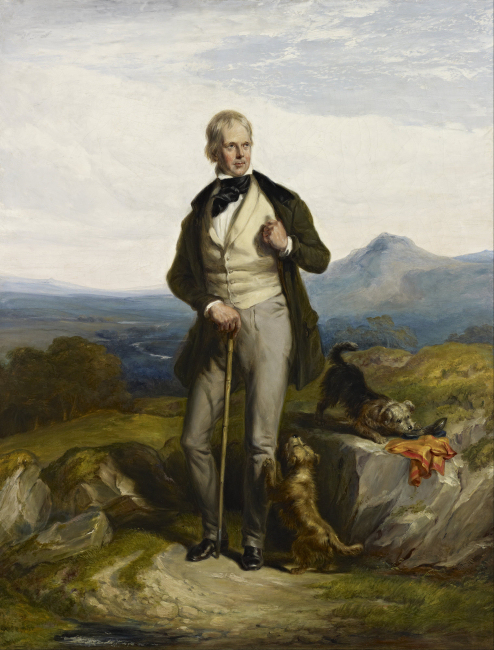
And so I come by Sir Walter Scott via H.P. Lovecraft. Perhaps this is not a common statement nowadays. But Barnes and Noble has put out a collection of stories called H.P. Lovecraft Selects, a compilation of Lovecraft's recommendations from his essay "Supernatural Horror in Literature". I'd always meant to go through all of Lovecraft's recommendations so this was pretty handy and I've been slowly making my way through the tales since October between all the other things I've been reading. This is how I first read Sir Walter Scott because an 1828 story of his, "The Tapestried Chamber", is included. Set just after the American Revolutionary War, it centres on a veteran of that war returning to England and staying at the home of an acquaintance near "a small country town, which presented a scene of uncommon beauty, and of a character peculiarly English." Scott, a Scotsman, is known for his works of fiction involving Scotland so I guess it's kind of funny my first exposure to him is a story clearly meant to evoke a particularly English nostalgia. The supernatural element, the fact that the room the protagonist stays in turns out to be haunted, isn't explicitly linked to how the incident is couched, but maybe there's something in being on the losing side of a war that was in many ways ideological that makes sense of a ghost who's frightening because of how little it seems to make sense on the surface.

Issues that come to the surface for reasons outside discernible, rational logic are of course a hallmark of H.P. Lovecraft's work so it makes sense he'd consider this story to be an influence. I was surprised how effective it was; it starts off pleasant enough with Scott's descriptions of his protagonist's journey. The tranquil, pastoral tone is very suddenly replaced by something bizarrely visceral in a description of the walking, seventeenth century corpse of an old woman that disturbs the soldier's sleep. This is followed by a discordantly mild denouement that leaves an eerie after-taste; a couple of friends affably discussing the matter that suggests the ways in which terrible issues are suppressed by the commonplace.

So this sure won me over on Walter Scott. I looked through the list of novels he wrote, probably I should've started with Ivanhoe or Waverley, but I've been reading his 1822 novel The Pirate. I'm only seven chapters in, just under a fourth of the way through. The first couple of chapters weren't especially interesting, introducing the environs and some of the history of Zetland in the seventeenth century--the place and time in which the novel's set--and the old man and his adult son who come to live there. The son, Mordaunt, is a barely sketched romantic figure who's described as befriending the two beautiful daughters of the local landlord. An entire chapter is spent describing the daughters but remains ploddingly abstract throughout, using no dialogue and few anecdotes to establish that one daughter is serious and the other fun and Mordaunt has no way of choosing between the two or any apparent desire to.

But then things start to get colour when Scott spends a series of chapters concentrating on a house Mordaunt's forced to take shelter in during a bad storm. We're given the entertaining backstory of its residents--an eccentric horticulturist who failed in an attempt to become a pastor and his miserable sister named Baby. And then another mysterious visitor arrives and Scott gives this wonderfully gothic description of the witch, Norna:

“I say to you beware—while Norna looks forth at the measureless waters, from the crest of Fitful-head, something is yet left that resembles power of defence. If the men of Thule have ceased to be champions, and to spread the banquet for the raven, the women have not forgotten the arts that lifted them of yore into queens and prophetesses.”

The woman who pronounced this singular tirade, was as striking in appearance as extravagantly lofty in her pretensions and in her language. She might well have represented on the stage, so far as features, voice, and stature, were concerned, the Bonduca or Boadicea of the Britons, or the sage Velleda, Aurinia, or any other fated Pythoness, who ever led to battle a tribe of the ancient Goths. Her features were high and well formed, and would have been handsome, but for the ravages of time and the effects of exposure to the severe weather of her country. Age, and perhaps sorrow, had quenched, in some degree, the fire of a dark-blue eye, whose hue almost approached to black, and had sprinkled snow on such parts of her tresses as had escaped from under her cap, and were dishevelled by the rigour of the storm.

After the airless exposition on the landlord's daughters, this was a welcome change. After this, even the kinds of descriptions of gloomy landscape and buildings I wasn't particularly enjoying suddenly seemed awesome and absorbing. I look forward to the rest of the book.