Showing posts with label roy ward baker. Show all posts

Monday, July 04, 2022

Fires in the Desert

A millionaire with a broken leg is left to die in the desert by his wife and her lover. It all would've worked out so well except they didn't count on one thing--that millionaire is played by Robert Ryan in 1953's Inferno. Ryan busts his way through the desert with a makeshift splint in this terrific man-versus-nature film.

The screenplay by Francis Cockrell and director Roy Ward Baker are good at staying smart and keeping the story rooted in a real sense of the circumstances. When Donald (Ryan) spots a car and unsuccessfully tries to get its attention, I thought, "At least now he knows where the road is." Almost immediately, Ryan had a line almost exactly along those lines. It's that kind of thing that makes you feel you're right there with a character; you're figuring things out together.

Ryan is supposedly playing a spoiled brat but he comes off as way too tough for that. I guess that's a flaw but I'm not complaining.

His crooked wife is played by Rhonda Fleming while her lover is William Lundigan, giving a performance decent enough for an action scene. Fleming is pretty good as someone truly shallow with some hidden depths of evil. She rationalises that leaving Donald is not as bad as actually killing him but Lundigan quite rightly points out that a slow death in the desert is much, much worse than a quick shot to the head. Is she really just a coward or does she actually want him to suffer?

Meanwhile, Robert Ryan lurches across the desert sands, surviving on cactus water, deer, and a thirst for revenge.

Inferno is available on The Criterion Channel as part of their new Film Noir in Colour collection.

Monday, January 07, 2019

Comus at the Window

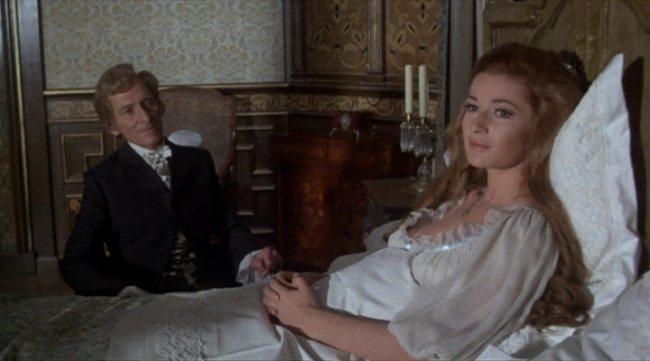
A young woman moves into her new husband's enormous ancestral estate and is almost immediately beset by a malevolent supernatural force. It's 1973's And Now the Screaming Starts, and it certainly does, and recurs at every opportunity. Despite the cheesy title, director Roy Ward Baker establishes a wonderfully effective gothic atmosphere in this film from Amicus. It's also a film with an argument about traditional class structures, presented as a dialogue with John Milton's masque Comus. It doesn't make a particularly profound argument but its presence helps bring a sense of personality to the supernatural menace.

Peter Cushing, Herbert Lom, and Patrick Magee get top billing but most of the film centres on the young woman, Catherine, played by Stephanie Beacham--Cushing doesn't turn up until halfway through the film and Lom is mostly there only in portrait form, playing Sir Henry Fengriffin, the grandfather of Catherine's young husband, Charles Fengriffin (Ian Ogilvy). As she tries to figure out why she's seeing spectral hands reaching out of portraits and a leering face with its eyes gouged out peering at her through windows one might suppose this is a movie belonging to the gaslighting genre. Though if any of the phenomena she's witnessing are merely illusions meant to drive her mad, they're certainly very good illusions and don't explain why everyone else is terrified to talk about Charles' family history.

This includes Patrick Magee who finally shows up in a minor role as a doctor who attends to Catherine after she becomes pregnant. When things get too weird for he or Charles to handle, Magee sends for an expert, much like Van Helsing was sent for in Dracula, and accordingly Peter Cushing shows up playing a sort of proto-psychologist named Dr. Pope.

As the film's set in the 18th century I wondered if maybe Cushing's character was named for Alexander Pope but there's nothing in his personality to suggest it, being much a straight forward detective character, Van Helsing without belief in the supernatural. Cushing's good as always, leaning back in his chair playing with a snuff box, pondering as Catherine tells him her troubles. It's a literary giant of the 17th century the film explicitly references; John Milton, whose 1634 masque, Comus, Catherine is shown reading, the camera deliberately focusing on the title though it's never discussed in dialogue.

Any confusion as to whether or not this is Milton's Comus and not some other work about the being from Greek myth is cleared up when Charles later checks what Catherine's been reading and scoffs bitterly at this passage:

Comus was originally called A Masque Presented at Ludlow Castle, a masque being a sort of play typically presented in a court setting where the players are in a sense the audience. Comus is about three noble siblings, two men and a "Lady", who become separated in the woods. The Lady encounters Comus, described in the masque as the son of Circe, who endeavours to seduce her. The passage above is a quote from one of the brothers as he tries to think of reasons their sister is probably perfectly fine, wherever she is. These guys prove not to be the sharpest tools in the shed.

It's thought that the masque was partly intended to indirectly bolster the reputation of the Earl of Bridgewater and his family, the residents of Ludlow castle (some of them participated in the masque), as a countermeasure to the scandal surrounding a family relation who'd been tried and executed for rape and sodomy.

This becomes relevant in And Now the Screaming Starts once we get a proper flashback of Herbert Lom's character and just what he'd gotten up to that brought on the curse Catherine's now suffering from. Milton may have sympathised with the film's indictment of an abusive and debauched hereditary authority but the plot's a little broad to be worthy of Milton. As a horror film, it whittles things down to a pretty bleak proposition and there's something generally insubstantial about it. But it has plenty of that Amicus/Hammer atmosphere that makes you just want to live in this place for a while. If only Cushing and Magee had more screen time and some better dialogue.

Monday, April 09, 2018

Hyde's Immortal Hair

Do women hold the secret to eternal life? Given that, as far as I know, all women eventually die, I would say no. But this is not the conclusion reached by Dr. Jekyll in Hammer's 1971 film Dr. Jekyll and Sister Hyde. It's a film that mixes in two true stories of murder--that of Burke and Hare and of Jack the Ripper--with Robert Louis Stevenson's concept and, as if that isn't enough, in this version Jekyll becomes a woman when he transforms into Hyde. The result is a confused mess, alternating between empty ideas and embarrassing ideas.

My favourite thing is the music when Jekyll (Ralph Bates) transforms into Hyde (Martine Beswick). Cascading piano and strings, stock "woman" music, a bit like the theme to a daytime soap opera. Look out world, sisters are murdering prostitutes for themselves!

I suppose it's a bit sexist but it's hard to pin anything even coherent as sexism to this movie. Jekyll's not looking for any moral purification in this film, he's just trying to find the key to eternal life, plain and simple--he wants to live forever so he can continue his work finding cures for deadly diseases. That sounds a bit like turning the sun on to find a lamp to me but this guy gets even wackier. His reasoning that the key to eternal life lies in the bodies of women? Women don't go bald and they have "silken" skin.

Why stop there? Why not dare to ask how women naturally grow lipstick and nail polish?

As goofy as Jekyll sounds, it's not as bad as when Hyde turns out to have inexplicably longer and more lustrous hair than Jekyll.

Great Scott, he's isolated the Pantene molecule! After this movie I think the world was definitely ready for The Rocky Horror Picture Show. I might almost think this movie was a parody in itself except Ralph Bates plays it so sincere.

Jekyll does have a moment of moral contemplation when he asks the innocent young woman from upstairs, Susan (Susan Brodrick), if it's right to kill a raft full of people to save a whole cruise ship, and she very quickly agrees yes, it is. She doesn't guess he's going about murdering women under some vague notion of it eventually leading to finding the secret of eternal life. It doesn't seem to be very eternal so far considering every transformation into Hyde is temporary, thus requiring Jekyll to go out and murder more prostitutes for parts. At first, Hyde is just a convenient disguise, then she develops a personality that wants dominance.

Director Roy Ward Baker and cinematographer Norman Warwick conjure some oddly gloomy atmosphere for this material that would seem better suited to the saturated colours of earlier Hammer films. But I can't say the film didn't make me smile--how much it did so on purpose I can't say.