Showing posts with label robert ryan. Show all posts

Thursday, January 26, 2023

Outlaws in All Directions

A deadly situation in the hostile winter of Wyoming is ambushed by another deadly situation in 1959's Day of the Outlaw. It's an engrossing film that deftly layers one source of tension on top of another and another.

At the centre of this storm is Robert Ryan playing a rancher called Blaise Starrett. The movie gets into it right from the opening credits in which an impressive wide shot of snowy wilderness is inhabited by two horsemen talking about murder.

Blaise is angry about barbed wire fences that local farmer Hal Crane (Alan Marshal) plans to put up. After arguing with Hal for some time, he's now concluded that murdering the man is the only solution. And he can get away with it, too, out here in the wild frontier. He might have to make his case with the few townspeople, though.

On top of this, he's also in love with Hal's wife, Helen (Tina Louise). She pleads with him to spare her husband, offering herself in exchange. But it's all about to lead to a gunfight anyway when Burl Ives walks in with a desperate gang of hoodlums.

Ives plays Jack Bruhn, a former military officer. It's only his command which is restraining his rowdy men from raping the women and razing the town.

Director Andre De Toth skillfully blends all these sources of tension until the last twenty minutes or so of the film when, according to Wikipedia, he ran out of money. The plot suddenly becomes simpler, there are some obvious pickup shots filmed in front of rear projection, and a lot of the subplots are just forgotten about. Still, it's a hell of ride up until that point and Robert Ryan is terrific. It's still a nice rumination on the meaning of murder and heroism in a relative moral vacuum, as Westerns often are.

Day of the Outlaw is available on The Criterion Channel.

Twitter Sonnet #1663

With measured heat the snow amounts to fluff.
A vagrant flake was cold beneath the fur.
Upon the beach, an arm was little buff.
And ev'ry candy grain commits to her.
A roaming mouth removed its eyes to run.
A lightless pit remained an empty box.
The gentle snow could never kill the sun.
The heavens beg the elves for heavy socks.
The dogs await the end of fire threats.
Forgotten fights became a wisp of smoke.
A whiskey bottle clutched a sheet of bets.
At dusk, the sickly captain first awoke.
Another flake of frost was like the last.
An island girl returned to build the past.

Friday, July 15, 2022

Muscling In On Tokyo

Samuel Fuller is one of the most influential directors of all time but it's strangely difficult to find most of his movies. The Criterion Channel just added one of his more fascinating accomplishments, 1955's House of Bamboo. A disorienting and beautiful film noir purportedly shot entirely in Japan, it stars a surprisingly scruffy Robert Stack as an American searching Tokyo for answers.

In fact, he's from San Diego, just like me, as he reveals in one scene. It makes me want to not shave and to swagger around scowling at everyone. That's what he does, finally tracking down the beautiful wife of a recently deceased gangster.

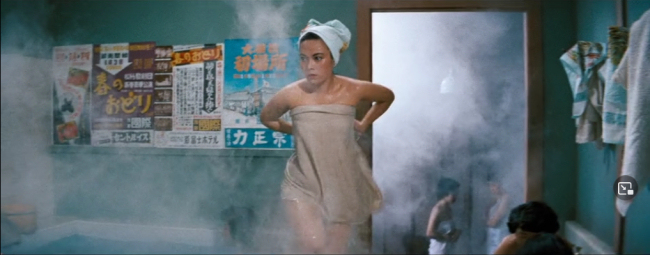
We meet Mariko (Yoshiko Yamaguchi) in a bathhouse where Stack nearly busts in on her. He does get physical with her when he finally corners her in her home. Later in the film, this is all excused because it was all an elaborate act and Stack's on the side of the law. But what happened, happened, of course. Arguably, it's this kind of movie that Hitchcock's Vertigo was riffing on.

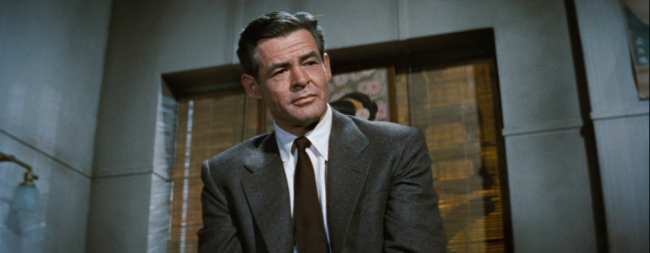
It's Robert Ryan as the head of the local mobsters who's the real star of this movie, giving a terrific performance as always. He has an amazing entrance, too, when Stack is thrown through a paper wall, winding up at Ryan's feet.

As Stack is accepted into the gang, the plot starts to borrow a bit from White Heat. It's a bit disappointing as it comes along with the gang of Americans having very little to do with the local Japanese. They don't even seem to speak Japanese. How have they managed to operate in Tokyo so long?

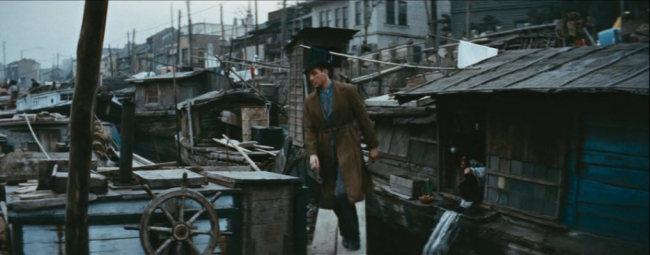
It's disappointing because the film is in many ways light years ahead of other American films of the period in terms of authenticity. It's not just shot in Tokyo, it really feels like Japan when Robert Stack is roaming the streets, roughing people up.

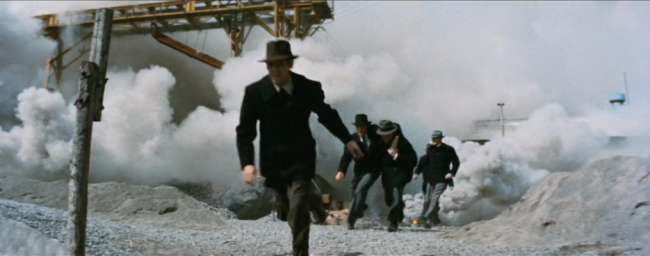
Fuller and his cinematographer come up with some amazing shots. I really liked the look of a heist at some kind of factory.

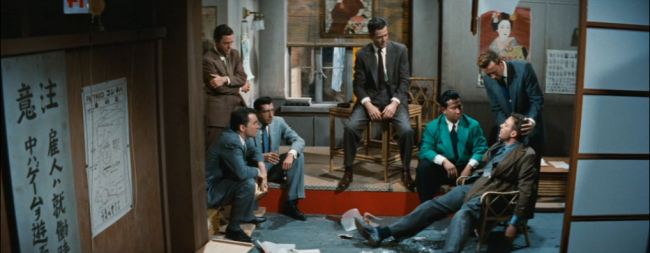
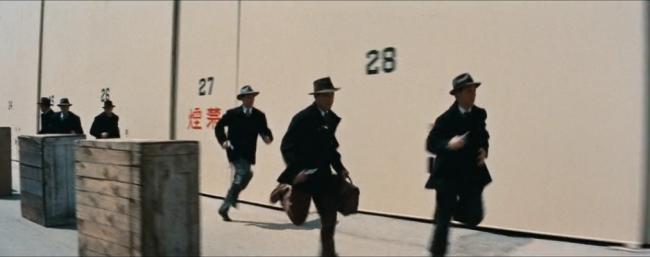
For some reason I really like this shot of the gangsters running in front of these nearly blank walls.

Among Ryan's gang are Cameron Mitchell and DeForest Kelley in small but very effective roles.

House of Bamboo is available on The Criterion Channel.

Monday, July 04, 2022

Fires in the Desert

A millionaire with a broken leg is left to die in the desert by his wife and her lover. It all would've worked out so well except they didn't count on one thing--that millionaire is played by Robert Ryan in 1953's Inferno. Ryan busts his way through the desert with a makeshift splint in this terrific man-versus-nature film.

The screenplay by Francis Cockrell and director Roy Ward Baker are good at staying smart and keeping the story rooted in a real sense of the circumstances. When Donald (Ryan) spots a car and unsuccessfully tries to get its attention, I thought, "At least now he knows where the road is." Almost immediately, Ryan had a line almost exactly along those lines. It's that kind of thing that makes you feel you're right there with a character; you're figuring things out together.

Ryan is supposedly playing a spoiled brat but he comes off as way too tough for that. I guess that's a flaw but I'm not complaining.

His crooked wife is played by Rhonda Fleming while her lover is William Lundigan, giving a performance decent enough for an action scene. Fleming is pretty good as someone truly shallow with some hidden depths of evil. She rationalises that leaving Donald is not as bad as actually killing him but Lundigan quite rightly points out that a slow death in the desert is much, much worse than a quick shot to the head. Is she really just a coward or does she actually want him to suffer?

Meanwhile, Robert Ryan lurches across the desert sands, surviving on cactus water, deer, and a thirst for revenge.

Inferno is available on The Criterion Channel as part of their new Film Noir in Colour collection.

Friday, June 25, 2021

For Wealth and Forgettance

There may be infinite ways you can look at any work of art but I see two principle ways you can look at 1949's Caught: either as a left-wing fantasy about the intrinsically superior virtue of the working class or as a restless battle between two vindictive, psychologically disturbed people. I find the latter interpretation more interesting but Lee Garmes' enchantingly dark cinematography and lead performances from Robert Ryan, Barbara Bel Geddes, and James Mason make this a dynamite noir either way.

I watched this movie on Wednesday night and it wasn't until about twenty minutes in I realised I'd seen it before. And here's my review from nine years ago. It's a playful review that doesn't probe too deeply in the film, focusing more on the opening scene where Barbara Bel Geddes washes her feet, but I might have made something more of the opening screenshot I used.

While she dreams about a life of wealth and comfort, Leonora (Bel Geddes) spreads her legs and swats flies between them. This seems a potent symbol of the methods she'll eventually use to marry into wealth, as much as she does have pangs of conscience about it. After being invited to a yacht party thanks to blind luck--catching the eye of a customer at a department store where she works--she's reluctant to go through with attending the party despite having spent time and money on a dress and makeover. Her very reluctance to go says volumes about her motives when she finally does.

She happens to run across the wealthy guy running the party, Smith Ohlrig (Robert Ryan), before she even gets on the boat. She accepts a ride with him but balks at going into his house. There's an abrupt jump cut to Smith in his psychiatrist's office talking about how he'd broken up with Leonora after four dates. When the psychiatrist implies Smith doesn't know how to be intimate with people, he immediately calls Leonora and starts to take steps to marrying her, apparently out of sheer contrariness. Despite the fact that Leonora's internal conflict is supposedly the centrepiece of the film, we don't have a single scene of Smith's courtship of her or of the moment where she consents to marry him.

There's another jump cut, now to Leonora alone in Ohlrig's mansion with Franzi (Curt Bois), a servant of Ohlrig's who plays piano and makes catty jokes about how Ohlrig is a monster. Ohlrig does seem to be paranoid and becomes jealous enough when Leonora laughs at a colleague's joke that he orders both of them out of the room. But Ohlrig never physically abuses her. Nevertheless, Leonora is unhappy enough that when Ohlrig suggests she go away, she takes him up on the offer. She goes to work as a secretary for the saintly Dr. Quinada (James Mason), a paediatrician serving the poorest, working class citizens of New York.

When critics talk about a film noir like Detour, they talk about how the movie's narrative being through Tom Neal's point of view clouds the events depicted with suspicion, especially the people who just happen to die around him, from whose deaths he gains financially or otherwise. The number of unnatural jump cuts in Caught make me think director Max Ophuls has something similar in mind. At one point, Ohlrig comes to find Leonora in her new life. She tentatively agrees to go with him and then there's a jump cut to her waking up in bed in Ohlrig's house. There are no scenes to show any of Ohlrig's behaviour that result in her having sex with him or marrying him. We have no direct evidence that he coerced her, that she was genuinely attracted to him, or that she succumbed to his wishes due to a desire for his wealth. The absence of these key scenes, crucial for the film's nominal argument, raise my suspicions about our point of view character, Leonora. Are we seeing her edited memory?

To add fuel to this fire, we do know that Ohlrig suffers heart attacks when he doesn't get his way--in one case, Leonora admits wishing he would die. The film ends with an event truly remarkable for a film from 1949--Leonora and Quinada actually celebrating the fact that she miscarries the child she'd conceived with Ohlrig. Ohlrig had threatened to get sole custody of the child, something portrayed as a villainous act, and yet . . . Would the kid have really been better off with Leonora? And, hey, if we're talking about edited memories, can we be so sure it was a miscarriage?

Caught is available on The Criterion Channel until June 30.

Twitter Sonnet #1456

A figure turned and faced the empty board.
The figure changed as walls and curtains blurred.
The iron gate repelled the rusty sword.
Confounding truth was ever plain absurd.
Suspicious coats were carried back to Saks.
An easy heart destroyed the hardest man.
The money built a town in lofty stacks.
A house was built of wood and moistened sand.
The cooking sheet was rife with cookie crumbs.
We hid the bike to trick the passing boat.
A growing cake defeats the sickly sums.
A shrinking pie displays the number goat.
It's via steps the feet return to roost.
The dreamy brain confers to greed a boost.