Showing posts with label sylvester mccoy. Show all posts

Thursday, August 31, 2023

Another Mountain

Last night I dreamt Sylvester McCoy was my uncle and he was taking me on a tour of New York City. I suppose it's because McCoy's birthday was recently and I was admiring New York in Only Murders in the Building.

Yesterday, the last day of August, I decided to go up Mount Amanokagu, one of the three famous mountains of Kashihara, the Yamato Sanzan.

So now I've been up all three, though it's been a year or two since I went up Miminashi. Maybe I'll go again this weekend. Here's a map at Amanokagu showing the three mountains:

The grid shows Fujiwara City, the capital of Japan from 694 to 710, with Fujiwara Palace being the dark square in the middle.

Amanokagu is 500 feet tall, smaller than Unebi but a little taller than Miminashi, which surprised me. I felt like I got to the top of Amanokagu much faster.

There was a little shrine at the top. I saw a guy there with a big green bug net. A popular summer activity in Japan is bug catching. There's also an insect museum near Amanokagu. I think I had my fill of gnats yesterday but I was heartened to see plenty of spider webs.

Here's Mount Unebi from Amanokagu:

Here's Miminashi:

My glamorous selfie:

Sunday, July 05, 2020

A Doctor and Aliens on Ice

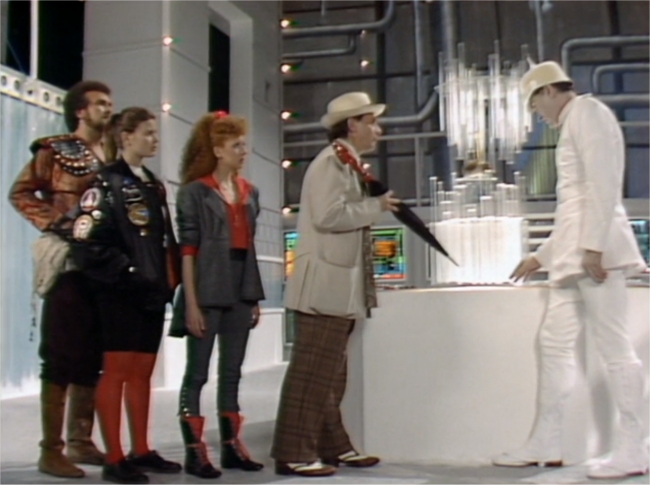
Rarely have the heroes on Doctor Who had such a strangely consistent colour scheme as they do in 1987's Dragonfire. Red, black, charcoal, and off-white. I also tend to forget how intriguing the teleplay is for this story.

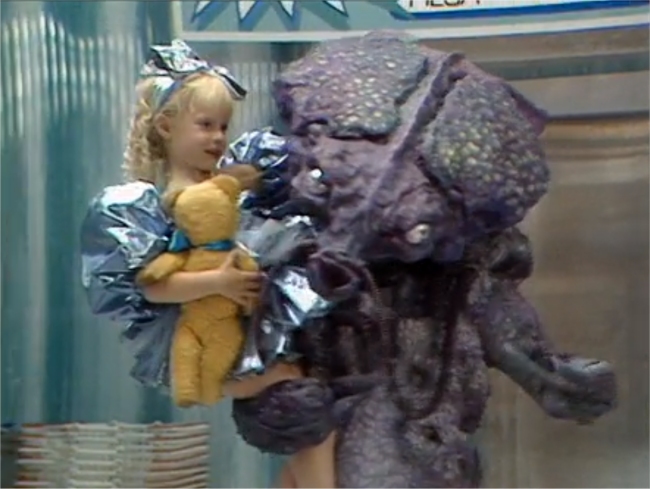
We have this alien exile, Kane (Edward Peel), a sort of ice vampire nursing a grudge for three thousand years, and his followers who all bear a mark and are bound to his service. Kane sounds like Cain, of course. Who's Abel? Maybe the cuddliest xenomorph ever.

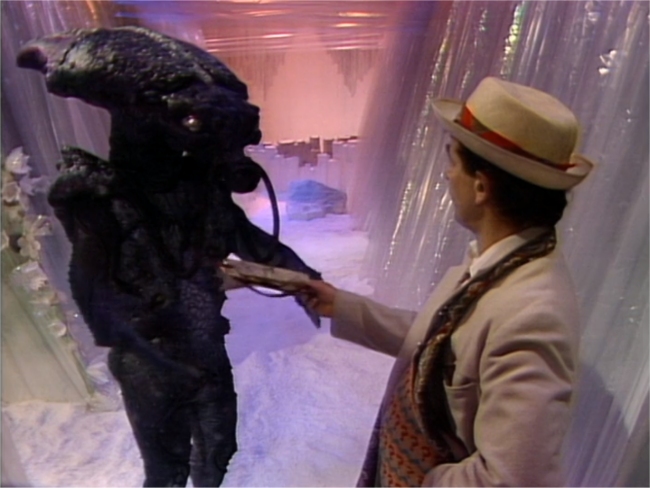
The costume bears a strong resemblance to the xenomorph from Alien. The Seventh Doctor (Sylvester McCoy) is friendly to him, of course, just like the Third Doctor with the Silurians, though maybe this story bears more resemblance to The Hand of Fear. Kane turns out to be a little like Eldrad, the civilisation that exiled him turning out to be long gone. The set design is more like Richard Donner's rendering of The Fortress of Solitude, though.

I love the Doctor handing his map to the xenomorph. No wonder Ridley Scott thought his monster was overexposed when he made Prometheus (he was right, you know). Decades before Avatar, this episode inverts the story of Aliens, and the substance in the alien's brain is something the ice vampire sees as a resource the ice vampire is willing to kill for.

I like bored Ace (Sophie Aldred) and Mel (Bonnie Langford) playing "I Spy"=="Something that begins with 'I'"--"Ice."

This was Ace's first episode, a strangely matter-of-fact introduction for a modern day girl who's gotten herself lost in time and space before meeting the Doctor. It fits perfectly with how naturally odd Sophie Aldred is, a massive relief after the irritating penny whistle that is Mel.

I love Glitz (Tony Selby), a welcome carry over from the Sixth Doctor era. The mercenary, like Ace, is brought in with so little fanfare, jumping right into the story. It would be kind of great if he popped up in the new show in exactly as abrupt a manner.

This is Mel's final episode and as bland as she is her final scene with Sylvester McCoy is one of McCoy's finest.

Sunday, December 01, 2019

That Old Ghostlight is Evergreen

No matter how many times I watch Ghostlight it stays fresh. Probably because the 1989 Doctor Who serial is so dense with subplots--some might say muddled. Originally written as a four part serial by Marc Platt, it was all crammed into three, with the result being that this haunted house/drawing room mystery is delirious in its pace. I love it.

What's going on here? Set in the late Victorian era, the whole serial takes place in an enormous mansion. Let's see if we can identify every thread;

1. Ace (Sophie Aldred) has lingering trauma from visiting the house as a teenager, in the future, and the Doctor (Sylvester McCoy) has partly brought her here to confront it.

2. The current owner of the house, Josiah (Ian Hogg), is secretly a renegade alien scientist intent on cataloguing and tampering with lifeforms.

3. There's a woman or monster called Control (Sharon Duce) locked in the basement.

4. The Butler, Nimrod (Cart Forgione), is a Neanderthal with his own motives.

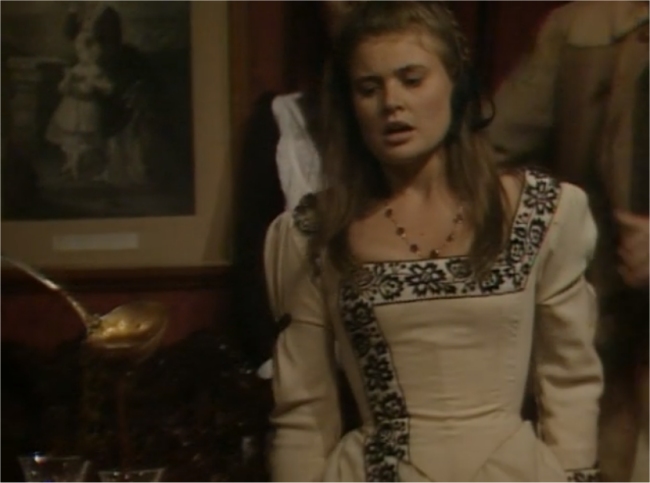
5. A young woman named Gwendoline (Katharine Schlesinger) is dealing with strange identity issues.

6. There's a policeman in stasis in the bottom drawer of Josiah's collection.

7. A gentleman game hunter (Michael Cochrane) is planning to assassinate Queen Victoria.

8. And, finally, there's a superpowerful alien being called Light (John Hallam) who has the appearance of an angel.

Oh, yeah, there's also a reverend (John Nettleton) who takes Josiah to task for his adherence to the theories of Charles Darwin so Josiah takes revenge on him by turning him into an ape.

Light is the enemy of Josiah and they seem to be at ideological extremes--Light abhors any form of change and turns people to marble when he detects any development while Josiah is obsessed with manipulating identity and genetics. He changes his own form several times. Platt seems to have been crafting a story about the folly of going too far in either direction. Gwendoline is liberated when Ace talks her into wearing a tuxedo but she's maddened when she discovers how many times her identity has been destabilised--she only finds peace when she goes back to her first one which, ironically, makes Light turn her into marble because he sees it as her changing too much.

"Too many games, even for me," says the Doctor but I somehow doubt that's true. I love how he advises Ace not to try the soup on entering the dining room some time before Light reveals the soup is primordial soup.

And then there's Control, who wants to be a proper Victorian lady and the strange bug faced men in a hidden futuristic room. It's a challenge to keep up with this one but it's a challenge I'm always happy to accept. I love haunted house stories and the sets here are pretty good. I always love the wood panelling and the green wallpaper.

Sunday, August 18, 2019

What's Bad for the Earthing is Bad for the Martian

It turns out Communism doesn't work in practice even when your whole planet is red. The 2011 Doctor Who audio play Thin Ice draws a parallel between the 1960s Soviet Union and a generation of Ice Warriors--the hissing, green helmeted Martian natives--who have a sobering encounter with one of the founding, legendary figures of their society. Adapted by Marc Platt from his own teleplay, Thin Ice is based on Ice Time, the story that was to be the season opener of the 1990 season that never happened. If it were anything like the audio play, it would've been a pretty good serial.

This was also originally meant to be the last story for Ace (Sophie Aldred) and we finally learn the purpose behind the manipulations which the Seventh Doctor (Sylvestor McCoy) put her through in stories like Ghost Light and Curse of Fenric--he's grooming her to enrol in a Time Lord academy on Gallifrey. This seems to make it clear once and for all that "Time Lord" is a title, not a species, which makes sense, though, as usual, the script creatively dodges addressing whether Ace would be called "Time Lord" or "Time Lady".

Supposedly the TARDIS is knocked off course in an attempted trip to late 60s London--they get the time right but location ends up being Moscow. They make friends with a Soviet lieutenant called Raina (Beth Chalmers) and a cockney thief called Markus (Ricky Groves). The Soviets are trying to use some Ice Warrior relics to their advantage which of course results in resurrecting an Ice Warrior, a fellow named Hhessh (Nicholas Briggs).

Through all this, the Doctor is leaving more and more decisions up to Ace and we gradually learn why when we hear his secret conversations with a Time Lord Adjudicator (Nigel Lambert). Ace indeed has to make some decisions when she finds herself in the midst of Ice Warrior drama after an ancient leader called Sezhyr (Beth Chalmers) is resurrected in the body of Raina. Sezhyr's occupation of Raina's body underlines some thematic paralleling of the dashed early idealism behind the formation of the Soviet Union and an ancient, revolutionary group on Mars headed by Sezhyr. The Ice Warriors even start calling one another "comrade". Hhessh's realisation that he can't blindly submit to his group's imperatives is contrasted with Ace grappling with the need to take greater control of the situation as an individual. Naturally her decisions involve Nitro-9.

It's an entertaining story and the cast are great as always. Platt also, thankfully, rewrote the story so that it does not, in fact, mark Ace's departure.

Twitter Sonnet #1268

A miller's stone adorns Tenochtitlan.
A floating crane alights beyond the state.
A squad of trees adrift support the swan.
A brig and sloop assist a second mate.
Selected stars appeared in mirror drinks.
The lightning froze to make somebody's veins.
The frozen air combined for skaters' rinks.
These summer thoughts diverge from proper lanes.
Prophetic rocks adorn the planet Mars.
A walking rabbit told a final joke.
A shave was sold behind the hidden bars.
A drawing's sequinned heart at last was broke.
Approaching tides harass the crabs and weeds.
An ancient drake subsumes a lizard's needs.

Sunday, March 17, 2019

Sounds Like Ireland

Happy Saint Patrick's Day, everyone. It's also Sunday, the day I normally write about Doctor Who, but Doctor Who has always been light on Irish characters and actors and the show has perplexingly never gone to Ireland. So I turned to the audio plays and listened again to the bold 2006 story The Settling from Big Finish's monthly range. Set in Ireland in 1649, it takes place during Oliver Cromwell's conquest of Ireland and features Cromwell as a character, played by Clive Mantle. The tone is sometimes too light, particularly when it comes to some of Cromwell's dialogue, but mostly it treats the subject matter seriously with a score made up mostly of mournful strings that might overdo it slightly.

This may have been before the "fixed point" term came into use on the show but the sieges of Drogheda and Wexford are clearly regarded as fixed points by the Doctor, events that he can't effect substantial changes to. Instead of big things, he mostly focuses on individuals and helps an Irishwoman named Mary (Clare Cathcart) deliver a baby while her town is being ravaged by Cromwell's forces.

It's a Seventh Doctor story and Sylvester McCoy may be the most appropriate Doctor for this material since his mother was Irish and his father was English (he grew up in Scotland). I suspect he taught the rest of the cast how to pronounce "Drogheda". While he's concerned with townspeople, his companions, Ace (Sophie Aldred) and Hex (Philip Oliver), alternate spending time with a conversational Cromwell. Clive Mantle plays Cromwell as unambiguously villainous. The smug sense of constantly amused superiority that comes through in the performance conjures an image of an obese cat with a curling moustache.

The script is much subtler, though. As Ace and Hex start trying to argue with someone they know only as a monster, they're stymied by responses and examples of behaviour that indicate a man who believes in virtue and the value of human life. He teases Hex by pretending to think he's a witch and then laughs it off--Cromwell was out of step with his Puritan cohorts in that he didn't consider witches a real threat. But then he flies into a rage when Hex utters the casual blasphemy, "Oh my god!" Realistically, I think Cromwell would be more taken aback by Hex's comfort with the expression than enraged by it, even if it was a grave offence.

It's not until the end of the story that the Doctor has a conversation with Cromwell and Cromwell's questionable defence for slaughtering the inhabitants of two towns, that he saved thousands more by doing so and that his men acted against his orders in slaying women and children, is met with McCoy's low tone of ominous scepticism.

Mainly, I admire the story more for the boldness of its premise than for its execution but it's not bad. Maybe one day the show, too, will visit Ireland.

Sunday, January 13, 2019

Never Forget Daleks

I naturally continued my tour of Dalek episodes of Doctor Who recently added to BritBox's collection by watching Remembrance of the Daleks this past week, a Seventh Doctor serial from 1988. This season première serial is when the Seventh Doctor really started to cook after his spotty first season and when his companion, Ace, made good on the potential she showed from her first appearance in the previous season's finale. It also continued the Dalek civil war storyline from Resurrection of the Daleks and Revelation of the Daleks but with the decidedly different tone of the Seventh Doctor's era. It lacks Eric Saward's penchant for pushing the envelope, violence-wise, yet its introduction of the Daleks conveys more of a sense of danger. But what I like most about this serial is its theme of misapprehension and people, good and bad, suffering for their mistaken impressions. But not the Doctor.

Despite an amusing moment in one of the episode cliffhangers where Sylvester McCoy as the Doctor pulls a face and delivers a line straight to the camera about how he miscalculated, it's very clear the Doctor's only miscalculations are pretty trivial. The proto-UNIT military group in the serial, with which the Doctor quickly makes himself an ally just by intruding on one of their surveillance vans and explaining things, seem to be also his only real problem. As he tells Ace (Sophie Aldred), he has to keep them occupied while the Daleks play into his hands.

The proto-UNIT group has no idea what they're fighting, of course, but a lot of this serial is about just how much the Daleks and humanity have in common, referencing the relatively recent menace of the Nazis in World War II (the serial's set in 1963) and the recent tensions arising from Jamaican immigrants who came to England for the rights promised to them as citizens of a British territory.

Although the serial isn't directly about racial tensions in Britain at the time, 25 year old Ben Aaronivitch's teleplay does a decent job of showing how racism operated in a community. Racists aren't simply easily identifiable two dimensional jerks; they can be the seemingly nice young man, Mike (Dursley McLinden), whom Ace almost falls for. Or Ratcliffe (George Sewell), an Englishman who felt the Nazis had it right, who now allies himself with the Daleks, finding their ideas of racial purity to be congenial.

The Daleks also aren't what they seem in this serial. The viewer is deliberately misled as to which side is which now in the Dalek civil war, which has become about race, as well, since one side has mutated, as is shown when the Doctor inspects the shell of a partially destroyed Dalek casing. The old rebels and the old establishment have switched roles but we don't know until we're directly shown, a nice way of showing just how illegitimate intrinsic ideas of racial superiority are.

Through it all, the Seventh Doctor earns his reputation as a manipulator, with Sylvester McCoy occasionally employing an effective, quietly sinister tone between his moments of clowning, giving the impression the latter is a calculated ruse. Like a good strategist, a lot of what he does is counter-intuitive, as when he seems to be working against his British military allies, or when he deliberately refrains from destroying some Dalek equipment, explaining to Ace that he doesn't want to strand the time travelling Daleks, which would increase the chances of them corrupting the timeline.

One of the famous moments in this serial is Ace cracking a Dalek with her enhanced baseball bat and that's one of the reasons she and Seven are such a great pair--he's the subtlety, she's the direct approach. But we see in this episode there's more to the Doctor's disdain for weaponry than pacifism--his techniques can be far deadlier than any weapon.

Saturday, August 25, 2018

Doctor and the Everything Else

The Seventh Doctor's first season on Doctor Who was not his best. It was an improvement over the Sixth Doctor era due almost entirely to Sylvester McCoy's better instincts as a performer. But I was starved for more Seven and I've watched the second and third seasons too many times so I watched 1987's Delta and the Bannermen again this week.

The Doctor and his squeaky carry-over companion, Mel (Bonnie Langford), from his previous incarnation, find themselves at an intergalactic tour depot where they win a trip to Earth in 1959. They meet a wacky guide dressed in a hideous, glittery purple suit played by venerable comedian and singer, Ken Dodd, who passed away this year at the age of 90.

Mel, excited to travel through time and space on a tour bus for once, heads off with a group of aliens disguised as humans while the Doctor follows along in the TARDIS. Unbeknownst to them, a fugitive from a species being wiped out by the terrible Bannermen is also aboard, a young woman named Delta (Belinda Mayne). The group's supposed to be going to Disneyland but a collision with a satellite sends them to the less budget prohibitive Wales.

This is a three episode serial that has way too much crammed into it. There's the jolly proprietor of a hotel resort, the starry eyed young man who falls for Delta, his Earthling girlfriend, Delta's strange baby, and a mysterious beekeeper, Goronwy, played by Hugh Lloyd who seems to know more than he lets on about time and space.

According to Wikipedia, "Steven Moffat endorsed the fan theory that Goronwy is a future incarnation of the Doctor, and said that the idea fit well with the Doctor's line about retiring to become a beekeeper in 'The Name of the Doctor'." He does look kind of like Tom Baker in the 50th anniversary special.

This serial features one of Sci-Fi/Fantasy's many Rays--this one almost became the Doctor's companion because Langford was considering leaving the show.

Played by Sara Griffiths, she's cute and not as annoying as Langford, but I doubt anyone's sorry the show went with Ace instead, introduced in the subsequent serial, Dragonfire. A lot of the actors in Delta and the Bannermen come off as exceptionally blank as though they were under orders not to attempt emotions. The romance between Delta and Billy (David Kinder) has all the passion of a customer asking a store clerk where the canned spinach is located.

Also crammed into this story are two CIA agents, one of whom is played by Stubby Kaye, best known now as Marvin Acme from Who Framed Roger Rabbit. The two have a mildly entertaining double act but like everything else it doesn't quite have time to build steam. The serial's villain is played by Don Henderson, recognisable to Star Wars fans as one of the Imperial generals from the first Star Wars film. There's an entertaining scene where the Doctor tries to shame him into giving up his plans and things don't quite work out.

There's also some business with a crystal and a musical number but the serial would've done well to cut one or two of these elements and develop what remained a little more.

Saturday, August 18, 2018

Responsibilities of the Doctor

The 2013 Seventh Doctor Doctor Who audioplay Afterlife feels more like a Tenth or Eleventh Doctor story than any audio I've heard so far. It's good, though, and it's kind of nice hearing Seven being taken out of his comfort zone.

Coming after the death of a companion in a previous audio, Afterlife begins with Ace (Sophie Aldred) furious with Seven (Sylvestor McCoy) over what she sees as his callous attitude. He tries to explain to her, as he has explained to many companions many times before and after, that he's gone through this so many times and his perspective as a Time Lord is so different from hers that he simply hasn't the capacity to grieve with the same levels of shock and horror that she feels. He makes an interesting point that, for him, all his companions are always alive and yet also always dead because all points in the timeline are equally real to him.

Of course, no explanation is going to make Ace's feelings go away so she finally talks him into visiting a relative of the deceased. The second and third acts of the story deal with resurrection and gods masquerading as gangsters which is partly airless and partly really intriguing. There's a lot of dialogue about whether the Doctor sees himself as a god, which makes sense considering how manipulative Seven typically is. But he finds himself frequently on the wrong footing as he's forced to deal with the emotions of others--"I keep getting things wrong!" he says plaintively a few times. At one point he's rescued kind of adorably by his occasional companion Sally Morgan (Amy Pemberton).

There's also a nicely sombre moment where Seven plays the spoons early on and a distinctively Elevenish-ish bit of grandstanding at the end which is effective coming from Sylvester McCoy and particularly gratifying coming after an audio where he spent most of the time off his game. Sophie Aldred's also really good, particularly in the early scenes, and there's some really good development for Ace's character.

Saturday, August 04, 2018

Doctor of the Parliament

1963 continues to be a busy year for the Doctor in the 2013 Doctor Who audio play 1963: The Assassination Games. The Seventh Doctor proves a natural fit for this entertaining conspiracy espionage thriller.

Neither the Doctor (Sylvester McCoy) or Ace (Sophie Aldred) show up for some time, the beginning of the serial featuring a press conference, an assassination, and some government men deciding what to do about it. John F. Kennedy's assassination is constantly referenced but Kennedy's name is never mentioned for some reason. In Britain dealing with this assassination are people from the UNIT predecessor Counter-Measures. The Assassination Games was one of several audios released for Doctor Who's 50th anniversary so it's fitting that it features an organisation introduced in the 25th anniversary television story, Remembrance of the Daleks, and Simon Williams reprises his role as Group Captain Gilmore from that serial.

There's a lot of misdirection and subterfuge which the story carries off well. Ace turns up as a housemaid and the Doctor seems to have become a Member of Parliament. As is so often the case with Seven, it's never completely clear how much he knows about what's going on. Less characteristic of him is some of the grandstanding he does in this story, giving a couple speeches about adventure and his blue police box that would've sounded much more at home coming from Eleven than the typically more mild mannered Seven. But maybe it was part of his politician role.

Mostly this is a good story. It features a direct reference to the inevitable fact that many years must have multiple Doctors visiting at once and there's an amusing moment where Ace nearly has a motorcycle accident.

Saturday, June 16, 2018

Forbidden Word of the Daleks

It seems at the beginning of the 2013 Doctor Who audio play Daleks Among Us that it's going to be a nice, paranoid tale about an Orwellian dystopia. The aftermath of the humans winning against the Daleks on Earth eerily has the governing humans enforcing a constant rewriting of history and now Daleks can't even be mentioned. This is justified by the fact that humans turned on each other after the Daleks were supposedly gone over recriminations aimed at Dalek collaborators. But the story ends up going in a far more conventional direction and at best is an echo of Jubilee. But it's always nice to hear Sylvester McCoy as the Seventh Doctor and he does a great job.

Coming after Persuasion and Starlight Robbery, Daleks Among Us forms the final part of a trilogy in which the Seventh Doctor is travelling with the sort of former Nazi, Elizabeth Klein (Tracey Childs), and the new UNIT scientific advisor, Will Arrowsmith. The Daleks are involved now, trying to get their suction cups on the Persuasion Machine introduced in the first story, a device that controls people through powerful hypnotic suggestion. This story goes back to the original concept involving Nazis and makes the not entirely novel thematic connexion between Daleks and Nazis. Yes, they do have a lot in common--belief in themselves as the master race, ideas about eugenics, and so on.

Davros (Terry Molloy), the creator of the Daleks, also features in this story and, as very often seems to happen in the audio plays, is forced to work with the Doctor and his companions after the Daleks have turned on him. But apparently this was the first audio play that paired Davros with the Seventh Doctor--sadly there are no allusions to the great "rice pudding" speech from Remembrance of the Daleks.

The latter half of this audio play features entertaining drama dovetailing confusion about clones with confusion about time travel and writer Alan Barnes comes up with some amusing dialogue. Ace makes a sort of appearance at the beginning in the form of a nude statue of herself with a baseball bat. That's something much easier to get away with in audio format. The word "Liberty" is engraved at the base of the statue on which the Doctor remarks, "A liberty is what she'd have called it."

Saturday, June 02, 2018

Sontaran Pockets

Who would dare rip of the greatest warriors in all of time and space? None other than Grendel from Beowulf in the 2013 Doctor Who audio play Starlight Robbery. Writer Matt Fitton brings back his version of Grendel, or "Garundel", introduced in the audio play he wrote the previous year, Black and White. Maybe he appears in something by another writer but I suspect he's a character only his creator could love (fitting, I suppose) because I was never impressed by how modern and sassy he is--a bit like one of the Pythons doing their gay American impressions (I kept imagining Terry Gilliam saying "Peachy Face"). But the story itself, which continues from Persuasion and features the reincarnated Nazi, Klein, and the UNIT scientific advisor, Will, as companions to the Seventh Doctor, isn't bad.

Garundel (Stuart Milligan) is a little easier to take outside the context of the period setting, too, and I found myself enjoying his scheming along with his blue skinned alien female assistant, Ziv (Jo Woodcock). This pretty young rogue captures the heart of bumbling young Will (Christian Edwards), the relationship between the two mostly evolving nicely over the course of the story with a very effective conclusion that made me want to know if there would be more in future audios.

Klein (Tracey Childs), meanwhile, seems to be channelling her old Nazi self when she starts to build a slow burn, love/hate relationship with one of the Sontarans (Dan Starkey), who are thankfully not played as a joke in this story.

Sylvester McCoy is good as always though the Doctor has kind of a background role for most of the story. He does manage an effectively clever bit of manipulation near the end that has even more effective, unexpected results.

Saturday, May 12, 2018

Harsh Persuasion

It seems the galaxy always needs sorting out because of people who think the galaxy needs sorting out. Luckily we have the Seventh Doctor who's doing something like that in the good 2013 audio play Persuasion. Starting with a pair of gods whose perfect benevolence is diminished somewhat when they're fighting for survival, the audio play moves in time and place to Germany in the aftermath of World War II and reintroduces the character of Elizabeth Klein.

Introduced in the 2001 Seventh Doctor audio play Colditz as a Nazi, Klein (Tracey Childs) became one of the Seventh Doctor's (Sylvester McCoy) most provocative companions in a series of subsequent audio plays. Sometimes written as a villain, sometimes as a reluctant pupil as the Doctor taught her the fundamental problems in Nazi philosophy, she certainly always held my attention. Mostly the writers avoided being too naive on her subject matter, sometimes she came off as too two dimensional to be a proper companion. In Persuasion, writer Jonathan Barnes sidesteps the issue by introducing an alternate incarnation of Klein, an Englishwoman who now occupies the Doctor's old role as scientific advisor to UNIT. But she clearly has some ties to Nazi Germany as when she follows the Doctor, like Alice following the white rabbit, into the TARDIS, he "accidentally" takes her to a hidden scientific facility in Germany where Allies are picking over the ruins for Nazi research.

In fact, aliens from all over the cosmos are turning up looking for Nazi secrets. Although this Klein has no apparent memory of travelling with the Doctor, the story does in essence pick up on their conversation about whether or not peace can only be achieved by a powerful central authority who believes in sacrificing the few for a potential improvement for the majority. The Doctor's eventual position on this is a little vague, which was possibly inevitable, but it's a nice story. Set evidently just before the 1996 TV movie, this is a Seventh Doctor who somewhat resembles the one seen at the beginning of that, and it sounded like it was the 1996 TARDIS interior, too--though another companion, Will (Christian Edwards), introduced in this one, describes the interior as though it were designed based on a movie adaptation of The Time Machine than by anyone who'd actually read the story, which sounded like a dig at the 1996 TV movie to me. Which I enjoyed--the only good thing to come out of that movie was Paul McGann, in my opinion.