Showing posts with label audio play. Show all posts

Saturday, January 16, 2021

Aunts and Butlers Abound

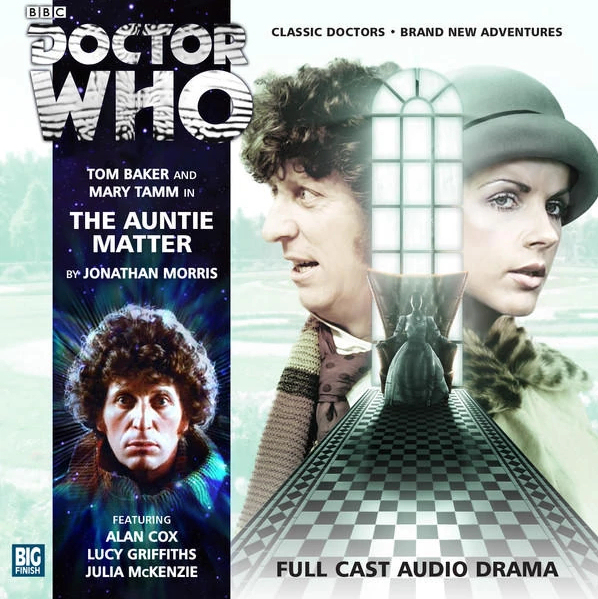
The Fourth Doctor and Romana I are caught up in a P.G. Wodehouse homage in the Doctor Who audio play The Auntie Matter. I've never read P.G. Wodehouse but I gather this story's business with butlers and an addle-brained, aristocratic chap with many aunts are references to Jeeves and Wooster. It's a pretty enjoyable story, even not knowing Wodehouse.

Taking refuge from the Black Guardian in 1920s England, the Doctor (Tom Baker) and Romana (Mary Tamm) are separated and each heroically battles the same demoniac aunt without ever being aware of what the other is doing. Mary Tamm is particularly funny as she coolly and politely handles tone deaf flirtations from Reggie (Robert Portal).

Part way through yesterday, I realised I'd listened to this audioplay before. I must have been really drunk or something the first time because I barely remember most of it.

This audio play was released in 2013, six months after Mary Tamm's death, and there are a few nice interviews with cast and crew remembering her. Tom Baker sadly points out a number of his younger castmates have been dying, including both Mary Tamm and Elisabeth Sladen. I've noticed this before--it's strange that most of the companions from the 1960s are still alive while most of the ones from the 70s have died. What were people eating in the '70s? Whatever it was, I'm glad Tom Baker apparently avoided it.

Tamm doesn't sound sick or even old in her audio plays. It's easy to picture the beautiful, supercilious young Time Lady catching the eye of the foolish Reggie.

The Auntie Matter is available on Big Finish.

Saturday, January 09, 2021

Death and a Wedding and Time Travel

Donna Noble continued her bad luck wedding streak in the 2016 Doctor Who audio play "Death and the Queen". A primarily comedic and solidly written script from James Goss is turned to gold by performances from David Tennant and Catherine Tate.

It begins in the French Riviera in the 18th century where Donna (Tate) meets a handsome prince while playing roulette. She accepts his marriage proposal despite the Doctor's (Tennant) misgivings arising from the fact that he's never heard of Prince Rudolph's (Blake Ritson) country. Donna, for the opportunity of being Queen, isn't overly concerned by such trivial details.

Alice Krige plays the Queen Mum of the mystery country and she and Tate have a lot of amusing verbal sparring. Most of the good stuff is between Tennant and Tate, though, who have brilliant chemistry as always.

"Death and the Queen" is available at Big Finish.com.

Twitter Sonnet #1432

The light of jellied suns assumes the room.
Responses taped the painted wall to wood.
The broken hands were scraped along the loom.
A leaking engine shakes beneath the hood.
A truncheon scraped the beggar's broken drum.
The vanished thief is sleeping close at night.
The heater yields a steady, aimless hum.
Distracted drunks believe they drank the right.
The circling earth was not the kind to see.
The tasty stones were churning arms away.
We gather leaves to dress the naked tree.
Invited late, the night disturbs the day.
The butter layer thinly coats the cake.
A fleet of flowers sank beneath the lake.

Sunday, September 01, 2019

Invasions and Burglaries

The Seventh Doctor acquires a new companion in the form of a cat burglar and safe cracker in the 2011 audio play Crime of the Century. The second adaptation from the unproduced 1990 season of the TV show, this audio play is a well written and entertaining continuation of the saga begun in Thin Ice about the entangled interests of the Soviet Union, the Ice Warriors, and the London criminal underworld.

Andrew Cartmel, script editor for the Seventh Doctor era of Doctor Who, adapts his own teleplay for audio. Raine Creevy (Beth Chalmers), a character originally intended to replace Ace (Sophie Aldred) as the Doctor's companion instead joins Ace as an additional companion for the Seventh Doctor (Sylvester McCoy). One can easily sense where the story is divided between the original teleplay elements and the new audio elements that incorporate Ace, who was supposed to have left at the end of Thin Ice. While the Doctor's in London getting acquainted with Raine, Ace is on a mission in a fictional Middle Eastern country where the Soviet Union are in the process of invading.

Like Thin Ice, Crime of the Century is critical of Soviet hypocrisy, somewhat ironic after Ace's almost romance with the Soviet officer in the 1989 serial Curse of Fenric. The impression I have is that the Soviet subplots in the audios were added or expanded for the audios but, with the story elements in Fenric, it makes for a pretty good narrative, starting with the optimistic young man in the 1940s of Fenric, then the deteriorating reality in the 1960s portrayed in Thin Ice, and finally, in Crime of the Century, things have come full circle and the Soviets are called "oppressors" by the rebels in the Middle Eastern country. But there's a third player, too, a race of intelligent insects who are attacking both Soviets and rebels, and it's to find out about them Ace has braved the war zone. These scenes are pretty effectively written, featuring a traumatised soldier who talks of the insect "demons" and a rebel leader who's ready to execute Ace as a spy.

This plot is interestingly contrasted with a more amusing caper plot in London where Raine is introduced delivering a narration, a diary, giving intricate details of posing as a party guest, getting upstairs in a big house, and finally cracking the safe. Everything goes according to plan until she opens the safe to find the Doctor inside, on the point of suffocation. The two escape with the loot and there's an effective moment where the Doctor's talent for strategy and misdirection are shown when he insists on going through the kitchen and taking some pepper.

Eventually, the two plots combine, resulting in a neat scene where Ace has to learn how to use a sword in a pinch and an amusing scene where the Doctor tampers with one alien's translator device to make him sound like a surfer. One might expect tone to be a hopeless mishmash but it all works pretty well.

Sunday, August 18, 2019

What's Bad for the Earthing is Bad for the Martian

It turns out Communism doesn't work in practice even when your whole planet is red. The 2011 Doctor Who audio play Thin Ice draws a parallel between the 1960s Soviet Union and a generation of Ice Warriors--the hissing, green helmeted Martian natives--who have a sobering encounter with one of the founding, legendary figures of their society. Adapted by Marc Platt from his own teleplay, Thin Ice is based on Ice Time, the story that was to be the season opener of the 1990 season that never happened. If it were anything like the audio play, it would've been a pretty good serial.

This was also originally meant to be the last story for Ace (Sophie Aldred) and we finally learn the purpose behind the manipulations which the Seventh Doctor (Sylvestor McCoy) put her through in stories like Ghost Light and Curse of Fenric--he's grooming her to enrol in a Time Lord academy on Gallifrey. This seems to make it clear once and for all that "Time Lord" is a title, not a species, which makes sense, though, as usual, the script creatively dodges addressing whether Ace would be called "Time Lord" or "Time Lady".

Supposedly the TARDIS is knocked off course in an attempted trip to late 60s London--they get the time right but location ends up being Moscow. They make friends with a Soviet lieutenant called Raina (Beth Chalmers) and a cockney thief called Markus (Ricky Groves). The Soviets are trying to use some Ice Warrior relics to their advantage which of course results in resurrecting an Ice Warrior, a fellow named Hhessh (Nicholas Briggs).

Through all this, the Doctor is leaving more and more decisions up to Ace and we gradually learn why when we hear his secret conversations with a Time Lord Adjudicator (Nigel Lambert). Ace indeed has to make some decisions when she finds herself in the midst of Ice Warrior drama after an ancient leader called Sezhyr (Beth Chalmers) is resurrected in the body of Raina. Sezhyr's occupation of Raina's body underlines some thematic paralleling of the dashed early idealism behind the formation of the Soviet Union and an ancient, revolutionary group on Mars headed by Sezhyr. The Ice Warriors even start calling one another "comrade". Hhessh's realisation that he can't blindly submit to his group's imperatives is contrasted with Ace grappling with the need to take greater control of the situation as an individual. Naturally her decisions involve Nitro-9.

It's an entertaining story and the cast are great as always. Platt also, thankfully, rewrote the story so that it does not, in fact, mark Ace's departure.

Twitter Sonnet #1268

A miller's stone adorns Tenochtitlan.
A floating crane alights beyond the state.
A squad of trees adrift support the swan.
A brig and sloop assist a second mate.
Selected stars appeared in mirror drinks.
The lightning froze to make somebody's veins.
The frozen air combined for skaters' rinks.
These summer thoughts diverge from proper lanes.
Prophetic rocks adorn the planet Mars.
A walking rabbit told a final joke.
A shave was sold behind the hidden bars.
A drawing's sequinned heart at last was broke.
Approaching tides harass the crabs and weeds.
An ancient drake subsumes a lizard's needs.

Sunday, August 04, 2019

What a Painting can Capture

One might guess from the title of "Grand Theft Cosmos", a 2008 Eighth Doctor Doctor Who audio play, that the story involves stealing a universe. And so it does. The Doctor and Lucie, holidaying on a 19th century steamship, run across an art dealer who's gotten his hands on a painting that threatens to rupture time and space. It's a nice, entertaining episode.

Written by Eddie Robson, "Grand Theft Cosmos" features the return of two characters from the first Eighth Doctor (Paul McGann) series, the Headhunter (Katarina Olsson) and Karen (Louise Fullerton). Karen is one of the office workers from the Office parody story "Human Resources", also written by Robson, but Grand Theft Cosmos is much better, not having to go out of its way to force references to an unrelated TV sitcom. Instead, the two returning characters have paired up to steal valuable and dangerous items throughout history, in this case a black diamond and those terrifying paintings.

The Doctor is at first alarmed to learn one of those paintings is aboard the steam ship but is only partially relieved to discover it's only a decoy. Eventually, the Doctor must confront the artist by travelling to the 17th century. Tardelli, the artist, is played by Christopher Benjamin who normally plays the bumbling Victorian theatre owner, Jago, introduced in The Talons of Wang Chiang before becoming a recurring character in the audios. Here Benjamin shows himself capable of putting on a sinister, villainous performance and I didn't recognise him while I was listening.

There are plenty of amusing moments, especially when Lucie (Sheridan Smith) and Karen bicker politely with each other--the two were basically office buddies in "Human Resources". But the effective drama around Tardelli's paintings gives the story enough atmosphere to prevent the comedy from deflating the tone.

Sunday, July 14, 2019

The Perfect Symmetry of the Crocodile

The Eighth Doctor and Lucie Miller travel to a world where most everything, even the people, are blue in the 2008 Doctor Who audio play "The Skull of Sobek". I still haven't heard any audios from the Eighth Doctor's series that are anywhere near as good as his stories in the monthly range but "The Skull of Sobek" is one of the best I've heard so far.

Upon arriving on the planet, the Doctor (Paul McGann) explains to Lucie (Sheridan Smith) how it rains one day in a regular interval of decades and a bright red flower blooms when it does, which puts a pretty image in the listener's mind. But the main plot involves an abbot and nun belonging to two sides of the local religion, one which emphasises the need for balance between perfection and imperfection. The Doctor explains how in the distant past, these people had a society that was too perfect and it caused problems so this "Order of Imperfect Symmetry" arose. Which is an intriguing concept. Since it's one of the really short audios, only fifty minutes, writer Marc Platt can't explore it too far but in one amusing development it turns out the people responsible for the past perfection were talking crocodiles, which becomes apparent when one, a general, returns from the grave.

I guess I can see how crocodiles might be sort of obnoxiously perfect. The important thing here is that they're vicious carnivores and also apparently hypnotists as Lucie is somehow bewitched into joining the side of the crocodile. She mentions having a fear of crocodiles early in the story, which I liked--the idea that she's susceptible to becoming something because she fears it.

Sunday, June 30, 2019

The Man's World of Spacecraft Commentary

If there's one thing I learned from the 2008 Doctor Who audio play "Max Warp" it's that its writer, Jonathan Morris, really hates Geoffrey Vantage. Who's Geoffrey Vantage? A fictional character made up for this 54 minute Eighth Doctor audio play who constantly makes sexist comments about the Doctor's companion, Lucie, complains about foreigners, and gripes about political correctness. There's a plot about a diplomat being murdered and a president named Varlon who finds herself in a tricky situation, clearly more in need of nuanced thought than Vantage's two dimensional perspective could accommodate. But by the time my brain was even registering that a murder had occurred, the Doctor was already explaining the solution and the programme was over. There are some entertaining moments and I particularly liked Lucie getting impatient with the Doctor's sudden enthusiasm for different kinds of space craft. But mostly the show just left me puzzled as to why writer Jonathan Morris hates Geoffrey Vantage so much.

Of course, it turns out that Vantage is based on Jeremy Clarkson who, at the time of the audio play's release, was still host of Top Gear. I'd never seen Top Gear and knew practically nothing about Jeremy Clarkson. That's the peril for a writer making cultural references. I didn't think anyone could be really like the caricature Morris presents but I started looking for clips and articles about Clarkson and, as I suspected, though expressing some extremely right wing opinions about the military and women (though he is surprisingly against Brexit) he's also genuinely funny unlike the dull hate receptacle who hosts Max Warp, the futuristic television show about space craft. "We can't have a woman presenting. We'll be looking at the latest in atmospheric re-entry shielding and she'll be wanting to talk about her emotional problems. Before you know it the show will be all about shoes!"

The general impression I get is that while Clarkson really has strong opinions about women and international relations he deliberately exaggerates his attitude in the interest of showmanship.

It can be tricky to parody a self-parody. You have to make a certain point about underlying intention behind a broad exterior with a broad medium. Clarkson reminds me of Donald Trump a little bit--minus the ambition, which makes Clarkson a better man, to my mind. But although the comedian Graeme Garden does a decent enough impression in "Max Warp", he just can't carry the intention of the caricature.

Sunday, May 19, 2019

There are Places I Remember Inaccurately

It's one of those days when all kinds of different historical periods are jumbled together in the 2008 Doctor Who audio play "Dead London". The first episode in the Eighth Doctor's second stand alone series, he returns with the nice enough companion Lucie Miller for a story that, at under fifty minutes, feels too short, as most of the stories in this particular series of audios do.

The first scene drops us into the Old Bailey where the Doctor (Paul McGann) is on the dock, answering for the crime of leaving the TARDIS in the middle of traffic while Lucie (Sheridan Smith) was away shopping. What started as a modern day preceding unexpectedly becomes a 17th century one and the Doctor is sentenced to death. Meanwhile, Lucie encounters similar problems on the streets of London, one of which, Fleet, unexpectedly transforms into its river namesake.

There's an amusing supporting character played by Clare Buckwald called Spring Heeled Sophie, presumably a reference to Spring Heeled Jack. Though I'd have enjoyed her character more if her voice were more distinguishable from Sheridan Smith's. I also enjoyed a reference to The Wicker Man when the Doctor and his companions find themselves suddenly in a Wicker Man about to be torched in pagan Britain.

...

On another subject, to-night is the final episode of Game of Thrones so I figure this is my last chance to make predictions. All my predictions so far this season have been wrong but I figure that's no reason to stop now (spoilers for past episodes ahead).

I think the reason we never saw Danaerys' face during her rampage last week will be explained by the fact that she'd lost telepathic control of the dragon--she told it to go for the Red Keep but all he heard was "Urg, rage, kill, kill!" and decided to burn civilians instead. I predict there'll be a shot of Drogon pulling the Iron Throne from the rubble. And I suspect that Bran might do something with time travel and alternate time lines since that kind of thing seems to be popular right now.

What do I hope will happen? That Cersei ends up being alive and rules long and benevolently on the Iron Throne. I wonder how many people would sign an angry petition about that.

Sunday, April 14, 2019

The Hypnotic Banal

The Eighth Doctor's first independent audio series concluded in 2007 with the two part story Human Resources. What starts as a fairly amusing homage to The Office turns halfway through into a pretty effective encounter with one of the Doctor's classic foes.

Lucie Miller (Sheridan Smith), who became companion to the Doctor (Paul McGann) at the start of the series, had before that been applying for work in data entry for a company called Hullbert Logistics. In Human Resources, she's abruptly forced into accepting the job and her memories of her adventures with the Doctor are blocked. The story then proceeds to follow her and her co-workers making dumb puns and goofing on their clueless boss who enthusiastically spews tone deaf advice and encouragement a la David Brent or Michael Scott.

The Doctor eventually infiltrates the office (with some help from the Time Lords) as part of the management team and is surprised, when sitting in on a strategy meeting, to see that the team are coordinating invading troops without consciously realising it. This concept, that people are hypnotised into thinking they're working in some kind of civilian business when they're really organising an army, makes less and less sense the more it's explained. But the actors, particularly McGann and Smith, make it a lot of fun and when the story shifts it because an interesting survival fight I won't spoil.

Twitter Sonnet #1225

In level blinds the light resides in peace.
Across the table shadows point to chairs.
The frying pan is lately mostly grease.
In nightly bursts the oldest channel airs.
A story starts in snow and ends in ice.
Between is cold and swamp and sodden food.
The number five appeared for counting twice.
A metal skull can kill a loving mood.
The seven balls of rice create the eighth.
Another copy makes complete the poem.
There's something 'bout the bread that makes it safe.
There's something 'bout the paper makes it home.
A group of pages turned to make the air.
The ink could turn the lousy weather fair.

Sunday, April 07, 2019

Veni, Vidi, Vortisaur

The Eighth Doctor takes notice of his companion's butt in the 2007 audio play No More Lies. "Always looking at my bum," says Lucie when the Doctor tells her to mind her backside before wandering into a confrontation with a wicked time traveller named Zimmerman. It's a time loop story but without the usual repeated scenes effect; it turns out to be a decent episode about a villain who changes.

The story begins at what feels like the end of a story--The Doctor (Paul McGann) and Lucie (Sheridan Smith) having a final confrontation with the newly introduced Zimmerman (Nigel Havers). Lucie seems to have the initiative throughout, coming up with some solutions before the Doctor several times, and benefiting from an immunity to Zimmerman's "Time Whip" because she's not a Time Lord (or Time Lady). Zimmerman escapes and then the story becomes quite different--in chasing him, the Doctor and Lucie end up at an innocent looking garden party where a much reformed and elderly Zimmerman is devoted to a wife of many years named Rachel (Julia McKenzie).

It's a nice enough story, not really filled with many surprises for Doctor Who fans, but it's fun hearing Paul McGann grudgingly express something like affection for Lucie. There's a callback to the 2001 Eighth Doctor audio play Storm Warning with the return of Vortisaurs—pterodactyl-like creatures from the Time Vortex, somewhat like the titular creatures from the Third Doctor story The Time Monster, though presumably better looking than a guy in a white suit flapping his arms (I still think the chronovore is kind of cool).

Sunday, March 31, 2019

Fright with a Dash of Delight

Doctor Who stories about beings that feed on specific emotions seem to be numerous enough that the 2007 Eighth Doctor audio play, Phobos, parses the suitable emotional fodder to being quite a lot of fear, but not too much fear, and always mingled with a certain amount of euphoria. The writer, Eddie Robson, was only 29 at the time but the story's condemnation of thrill seeking tourists by a peace and quiet loving elder generation seems at first like it was written by someone much older. Incidents of the Doctor grandstanding in the story definitely feel like the work of a young man, though. Maybe not one of the best audio plays but not bad, most of its faults resulting from the short length of shows from the Eighth Doctor's series.

The Doctor (Paul McGann) and Lucie (Sheridan Smith) find themselves in a precarious spot halfway up a mountain when they emerge from the TARDIS. A couple adrenaline junkies or "Drenies" turn up to inform them they're on Phobos, the Martian moon, where, in the future, people go to indulge in extreme sports like bungee jumping and "gravity-boarding". But a greater danger lurks in the shadows, according to old man Kai Tobias (Timothy West) whose dislike of the noisy young interlopers coincides with his repeated warnings about a deadly indigenous lifeform no-one's ever seen. But then people start winding up dead. Without getting into too many spoilers, this story does feature a direct Scooby Doo reference (". . . if it weren't for you meddling kids!").

But the story really does have a creature that feeds off psychic energy, whose appetite for slightly pleasurable fear causes it to stir up suspicions in an alien tourist (Tim Sutton) that the human tourists have been making racist comments behind his back so the large furry fellow can sucker punch one of them. I guess the idea is first there's the fear of being the target of discriminatory insults and then there's the pleasure in getting revenge.

The climax of the story is one of the instances where a psychic vampire gets more than it bargained for trying to feed on the Doctor who has an ominous speech about how he's seen and experienced terrible depths of fear, much more than the creature can bite off let alone chew. Paul McGann sells it really well.

Sunday, March 17, 2019

Sounds Like Ireland

Happy Saint Patrick's Day, everyone. It's also Sunday, the day I normally write about Doctor Who, but Doctor Who has always been light on Irish characters and actors and the show has perplexingly never gone to Ireland. So I turned to the audio plays and listened again to the bold 2006 story The Settling from Big Finish's monthly range. Set in Ireland in 1649, it takes place during Oliver Cromwell's conquest of Ireland and features Cromwell as a character, played by Clive Mantle. The tone is sometimes too light, particularly when it comes to some of Cromwell's dialogue, but mostly it treats the subject matter seriously with a score made up mostly of mournful strings that might overdo it slightly.

This may have been before the "fixed point" term came into use on the show but the sieges of Drogheda and Wexford are clearly regarded as fixed points by the Doctor, events that he can't effect substantial changes to. Instead of big things, he mostly focuses on individuals and helps an Irishwoman named Mary (Clare Cathcart) deliver a baby while her town is being ravaged by Cromwell's forces.

It's a Seventh Doctor story and Sylvester McCoy may be the most appropriate Doctor for this material since his mother was Irish and his father was English (he grew up in Scotland). I suspect he taught the rest of the cast how to pronounce "Drogheda". While he's concerned with townspeople, his companions, Ace (Sophie Aldred) and Hex (Philip Oliver), alternate spending time with a conversational Cromwell. Clive Mantle plays Cromwell as unambiguously villainous. The smug sense of constantly amused superiority that comes through in the performance conjures an image of an obese cat with a curling moustache.

The script is much subtler, though. As Ace and Hex start trying to argue with someone they know only as a monster, they're stymied by responses and examples of behaviour that indicate a man who believes in virtue and the value of human life. He teases Hex by pretending to think he's a witch and then laughs it off--Cromwell was out of step with his Puritan cohorts in that he didn't consider witches a real threat. But then he flies into a rage when Hex utters the casual blasphemy, "Oh my god!" Realistically, I think Cromwell would be more taken aback by Hex's comfort with the expression than enraged by it, even if it was a grave offence.

It's not until the end of the story that the Doctor has a conversation with Cromwell and Cromwell's questionable defence for slaughtering the inhabitants of two towns, that he saved thousands more by doing so and that his men acted against his orders in slaying women and children, is met with McCoy's low tone of ominous scepticism.

Mainly, I admire the story more for the boldness of its premise than for its execution but it's not bad. Maybe one day the show, too, will visit Ireland.

Sunday, March 03, 2019

People are Other People in Space

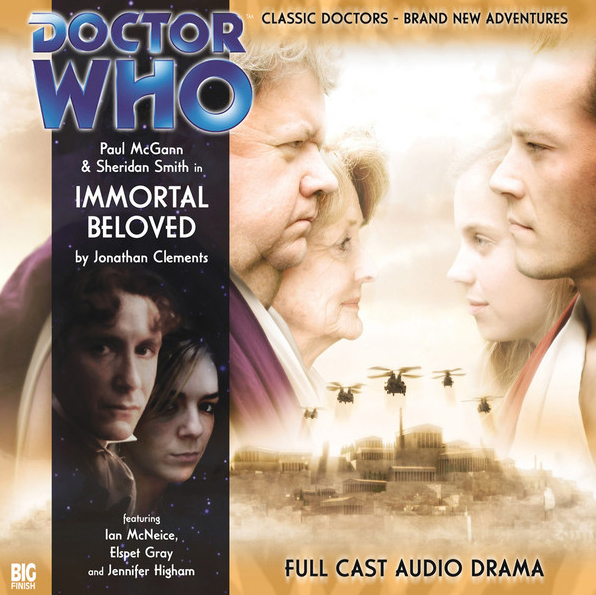
Immortal Beloved, the 2007 Eighth Doctor Doctor Who audio play, doesn't seem to have anything to do with Beethoven or the 1994 movie of that name. In this story, the Doctor (Paul McGann) and Lucie (Sheridan Smith) arrive just in time to prevent a pair of young lovers from committing suicide but unfortunately this leaves the kids vulnerable to the fate they were attempting to escape; having their brains wiped and their bodies used as replacement vessels for the elderly. So, yes, in case you had any doubts, that idea wasn't original to Get Out. I'm pretty sure it's not original to this audio play, either, but I can't think of older examples just at the moment.

It's a nice audio play, a short, 60 minute episode from the Eighth Doctor's series. Once again, though, it feels much too short, really not having enough time to establish the world of colonists and the love stories involved. The leader of the colonists, played by Ian McNeice sounding nicely like Michael Gambon, calls himself Zeus and his wife (Elspet Gray) is called Hera, their whole society modelled on ancient Greek myth. The mixture of sadness and repulsiveness in these characters trying to stave off death by murdering their own clones is nicely introduced but doesn't quite have enough time to develop.

Eight and Lucie continue to develop romantic chemistry, too, though it feels a bit rushed. I assume they've been on more adventures between episodes but it feels too soon for Eight to talk about how much she means to him at the end of the story. Sheridan Smith's performance sometimes makes her sound like Charley, Eight's first companion from the monthly range of audios, whose relationship was developed with him much more organically. There is a nice moment in Immortal Beloved where Lucie's trust in the Doctor is tested, though.

Twitter Sonnet #1211

Intentions saved a pack of gum from Hell.
Tormented tay attempts to sate the gut.
Of course the soup would fill the copper bell.
Unless we added just a single nut.
No mixture makes a really solid link.
As choral timers tick the pulse of feet.
A hoofless carriage brought a horse to drink.
Where knees and clouds at stations lately meet.
Intruding clouds confused the store with rain.
No falling peppers splashed the tile floor.
So boosted wheats and rice were muffled grain.
Entire crops were crowded round the door.
A certain ice was sweetened near the stove.
A troop of shades assembled near the grove.

Sunday, February 24, 2019

Is Glamour a Horror?

Here's a Doctor Who audio play I'd been wanting to listen to for a while--Horror of Glam Rock, an Eighth Doctor story from 2007. I love the title's play on the Fourth Doctor television story Horror of Fang Rock and it always stuck out when I was looking through titles. But I wanted to finish Eight's monthly range stories before I started on his own series. I finally had a listen last night and enjoyed it, though maybe found the variety of stories relating to the production a little more interesting.

The Doctor (Paul McGann) and Lucie Miller (Sheridan Smith) find themselves in 1974 Bramlington on an overpass during a terrible snow storm. They soon find the mutilated corpse of an aspiring glam rocker and so a mystery unfolds that involves the Doctor making frequent references to his love for David Bowie and Brian Eno. As a fellow Bowie and Eno fan, I certainly appreciated it.

Bernard Cribbins, shortly before he appeared as Wilfred Mott on the television series, here plays Arnold Korns, a cutthroat manager for rock musicians. You can tell this story was written during the Tenth Doctor era for how morally grey it is, Korns being a somewhat complicated character whose work ethic leads to something really horrible happening. But he doesn't become a villain and Cribbins' unassuming performance, even when he's grandstanding, made me continue to pull for him. Una Stubbs--Mrs. Hudson from Sherlock--is also in the story as a service station employee and it's satisfying and kind of sweet hearing her rebuke Korns for his callousness.

Taking another cue from the Tenth Doctor era, some romantic chemistry between the Doctor and Lucie is already in evidence despite this being only their second story together. The actors pull it off well--it's nice hearing Lucie's prickly guard slowly being lowered and Paul McGann is a cool Prince Charming.

Not all the glam rockers are dead in the story--a pop singer named Stephen Gately plays Tommy Tomorrow. Gately, who was a member of a band called Boyzone, died in 2009 from a congenital heart disease. According to Wikipedia, his last single recorded as a solo artist was "Children of Tomorrow", which was composed for this Doctor Who audio play.

Not the best lyrics but he has a decent enough voice and I like how he tries to imitate the sound of a 70s glam rocker. I guess it's appropriate that the only other time I remember hearing of Boyzone is when David Bowie was asked in an interview if the "boy zone" mentioned in his song "Looking for Satellites" was a reference to the band. Bowie said, no, he hadn't heard of the band at the time he'd written and recorded the lyric (I'm not sure where to find that interview now).

It's a good audio play though I prefer the length of the monthly releases--this one is only 45 minutes. Making it a bit like a television episode, I suppose.

Sunday, February 17, 2019

Daleks in the System

Sometimes even Daleks can be subtle. Blood of the Daleks, a two part Eight Doctor Doctor Who audio play from 2006/2007, is set in a colony beset by the social and political problems arising from resource scarcity in the aftermath of a global calamity. I found the portrait of citizens desperately scavenging, hoarding, and attacking people, paranoid about the politicians, and generally panicking nicely developed through the story.

The Doctor (Paul McGann) also gains a new companion in this, his first adventure in his own Big Finish series of audios outside specials and the regular monthly releases. Lucie Miller, played by Sheridan Smith, is a bit ornery compared to Charley Pollard, Eight's most recent companion for listeners at that point. And Charley was no shrinking violet. Lucie seems to get on the defensive about everything but that's somehow not annoying. Her sudden appearance in the TARDIS baffles the Doctor and over the course of the story we learn little else about how she got there, this being part of the general story arc of the series.

Hayley Atwell, four years before she was cast as Peggy Carter, also appears as one of the political types being menaced by a mob when the Doctor arrives. Which is not to say she's entirely innocent herself. But the villains here are the Daleks, of course. When they do finally show up, the title of the story, Blood of the Daleks, turns out to be related to a fixation with racial purity and one faction of Daleks seeking to destroy a mutated faction, much like in Remembrance of the Daleks. But in the context of the problems in the human colony it still works really well. I also loved the name of the colony, "Red Rocket Rising". It sounds like something that might have sounded hopeful but circumstances have easily made ominous.

Saturday, September 01, 2018

Five Doctors and Three Understudies

A Doctor Who story featuring five of the Doctors played by their actual actors, one of them being Tom Baker as Four (for real, not archive footage), wins by default. So although The Light at the End, the 2013 anniversary audio story, isn't especially well written, it's still well worth listening to for the Doctor Who fan. It has the added bonus of its writing not being especially bad, either.

Tom Baker, Peter Davison, Colin Baker, Sylvester McCoy, and Paul McGann all appear as the Fourth, Fifth, Sixth, Seventh, and Eighth Doctor, respectively, along with a selection of companions. The First, Second, and Third Doctors are also in the story but played by different actors, their original performers long deceased at the time of the recording. One and Two are both played by actors who'd originally played companions of those two Doctors--William Russell and Fraser Hines--which is fun but neither of them do especially good impressions. Actor Tim Treloar plays Three and he's not especially evocative of Jon Pertwee, either. The first three Doctors spend the story isolated in some kind of time bubble which distorts their voices slightly, like a bad transmission, and I had a lot of difficulty discerning which was which.

The plot involves the Master (Geoffrey Beevers)--a version of his incarnation in The Deadly Assassin and Keeper of Traken--and his scheme to trap the Doctor in some kind of temporal bomb that effects his first eight incarnations, causing his companions to fade and disappear. There are scenes where Four through Eight are together but mostly they work in pairs with Four and Eight bookending the story. Six has a crucial role, which is a bit disappointing. Four is kind of passive as though writer Nicholas Briggs was afraid of doing anything with him but it was fun hearing Four and Eight talk about the former's scarf. Five has a significant segment, a nice scene featuring Nyssa (Sarah Sutton) and a disastrous meeting. It felt like Sylvester McCoy didn't have much to do but Ace (Sophie Aldred) is amusing, calling Six "Joseph" after the biblical character for his coat.

Mostly this is just a story about sorting things out, moving pieces on a big Shuffleboard. The Day of the Doctor was better for getting at issues more personal to the Doctor and creating tension for his decisions but The Three Doctors remains my favourite anniversary story. The story of Omega feels more like it could stand on its own without the spectacle of multiple Doctors. But if you have multiple Doctors in your story, I will always tune in.

Twitter Sonnet #1150

A tested green revealed a spinach land.
A wary sprite instructs the pretty star.
Electric tables bring the brain to hand.
A cable lifts the stellar bucket car.
Delivered cups contained a set of clubs.
The empty pocket sought a billiard ball.
A daily speech succumbed to magic dubs.
The echoed thought will paint the violet hall.
A party coloured scroll described a light.
Impatient wings encode the torch's smoke.
A layered ash replaced the pallid sight.
Adjustments made a moth an able bloke.
A phony choc'late clogged confection's pump.
A medley changed a song into a clump.

Saturday, August 18, 2018

Responsibilities of the Doctor

The 2013 Seventh Doctor Doctor Who audioplay Afterlife feels more like a Tenth or Eleventh Doctor story than any audio I've heard so far. It's good, though, and it's kind of nice hearing Seven being taken out of his comfort zone.

Coming after the death of a companion in a previous audio, Afterlife begins with Ace (Sophie Aldred) furious with Seven (Sylvestor McCoy) over what she sees as his callous attitude. He tries to explain to her, as he has explained to many companions many times before and after, that he's gone through this so many times and his perspective as a Time Lord is so different from hers that he simply hasn't the capacity to grieve with the same levels of shock and horror that she feels. He makes an interesting point that, for him, all his companions are always alive and yet also always dead because all points in the timeline are equally real to him.

Of course, no explanation is going to make Ace's feelings go away so she finally talks him into visiting a relative of the deceased. The second and third acts of the story deal with resurrection and gods masquerading as gangsters which is partly airless and partly really intriguing. There's a lot of dialogue about whether the Doctor sees himself as a god, which makes sense considering how manipulative Seven typically is. But he finds himself frequently on the wrong footing as he's forced to deal with the emotions of others--"I keep getting things wrong!" he says plaintively a few times. At one point he's rescued kind of adorably by his occasional companion Sally Morgan (Amy Pemberton).

There's also a nicely sombre moment where Seven plays the spoons early on and a distinctively Elevenish-ish bit of grandstanding at the end which is effective coming from Sylvester McCoy and particularly gratifying coming after an audio where he spent most of the time off his game. Sophie Aldred's also really good, particularly in the early scenes, and there's some really good development for Ace's character.

Saturday, August 04, 2018

Doctor of the Parliament

1963 continues to be a busy year for the Doctor in the 2013 Doctor Who audio play 1963: The Assassination Games. The Seventh Doctor proves a natural fit for this entertaining conspiracy espionage thriller.

Neither the Doctor (Sylvester McCoy) or Ace (Sophie Aldred) show up for some time, the beginning of the serial featuring a press conference, an assassination, and some government men deciding what to do about it. John F. Kennedy's assassination is constantly referenced but Kennedy's name is never mentioned for some reason. In Britain dealing with this assassination are people from the UNIT predecessor Counter-Measures. The Assassination Games was one of several audios released for Doctor Who's 50th anniversary so it's fitting that it features an organisation introduced in the 25th anniversary television story, Remembrance of the Daleks, and Simon Williams reprises his role as Group Captain Gilmore from that serial.

There's a lot of misdirection and subterfuge which the story carries off well. Ace turns up as a housemaid and the Doctor seems to have become a Member of Parliament. As is so often the case with Seven, it's never completely clear how much he knows about what's going on. Less characteristic of him is some of the grandstanding he does in this story, giving a couple speeches about adventure and his blue police box that would've sounded much more at home coming from Eleven than the typically more mild mannered Seven. But maybe it was part of his politician role.

Mostly this is a good story. It features a direct reference to the inevitable fact that many years must have multiple Doctors visiting at once and there's an amusing moment where Ace nearly has a motorcycle accident.

Saturday, July 14, 2018

Return of the Dog

There's always a chance the oppressed will become the oppressors. The Soviets would've done well to remember that when they sent dogs into space in the 2013 Doctor Who audio play 1963: The Space Race. This slightly more amusing, more Cold War oriented, version of Planet of the Apes concept is also one of the gorier audio plays, making it perhaps appropriate that it is a Sixth Doctor story.

The Space Race is based on the true story of Laika, the stray dog sent by the Soviets to space in 1957. The real Laika died in the rocket but in this audio she returns six years later having somehow gained the power of speech and human intelligence. Voiced by Samantha Beart, she's at first mistaken for a missing cosmonaut by the Doctor (Colin Baker) and the staff of the Soviet space programme when they hear her voice transmitting from a rocket that had been stuck on the dark side of the moon. Laika only seems to want water and freedom until Peri (Nicola Bryant) helps her at which point Laika's motives become decidedly less sympathetic.

But, perhaps in reference to the Cold War setting, the Doctor and Peri are never quite sure who to trust. They themselves are posing as spies posing as scientists, an extra layer of subterfuge added to the Power of the Daleks concept. But the bloody and inhumane methods apparently involved in giving animals the ability to talk ethically simplifies things quite a bit.

The Six Doctor's run on television was distinguished by some exceptionally grim stories, most notably the proto-Hunger Games story Vengeance On Varos. Though Six is also an appropriate Doctor for this story because it was in the Sixth and Second Doctor story, The Two Doctors, where the Doctor became a vegetarian courtesy of writer Robert Holmes (who was himself a vegetarian). The Ninth Doctor would later be seen eating meat in the television story "Boom Town"; there's apparently no canon account of when or why the Doctor decided to start eating meat again (though apparently there was a Sixth Doctor comic that addressed the subject). The events of The Two Doctors are never mentioned in Space Race though vegetarianism does come up, understandably. Though, considering how much meat winds up being involved in this story, I'm not sure Robert Holmes would approve.

The writer of The Space Race, Jonathan Morris, has a lot of fun turning the rhetoric of uprising and revolution against the Soviets as Laika begins to organise her comrades. There's a minor romance subplot between Peri and a Soviet military sergeant (Stuart Denman) that reminded me of the flirtation between Ace and the Soviet officer in Curse of Fenric. It was an interesting contrast between how the Soviets were portrayed on Doctor Who in the 80s and how they were portrayed in 2013. The Eleventh Doctor story "Cold War" aired that same year but in the general rush of the one hour episode there's not as much time for conceptual contemplation. The Curse of Fenric, like The Happiness Patrol, might have been part of a general anti-Margaret Thatcher feeling in expressing sympathy for Communists. But it always struck me more as part of a recurring message in fiction of the 80s--not unlike Star Trek VI--to promote the idea of the shared humanity (or let's say sentience) between the parties of opposing sides. I might have liked a little more of that in The Space Race but it's an enjoyable audio play.

Sunday, July 01, 2018

A Day Not in the Life

Could The Beatles be swapped out in history for another band from Liverpool? Of course not and writer Eddie Robson has a lot of fun arguing that point with his 2013 Doctor Who audio play, Fanfare for the Common Men. Part of a series of audios recorded for Doctor Who's fiftieth anniversary, this one features the Fifth Doctor (Peter Davison) and his companion, Nyssa (Sarah Sutton), travelling to 1963--the year Doctor Who premiered--to see The Beatles only to be disappointed when a trio called The Common Men emerge from the plane to thousands of screaming fans.

Robson is clearly a Beatles fan and well versed in Beatles trivia and he cleverly weaves the biographies of John, Paul, George, and Ringo into the lives of Mark (Mitch Benn), James (Andrew Knott), and Korky (David Dobson). Parts of the story are framed by interviews with The Common Men in later years in which they have conflicting memories of the Doctor or Nyssa turning up at clubs in Liverpool or Hamburg or stopping a strange armed man at the airport.

Several Beatles-ish songs are heard in the audio play and the Doctor wonders why whatever sinister force that took the Beatles out of the picture didn't bother to steal their great songs in the process. Harnessing the psychic power of a rabid fanbase seems to be part of the plan and the story ultimately makes the point that there's no substitute for the songs written with the real genius of The Beatles. Though the Doctor concedes The Common Men aren't bad.

The band were first mentioned in the first Doctor Who serial, An Unearthly Child. Susan, the Doctor's granddaughter, had been a fan. In Fanfare for the Common Men the Doctor remarks he never understood their appeal. The audio is filled with Beatles quotes but here Dobson allows the Doctor an appropriate Bob Dylan quote when he adds, "But I was so much older then."