Showing posts with label the lord of the rings. Show all posts

Friday, October 14, 2022

The Rings of Battery Power

The first season of The Rings of Power concluded last night. I thought it was very bad. A few people I respect have said some positive things about it, though, so I've been trying to figure why. The visuals are nice and I've grown to appreciate some of the Pre-Raphaelite inspired stuff more. I liked the orange and blue in this scene with the Palantir.
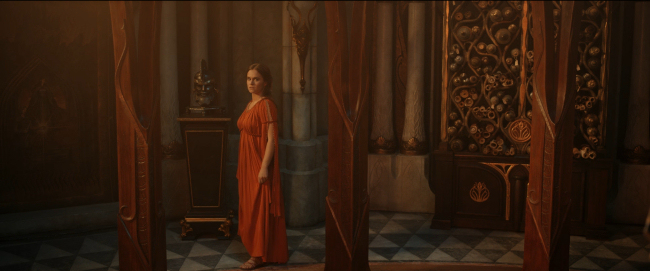
Maybe if I didn't know Halbrand was going to be Sauron and the bearded stranger was going to be Gandalf I'd have enjoyed the finale more. It seemed like everyone on the internet knew by the third episode that this was the state of things. Gandalf looked like Gandalf so I don't even know how that was supposed to be a secret. But in any case, the driving force behind the final episode seems like it was meant to be the question, "Who's Sauron?" Generally, even if the secret is very well concealed and cleverly revealed, I don't think this is a good peg for a story to hang its hat on. Especially not something with a lavish production which should hopefully encourage people to rewatch it. It can be interesting if you're using the obscure identities to explore an idea. There does seem to be some attempt at that. Gandalf believes he's "peril" and Nori gives him a speech about how he decides, with his actions, what he truly is, not someone else putting a name to him. Which is true, and something everyone knows to be a right moral answer. The aim of a story in presenting an idea, though, should be to show it in action, not just have a character directly state it to us. Even a simple idea like this could be interesting if there had been some genuine ambiguity. But Gandalf's only cause for concern is that he killed some fireflies, he accidentally knocked down a tree, and some scary looking strangers called him Sauron. It's a bit of a softball to say the least.
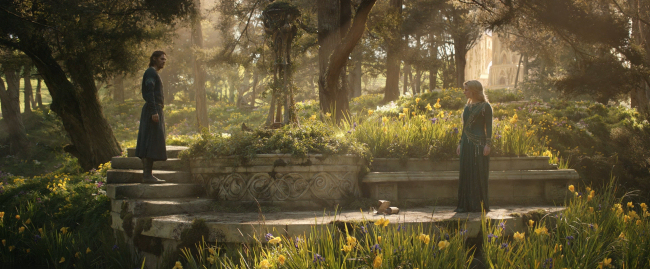
Similarly, the show tries to introduce tension about Sauron by having him throw back at Galadriel her statement about how anyone can atone for their past evils. I saw a quote from a producer on the show who said that, going forward, Sauron will be modelled on the Tony Soprano or Walter White anti-hero type. I can't see that working going forward unless the writers make even more significant changes to Tolkien's lore than they already have. Tony Soprano and Walter White both have clear, tangible, complex motives for doing what they do. Sauron says he wants to unite Middle Earth, with Galadriel by his side, under their rule. But Middle Earth isn't at war. The only physical conflicts have been with the orcs that Sauron himself created. And what's Sauron's motivation for this rhetoric? At this point, it just seems like he's trying to get in Galadriel's pants.
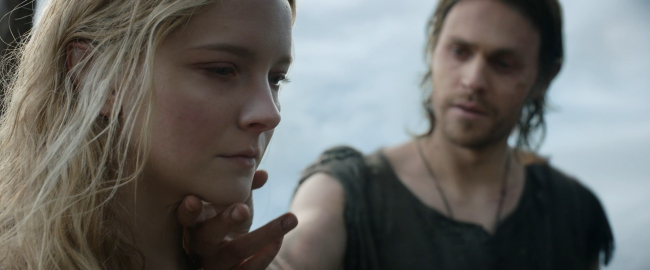
This is where the writing falls below the level of the Star Wars prequels. In Attack of the Clones, when Anakin has that interesting, foreboding bit of dialogue about how he thinks the government should be run--how people should be made to do the right thing--makes perfect sense coming from him. He's spent a lot of time fighting Separatists and dealing with a sluggish Republic bureaucracy and out of touch Jedi Order (admittedly, fleshing out from The Clone Wars series buttresses this dialogue considerably). All we know from this show is that Sauron was Morgoth's apprentice and they were trying to conquer the world. Maybe season two will catch up and give us valuable character development but with over nine hours of expensively produced episodes in the bag, it seems like this is something the writers should have been on top of already.
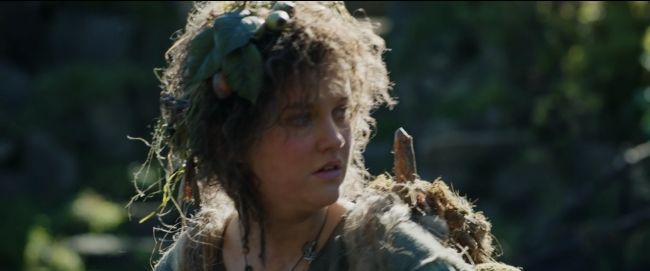
So those are the weakly delivered big ideas. What of the small matters? Elrond refers to "all of elfdom" at some point, which sounded lame. Galadriel investigating Halbrand by looking at a family tree on an old scroll hardly seems like the final, damning proof both she and Sauron act like it is. All of the emotional partings among the Harfoots were really empty because the series never got around to developing the characters.

I don't know. I'm trying hard, really, but I still don't see how this show is any better than a Transformers movie, or why I shouldn't feel sick and sad that this will be the first impression of The Lord of the Rings for millions of people.

The Rings of Power is available on Amazon Prime.

Friday, September 30, 2022

Of the Power and for the Power

Last night's Rings of Power was extravagantly stupid. For those who care about such things, that's hardly news. But there are plenty who prefer to be led by the bridle, so to speak, who judge a satisfying viewing experience by how much money was spent on it, or the context it was placed in by its creators and producers. So I've started thinking more about what Rings of Power means for The Lord of the Rings and the entertainment industry in general.

Recently, Nielson revealed that Rings of Power had more viewers than House of the Dragon. That's not so surprising. Amazon Prime has far more subscribers than HBOMax or HBO--people use Amazon Prime for other things besides streaming services. Rings of Power is PG, and House of the Dragon is adult. Amazon Prime is also much better distributed globally. Where I live in Japan, I find people I talk to have generally never heard of Game of Thrones or Lord of the Rings but I've seen some marketing here for Rings of Power and none for House of the Dragon. Rings of Power is fully translated on Japanese Amazon Prime. There is a streaming service here that carries House of the Dragon but I've never met anyone who has it.

So what is this strange thing we call Rings of Power? It hasn't succeeded on the merits of its creative talent. The closest analogy I can think of is the Transformers movies, films on which millions of dollars are spent despite terrible reviews and gradually diminishing box office returns. But Rings of Power was launched in an environment in which the IP had been damaged by an unpopular set of movies--the Hobbit movies--and one in which any financial gains from the project would be irrelevant or difficult to measure. I suppose if it were a series everyone loved, it might have driven up Prime subscriptions a little, but virtually everyone who can afford it already has Amazon Prime. There doesn't seem to be any rational reason for this thing to exist, which led to my theory last week about it being part of a money laundering scheme--that, and the fact that only a fraction of the money reportedly spent on the show is visible onscreen.

I called the show the Spruce Goose of the streaming era and, like Howard Hughes' expensive and ultimately useless vanity project, Rings of Power ultimately seems to be a flex for Jeff Bezos. It's a sign that we more and more live in a world where things are dictated by very wealthy minority as every day presents new stories about some massive franchise or internet service Jeff Bezos or Elon Musk has bought recently. Interestingly, Rings of Power actually reflects this reality. Last night's episode, "Udun", presented a story about ultra rich people swooping in to save the day contrasted with poor people too dumb and hateful to know what's in their best interests--the conclusion of the episode showing a leader of the people I call the hillbilles--because of their distinctive overalls--setting in motion a terrible catastrophe. One could read into it an allegory about how dim-witted poor people are responsible for climate change. In this light, the real competitor for Rings of Power may be Andor, which features poor, working class protagonists fighting against a wealthy ruling class who have little interest in the needs or wants of their social inferiors.

But last night's Rings of Power also introduced a "sympathetic orc" subplot, revealing the disfigured elf in charge of the orcs, Adar, is in fact an orc himself, one of the first of the elves who were twisted by Morgoth to create the orc race. Which of course immediately makes him more interesting than anyone else on the show, in the process also deviating considerably from the kind of story Tolkien sought to tell with the orcs. But not so far from the kind of story Tolkien sought to tell with Gollum, so I'd say it could be fair game, but it's handled very badly. Adar has something like a St. Crispin's Day speech, all but calling the orcs his band of brothers, and his dialogue with Galadriel is about how the orcs are slaves and oppressed people. This would explain why the orcs would attack Sauron or Morgoth but does nothing to explain why he's attacking humans and elves. Galadriel starts to come off as a bloodthirsty tyrant in the dialogue, too, which may have been partially intentional but raises too many questions and inconsistencies. For example, as Galadriel mentions, it was known among the elves that Morgoth captured and twisted elves to create the orcs. Was there ever any discussion of redeeming them? Of rescuing them? What happened to make the elves so firmly set against the idea? If we don't know this, we can't gauge how irrational Galadriel is being.

I'm tempted to say the ultimate effect of The Rings of Power will be to put another nail in the coffin of the Lord of the Rings IP. But it's so disconnected from the actual interests of the audience that it may be an indication of a future media landscape in which the majority of viewers are invited to get what satisfaction they can from the scraps of feasts that the wealthy commission for themselves.

Rings of Power is available on Amazon Prime.

Twitter Sonnet #1627

A burst of blue absorbed a metal pill.
A cloudy cup consumed a coffee break.
We put a blender deep beneath the will.
A breaded flake does not a pastry make.
The second tea dispersed the lump of dough.
A frozen cream delights the varied mob.
The angel knocked her arrow by the bow.
The corn exceeds the length of Mister Cob.
A billion lights were dead before the flame.
A withered moose believed a grassy thought.
The falling status burst the killer's name.
We broke a wooden sword to mend its rot.
The doughy ring has swelled with oil juice.
A billion babies ate the copper goose.

Friday, September 23, 2022

The Restrictive Ring

Last night's Rings of Power was the second best episode so far, after the one written by Gennifer Hutchison. It was badly written and filmed, like all the episodes, but it felt sort of like it could have been a weak episode of a strong series. The writer, Justin Doble, who's written for Stranger Things, seems like maybe he's a kind of writer who specialises in padding episodes, episodes where the few important things that happen could have easily been shifted to a prior or subsequent episode but, for whatever reason, the show needs to meet a certain episode quota. So a "hack" in the original, slightly less derogatory, sense of the word.

The main reason I think this is the case is the episode's indulgence in a device I like to call "Everyone Always Finds Out Everything". This is something you see repeatedly in the later seasons of The Expanse, another Amazon Prime series. One character does something or has something they need to keep secret from one or multiple people. An episode or two later, those people find out and we have the "Can we still be friends/allies?" conversation. We find out where the two stand with each other by the end of it, which is generally right back where they started. It's stupid, especially as a device that is used repeatedly. You don't have to be a conspiracy theorist to say that sometimes people in real life successfully keep secrets. It's really just a way of treading water until the show gets to a more important episode.

In this case, it's Elrond's promise to keep Durin's secret about the mithril mines. The way in which the secret is revealed involves some especially gratuitous strains of logic. The vague diminishing from The Lord of the Rings that compels the elves to go into the west has been recast as an affliction only mithril can somehow cure. The substance Durin believed the dwarves came up with a name for, and which Elrond seemingly translated properly to elvish for the first time, is now in this episode something the high ranking elves already know of by name. And then Elrond does an unintentionally hilarious job of keeping the secret. When Gil-galad basically asks him, "Do the dwarves have mithril?" Elrond basically says, "I promised I wouldn't tell." It wouldn't take a genius to interpret that as "Yes."

And then it cuts to a shot of Celebrimbor actually holding the chunk of mithril Durin gave Elrond and Elrond is wringing his hands, talking about how he has this secret and he's torn between his friendship and his loyalty to the elves. But . . . . Man, clearly you've divulged the information to Celebrimbor.

There was a moment I kind of liked in the episode where Probably Gandalf saved the Harfoots from wargs. That at least had some drama to it. As action sequences go, though, the show is still rather weak when it comes to swordplay, as can be seen in Galadriel's lumbering, heavily edited training scene.

Not for the first time, I started to wonder where the money really did go. I can believe, with the sets and costumes, and weak actors, the show cost maybe a little less than a million. But ten million? Twenty? No way. Could Rings of Power be part of a big money laundering scheme? I guess it's better than Laser Tag.

I heard a lot of people believe that Halbrand is going to turn out to be Sauron. I guess that would fit with the show's pattern of racial and gender casting in which white men are all evil or pathetic (or both). Pharazon, the Numenorean wise man with the black and white beard, was revealed in this episode to have a racial hatred of elves despite having helped Galadrel escape from prison in the previous episode.

Last night's episode also had half of the white hillbillies defect to pledge loyalty to whom they think is Sauron. If that guy doesn't turn out to be Sauron I wonder who he is meant to be.

The Rings of Power is available on Amazon Prime.
Friday, September 16, 2022

The Ring Goes Round and Round

I watched some paint dry last night for about an hour, but it was really expensive paint called The Rings of Power (etc, etc, etc). I can think of few such stark examples of ten cent imaginations working on a billion dollar budget.

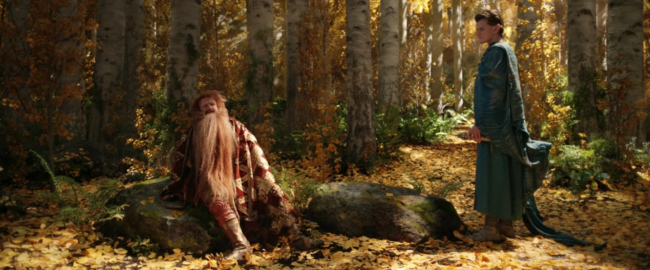
Most people talk about how bad the writing is but the visuals deserve some mockery, too. Yeah, the sets and props clearly show the amount of detail a pile of money can buy. But there's not a single interesting composition, there's nothing interesting about the colour schemes beyond how well they imitate Pre-Raphaelite and John Howe paintings. It's like the director just shrugged and said to the production designers, "I don't know, do something expensive."

The action scenes are getting dumber, too. My favourite was Galadriel overpowering a group of armoured guards putting her in handcuffs. Okay, it's a bit silly they decided to turn Galadriel into a genius martial artist, but if you're going that route, and you have all this money, shouldn't you show us how she manages to do something like this? The best I can make out is she just kind of pushes the five guys twice her size with her little bare hands.

Is this elven magic? You want to weave some kind of story around Galadriel's prowess? No?

Again, the racial casting fits a clear pattern. A bunch of working class white guys in Numenor gather to protest elven immigrants taking their jobs. In Tolkien's lore, some Numenoreans became jealous of the immortality of elves. Tolkien, who hated allegory anyway, obviously couldn't and wouldn't have made this nonsensical caricature of Trump voters.

And, once again, no-one's East Asian except one or two background extras, which dispels the argument that the show's leaving East Asians for the Easterlings. I guess, as far as main characters went, injecting anachronistic racial diversity was important, but they thought Asians were a step too far. Or maybe they're just racists.

The Lord of the Rings: The Rings of Power: The Energy of Jewellery: The Finger Cuffs of Sauron: The Golden Cheese: The King of the Hula Hoops is available on Amazon Prime.

Friday, September 09, 2022

The Circles of Rote

Last night's Rings of Power was the best visually and the worst in terms of writing so far. I was finally able to really see the budget onscreen when Galadriel and Halbrand got to Numenor. It looks like a Pre-Raphaelite Ancient Greece, like a Lawrence Alma-Tadema painting.

Unfortunately, the Numenoreans turn out to be a bunch of broadly written twits whose slogan is "The sea is always right." Oh, boy. Are you sailors are bellhops?

Galadriel and Halbrand get to talk to the Queen Regent. Halbrand advises the Elven noblewoman hundreds of years older than him to kneel but the Queen Regent tells them no-one kneels in Numenor. There's a handy way to show your guests the disrespect of trashing their voluntary signs of respect. It makes the Queen Regent look like a jerk to me but I live in Japan, where everyone still bows to each other, so I think we're meant to think she's very wise and egalitarian.

The real disaster on this show is Galadriel who seems to despise everyone she speaks to. And there was a really strange, slow motion, horseback riding scene that lingered on her unflattering facial expression.

Some of this might be intentional. I noticed a few of the people working on this show also worked on Outlander, which also features a female protagonist who is abrasive while also being constantly in the right among groups of men who are persistently wrong for no logical reason. This is a staple of women's pulp fantasy. Mind you, not feminist fantasy, but the cheap wish fulfillment kind. I think that's the genre and target audience the makers of this show are aiming for. It shows with the Harfoots, too, where Nori is quickly being established as the Lone Troublemaker Woman heroine type amid a community of proto-hobbits who apparently abandon their weak for dead in a somehow traditional migration.

The show is riddled with many other logical problems and bad dialogue but this is all beside the point. A lot of money was spent to make this a cheap indulgent fantasy. It actually makes a bit of sense, it may even turn out to be a sound investment if the right kind of viewer is attracted to this fluff. I find it difficult to believe anyone working on the show likes Tolkien's books, though.

The Lord of the Rings: The Rings of Power: The Power of Rings: Of Sovereign Rings: The Rings of Rings: Ringo la Bingo is available on Amazon Prime.

Twitter Sonnet #1620

The swirling dust was trapped above the room.
The whisp'ring guests began to fear the dark.
No shadow jumped but told the souls of doom.
Eleven strikes then softly burned the mark.
The odd appendage burst the brick and stone.
A crimson glow defined a graven cage.
The safest house became a brittle bone.
A stalking threat condemns the holy base.
The standard goblin snarl was lacking blood.
Eternal rage consumed the swimming elf.
The withered hands of paper soaked the mud.
A broken skull observed from lofty shelf.
Above the fragile roots are cotton skies.
In cakey veins the cherry river lies.

Monday, August 16, 2021

Shire Impressions

I'd gradually been getting into the mood to watch Peter Jackson's adaptation of The Fellowship of the Ring for a couple years. In the two years before leaving the U.S., I read The Lord of the Rings twice, first in my hardback and then as an audiobook in the last month before I left the country. At that point I wasn't at all in the mood for Jackson's movies and it'd become clear to me just how tonally different the book is to them. It may be that I was identifying with book Frodo in ways I couldn't with movie Frodo, too. Elijah Wood was a smooth-faced boy while the Frodo of the book was a hobbit of fifty years when he left the Shire. I felt closer to the stage of maturity and age Frodo is shown to have in the book but I think, even more than that, the process Frodo went through before leaving the Shire, of gradually selling or giving away his home and possessions, over the course of months before leaving, seemed to mirror my own experience. I was listening to that audiobook in my car while I drove to places where I could sell my books or donate a lot of my clothes. And there was the sense of doom hanging over everything. Corona was just gaining traction but I'd had an impression of incremental decline in my home city of San Diego for years.

I did love the Peter Jackson movies when they came out twenty years ago. I remember watching Fellowship of the Ring before driving to Seattle, my first big road trip, and it calmed my nerves a lot. The film presents more of a young man's adventure rather than an unseasonable exile.

But Japan is no Mordor. Frodo was going towards a bleak and horrible destination while I was fleeing to someplace I'd always longed to visit. And I found the good impressions I'd had of Japan not only proved to be true but better than I'd cautiously imagined. Maybe it's working with kids, too, that got me in the mood for the films again, though Lord of the Rings is sadly not popular or even well known around here.

I could watch them on Australian Netflix if I used my VPN but only the theatrical cuts and that just seems pointless. I was pleased to find HBOMax has the extended editions.

As with Labyrinth, I marvelled at what a feast Fellowship of the Ring is in terms of production design. But of course it's even more ambitious than that. What a miracle this movie was financed, a movie that's so many things. What other movie has scenes like the boys reuniting in effervescent Rivendell along with scenes of the billowing black smoke creature in Moria? A movie with an amusing birthday party and also heads being lopped off? Few movies dare to devote so much time to such disparate tones, at least in Hollywood now. The closest analogy I can think of is the old biblical epics or certain Bollywood films. Films designed for audiences who plan their whole day around one very long movie.

It begins all wrong, with a history lesson, Cate Blanchett dumping exposition on us. Everyone knows you're not supposed to do something like that. The book doesn't start that way, every movie that imitated Jackson's was just shooting itself in the foot. In itself, the info-dump in Fellowship isn't good cinema but when taken as part of the whole it works very well. It really is a history lesson so when you start to get little call-backs throughout the film, new little snippets of Isildur or Sauron, it feels like encountering some real, physical evidence of something you heard about in a history class long ago. It gives you a nice, creeping feeling of having been warned, but not having appreciated the warnings, far in advance.

The film's excessive closeups, that were so refreshing at the time, haven't aged well. My opinion may change on that in ten years. But they don't hold up like Sergio Leone's famous long closeups primarily because of the pace of the editing. Leone lingered on closeups but he also lingered on wide shots more.

The performances and casting are all pitch perfect, though I might quibble over Elijah Wood and Sean Astin. I've always felt British or Irish actors would've been better in the roles and I still do. But they're not really bad. Ian McKellen has the perfect combination of warmth and wisdom and a genius for subtle but clear expression. Viggo Mortensen has that cagey stillness about him moderated by subtle, sensitive quirks of the eyebrow or a faint grin. He really comes off as self-possessed, someone perfectly suited for leadership. Sean Bean, jockeying for time among everything else in this movie, believably establishes Boromir as a man torn between resentment and respect for Aragorn.

Jackson generates terrific excitement. The Moria sequences have a real swashbuckling sense to them. Gandalf's apparent death is still gut-wrenching.

I just realised December this year will mark the 20th anniversary of the film's premiere. Twenty years is a long time but it's recent enough to still seem like a miracle of modern cinema. To me, anyway. To plenty of kids, it's as ancient as the Great Depression or World War I.