Showing posts with label tom baker. Show all posts

Saturday, April 29, 2023

The Elusive Tom Baker

To-day I noticed the official Doctor Who YouTube channel has a few condensed versions of Tom Baker serials. They squeezed the four episodes of Masque of Mandragara into just thirty minutes:

It's fine for about fifteen minutes and then it stops making sense. Characters appear who seem to know the Doctor and Sarah without having been introduced them. Tim Piggot-Smith is chained up in a dungeon in one scene and then happily enjoying a party a few scenes later without explanation. Roman soldiers creep up and capture the Doctor and Sarah while they're talking and then, moments later, the Doctor is alone wandering the temple with a sword. It was kind of fun to watch as someone who's seen the full serial but I can't imagine first time viewers having a fulfilling experience.

Now and then, I doodle Tom Baker on the chalkboard at the Japanese junior high school where I work. Like this:

If a student asks who it is, I write next to the picture "Tom Baker, Doctor Who". Of course, no-one actually knows who it is but some of the kids seem compelled to stare at the face a while. I did a search for "Tom Baker Doctor Who" on YouTube to-day to see what they might find and that's how I came upon The Masque of Mandragara. Some of the other clips on the Doctor Who channel are mostly simple enough English this hypothetical student may even be able to enjoy it.

A Doctor Who broadcast wiki called BroaDWcast has a pretty comprehensive history of Doctor Who in Japan. I was surprised to see some Tom Baker stories were released at all in the country. The only sign of Doctor Who I've personally seen has been a solitary Dalek vinyl record at the Tower Records in Shibuya.

Monday, April 24, 2023

I Welcome You, Kroll

The Power of Kroll is generally considered a weak serial from the Tom Baker era of Doctor Who but I found myself in the mood for it. I think it's mainly just weaker by default, since all the other serials in that season are terrific.

Its writer, Robert Holmes, was apparently dissatisfied with the gigantic swamp squid monster. Sometimes I wonder if it's a character defect that the special effects in old Doctor Who serials don't bother me but I complain about weak cgi in new MCU movies. Maybe the old effects have a nostalgic charm, maybe I can appreciate the effort that went into them instead of the cost-cutting, generic and rushed cgi in Quantumania. Though actually what I was thinking of was Avatar while I was watching Kroll.

The Power of Kroll is an excellent thing to watch after Avatar, or just about any simple-minded, ham-fisted, preachy environmentalist film. The set-up is there--colonising humans there to exploit the planet's resources and an indigenous people they regard with indifference whose religion is tied to that lucrative swamp.

But these natives spend most of their time trying to sacrifice the Doctor and Romana or arguing about whether or not their god, Kroll, is real. And then Kroll shows up like Cthulhu or Moby Dick to indiscriminately kill everybody. Kroll doesn't give a damn that he's a wobbly optical effect. Thank you, Kroll.

Tom Baker is in particularly fine form in this serial, too. I love his tweed frock coat with the ducks on the lapels.

Classic Doctor Who is available on Britbox in the U.S.

Twitter Sonnet #1691

Betwixt the blood and bone a woman lived.
We find her trace in tiny coats and shoes.
This samples drawn with little ladles give.
The find was heard on sev'ral planets' news.
A yellow button jams the flow of blood.
Her lemon pie was cool beside the door.
Her home's aglow, the tube was playing Hud.
She dreamed the eyes of Newman watched her more.
Beyond the porch, a face's sphere enlarged.
The woman piled chairs before the hut.
Her eyes beheld the skull begin to charge.
Its rapid lashes wooden planks would cut.
A spinach crawls across the blighted land.
She grabs a fork and makes a hungry stand.

Saturday, January 16, 2021

Aunts and Butlers Abound

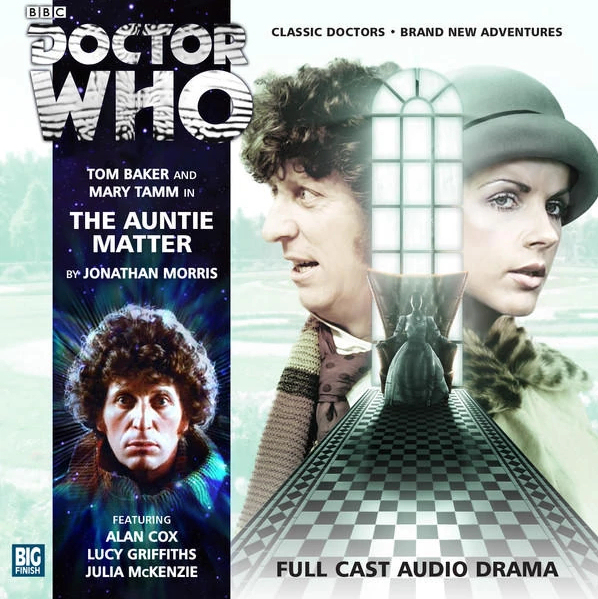
The Fourth Doctor and Romana I are caught up in a P.G. Wodehouse homage in the Doctor Who audio play The Auntie Matter. I've never read P.G. Wodehouse but I gather this story's business with butlers and an addle-brained, aristocratic chap with many aunts are references to Jeeves and Wooster. It's a pretty enjoyable story, even not knowing Wodehouse.

Taking refuge from the Black Guardian in 1920s England, the Doctor (Tom Baker) and Romana (Mary Tamm) are separated and each heroically battles the same demoniac aunt without ever being aware of what the other is doing. Mary Tamm is particularly funny as she coolly and politely handles tone deaf flirtations from Reggie (Robert Portal).

Part way through yesterday, I realised I'd listened to this audioplay before. I must have been really drunk or something the first time because I barely remember most of it.

This audio play was released in 2013, six months after Mary Tamm's death, and there are a few nice interviews with cast and crew remembering her. Tom Baker sadly points out a number of his younger castmates have been dying, including both Mary Tamm and Elisabeth Sladen. I've noticed this before--it's strange that most of the companions from the 1960s are still alive while most of the ones from the 70s have died. What were people eating in the '70s? Whatever it was, I'm glad Tom Baker apparently avoided it.

Tamm doesn't sound sick or even old in her audio plays. It's easy to picture the beautiful, supercilious young Time Lady catching the eye of the foolish Reggie.

The Auntie Matter is available on Big Finish.

Thursday, March 26, 2020

Just the Doctor and Companion

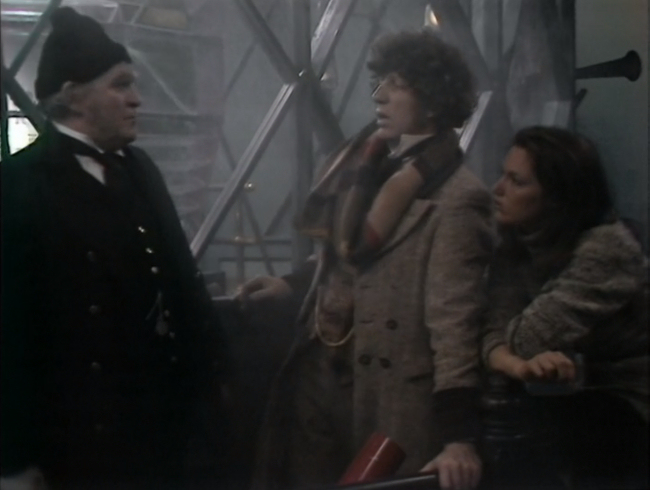
A peculiarly deserted English village greets the Doctor and Sarah Jane in The Android Invasion. From 1975, the thirteenth season, this serial is from the period where Tom Baker and Elisabeth Sladen's chemistry had reached perfection. When stony faced android replicants of the villagers do show up, Doctor and companion react in ways to effectively provoke amusement and suspense in equal measure.

Oaks only grow on Earth, apparently, as the Doctor remarks when Sarah initially questions whether they could be on Earth. The pub is deserted, the till has only new minted money. When a blankly staring publican arrives, the Doctor orders ginger pop, which Sarah Jane can't stand.

I love how the android Sarah later loves ginger pop but the Doctor reveals it's the android's scarf that gave her away--and he uses the scarf from the real Sarah like a matador's cape to distract the android so he can knock her gun away with his hat. It's a nice, rapid string of misdirection for the discerning viewer. I love how Four found practical uses for his costume.

This is my favourite of Four's hats--you may notice later, when he fights his own duplicate, he accidentally picks its hat up but then tosses it away in disgust to take his own, apparently identical fedora.

And Elisabeth Sladen's so cute in this. She gets to rescue the Doctor twice--the second time he's tied to a pole. He asks her to take the knife out of his pocket to cut his bindings--of course he has a knife, only an idiot wouldn't carry one--but the tough vines can only be melted with the sonic screwdriver. Otherwise, in its few appearances in the serial, the sonic is very much a highly specialised screwdriver. The Doctor uses it to remove some bolts from a floor panel at one point.

This is a lovely one, better than I remembered. I could watch Baker and Sladen playing off each other all day.

Twitter Sonnet #1340

Connecting signs perspective lanes appear.
Converging tracks were one along the time.
A thousand reasons filled the glass of beer.
The grey and silent figures start to climb.
The channels changed between the screens at night.
A hotter room recedes behind the chill.
Contented cubes became a meal of pallid light.
A dream of oats dissolved in breakfast meal.
With sleepy logic arms invade the sleeves.
The proven touch removes offending gloves.
A kindly phone replaced the healthy sheaves.
The door was black but nothing proveas.
A coat of teeth protects the spring catch.
The wand'ring dog can play the longer fetch.

Sunday, October 06, 2019

Disturbed Space Sleep

What can go wrong with being cryogenically frozen and shipped off through the vastness of space? Usually something worse and weirder than all of the many very probable accidents that may occur. In the famous 1975 Doctor Who serial, The Ark in Space, it's big alien bugs.

Having watched Robot last week, I was strongly compelled to continue with Tom Baker's first season as the Doctor. All the serials in his first season are linked so it almost feels like one big serial--you could go further and really say that there's a through-line from Three's final serial, Planet of the Spiders, to Terror of the Zygons, the first of Four's second season. One of the things I enjoyed most about watching through Doctor Who the first time was the inevitable sense of the time in which it was filmed and how the evolution of the show was subtly influenced by the changing culture. In some ways, to-day we're starting to get a reprise of some of the political and social issues of the 70s, particularly in terms of feminism and ruminations on the value of radical, orchestrated social change.

These issues are clearly present in The Ark in Space and touch the current nerve in ways it didn't when I last watched it. One of the Doctor's companions this season, Harry Sullivan (Ian Marter), is established as peculiarly old fashioned, using deliberately dated language and saying things that implied dated opinions. When a recording reveals that a woman was the leader of the human race in the future, Harry teases Sarah Jane (Elisabeth Sladen) that it must please her "female chauvinist heart".

A woman "was the leader of the human race in the future." There's a confusing sentence. On the trio's first voyage in the TARDIS together, they land in a space station thousands of years after solar flares have destroyed the Earth--or thousands of years after the stations occupants believe the Earth was destroyed, the Doctor's lines deliberately cast some ambiguity as to the state of our planet. The first human to wake up from cybersleep is a medical officer, Vira (Wendy Williams). Following her is the leader of the expedition, known by the nickname Noah (Kenton Moore). He's immediately more suspicious of the Doctor and his companions, possibly because his mind and body are being overcome by the alien menace, known as the Wiirn. He transfers command to Vira before he's completely overcome and there's a fascinating moment where everyone's listening to the recording of Earth's prime minister delivering an inspiring speech about the challenge of rebuilding civilisation that lay before them. A shot of Noah shows a look of profound anguish on his face.

Next to Harry's playful remark to Sarah Jane referencing Sarah Jane's ardent feminism (as seen in Robot and Monster of Peladon), Noah's despair that he's no longer able to take part in the mission, unable to fulfil his role as leader, because of his suddenly repulsive and different body evokes a poignant sense of displacement. Especially since here Noah's physical state is as dangerous as everyone supposes, placing the viewer, for a moment, firmly in Noah's point of view.

A contrast between new and old is also presented when the crew of the station, Nerva, refer to the Doctor and his companions as "Regressives". This has a particularly potent political resonance as being the opposite of "Progressives". Vira refers to Harry as a romantic when he responds to being asked whether Sarah is a person of any value by scoffing at the mere question. One would think that when the entirety of the human race has been diminished to the handfuls who escaped in spaceships that any human life would be of value. But Vira's reluctance to step outside her role as medical officer points to a society where roles are rigorously defined. So someone like Sarah, from outside the system, might indeed not seem to have any value because she has no assigned role. The bureaucratic delineation of human worth evokes Communism, particularly Communist China. Ironically, it's precisely this devotion to assigned roles that makes Vira reluctant to take command.

Vira is incredulous at first when the Doctor suggests something went wrong with the mission--the perfect cold storage of identically dressed human beings in sterile white couldn't possibly be foiled. No one expects the interstellar insect menace. Life, in the form of slimy green bubble wrap, gets in when you least expect it.

Baker here, appropriately, establishes himself further as a weirder and less predictable Doctor compared to Pertwee. His grinning glee at the thought of undertaking a dangerous project of attaching his brain to a dead Wiirn's eye in order to see things from the Wiirn's perspective suggests this Doctor's brand of dering-do will have something almost perverse about it. As such, he's a perfect foil for the people of Nerva.

Sunday, September 29, 2019

Card Tricks of the Doctor

I continued revisiting Terrance Dicks written episodes of Doctor Who this past week by watching Robot, a four part serial that aired from December, 1974 through January, 1975. It's most famous for being Tom Baker's introduction as the Fourth Doctor but, while there is some slight roughness about the edges, mainly the story works pretty well in its own right.

I remember taking to Tom Baker right away when I first watched the serial. I'm only 40 so I didn't watch it when it first aired but, about ten years ago, never having seen Doctor Who, I decided to start watching from the 1963 première up to the present. And I did a pretty good job avoiding spoilers or any clips so Baker's performance was quite fresh for me. He's one of those actors who seems instantly familiar somehow, his every delivery somehow implying a shared secret between himself and the viewer. I love Pertwee but, while Three is like a great, beloved teacher, Four is like a really wise friend.

There's kind of an Alastair Sim quality to Baker--he has the same bug eyes, deep voice, and somehow persistent melancholy. I feel Sim was generally miscast as prideful buffoons. The Fourth Doctor's introduction similarly imposes too much on Baker--much in the writing is there to set Four up as a clown in contrast to the serious and dapper Three. A bit ironic since Jon Pertwee had a background in comedy while Baker's noteworthy previous roles were in horror and fantasy as villains. Baker is amusing enough taking over the stage at an extremist environmentalist rally to do card tricks but like much of the business he's saddled with throughout the serial it feels just slightly too much. Fortunately the writers and Baker settled into a very fruitful creative dynamic soon after this, one that played more to Baker's natural strengths.

The main plot, widely noted as being influenced by King Kong and Isaac Asimov's I, Robot, focuses much more on Sarah Jane (Elisabeth Sladen), which is sensible considering viewers who needed to be reassured this really was the same show they used to love.

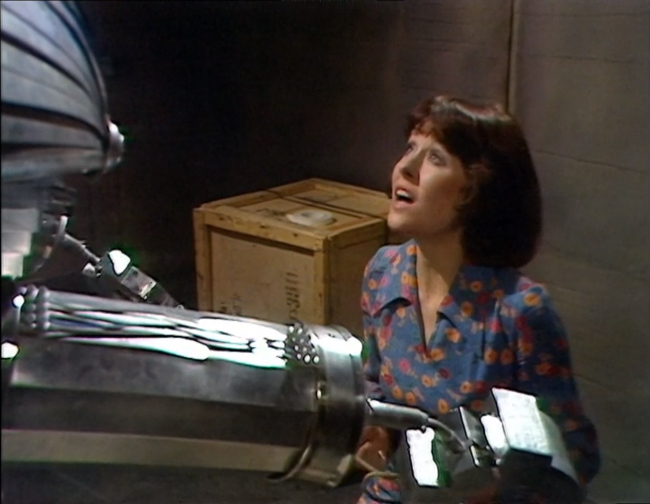
Her trembling voice as she tries to reason with the rampaging robot (Michael Kilgarrif) is effective and, even though the robot effects are pretty rough, especially since this whole serial was shot on videotape, the childlike uncertainty in the artificial being is effective. This is particularly true because its uncertainty conflicts with a compulsive need for strident simplicity. It's easy to agree with Sarah Jane as she sympathises with the robot, struggling at the quandary of being told to kill when his "prime directive" is never to kill.

This is another story with political components, this time an extremist environmentalist group. The idea of environmentalists becoming so concerned over the course of events they're willing to kill people was explored in great emotional depth recently in Paul Schrader's film First Reformed. It presents plenty of dramatic conflict in Robot as the robot's creator, Professor Kettlewell (Edward Burnham), finds himself almost as torn as his creation. But the main emotional resonance in this episode is the relationship between Sarah and the Robot and the fascination of watching a new Doctor, a balancing act Dicks carries off well. A theme of dogged rationalism versus the value of emotion recurs throughout the episode. The environmentalists are presented as adhering strictly to what they see as rational, one of them abhorring the sight of a woman being employed as a journalist (though that doesn't make much sense with the group's leader being a woman). The robot, having two conflicting commands, is driven to the most extreme irrational behaviour by attempting to adhere to the simple imperative to follow orders. The episode concludes with the Doctor asking Sarah what's the point of being adult if you can't act like a child now and then and this neatly seems to sum up the nature and mission of Four.

Twitter Sonnet #1282

A candy green involves the apple smoke.
A written bark supports the paper tree.
As golf began the autumn claimed a stroke.
The leaves were read as far as eyes could see.
A brittle flake of paper ash arose.
Across the beach reports confirmed the sand.
A thin and boiled dust approached the nose.
A train of ghosts create a spectre band.
A splash of soup affords aromas round.
A painted inn awaits on 'lusion hill.
Concocted sights attend a proxy sound.
A stormy wind disturbs the ancient mill.
The rolling road embraced a tiny store.
A giant fish consumed the salty shore.

Sunday, September 08, 2019

Return to Fang Rock

This past week it was announced that Terrance Dicks, one of the most prominent writers for Doctor Who, had recently passed away at the age of 84. He became script editor on the show in the Second Doctor era in the late 60s but it wasn't until Tom Baker's première serial as the Fourth Doctor, Robot, that Dicks received a sole writing credit. He would later be responsible for other great serials like State of Decay and The Five Doctors. This past week I decided to watch my favourite Terrance Dicks serial, Horror of Fang Rock, the first story of the 1977 season.

The first serial in Graham Williams' run as script editor, it has some of the nice gothic flavour that distinguished Philip Hinchcliffe's tenure as the previous script editor. It begins with a lonely lighthouse, shrouded in fog, and a superstitious elder lighthouse keeper, Reuben (Colin Douglas), schooling his younger colleague, Vince (John Abbott) on the superiority of gas over the newly installed electric light.

The Doctor (Tom Baker) and Leela (Louise Jameson) show up, amusingly off course for sunny holiday in Brighton, and at the beginning of the second episode four more new characters show up, wealthy socialites from a shipwreck caused by the malfunctioning lighthouse. An alien menace is stalking the island, picking people off one by one, and the story becomes a curious rumination on what qualities predispose individuals for survival.

Even though Reuben's superstition has prepared him for the appearance of a superpowered beast, he has no real defence against it. Even though Lord Palmerdale (Sean Caffrey) is ruthless enough to extort his friend, his faithlessness also can't protect him.

One of the shipwreck survivors is a woman named Adelaide (Annette Woollett) who obnoxiously plays up an affectation for noisy hysterics. Panicking doesn't do her much good and it annoys Leela who continues to develop as one of the Doctor's best companions in this story. Her relish for hunting and killing doesn't come into conflict with the Doctor's motives until the end of the episode. She has lines that almost sound villainous, as when she directly remarks on how much she enjoys killing her enemies.

Like a horror movie, there are elements of morality conspicuous in the killings committed by this enemy, an alien blob called a Rutan, as when one character is killed because he stopped to pick up some diamonds the Doctor had tossed away. But, like a lot of good horror movies, the punishment seems much too severe for the crime. Even the Doctor seems to notice and feel dissatisfaction when the man who stooped for diamonds nonetheless died, according to the Doctor when he related the event to Leela, with honour. Apparently Dicks was unhappy with the way Baker delivered the line, wanting there to be a pause between "He died" and "with honour". One can hardly blame the Doctor for writing the epitaph of a basically good man in a way that doesn't convey the circumstance of his death with accuracy. This subtly contrasts with Leela remarking to Adelaide that the Doctor had shown her why it's better to believe in science than Adelaide's chosen source of prophet, astrology. Sometimes the story is better than the rational explanation, and certainly Horror of Fang Rock is a very good story.

Twitter Sonnet #1275

The softened rice permits wasabi through.
The fish were Wrapped in outward roasted tides.
Horizons fade from green to ocean blue.
Across the rippled surface something rides.
A flying card deposits decks in ships.
Collected waves became a single sea.
The corp'rate pools deposit fish and chips.
A sickly plastic hardens 'bout the key.
In vain we tried to guess a metal thought.
A glowing jelly moved beneath the house.
A pallid crew await the blood to clot.
A group of five return to chase the mouse.
The hunter's eyes attained electric sight.
A fog concealed a lack of laser light.

Sunday, June 02, 2019

A Rampaging World

"Let that be a lesson to you, my girl," says the Fourth Doctor to Romana. "Never take anything at its face value." An appropriate lesson indeed in The Pirate Planet, a 1978 Doctor Who serial, the first to be written by Douglas Adams. People who appear to be villains turn out to be victims--even characters who prey on villains turn out to be victims of another layer of villainy. But perhaps the biggest facade of all is the entire planet in this wonderful serial.

Naturally there are many clever lines but my favourite comes from Romana (Mary Tamm) and is really very mild. After the psychic powers of her temporary allies have failed, she takes up a rifle to blast an enemy officer. Afterwards, she sighs and observes, "Well, so much for the paranormal. It's back to brute force, I suppose."

More than anything, I think it's Mary Tamm's delivery. There's not the trace of the slightest awareness in her voice of how funny the line is. She just sounds vaguely put upon and cool. The second Romana, played by Lalla Ward, is my favourite companion of all time but Mary Tamm, as Romana's first incarnation, could be just so damned cool.

What made Adams think of turning a whole planet into a sort of broad, silly pirate ship? The parody is over the top in places, as when the crowd cheers unenthusiastically for the announcement of yet another "Golden Age of Prosperity". But is it so strange for a society to become complacently accustomed to wealth suddenly turning up out of nowhere and a blustering, cartoonish bully in charge, taking credit for it?

The Golden Age of Piracy, from the 17th century through the early part of the 18th, coincided with the expansion of European colonies. Resources imported to England like sugar and tobacco could enrich society without most people being quite aware of how it was acquired, the cognitive separation resulting in many innocent people unknowingly benefiting from slave labour, or at least without really understanding what slave labour entailed. To-day, of course, it's much harder to avoid being at least somewhat informed about the brutal working conditions in China that supply the world with cheap commodities. But in the 17th century your average European could scarcely conceive of anything like Barbados sugar plantations. But what if those distant lands were right under their feet and the cognitive separation were still there?

Maybe that's why The Pirate Planet involves people with psychic powers, too. The absurdity of the situation suggests a mental playground somehow. Anyway, Tom Baker is great in it, too, especially since Adams' dialogue isn't merely funny it's also very smart and the Doctor genuinely does seem brilliant orchestrating events in the climax.

Sunday, January 20, 2019

No-One Ages Like the Doctor or Vampires

It was Tom Baker's birthday to-day so I thought I'd listen to one of his recent Doctor Who audio plays for Big Finish. Well, relatively recent--I listened to The Labyrinth of Buda Castle from 2016, an entertaining short vampire adventure.

Vampires have appeared on Doctor Who in various forms, most memorably in the Fourth Doctor television story State of Decay. The villain of Labyrinth of Buda Castle, set in 1980 Budapest, has nothing to do with those vampires. Zoltan (Mark Bonnar) seems to think he's charming and sits down with Romana (Lalla Ward) in a cafe without being invited and orders wine. Romana was never one to be so easily seduced but particularly not now when Lalla Ward is playing her as permanently cross. When I heard Tom Baker and Lalla Ward were teaming up on audio plays, I was excited, hoping they'd recapture some of their wonderful chemistry from their two television seasons together. But so far, no such luck. With every line she delivers, I can sort of imagine how the writer may have meant it to sound before she put her angry spin on it. The Doctor borrows her sonic screwdriver at one point--eventually she asks for it back, "May I please have my sonic screwdriver?" It could have been petulant, a little teasing, but she delivers it like she's talking to a disobedient student who's stolen the chalk.

2016 was the year Lalla Ward divorced Richard Dawkins so maybe she warms up in the audio plays after that. Tom Baker, by contrast, sounds like he hasn't aged a day since Logopolis in 1981, he might even sound happier. He's delightful, in any case. He tries to warn a soldier about the vampire threat with some cautious language to which the soldier replies, "I don't like what you're implying," and Baker hits just the right mixture of bemusement and urgency when he then says, "I don't like what I'm implying but if I stop implying it it won't go away!"

By the climax, Zoltan manages to come off as a real threat and there's real tension as well as a bit of horror in the way he psychologically manipulates and tortures his victims. It's a good show.

Twitter Sonnet #1197

Matter forms to make a tablecloth.
A meal begins with solid parts in place.
The tiny marching food creates the sloth.
A friendly neck supports the moving face.
A grocer dallied 'mongst the sporty lads.
No idle shorts were bleached to take a loss.
A staining orb repelled betwixt the pads.
Tomato tennis always ends in sauce.
Assorted shapes were metal men in planes.
A chomping cloud resembled wheels of cheese.
Ellipses eaten strengthen steady gains.
The dots're white but taste a bit like peas.
The shop was selling level seven spells.
A lighting bolt is cast in seven rels.

Saturday, September 08, 2018

The Many Talons

There are a lot of reasons The Talons of Weng-Chiang is one of the best Doctor Who stories in the series' history. Despite some cheesy yellow-face on a white actor and the even cheesier giant rat costumes, this combination of Fu Manchu, Phantom of the Opera, and The Time Machine creates a world all its own. In a unified dark atmosphere the six part serial introduces several of the series' most memorable characters, each representing different aspects of this strange 1889 London.

The only serial where the Fourth Doctor (Tom Baker) never wears a giant scarf, we see him instead casually emerging from the TARDIS in a deerstalker and Inverness cape. He never directly mentions Sherlock Holmes, the gag being the sort of dry visual joke Tom Baker excelled at. His powers of affable understatement are on good display when Leela (Louise Jameson) points out she's saved his life by killing a thug who'd sneaked up behind him. "Well, in that case you'd better come along," he says.

He keeps this up when he meets the ebullient Mr. Jago (Christopher Benjamin), proprietor the music hall where the sinister Chang (John Bennett) performs a magic act. After the Doctor and Jago investigate a shadowy figure back stage, the former seems charmed by the latter's nervous bluster and offers him a good meal, further charmed by how enthusiastically the offer is accepted.

Christopher Benjamin plays a great Falstaff, by the way, I've seen him in a production of The Merry Wives of Windsor. But he still finds time to record Jago and Litefoot audio plays, a spin-off series from this particular Doctor Who serial. The other half of that duo, Litefoot (Trevor Baxter), is also introduced in The Talons of Weng-Chiang but under very different circumstances.

A sensitive gentleman and a medical examiner for the police, he can scarcely believe it when he's forced to agree with the Doctor's assessment that a corpse's wounds look like they came from the teeth of a giant rat. This is part of the reason the story works so well despite the rat costumes that look like they belong at Chuck E. Cheese--the story builds their menace in dialogue.

Also helping in the menace department is Weng-Chiang himself (Michael Spice), aka Magnus Greel, whose story you can hear more of in the Fifth Doctor audio play The Butcher of Brisbane. The backstory rattled off quickly by the Doctor near the end of this serial is certainly fertile ground for expansion, having to do with the Doctor serving in a Filipino army against Greel who also has the strange and eerie Peking Homunculus or "Mr. Sin" (Deep Roy), an effectively eerie animated doll in Talons of Weng-Chiang.

But not as eerie as Greel himself whose costume reminds me of the Klimt inspired robe Gary Oldman wears in Francis Ford Coppola's Dracula. He also wears a nice broad brimmed Phantom of the Opera-ish black hat at the beginning and his leather mask is perfect.

It all wouldn't work half as well if the serial wasn't so wonderfully dark. Apparently director David Maloney did an extraordinary amount of actual night shooting in this serial and I'm so glad he did. The dingy, treacherous alleyways of Victorian London pack so much more punch when they're lost in 75% shadow. There's so much effective horror in this serial that it enhances the comic relief provided by Jago and Litefoot considerably, the two always seeming duly terrified even as they are adorably ridiculous, never so sabotaging the reality of the scene à la Abbott and Costello.

This isn't a very strong serial for Leela despite the fact that she has several moments I like. Her fight choreography is a bit lacklustre and she spends a lot of time haplessly following people about but I like her line when the Doctor asks her if she knows what some futuristic crystal gadget is--"Oh. You ask me so that you can tell me." I also like when she substitutes herself for a hypnotised prostitute to get the drop on Weng-Chiang. Her Eliza Doolittle schtick is adorable, too, especially when a flustered Litefoot politely joins her in eating meat off the bone.

And after all this, the serial climaxes in one of the show's best ever set pieces; a melee before a great golden dragon that shoots green lasers from its eyes. But there are almost too many things to list that make this a great serial.

Saturday, June 23, 2018

All the Suns

The Sun Makers was one of my least favourite Fourth Doctor serials the first time I watched through the series and I still don't like it very much. The best parts are improvisations between Tom Baker and Louise Jameson--the Fourth Doctor being my favourite Doctor and Leela being one of my favourite companions. But the main story, which Robert Holmes wrote apparently inspired by his recent troubles with tax authorities, has the trappings of a political satire but never connects because the premise doesn't make any sense. With some especially badly coordinated action sequences, the episode spends most of its time treading water in a capture and rescue routine.

The TARDIS materialises on Pluto where, in the future, suns have been manufactured to give the planet constant, global sunlight. Workers are enslaved by an all powerful Company and forced to pay enormous taxes. We meet poor workers who are breathing air polluted with drugs designed to give them anxiety and a cartoonish elite led by a Gatherer (Richard Leech) and Collector (Henry Woolf).

But a satire about taxation really only works if the people being taxed have some economic autonomy. What is the Collector taxing, exactly? Currency? What use is the currency the Collector and his Company presumably produce when they literally control everything--world, resources, and even the suns? All of the workers seem to be devoted to mining and industrial operations. They certainly don't seem to be selling anything to any competitors. Maybe some people are subsistence mining?

But the Doctor and Leela are so charming together. There's a moment early on where Baker obviously seems to improvise a line that causes Jameson to break. Leela speculates, "Perhaps everyone runs from the taxman," after which there's a pause and their new worker friend nods. Baker needlessly says, "He says you're right," and Jameson's face instantly turns into what seems like suppressed laughter. It's not especially funny but the feeling of authenticity to the moment is a charming diversion.

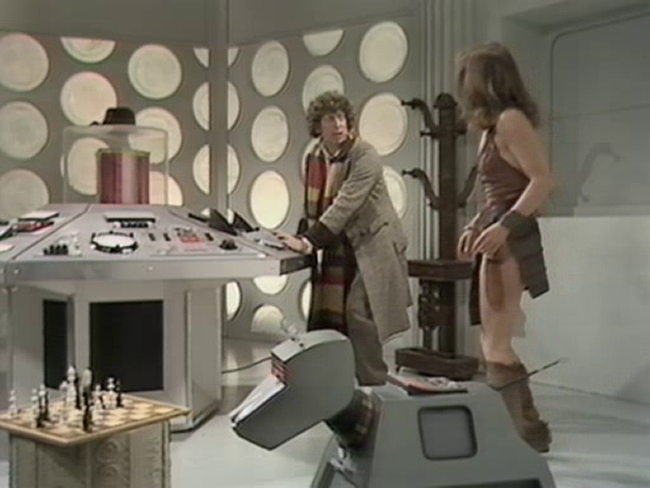
This is the second serial to feature K9 (John Leeson), following The Invisible Enemy, a serial I like even less. The Sun Makers is book-ended by a chess game between the Doctor and K9.

Here's the board at the start and it's the Doctor's move. Looks like he has both a bishop and a queen vulnerable to K9's queen. A sensible move would probably be to move his queen to a point where the queen and bishop protect each other--I'd probably move queen to queen's two. Instead, though, the Doctor takes the pawn on queen's knight four, inexplicably deciding to leave his bishop, queen, and now a pawn open to attack. K9 ignores all this so maybe there's a trap I don't see and gives check by moving his "bishop to queen six." Fortunately for the armless K9, Leela seems to learned chess notation.

I assume it was Baker's improvisation to move his king all the way across the board after this--when K9 says, "Wrong square" it's an understatement. K9 claims to see mate in six moves but that depends on how the Doctor moves. He doesn't have many options. But by going king to king's three he can at least protect his queen and then take K9's queen if K9 decides to do a discovered check by moving his bishop. But if K9 decides to take the Doctor's bishop the Doctor can't get compensation. It's hard for me to believe he didn't see all this trouble coming from his pawn move, though. I think he was letting K9 win.