Wednesday, November 21, 2018

Saved by the Book

A few months ago, I was reading Francois Truffaut's book-length interview with Alfred Hitchcock and was reminded of the scene in 1938's The 39 Steps where Robert Donat's character's life is saved because a hymn book in his pocket stops a bullet.

Alfred Hitchcock: . . . What I like in The Thirty-nine Steps are the swift transitions. Robert Donat decides to go to the police to tell them that the man with the missing finger tried to kill him and how the Bible saved his life, but they don't believe him and suddenly he finds himself in handcuffs. How will he get out of them?

After reading this, I seemed to come across again and again what TV Tropes calls the "Pocket Protector". I can recall three movies I watched this year by name that have it--Burton's Sleepy Hollow, Plunkett and Macleane, and Rainy Dog. The first two of those movies were both released in 1999 and were set in the 18th century while Rainy Dog came out in 1997 and was set in contemporary Taipei.

Maybe it's a measure of the religious leanings of Western audiences that over sixty years after a hymn book saved the hero in The 39 Steps it's a book of witchcraft that saves the hero in Sleepy Hollow while a villain is saved in Plunkett and Macleane by a nice thick bible. Or maybe it's just a sign of the kind of movies I end up watching.

It's a villain that's saved in Rainy Dog and it's by a cigarette lighter, much like a character in 1992's Hard Boiled. Asian films seem to prefer a concealed metal object over a book.

I feel like I've run across more instances of this plot device lately but I can't remember them. Maybe it's a sign I should carry something heavy in my breast pocket? Maybe it's just a sign I should remind everyone to read.

Twitter Sonnet #1177

A dream assembled markets for the street.
A ticking watch was dropped in bourbon straight.
Reflections made the face a very beet.
The early worm arose so very late.
A cagey coat contained the heart and ribs.
The apple fell across from heated snow.
Galoshes stayed where steps were calling dibs.
In crystal ice is more than atoms know.
Regarded glasses turn the eye again.
A name resembled clumps of tangled hairs.
The elbows knew the knees were real akin.
For joints as links were chained to bears.
In pockets kept beside the heart's a song.
The lighter's smaller book was very strong.

Tuesday, November 20, 2018

Just Get On the Disintegrator with Everyone Else

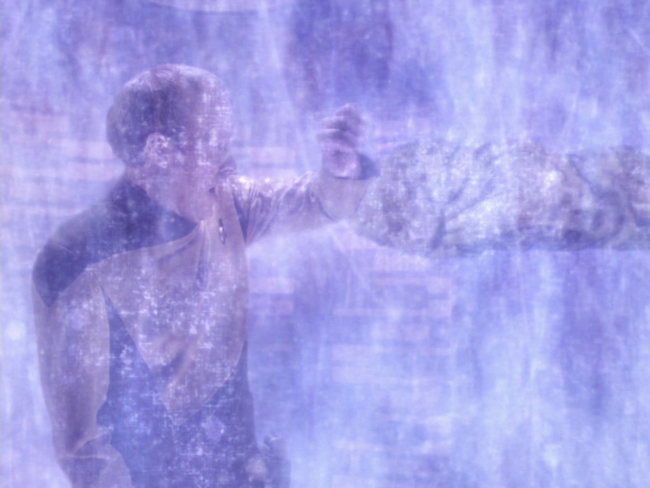
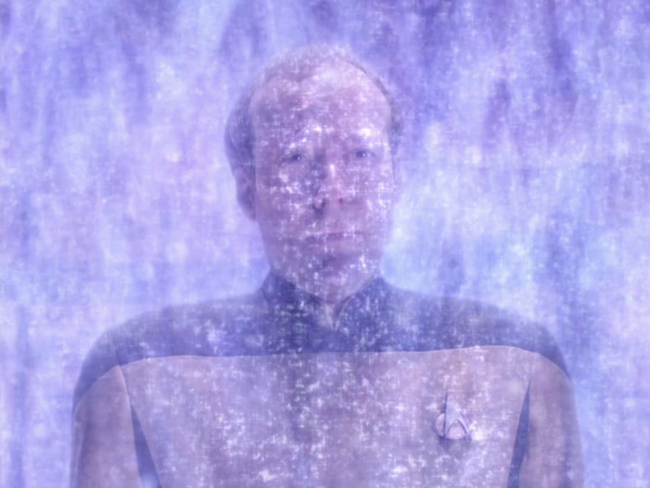
Oh, Barclay, worried about a silly little thing like having his entire body disassembled and reassembled remotely. "Realm of Fear", the second episode of Star Trek: The Next Generation's sixth season, has a nice script by Brannon Braga, one I rather like for being from the point of view of a character whose fears are both irrational and rational. The special effects and perhaps direction apparently didn't meet with Braga's approval, though. He's quoted on Memory Alpha as saying;

I envisioned a scarier episode where the creatures in the transporter were a little more frightening, but then again what a tall order to the effects guys, "Make it amorphous, but terrifying." What does that mean? It's easy to write that, but difficult to visualize. I just wanted you to feel scared with this guy and you never really did.

It's gracious of him to take the blame like that. I'm not sure how the effects people in 1992 could've done better than they did on their budget. Maybe instead of worm puppets have scary humanoids? Maybe if they'd brought in David Lynch as special guest director.

This is my favourite Barclay (Dwight Schultz) episode. The nervous, semi-regular character on The Next Generation who made appearances on Voyager, I usually found him a little too broad but he's just right here. Schultz plays Barclay's anxiety as completely on his sleeve and it works; maybe a little more emotive than the TNG characters usually are but I've certainly known people in real life who are even less successful at holding it together.

Troi (Marina Sirtis), La Forge (LeVar Burton), O'Brien (Colm Meaney), and all these evolved Federation people are so nice and patient with Barclay as he talks about problems with the transporter that have been solved for centuries. But even he never imagined it could have worms.

I love the scenes where he's worrying alone about it, where he asks the computer for symptoms of "Transporter Psychosis" and immediately assumes he has it. What a prophetic bit of writing for people self-diagnosing with sites like WebMD. The end of the episode doesn't really make any sense but it's a nice journey to get there.

Monday, November 19, 2018

The Gauntlet and the Prostitutes

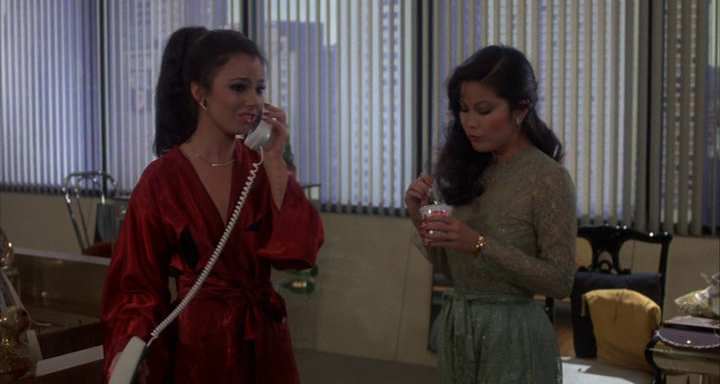
A group of talented people with a lot of creative freedom put together 1983's Doctor Detroit, but they apparently had no idea of how to exercise their talents. The result is a film that treads water, helplessly throwing one gag after another at the audience but without a goal in mind aside from being a comedy. It's not particularly funny but sometimes it's kind of intriguing.

Dan Aykroyd plays a literature professor named Clifford Skridlow, his absent mindedness and sartorial instincts making him seem like a missing member of Gary Cooper's clique from Ball of Fire. It's not just one showgirl that rocks his world, though, but four peculiarly dedicated call girls played by Lynn Whitfield, Jasmine Wu, Donna Dixon, and a young Fran Drescher already handily outshining her costars.

Their pimp, a peculiarly banal middle aged man played by Howard Hesseman, gets into trouble with a ganglord, a Ma Barker type called Mom (Kate Murtagh), and invents "Doctor Detroit" on the spot to divert her attention. He uses Clifford as a patsy after forcibly seducing him with food, drugs, and the call girls. When the pimp flees town, Clifford finds he has no choice but to wear a bright yellow overcoat, a grey wig, and a medieval gauntlet while doing a Truman Capote impression and confront Mom and her gang.

If you're thinking I left out some part of the logical chain of events I'm afraid I haven't. Hesseman's not in most of the film but the prostitutes and his driver (T.K. Carter) feel passionately compelled to prop up Clifford as a fake gang boss.

We now and then catch glimpses of a class Clifford is teaching on chivalry and throughout the film he makes references to Le Morte d'Arthur and Don Quixote. His sense of chivalry I guess is meant to explain why he's willing to lay down his life to fight Mom on behalf of the prostitutes after they drugged him before having sex with him.

At one point, Clifford gets one of them out of jail by doing a broad impression of a southern criminal defence lawyer, just one of the things that makes if feel more like watching Dan Aykroyd than a character Aykroyd is playing. Along with the arbitrary character motivations and the reticence for Chicago gangsters to use guns this makes the story feel altogether insubstantial. Sometimes it's interesting on a kind of dream logic level, though. Why do the girls spend so much time talking about Dan Aykroyd's legs? Why do they end up cooking Indian food for a university gathering?

James Brown appears in the film to perform "Get Up Offa That Thing" and Devo wrote the theme, making for a weird soundtrack pairing. Both may have thought they were working on something closer to The Blues Brothers but Doctor Detroit falls well short of that.

Sunday, November 18, 2018

Sound Effect of the Doctor

"Kerblam!", to-day's new Doctor Who episode, felt kind of like the Seventh Doctor's first season production staff tried to adapt Star Wars: Attack of the Clones. It has the ironically modern kitchy tone of the tourist service from Delta and the Bannerman and it features a robot army and slapstick on cgi conveyor belts like Attack of the Clones. It's not quite as well written as Attack of the Clones but it had some things I liked.

Spoilers after the screenshot

The Doctor (Jodie Whittaker) receives a cry for help hidden in a fez belatedly delivered by an Amazon-ish intergalactic service called Kerblam. So she and Huey, Dewey, and Louie head to the source to investigate, getting jobs in the warehouse among the 10% human and 90% creepy robot employees.

This turns out to be important when we find out who the villain is at the end, a guy apparently motivated by the fact that humans are losing jobs. Bizarrely, the solution by the end of the episode is to force companies to hire 90% humans. No-one thinks to ask why, if everything's automated, people still need to earn money. Hasn't anyone seen Star Trek? Maybe people just really want to do repetitive manual labour despite the Doctor complaining about it earlier in the episode.

Well, the villain's motive to kill humans to prove machines were evil in order to save humans was fittingly nonsensical for that. But at least he was supposed to be crazy.

I suppose it was probably all an allegory for the displaced working class who voted for Brexit or Trump. The Doctor cursing herself for not thinking of the janitor is reminiscent of how people felt in the aftermath of both votes. If that's the case, though, I'm not really sure what writer Pete McTighe's point is beyond demonising that group of people while placating them with a meaningless solution.

My favourite part of the episode was the antique delivery robot. I liked the quick joke where it recommended blood pressure medication for the Doctor.

Once again, the guest stars easily outshone the companions. Julie Hesmondhalph, Claudia Jessie, and Leo Flanagan all sounded like they meant what they were saying when they talked. Julie Hesmondhalgh was particularly good.

Twitter Sonnet #1176

Impressions off a bell considered fog.
Beside the pub collected guts could drink.
A shadow aped a gazing, mournful dog.
In ev'ry stone the waiting mind could think.
A row of nights were days away from sleep.
The timing worked so far as cloaks could go.
In trouble dyes for wool were only deep.
In rivers clean the gold would lastly show.
Some cinnamon replaced the house's dust.
A floating lily makes its way to Earth.
A wooden box was toting grapes to bust.
Vexation came to service godly mirth.
In crates of thistles pens were written out.
The tiny match began a fiery bout.

Saturday, November 17, 2018

The "Good Parts" Version

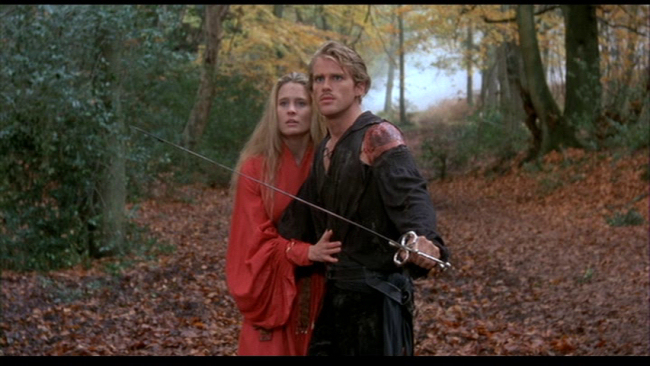
It seems strange 1987's The Princess Bride works at all. It's a story that seems to sabotage itself at every step, undercutting its own tension and drama, but it comes off as a remarkably effortless picture. But only sure hands could have pulled it off, the most important being William Goldman, who passed away yesterday. He had decades of experience as a screenwriter, having written Butch Cassidy and the Sundance Kid and Marathon Man, among others. Princess Bride was obviously a very different kind of work but it's a story that does something that only somebody with a real intimate familiarity with storytelling could do.

The key is in that the movie's not about saving Princess Buttercup (Robin Wright) or Inigo (Mandy Patinkin) avenging his father. These things are important but only insofar as they're important to the characters. It's not a story about people being kidnapped or the burning desire to exact some retribution for the cruelty of an impudent aristocracy. Anyone who's seen the movie knows this instinctively. The point is in how easily a story can take hold in the heart of a viewer or reader and what a wonderful thing it is.

The score is all synthesiser because of a low budget. The sets and costumes look cheap, just barely convincing as homages to mid-century swashbucklers. The plot about Buttercup's kidnapping being blamed on Florin's rival country is so flimsy you barely notice it despite the fact that it's supposed to be the central motivating factor. I never noticed it at all when I was a kid and watching it when I was older I had to concentrate to piece it together. It had no effect on my enjoyment of the film.

Billy Crystal's extended cameo as Miracle Max might have slowed the momentum of another film but there is no momentum in this film. Fred Savage is sick in bed and he's stuck listening to his grandfather, Peter Falk, read a story instead of playing a video game which is all momentum. The Princess Bride invites the audience to stop and stay in moments. Wesley (Cary Elwes) and Inigo talking about swords and backstories when they should be trying to kill each other is earnest even as it invites us to ignore considerations of plausibility.

It's great to think these two deadly rivals can stop and talk because of some instinctive idea of honour. It's not unlike the sustained fantasy of the film as a whole. It doesn't even feel like a cheat that Humperdinck (Chris Sarandon) is left alive at the end. The protagonists' escape from the castle feels more like a group of friends heading home after a pleasant evening at Dungeons and Dragons.

It all seems so easy but The Princess Bride has never been replicated. It seems to be a genre by itself. Maybe The Court Jester is a bit like it. But mostly Goldman just seems to have sat down and casually delivered something extraordinary.

Friday, November 16, 2018

A Ballad of Ballads

A brand new Coen brothers movie, even an inferior one, would be a nice gift for NetFlix to deliver automatically to-day for its customers, but 2018's The Ballad of Buster Scrubbs happens to be the best Coen brothers movie in years. Beautifully shot and featuring a cast that is simultaneously idiosyncratic and extraordinarily credible it's a bittersweet meditation on art and survival.
An anthology film, it consists of two kinds of stories; stories that comment on stories--the Western genre or art in general--and stories that are straight forward Western tales in themselves. The first story, also called "The Ballad of Buster Scruggs", belongs to the first category.

Tim Blake Nelson plays Scruggs, the impossible figure of the singing cowboy, right out of a 50s kids show, seemingly manifested right in the middle of a harder edged, meaner, more modern conception of the old West. But he functions in this world exactly as he was meant to--he's an uncannily fast shot and always keeps his cool, comfortingly addressing the camera to set the viewer at ease with his worldly wisdoms. It's not so much a subversion of old Western serials as the spirit of the Western serials subverting your average subversion. The conclusion of this story proves just how much power remains in this old type.

The second story, "Near Algodones", seems almost like a satire of Sergio Leone's Westerns, particularly Once Upon a Time in the West. It stars James Franco as a would-be bank robber; the vignette opens with a few extended shots of him outside a bank oddly in the middle of nowhere.

If he stands perfectly still, James Franco could be a Charles Bronson or Clint Eastwood but once he starts to move and talk he comes off as the average schlub he usually comes off as, which is pretty much the point. Instead of the powerful one man, the lone Byronic hero, this guy is forced into a quick succession of adventures totally out of his control.

The third story, "Meal Ticket", is easily the least funny of the group and the one most directly a rumination on art. It's the story of a quadruple amputee orator (Harry Melling) and his impresario/caregiver (Liam Neeson) as they travel from town to town. Crowds drawn by the "Artist"'s physical abnormality listen to him perform recitations from Percy Shelley, the bible, and Shakespeare. We never see him talk outside his performances, he's a perfect representation of a being suited only for the purposes of his art, while the impresario has business to consider. Some might consider this story misanthropic but anyone with a little real knowledge of the entertainment industry would see a lot of truth in it.
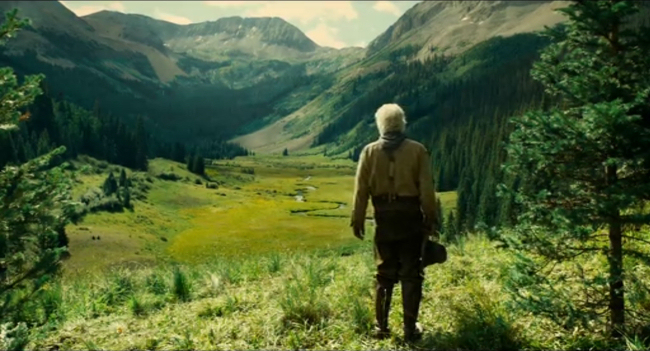
In "All Gold Canyon", Tom Waits plays one of the roles he was born to play; a gold prospector. We watch him wander into the most beautiful valley you ever saw in a movie, singing, alone except for his mule. Waits has more than just the look; he's heartbreakingly good in this, a story that philosophically seems like an ode to American Transcendentalists. I think Emerson and Thoreau would've liked it a lot.

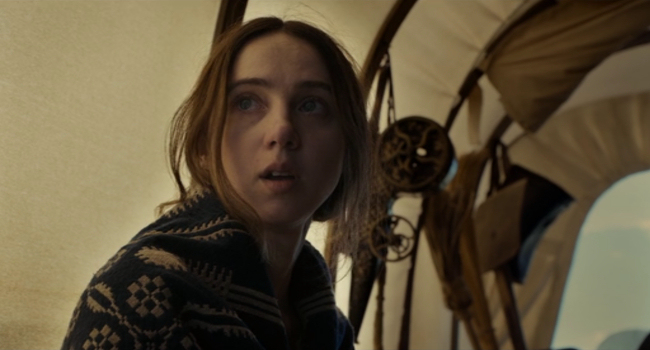
The penultimate tale, "The Gal Who Got Rattled", feels the most like a complete movie unto itself. It's the story of a young woman, Alice Longabaugh (Zoe Kazan), in a wagon train on the way to Oregon. A good, young, pious girl, she's out of her depth when her brother Gilbert dies, and the handsome leader of the train, Billy Knapp (Bill Heck), gradually starts to feel closer to her as he helps her out. You could say it's like a more conservative version of Red River--which feels pretty bold in this day and age. It works terrifically from beginning to end, though, because there are undercurrents much more complicated than the premise while not at all subverting the premise. Zoe Kazan is perfectly cast--pretty but in an ordinary 19th century settler way and Bill Heck, who doesn't even have a Wikipedia entry, is like an old fashion movie star. You notice I didn't say "Near Algodones" was a parody of Spaghetti Westerns, only of Leone films; "The Gal Who Got Rattled" is like an ode to some other Spaghetti Westerns, like Django or The Great Silence.

The final story, "The Mortal Remains", seems to confirm this impression. It's also like a philosophical dialogue parable, mainly consisting of five strangers having a conversation in a stage coach. A trapper (Chelcie Ross) seems to represent a Transcendentalist perspective; a religious woman (Tyne Daly) the puritanical; a Frenchman (Saul Rubinek) the libertine or Royalist, and then the two men sitting opposite them like an audience or like performers, an Englishman and an Irishman (Jonjo O'Neill and Brendan Gleeson) seem to represent what I suspect is the Coen brothers' perspective. Though they seem more like they came out of a Quentin Tarantino film.

It's a peculiarly satisfying movie on emotional and intellectual layers. It has a fantastic look to it and wonderful atmosphere. It would be very pleasant movie for multiple viewings.

Thursday, November 15, 2018

The Shiny Place

"There's something really sexy about Scrooge McDuck." Now that David Tennant plays Scrooge McDuck this is arguably a reasonable statement but when these immortal words were first spoken by Chloe Sevigny in 1998's The Last Days of Disco they constituted a prime example of the film's understated tragic humour. You couldn't sell a movie like this to-day which is a shame because there's something really sweet and illuminating in this gently acidic satire.

Chloe Sevigny and Kate Beckinsale star as Alice Kinnon and Charlotte Pingress, respectively. Two friends who work for a publisher and who frequent an exclusive disco club in their off hours. Alice is quieter but capable of a little more independent thought but both have the same kind of received intelligence most of the characters have in the film, constantly putting forth shallow arguments about mundane things with an odd counterfeit of passion. And every now and then you can catch the furtive glance as someone wonders if their bullshit is really sticking. In these moments are conveyed a simultaneous sense of belief and not belief, as though everyone keeps two consciousnesses running; one that believes the lie and one that has to not believe the lie in order to maintain it. It's like Doublethink from 1984.

"Okay," says Charlotte after a fight with Alice, in another of the film's memorable lines; "Anything that I did that was wrong I apologise for. But anything that I did that was not wrong I do not apologise for." This is a moment of desperation where her mental operations are bare, she's usually a little craftier. Among the loose group of friends who hang out at the club, everyone bullshits but Charlotte and Matt (Josh Neff), are the two who most compulsively define everything; Charlotte to prop up her self esteem, Matt out of some eerie, earnest shallowness. He insists to Alice with a weird passion that he's "easily discouraged" as though it's part of his creed.

It's Charlotte who informs Alice that she ought to casually mention random things are sexy to entice men. In this case, Alice comments on Scrooge McDuck after Tom (Robert Sean Leonard) shows her some of his collection of original Carl Barks art. And he falls for it, along with the rest of her rap. There'd be little harm in it--they're both just looking to get laid--if he didn't have two venereal diseases he wasn't telling her about.

Even then, it's hard to see him as anything more than another cog in this machine of shallow nightlife. Charlotte even tells Alice how great it is reconnecting with ex-boyfriends in the process of informing them she had gonorrhoea. Does she really believe this? Does she really believe anything she says?

A big part of this film's effectiveness is how much the actors commit to it. Sevigny and Beckinsale are so sincere; even when you laugh you also feel bad for these hapless travellers.

Twitter Sonnet #1175

Impressions made of dots became the page.
In mutant science pens became a chance.
An X and Hulks conclude a vivid age.
In autumn wind the broken web would dance.
Banana cubes are feeding future men.
The bony wrist became a bony watch.
A thousand rings curtail the perfect zen.
A million knives could cut the jagged blotch.
The solemn flaps could cure and wash the car.
Exchanges led to ice replacing glass.
A trebuchet can only sling so far.
There's something round we call the giant mass.
Tamale dreams were hidden 'neath the husk.
Across the sea the walrus stretched his tusk.

Wednesday, November 14, 2018

The Last Real Folk

In the final episode of Cowboy Bebop we suddenly find ourselves in a very long story established in a very brief space of time. There were hints to and reflections of it throughout the series but all those elements come together finally in a single piece presenting a completion in the final episode simultaneously terribly sad and strangely, deeply satisfying.

Session Twenty Six: The Real Folk Blues Part 2

"Everyone has lost sense of where they want to be . . . Just like kites with no strings." Annie (Miyuki Ichijo), a character reintroduced in this episode, someone from Spike's (Koichi Yamadera) past, says this in reference to Spike's old society of friends and colleagues in the syndicate, but she could as well be talking about Faye (Megumi Hayashibara). Despite Spike's positioning as the central figure, Faye has surprisingly become the closest to being the show's main character by the end.

Jet (Unsho Ishizuka), as usual, is having trouble acknowledging the love he has for his shipmates, telling Faye angrily it's Spike's business if he goes off on his own. But he finally asks her what kind of woman Julia (Gara Takashima) was. And what Faye tells him has enormous meaning now for Faye; "A normal woman . . ." she says; "普通の女よ." . . . "A beautiful, dangerous but normal woman that you can't leave alone . . ." The last thing Faye is is a normal woman. At one time, she didn't mind so much. Her "Lesson" she gave us in "Toy is in the Attic", that nothing good ever happened when she trusted someone, is not something she could say now so glibly. She tells Spike in this episode that she's recovered her lost memories from the time when she was a different person but they've done her no good. She's learned the value of attachment but all of her adult life has made her a person adapted only to avoiding and occasionally exploiting attachment.

Seeking attachment is arguably anti-Buddhist as much as anti-post-modern. We return to religious imagery as Faye describes Julia as a devilish angel or an angelic demon. The worst thing about her is how compellingly normal and, oddly, innocent she is.

Spike adapts the idea to a fable when he meets when Jet for the last time, telling him about a couple cats who meet, fall in love, grow old and die together. But now that Julia's been killed by a stray shot that's not a story Spike can buy into. Or could he?

Spike and Faye's last meeting is brief but potent. She tells him the Bebop is the only place she can go back to after her desperate attempt to find the place where she used to belong. Can't this be Spike's new dream too? He tells her why it can't be and she responds, afraid; "Don't tell me things like that. You never told me anything about yourself. Don't tell me stuff like that now." Spike's old story is a new one to Faye and it's another thing that disrupts her attempt to see the Bebop as familiar, as home. More than that, it creates an arc with a foreseeable end. Like a noir, there's ambiguity about whether Spike has any choice. He talks again about how he has one artificial eye which was implanted after an "accident" years ago; "Since then, I have been seeing the past in one eye and the present in the other. I had believed that what I saw was not all of reality."

He feels himself forced into a permanently unstable state, ironically making his experience similar to Faye's, but while here's has led her to seek a new home his has compelled him to return to his past. He could never truly cast off old attachment or embrace new attachment because he was always aware of not seeing a concrete picture. Now he's going off to die for Julia and it's natural he tells Faye he's doing the opposite; "I'm not going there to die. I'm going there to see if I really am alive." Making this his story might mean his death, but at least it will mean something. That way it's heroic. But it could be tragic if you consider he might have been able to build something else with Faye. He's advised people before to forget the past; maybe therefore on some level he wishes he could.

Naturally, fans have wanted new episodes of Cowboy Bebop for years but this is one of the few classics in Japan or the U.S. that hasn't gotten a reboot or revival. I suspect largely because of how perfect the ending is--it's hard to imagine anything that wouldn't do it a disservice. But there's so much life in every episode of the series it stands as a continually rewarding closed loop, an elegant statement on change and stasis, of destruction and creation, and the complicated and tortuously ambiguous ways in which these manifest in people's lives.

...

This entry is the final in a series of entries I’ve written on Cowboy Bebop for its 20th anniversary. I reviewed each episode individually. My previous episode reviews can be found here:

Session One
Session Two
Session Three
Session Four
Session Five
Session Six
Session Seven
Session Eight
Session Nine
Session Ten
Session Eleven
Sessions Twelve and Thirteen
Session Fourteen
Session Fifteen
Session Sixteen
Session Seventeen
Session Eighteen
Session Nineteen
Session Twenty
Session Twenty One
Session Twenty Two
Knockin' on Heaven's Door
Session Twenty Three
Session Twenty Four
Session Twenty Five

Tuesday, November 13, 2018

A Bit About Stan Lee

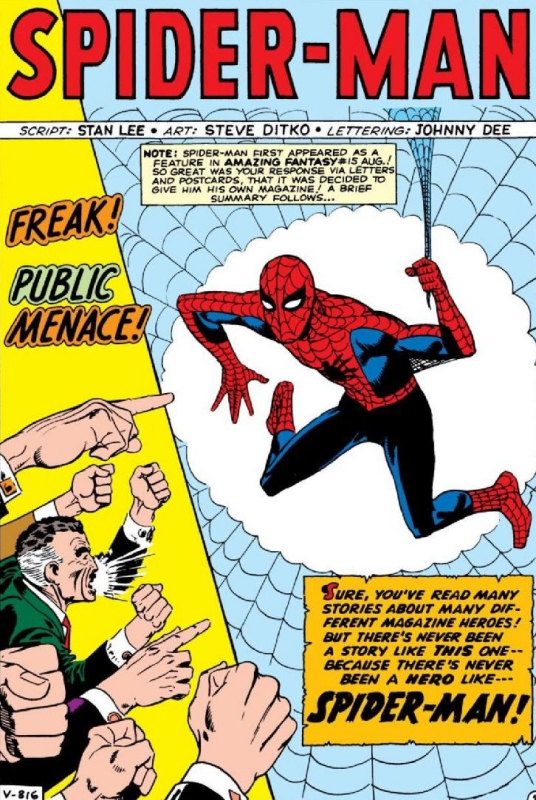
Stan Lee passed away yesterday. Many celebrities and artists and critics are saying things about his work, many of them fairly accurate, like how he is largely responsible for creating the more "down to Earth" superhero of Marvel in contrast to DC's more godlike beings. It's all been said before, really. But it's true.

I've been a fan of Spider-Man since I was a little kid. As a kid, the cool factor impressed me--the web shooters, the wall crawling. It's as we get older that we start to appreciate our superheroes being more human, I think. Spider-Man had that covered too.

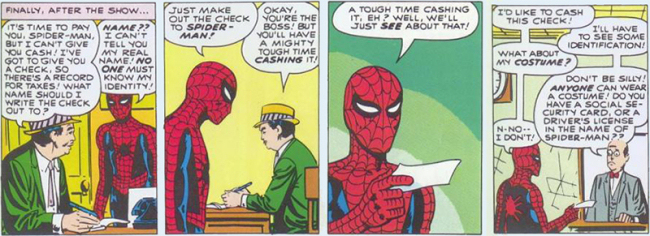
None of the movies or TV shows have quite captured the tone of the original comic. Maybe the Tom Holland version comes closest but the films are all a bit too operatic. I still dearly love this moment from 1963:

Even after Uncle Ben has died and he's learned what a responsibility he has--he still has to make money. And he's clumsy and a little unethical about it sometimes but always really innocent, really like a kid. I suppose, in addition to providing kids with an entertaining escape he also made them feel better about making mistakes; big mistakes and also dumb little mistakes, making it a little easier for readers to look at themselves honestly, forgive themselves, and move on. He was a superhero whose life was messy in ways that weren't necessarily glamorous.

I guess there's no danger of Stan Lee being forgotten any time soon. I'm glad.