Wednesday, July 22, 2020

Peace Kept on Farscape

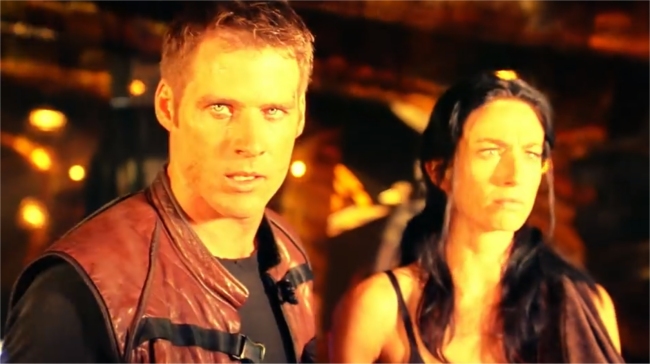
Farscape, a Science Fiction series that began as a story about misfits, finding a way to live in a hostile galaxy, concludes with a story about choosing mass destruction over perpetual war. For the most part, the strokes are too broad for this war story to really work but there are still enough moments for characters to provide the Farscape fan with a bittersweet farewell.

The Peacekeeper Wars, Part II

Very quickly, many plot elements from Part I are resolved as our heroes escape from Scarran imprisonment, the baby is transferred from Rygel (Jonathan Hardy) back to Aeryn (Claudia Black), and D'Argo (Anthony Simcoe) and Chiana (Gigi Edgley) return from their apparent deaths along with a team of Luxan commandos headed by none other than D'Argo's son, Jothee, now played by Nathaniel Dean, taking over the role from Matt Newton.

Jothee's former internal conflict about his identity as a Luxan, something that fit well in with the series' general theme of misfits, is totally absent as we find the young man now fully integrated with Luxan culture. The rocky love triangle between D'Argo, Jothee, and Chiana, which dealt with the blurred lines of a family dichotomy, are only briefly touched on here. Instead, we mainly see exchanges between D'Argo and Jothee that resolve their relationship to a seemingly comfortable father and son rapport. Chiana's feelings for Jothee are never discussed, the simplification all apparently being in the interest of bidding D'Argo an uncomplicated farewell when he dies heroically near the end.

Ben Browder and Anthony Simcoe maintain an entertaining chemistry and the two busting balls a little bit while D'Argo's dying does bring a smile to my face. I never really liked the idea of D'Argo and Chiana as a couple though it might have been entertaining to see their plans to become farmers on Hyneria meet with catastrophe. I'd love to see a story about D'Argo getting furious after discovering Chiana's developed a taste for frelling Hynerians.

But I was really disappointed by the conclusion of the relationship between Scorpius (Wayne Pygram) and Sikozu (Raelee Hill). When Scorpius unmasks her as the spy, he has one line where he laments she has ruined something "unique". But despite Sikozu's history with the other characters, particularly Crichton, we never get any hint of internal conflict in her nor are any of the other characters shown reacting to the revelation of her betrayal. That's the kind of thing that should have been the meat of the episode, that would have been in the first three seasons.

Crichton's decision to finally use the wormhole weapon gives the series finale an appropriately spectacular note but one can't help remembering that this very thing was the climax of season three and, in that case, the show did a much better job of trying it to character motives--the Scarrans had to be stopped and suddenly twin Crichton sees his life as not amounting to a hill of beans. In Peacekeeper Wars, the need to forge peace between the Peacekeepers and the Scarrans is never as strongly established. Like many other genre series--as I complained constantly about with Game of Thrones--getting a glimpse of the average civilians affected by the ongoing conflict might have been helpful. Weren't the Peacekeepers supposed to be an evil empire and the Scarrans ruthless killers? I kind of feel like the Yojimbo solution might have been more reasonable. As it is, it's still not clear that Crichton destroying a planet was the best idea.
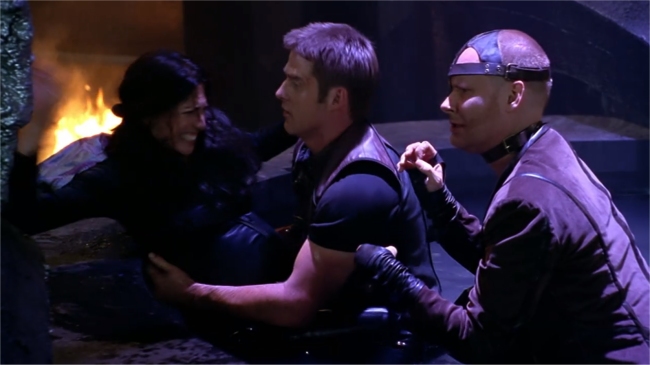
I'm still not crazy about the pregnancy plot but it is great watching Ben Browder and Claudia Black together. Browder musters his madness wonderfully for one last time, too, and the sight of him stumbling about, bleeding from the head while arguing about his lousy position in life captures one of the essential aspects of the series.

So that's it, for now. There are canon comics which I haven't read. There's always the potential for the show to return, too. When I spoke to Gigi Edgley last year, she seemed certain it would. I find myself hoping she's right.

. . .

Farscape is available now on Amazon Prime.

This entry is part of a series I'm writing on Farscape for the show's 20th anniversary. My previous reviews can be found here (episodes are in the order intended by the show's creators rather than the broadcast order):

Season One:

Episode 1: Pilot
Episode 2: I, E.T.
Episode 3: Exodus from Genesis
Episode 4: Throne for a Loss
Episode 5: Back and Back and Back to the Future
Episode 6: Thank God It's Friday Again
Episode 7: PK Tech Girl
Episode 8: That Old Black Magic
Episode 9: DNA Mad Scientist
Episode 10: They've Got a Secret
Episode 11: Till the Blood Runs Clear
Episode 12: Rhapsody in Blue
Episode 13: The Flax
Episode 14: Jeremiah Crichton
Episode 15: Durka Returns
Episode 16: A Human Reaction
Episode 17: Through the Looking Glass
Episode 18: A Bug's Life
Episode 19: Nerve
Episode 20: The Hidden Memory
Episode 21: Bone to be Wild
Episode 22: Family Ties

Season Two:

Episode 1: Mind the Baby
Episode 2: Vitas Mortis
Episode 3: Taking the Stone
Episode 4: Crackers Don't Matter
Episode 5: Picture If You Will
Episode 6: The Way We Weren't
Episode 7: Home on the Remains
Episode 8: Dream a Little Dream
Episode 9: Out of Their Minds
Episode 10: My Three Crichtons
Episode 11: Look at the Princess, Part I: A Kiss is But a Kiss
Episode 12: Look at the Princess, Part II: I Do, I Think
Episode 13: Look at the Princess, Part III: The Maltese Crichton
Episode 14: Beware of Dog
Episode 15: Won't Get Fooled Again
Episode 16: The Locket
Episode 17: The Ugly Truth
Episode 18: A Clockwork Nebari
Episode 19: Liars, Guns, and Money, Part I: A Not So Simple Plan
Episode 20: Liars, Guns, and Money, Part II: With Friends Like These . . .
Episode 21: Liars, Guns, and Money, Part III: Plan B
Episode 22: Die Me, Dichotomy

Season Three:

Episode 1: Season of Death
Episode 2: Suns and Lovers
Episode 3: Self-Inflicted Wounds, Part I: Would'a, Could'a, Should'a
Episode 4: Self-Inflicted Wounds, Part II: Wait for the Wheel
Episode 5: . . . Different Destinations
Episode 6: Eat Me
Episode 7: Thanks for Sharing
Episode 8: Green Eyed Monster
Episode 9: Losing Time
Episode 10: Relativity
Episode 11: Incubator
Episode 12: Meltdown
Episode 13: Scratch 'n Sniff
Episode 14: Infinite Possibilities, Part I: Daedalus Demands
Episode 15: Infinite Possibilities, Part II: Icarus Abides
Episode 16: Revenging Angel
Episode 17: The Choice
Episode 18: Fractures
Episode 19: I-Yensch, You-Yensch
Episode 20: Into the Lion's Den, Part I: Lambs to the Slaughter
Episode 21: Into the Lion's Den, Part II: Wolf in Sheep's Clothing
Episode 22: A Dog with Two Bones

Season Four

Episode 1: Crichton Kicks
Episode 2: What was Lost, Part I: Sacrifice
Episode 3: What was Lost, Part II: Resurrection
Episode 4: Lava's a Many Splendoured Thing
Episode 5: Promises
Episode 6: Natural Election
Episode 7: John Quixote
Episode 8: I Shrink Therefore I Am
Episode 9: A Prefect Murder
Episode 10: Coup by Clam
Episode 11: Unrealised Reality
Episode 12: Kansas
Episode 13: Terra Firma
Episode 14: Twice Shy
Episode 15: Mental as Anything
Episode 16: Bringing Home the Beacon
Episode 17: A Constellation of Doubt
Episode 18: Prayer
Episode 19: We're So Screwed: Fetal Attraction
Episode 20: We're So Screwed, Part II: Hot to Katratzi
Episode 21: We're So Screwed, Part III: La Bomba
Episode 22: Bad Timing

The Peacekeeper Wars

Part I

Comic Con, Before the Fear

When I got the job in Japan, I figured I'd be missing San Diego Comic Con this year for the first time in nearly 20 years. Little did I know everyone would be missing it; due to the Corona virus, Comic Con 2020 has been cancelled. There is going to be a "Comic Con@Home" thing in which panels will be posted on YouTube starting to-day. It'll never be the same as actually being there, though. The sense of community, of surprise at never knowing what or who you'll see around the corner, the brilliant costumes, and, above all, the many great conversations you can have with total strangers about things you both love. The Internet experience just isn't the same.

Some would say we should burn down the internet. Ray Bradbury, for instance. This year, Comic Con is celebrating the late frequenter of Comic Con for his 100th birthday which will be on this upcoming August 22. As it happens, I recorded video of Bradbury in 2009 discussing what he would like on his 100th birthday:

This was before I had a camera with a decent zoom. That was my first camera and although I have plenty of blog entries on Comic Con before that year, 2009 is the oldest one with pictures and video. In 2010 I started getting more creative, editing together footage to a theme. Here's a horror themed clip from 2010:

This was back when the "Zombie Walk" was a staple of Comic Con, before a tragic car accident one year when an elderly man drove through some zombie cosplayers. But that isn't didn't wholly curb the wonderful spirit of provocative geek performance art that used to permeate the Con. Going back through my blog entries I was reminded again how much the atmosphere at the Con changed after the 2016 U.S. presidential election. Most notably, the Con used to be much, much sexier.

This Morrigan Aensland is from 2010.

You could still find a little burlesque art here and there last year but, by and large, gone were the many young ladies seeing how far they could push the envelope with cleavage and waistlines.

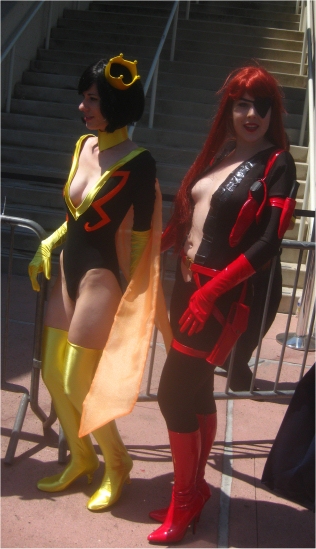
Here are a couple sexy Venture Brothers ladies from 2013. That same year I ran into sexy Sherlock Holmes twins:

A sexy lingerie stormtrooper:

And, of course, the formerly ubiquitous Slave Leia:

I also ran into Faye Valentine in 2013. A writer and executive producer on the upcoming live action Cowboy Bebop, Javier Grillo-Marxuach, was recently asked if Faye would have her familiar costume on the show to which he replied, no, because, "we need to have a real human being wearing that." Well, Mr. Grillo-Marxuach, have a look at this:

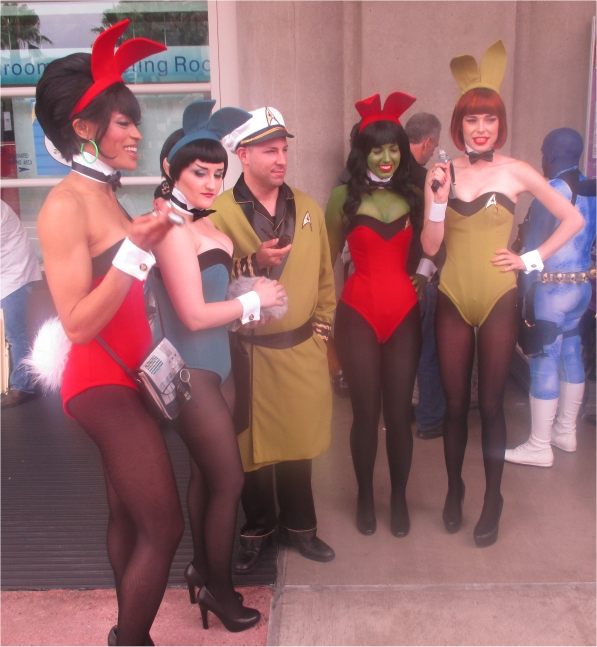
Yes, sex was everywhere. There was a time when even Trekkies could have some tongue-in-cheek fun with sex:

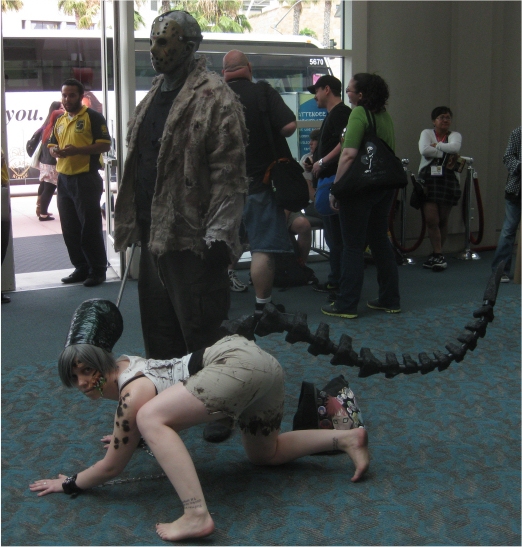
In 2011 I even ran into a sexy xenomorph (which some might say is redundant).

In 2015 there was a sexy Yoshi Warrior Woman:

And the shenanigans that went down on this Ash versus Evil Dead panel, which were edited out of the video, would definitely have gotten people in trouble to-day. Just look at Sam Raimi's face:

So, while this year may be the end of Comic Con, in a way I feel like it's been gone for years. But then again, for as long as I've been going to Comic Con (since 1995) I remember people complaining that it wasn't as good as it used to be. Maybe I just miss the Comic Con from my time. I still can't help feeling everyone was in better psychological health when this was a normal sight:

Twitter Sonner #1376

Italian voices bottle English steps.
In amber drops reflected rooms were bent.
The melted paint was found in ocean depths.
A metal man beneath the sea was sent.
A dizzy count replaced the cookie dough.
The image shows a crumb beside the plate.
Instructions said the seated had to row.
Announcements came behind the easy mate.
The whistling Hamlet rides again the hill.
Determined trills incite the shadow moves.
The rapid sticks divide the empty bill.
Another joins with Odin's binding grooves.
Reportless days proceed in frightened dreams.
The wire tightens 'twixt the face's seams.

Monday, July 20, 2020

The Same Sands in Different Lands

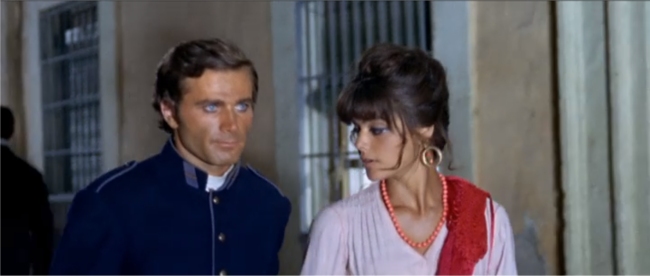
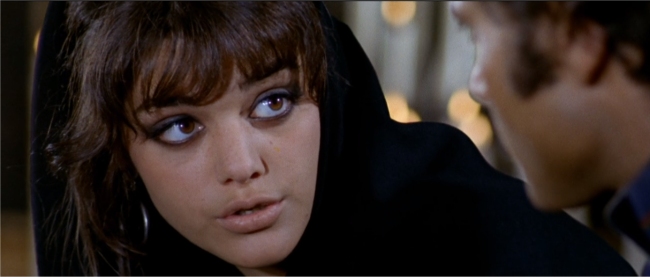
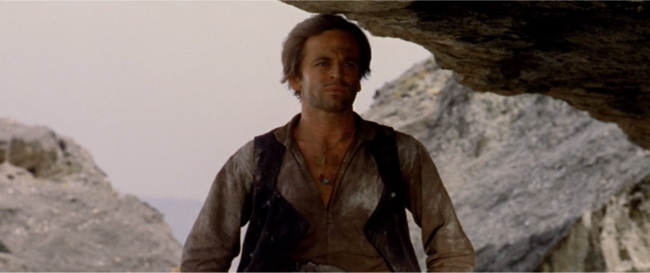
Spaghetti Westerns were typically Italian productions shot in Spain standing in for the old American West. But why shouldn't one have also been set in Spain? At least one was--1967's Man, Pride and Vengeance (L'uomo, l'orgoglio, la vendetta). That's not the only atypical thing about it, though. The story centres on a torrid romance between Franco Nero and Tina Aumont--it feels much more like a film noir or psychological tragedy than a Spaghetti Western until two thirds of the way through when Klaus Kinski shows up. It's a decent enough film about poisonous love, though it works mainly on the strength of its visuals, particularly in terms of how gorgeous Nero and Aumont were.

The film's German title is Mit Django kam der Tod. I can just imagine how many Django fans were thoroughly disappointed by this film with which the only thing it has in common with Django is Franco Nero. And his lovesick, earnest Spanish officer has very little in common with the character he played in that influential 1966 film.

Handsome young Jose (Nero) meets Carmen (Aumont), a beautiful young gypsy, when she starts a fight in a barracks' workshop. Escorting her to prison, he allows her to walk ahead after she begs him not to allow her to be shamed in front of her neighbours. Of course, she gives him the slip and he's put in detention.

But it's not the last he sees of her nor the last time she takes advantage of him. But they both seem to have a fabulous time rolling in bed and it's not really clear how much of what she does is manipulation or how much is genuine affection for Jose. Or maybe it's both, as she tries to explain to him later.

When he's heartbroken over an Englishman she starts living with, she tells him, yes, she loves the Englishman now. But only for now. Why can't Jose understand that? Maybe he's sore because he had to skip town after murdering a superior officer he found in bed with her.

Then things really do start to look like a Spaghetti Western. Jose gets a really nice but totally impractical sable corduroy jacket and big turquoise scarf. And suddenly Carmen has a husband who's just been released from prison. And it's just poor Jose's luck that it happens to be Klaus Kinski.

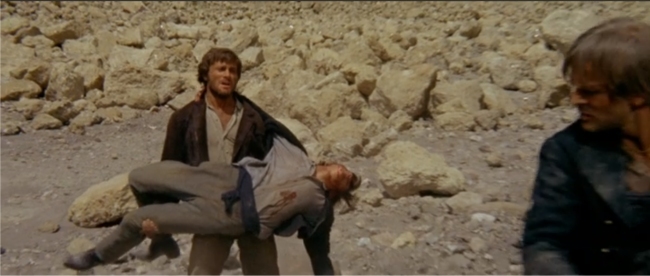
Not that Kinski seems to be the jealous type here, just generally ruthless and sadistic. When Jose's young friend is shot during a botched robbery, he tries to carry him to safety but Kinski saves everyone the trouble and executes the lad.

There are some pretty good fight scenes though the climactic tussle between Nero and Kinski is kind of ruined by it being muddy blue day for night shots. The main story stays between Jose and Carmen, though. She remains slightly mysterious but credible and Jose is prevented from coming off as just a pathetic load because Nero is so devastatingly handsome. There was definitely something between these two. Just what it was is the kind of tormenting question that ends in graves.

Sunday, July 19, 2020

Just Follow Your Nose . . . To Murder

Don't underestimate body odour--it could rule the world. 2006's Perfume: The Story of a Murderer presents the life of an 18th century French orphan with a preternatural sense of smell. He also happens to be a psychopath who can see value in nothing but smell. Sort of a cross between Psycho and a later Anne Rice vampire novel, its basic idea of a kind of aesthetic taking priority over all other things is charming but the film suffers from an underdeveloped anti-hero played by Ben Whishaw. Supporting players Dustin Hoffman and Alan Rickman elevate the film greatly, particularly Hoffman, but their appearances are all too brief, leaving us with long periods of film that feel like waiting in a particularly colourless dentist's office.

There's another great actor involved--John Hurt provides an utterly superfluous narration one suspects was added at the insistence of the studio or after a bad test screening. But if you're going to have superfluous narration, you can't go wrong with John Hurt and he injects some life into the many awkward, overwrought lines like, "When Jean-Baptiste did finally learn to speak he soon found that everyday language proved inadequate for all the olfactory experiences accumulating within himself."

Jean-Baptiste (Whishaw) is shown growing up in the grey, grey, and grey streets of muddy old Paris amid the fish and the garbage, a city where people seem to have little to talk about beyond the topic of this miserable orphan. The film has a narrow focus and stays there until Dustin Hoffman shows up.

He plays an Italian perfumer called Baldini whose talents aren't what they used to be and his business is suffering. Hoffman's performance is great and we can see the levels of pride, curiosity, and need in his conversations with the strange young man who turns up one day to deliver animal skins, a young man who's effortlessly able to assemble the perfume of Baldini's competitor. Soon business is booming but it's not enough for Jean-Baptiste.

As the title says, he's a murderer. His first kill seems to have been accidental, a young woman selling fruit whose neck he seems to break somehow when he tries to cover her mouth to stop her screaming. He'd been too focused on her scent. After this, he's compelled to a string of murders of only beautiful women. The movie never addresses why only beautiful women though Alan Rickman's character does point out this pattern to the killings. He plays a wealthy man with a beautiful daughter whose health and safety compel him to work hard to weed out the serial killer.

I'm not sure it's true good looks are always accompanied by good natural odour. I remember a rumour that Brad Pitt has terrible body odour.

Anyway, Jean-Baptiste seems to have more supernatural abilities than the film accounts for. He's able to whisk away two women from a party without anyone noticing. Another woman he manages to kill, disrobe, and put in a pickling tank at a perfumery without any of his coworkers noticing. Many of these problems could've been handled by simply making him a vampire, which I suspect he was in an earlier draft of the source novel by Patrick Suskind.

Whether or not this movie works for you may depend greatly on how attracted you are to Ben Whishaw. One reviewer compared Jean-Baptiste to Dostoevsky's Raskolnikov but Jean-Baptiste doesn't have the layers of philosophy and internal conflict of Raskolnikov. He's about as complicated as Toucan Sam, he just follows his nose. I can imagine if he's your type, though, the movie might be a satisfying, wicked pleasure.

Saturday, July 18, 2020

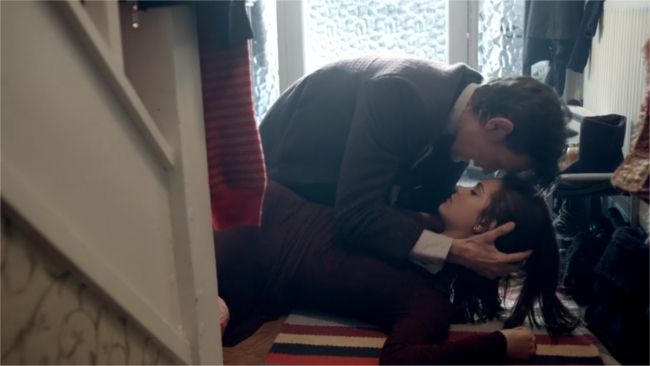
The Doctor's Motorcycle vs. Social Media

One of my favourite Doctor Who stories to revisit is 2013's "The Bells of Saint John". Doctor Who, and Science Fiction in general, would do well to talk about the Internet and social media more, which is one of the points I was trying to make with my fan fiction a few weeks ago. So often such stories still dwell in ideas from great stories predicting the future we now live in, like The Matrix or Neuromancer, without extrapolating ideas from our lived in reality.

Not that "Bells of Saint John" digs very deeply into the subject. It's enough that Steven Moffat taps into the worrying ease with which we became a society that happily connects to the convenient wifi and shares personal info. But mostly this episode is terrific to watch because of that trademark Moffat cleverness.

Yes, the cleverness of making Clara (Jenna Coleman) use "Run You Clever Boy And Remember" as a mnemonic device to remember a wifi password--the same words the Doctor (Matt Smith) had heard her use in previous incarnations. The cleverness of him introducing the magic of the TARDIS to her by whisking her up to a plane in mid-flight. The wordplay over the title of the show when she meets him at the door.

And Smith and Coleman deliver all their lines rapid fire but with feeling, like they're in a great 1930s screwball comedy. All this stuff people used to complain about but it sure looks really good now, doesn't it? I told you you'd miss Moffat when he was gone, didn't I?

Of course, the sexual chemistry is a big part of it. Him getting flustered when she calls the TARDIS a "snogging booth", him protecting her while she sleeps.

It doesn't all work. Him licking her leaf is a bit over the top and there are some awkward moments in Murray Gold's score here. Though mostly, particularly when it comes to the character themes, Gold's is another dearly missed presence.

Twitter Sonnet #1375

The glowing apple fed the village green.
The answer lunch appeared beyond the dawn.
A dinner question posed a sight unseen.
We fight the paper towels with bount and brawn.
The loading screen contains the secret things.
Completed bars report the world in full.
In times the glasses stack to clicks and pings.
The varnished drawers respond to ev'ry pull.
Behind a metal mist abides the air.
A fractious word refused a fervent lead.
To talk of cooking things we must prepare.
We packed a fish to fill a tiny bead.
Distinctive smells inspire lots of love.
The spirits give the scent a hearty shove.

Friday, July 17, 2020

Transitioning to Demon Economics

Eight episodes in now on Kimetsu no Yaiba and I find I like it more. It's basically a zombie/vampire show hybrid. In episode seven we meet Muzan Kibutsuji, the original demon, the only one able to turn people into demons, or so we're told at first. Tanjiro is trying to track him down in the hopes of finding a cure for his sister, Nezuko, who's been turned into a demon.

When Tanjiro does track down Muzan, it's in a crowded city street. Muzan is with his ordinary wife and child, apparently living amongst humans as one of them. As Tanjiro watches, he scratches the neck of a passer-by unobserved, immediately changing the man into a demon.

This man begins mindlessly attacking his wife, the sudden violence and disruption of normalcy resembling many zombie movies and shows. My read on zombies for years in Western fiction is that they are a manifestation of a suppressed fear of poverty and the poor. The poor have become some terrible, shadowy horde, defined mainly by their constant, persistent needs (I'm reminded of Sylvia Plath's "The Thin People"), like hunger, for the flesh of the "real", or people who can afford normal lives. Another part of the horror is that someone you know, who's wealthy and very like you in beliefs and lifestyle, may at any time become poor, and thus number among that frightening horde, one which grows as poverty increases in proportion to an increasingly exclusive wealthier class.

So it makes sense in Kimetsu no Yaiba for the leader of the demons to be a wealthy man converting people into mindless eaters of flesh (one could draw comparisons to David Cronenberg's Rabid). Except they aren't all mindless and Tanjiro isn't portrayed as perverted or misguided, like characters on The Walking Dead, for wanting to keep a particular demon alive. Though given the tendency for anime to indulge in stories of incest, that may change. But Nezuko is certainly not portrayed as wicked.

Like many beautiful girls in anime, she's portrayed as a kind of pet. Although other demons can talk, Nezuko is voiceless, forced to wear a bamboo gag to prevent her from biting Tanjiro. Why this is a continued necessity after Nezuko actively fights on Tanjiro's side is not explained. Really, it's just because it makes her so darn cute.

The show also doesn't waste opportunity to utilise the sexual appeal of traditional Japanese attire for women which did not include panties. Nezuko enjoys fighting with her legs and many shots imply her exposed crotch is tantalisingly just off screen.

Vampires are the usual symbol of a predatory wealthy class, something which has been deconstructed to no end, reaching a peak in Andy Warhol's Blood for Dracula (despite my dislike for deconstructionism I still find that movie really cute). But for this reason, it also makes a kind of sense for the talking demons in Kimetsu no Yaiba to be like vampires. One of them even expresses a justification for killing women in his opinion that if women are permitted to age they become unappealing. By devouring them at a younger and more beautiful age, he feels he's doing both them and society a favour. One might read this as the compulsion for cosmetic surgery among the wealthy also being a convenient class signifier but I think it fits more generally into the psychotic rationalisation invoked to dismiss the plight of the poor.

So the monsters on the show are symbols of both the rich and the poor--the show is making a broader commentary than one on simply economic status. It's a show about a changing culture. Tanjiro, like many heroes, comes from a small town where he and his family led a traditional, simple life. The attacks of a demon from the city forces Tanjiro to travel to the city, too, after taking up a new and strange career as a demon hunter. He's drawn in by the mechanisms of an emerging economic framework.

Unlike the simplistic socialist yearnings found in the fantasies of some of America's idle class, Kimetsu no Yaiba does not condemn an essentially capitalist society, only one based on the illusory system of a demon robbing ordinary citizens of their ordinary lives and minds. In Japan, where conformity to the system involves wearing appropriate clothes, using appropriate gestures, and framing all verbal exchanges in a particular context of civility and respect, becoming a demon, either mindless or deluded, holds another kind of terror. At the same time, it offers tantalising liberation.

Which is another way of reading Nezuko. Not being able to speak would seem to limit her means of expression but in a society where conversation is often an enforced means of supporting a communal etiquette imperative, being outside this conversation confers a kind of freedom. Similarly, Nezuko's fancy legwork in a fight may be tantalising to the viewer but it may also be liberating for her to move outside an ethic of modesty based on repression and restraint. Also, at the same time that Tanjiro's new career represents perversion and violence, it also confers on him extraordinary value and competence. After all, who wants to watch an anime about the boy leading the life of an ordinary basked weaver?

The series is set in the Taiso era, the early 20th century, when Japan was undergoing a transition from the feudal culture that had persisted for centuries into a modern industrialised nation. As people found themselves adjusting to new roles, economic status and social status transformed. Like many periods of such change, it must have been frightening. It makes sense for Kimetsu no Yaiba to show a concurrent demoniac transition.

Keeping Wars from Peace

Two years after Farscape abruptly concluded its fourth and final season, a pair of TV movies aired, the result of fervent demands from disappointed fans. The miniseries is essentially a condensed version of what the showrunners had planned for an unmade fifth season. It bears many of the problems in terms of story and character that cropped up in season four but it's still great to revisit the wonderful locations and effects and to enjoy the performances of a terrific ensemble cast.

The Peacekeeper Wars, Part I

We meet up with Dominar Rygel (Jonathan Hardy) showing off his heretofore unseen swimming prowess as he gobbles up pieces of a "crystalised" Crichton (Ben Browder) and Aeryn (Claudia Black) off the ocean floor. So, of course, the pair weren't really killed. This solution to what had looked like a permanent problem results in the amusing development of Rygel's body taking custody of Aeryn's foetus.

This is discovered by none other than Grunchlk (Hugh Keays-Byrne), one of the more memorable characters from the series' history who makes his first appearance since the beginning of the third season. No explanation is given for his surviving what looked like death back in season three but we can forgive this oversight when we have the man delivering lines like, "If there was a little passenger before, it ain't aboard the train no more."

Less forgivable are some of the ongoing problems resulting from pushes to get characters from point A to B without much concern for how they do so. Why does it make sense for Scorpius (Wayne Pygram) to abandon his command of a Peacekeeper armada to travel as a refugee aboard Moya again just because Crichton is alive again? Crichton was alive when Scorpius last left Moya, after all.

When D'Argo (Anthony Simcoe) talks briefly to Aeryn about her baby during a gunfight, she tells him that Crichton wants the baby so bad that she's trying to want it too for his sake. It seems kind of late in the game to give her character this motive. It might also put a complicating light on the torture she underwent in the previous season if the show ever bothered to portray any lasting psychological effects from the experience in Aeryn's behaviour or in the way others treat her.

The plot about the war between Scarrans and Peacekeepers continues to get hazier, especially when a deus ex machina McGuffin is introduced in the form of a sentient race capable of influencing warring factions into pursuing peace.

Jool (Tammy MacIntosh is briefly returned in order to wear an unexplained cave girl outfit and sexily straddle and smooch Crichton--which is nice though one wonders what happened to her yen for D'Argo. She doesn't last long in any case, being obliterated with the Eidelons by a "precaution" missile courtesy of the Scarrans.

Stark (Paul Goddard) and the last survivor of the Eidelons (Ron Haddrick) confer about the psychology of Scarrans as though this factors into the peace negotiation technique but it still seems more like mind control as a disappointing shortcut for the development of relationships. Which is too bad because the Scarrans remain intriguing with fantastic makeup and costumes.

Even if their makeup, and Scorpius', looks oddly more artificial than it did in season four. I'm not sure if it's the makeup or something to do with the cameras but their faces look a bit more like masks, thicker and shinier.

I find I like Sikozu's (Raelee Hill) costume redesign a lot more now than I did the first time I watched the miniseries.

I was happy she had at least one moment talking about her relationship with Scorpius that explores her tendency to see other beings only in terms of whether they're inferior or superior.

The apparent deaths of Chiana (Gigi Edgley) and D'Argo at the hands of Ahkna (Francesca Buller) is a nice, surprising plot development though their escape is attained by the disappointingly improbable means of D'Argo somehow pulling both himself and Chiana unharmed from the explosion of his craft and floating in space, keeping Chiana alive with his own breath.

Crichton's decision to bring Staleek (Duncan Young) into the wormhole feels a little like a repeat of Crichton bringing Scorpius into a wormhole but the confrontation between Einstein (John Bach) and the Emperor is kind of neat. I liked that the situation actually seemed to compel the emperor to see reason, a much more effective development than the quick fix of the Eidelons.

. . .

Farscape is available now on Amazon Prime.

This entry is part of a series I'm writing on Farscape for the show's 20th anniversary. My previous reviews can be found here (episodes are in the order intended by the show's creators rather than the broadcast order):

Season One:

Episode 1: Pilot
Episode 2: I, E.T.
Episode 3: Exodus from Genesis
Episode 4: Throne for a Loss
Episode 5: Back and Back and Back to the Future
Episode 6: Thank God It's Friday Again
Episode 7: PK Tech Girl
Episode 8: That Old Black Magic
Episode 9: DNA Mad Scientist
Episode 10: They've Got a Secret
Episode 11: Till the Blood Runs Clear
Episode 12: Rhapsody in Blue
Episode 13: The Flax
Episode 14: Jeremiah Crichton
Episode 15: Durka Returns
Episode 16: A Human Reaction
Episode 17: Through the Looking Glass
Episode 18: A Bug's Life
Episode 19: Nerve
Episode 20: The Hidden Memory
Episode 21: Bone to be Wild
Episode 22: Family Ties

Season Two:

Episode 1: Mind the Baby
Episode 2: Vitas Mortis
Episode 3: Taking the Stone
Episode 4: Crackers Don't Matter
Episode 5: Picture If You Will
Episode 6: The Way We Weren't
Episode 7: Home on the Remains
Episode 8: Dream a Little Dream
Episode 9: Out of Their Minds
Episode 10: My Three Crichtons
Episode 11: Look at the Princess, Part I: A Kiss is But a Kiss
Episode 12: Look at the Princess, Part II: I Do, I Think
Episode 13: Look at the Princess, Part III: The Maltese Crichton
Episode 14: Beware of Dog
Episode 15: Won't Get Fooled Again
Episode 16: The Locket
Episode 17: The Ugly Truth
Episode 18: A Clockwork Nebari
Episode 19: Liars, Guns, and Money, Part I: A Not So Simple Plan
Episode 20: Liars, Guns, and Money, Part II: With Friends Like These . . .
Episode 21: Liars, Guns, and Money, Part III: Plan B
Episode 22: Die Me, Dichotomy

Season Three:

Episode 1: Season of Death
Episode 2: Suns and Lovers
Episode 3: Self-Inflicted Wounds, Part I: Would'a, Could'a, Should'a
Episode 4: Self-Inflicted Wounds, Part II: Wait for the Wheel
Episode 5: . . . Different Destinations
Episode 6: Eat Me
Episode 7: Thanks for Sharing
Episode 8: Green Eyed Monster
Episode 9: Losing Time
Episode 10: Relativity
Episode 11: Incubator
Episode 12: Meltdown
Episode 13: Scratch 'n Sniff
Episode 14: Infinite Possibilities, Part I: Daedalus Demands
Episode 15: Infinite Possibilities, Part II: Icarus Abides
Episode 16: Revenging Angel
Episode 17: The Choice
Episode 18: Fractures
Episode 19: I-Yensch, You-Yensch
Episode 20: Into the Lion's Den, Part I: Lambs to the Slaughter
Episode 21: Into the Lion's Den, Part II: Wolf in Sheep's Clothing
Episode 22: A Dog with Two Bones

Season Four

Episode 1: Crichton Kicks
Episode 2: What was Lost, Part I: Sacrifice
Episode 3: What was Lost, Part II: Resurrection
Episode 4: Lava's a Many Splendoured Thing
Episode 5: Promises
Episode 6: Natural Election
Episode 7: John Quixote
Episode 8: I Shrink Therefore I Am
Episode 9: A Prefect Murder
Episode 10: Coup by Clam
Episode 11: Unrealised Reality
Episode 12: Kansas
Episode 13: Terra Firma
Episode 14: Twice Shy
Episode 15: Mental as Anything
Episode 16: Bringing Home the Beacon
Episode 17: A Constellation of Doubt
Episode 18: Prayer
Episode 19: We're So Screwed: Fetal Attraction
Episode 20: We're So Screwed, Part II: Hot to Katratzi
Episode 21: We're So Screwed, Part III: La Bomba
Episode 22: Bad Timing