Showing posts with label spaghetti western. Show all posts

Wednesday, August 30, 2023

The Ambling Ahsoka, Further Down the Trail

Ahsoka episode three was a brief flight covering little ground. There were some things I liked, though, and a couple things I thought, in addition to being bad, were kind of curious.

Top of that list would be Hera's son, Jacen. Last week, one of the things people complained about in the first two episodes was the absence of Hera's son, last seen at the end of Star Wars: Rebels. I didn't complain about it because I honestly forgot all about him and didn't care very much when I was reminded.

But it's so odd the way he was shoehorned into the third episode I kind of think Dave Filoni had forgotten about him, too. First we hear Mon Mothma ask Hera about Jacen--which makes it seem even stranger that Ahsoka and Sabine never inquired about him as presumably they're closer to Hera than Mon Mothma. And then we get an actual scene with the kid.

It feels so perfunctory, so much like an afterthought. I was tempted to think it was shot over the past week after all the reviews pointed out Jacen's absence but surely that's not possible with the actor's strike going on. But I bet it was added some time late in the production.

This was also the first time we saw Genevieve O'Reilly playing Mon Mothma in a show set after the original trilogy. I'd have thought they'd have made more effort to make her look like Caroline Blakiston. They could have at least changed her hair. She actually looked more like Blakiston in Rogue One. But I guess I don't mind O'Reilly taking over the role. She was excellent on Andor though perhaps her presence serves as another reminder of how much better the writing was on that show.

The New Republic politicians mostly appeared to sneer at Hera for wanting to follow a trail of evidence leading to Imperial Remnant activity. She provokes their disdain because the trail is loosely related to a friend of hers who went missing. Boy, that was lame. I was reminded that in the old Expanded Universe books, the New Republic was also portrayed as immobilised by bureaucratic disagreements and a belief that the Imperial remnants no longer presented a serious threat. I remember finding that tedious and silly then, too, though at least it turned out a spy was at the bottom of it.

Lately, I've been thinking about this interview with George Lucas and Dave Filoni (it starts at around 9:20):

One of the striking things about it is that, even though it's heavily edited, George Lucas has nothing nice to say about Filoni and a couple of Filoni's remarks are critical of Lucas, like where he implies Lucas was being foolish for making episodes of The Clone Wars about banking. It's a little ironic since some of the best parts of Mon Mothma's subplot on Andor involved banking. Filoni says kids wouldn't be interested in it, and that may be true, but kids aren't the only audience for Star Wars. Even setting aside the fact that people who were kids in the '70s, '80s, and '90s are adults now, a lot of the people lined up for Star Wars in 1977 were teens and adults. So I reject this idea that Star Wars is just for kids.

Another interesting part of the interview is the story about how Filoni frequently had to explain to Lucas what he was trying to do and Lucas frequently had to tell him that his, Filoni's, ideas were not translating onto the screen. That sounds like it would be good advice about now when it comes to the relationship between Ahsoka and Sabine.

We still have no idea what the big fight was that drove these two apart. There's not even a hint of the kind of tension you'd expect in the aftermath of such a rupture. They're just blandly polite to each other.

I did kind of like the training scene (though the show's weak fight choreography was again in evidence). Mainly it was for David Tennant as Huyang.

You could say he's kind of playing a deluxe C3PO. Few people argue Anthony Daniels is an especially good actor (Alec Guinness certainly wasn't impressed) though he works in a broad role like C3PO and oddly kind of makes the case that Star Wars droids aren't sentient. However, David Tennant is, I believe, one of the greatest actors of his generation (watch his Hamlet if you haven't already). Some of the nuance he puts on his lines on Ahsoka make them almost delicious. And, as usual, Filoni seems to loosen up when he's writing male characters.

The score on Ahsoka is good and I like the planet with the red trees. Is it supposed to be Dathomir? If only Filoni could write Ahsoka and Sabine. A lot of people are criticising all of the unnatural pauses. I think Filoni may be trying to emulate Spaghetti Westerns, particularly Once Upon a Time in the West.

For one thing, Once Upon a Time in the West isn't universally beloved (though I love it). It's not even usually considered Sergio Leone's best (though it's generally in the top three). But I would say Once Upon a Time in the West is more effective because the motives behind the sparse dialogue are clearer and the stakes are obvious enough that real tension hangs in the pauses.

It also should be noted that Once Upon a Time in the West isn't a kids' movie. I certainly wouldn't expect a three year old to sit still for long lingering shots of Jack Elam's face. So another part of Filoni's problem may be that he's not even clear on what he's trying to do.

Ahsoka is available on Disney+.

X Sonnet #1733

Essential buttons pay for houses cheap.
The demon mirror cries to see itself.
Through woods of wire hair the kittens creep.
A pastry box contains a captive elf.
Her eyes bananas called for sporty splits.
Explaining cows has led to foreign zoos.
It's not for eyes the summer cooler spits.
But time is short for paying fruitless dues.
As danger mornings mount the nights extend.
A floppy fist rewards the wimpy man.
As lousy lines were gathered blanks descend.
A vapid kid regressed to rusty pan.
Another zebra ball has knocked the night.
She lifeless flipped through space in lifeless flight.

Friday, April 30, 2021

A Bounty Hunter and a Bandit

Rape, particularly the rape of a child*, is such a despicable crime that it provokes strong feelings of disgust for the perpetrator. This feeling of disgust comes with a desire to see justice done, or as close to it as possible, so to falsely accuse someone of rape could be a powerful political tool, as it is in the 1967 Spaghetti Western The Big Gundown. Anchored by a cool lead performance from Lee Van Cleef as a highly skilled bounty hunter, the film has some nicely edited action sequences and genuinely clever, darkly amusing, writing.

Jonathan Corbett (Van Cleef) casually accepts the job of tracking down Cuchillo (Tomas Milian) from a railway tycoon (Walter Barnes). No bounty ever approaches being slightly difficult for Corbett so he seems to think nothing of offering to get Cuchillo gratis.

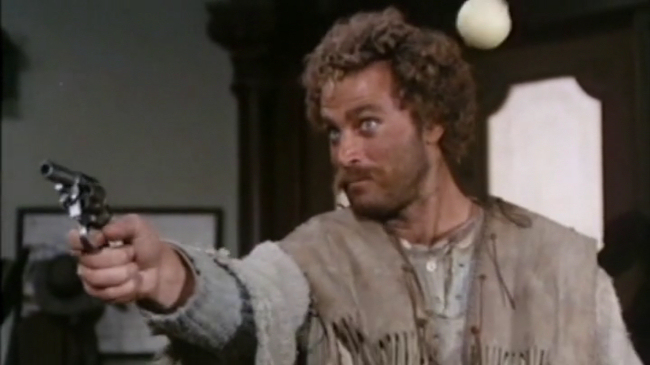
But very quickly, Cuchillo turns out to be a suspiciously elusive quarry. Tomas Milian went on to play Tepepa, another puckish Mexican revolutionary, and perhaps Cuchillo was one of the parts that solidified his perceived aptitude for such roles. Van Cleef is so cool in this film and Milian is such a goofball, there's almost a Batman/Joker dichotomy at play.

The film's comprised of several episodes in which it seems Corbett is just about to nab Cuchillo only for Cuchillo to narrowly escape, often taunting Corbett while galloping away; "You'll never catch me!"

In one episode, Corbett finds Cuchillo under the protection of some Mormons and the 12 year old girl Corbett thinks he's rescuing from statutory rape at Cuchillo's hands turns out to be the fourth wife of a middle aged Mormon. Sir Arthur Conan Doyle warned us about this sort of thing in A Study in Scarlet.

In another episode, Corbett finds Cuchillo at the mercy of a beautiful ranch owner (Nieves Navarro) whom Cuchillo spurned--so Corbett can also spurn her in turn. A big gunfight ensues.

With each episode, a grudging respect and even a kind of affection starts to develop between Corbett and Cuchillo, especially as they both react similarly to the hypocrisy of land owners and respectable citizens. The tension surrounding the question of whether or not Cuchillo committed the crimes he's accused of is absorbing but it's also great when that question is gradually answered in subtle ways.

The Big Gundown features some exceptional work from Ennio Morricone (two tracks were used by Tarantino) and is currently featured in a Morricone collection on The Criterion Channel.

*Yeah, fuck all the trigger warnings.

Monday, July 20, 2020

The Same Sands in Different Lands

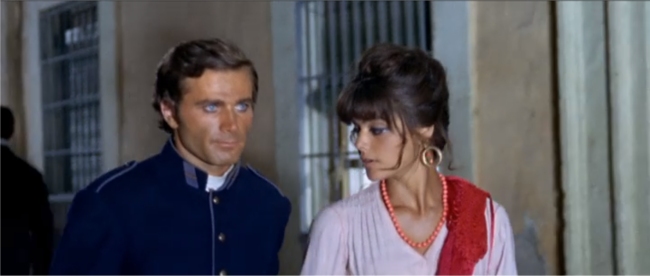
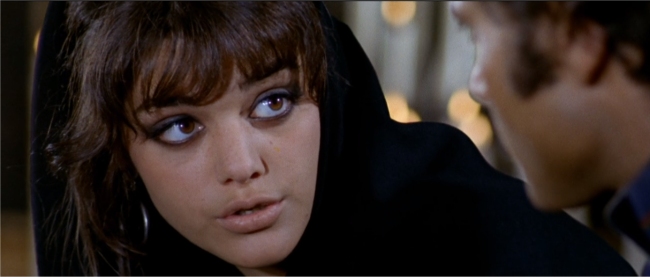
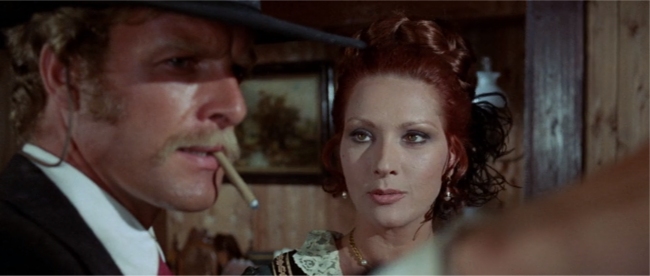
Spaghetti Westerns were typically Italian productions shot in Spain standing in for the old American West. But why shouldn't one have also been set in Spain? At least one was--1967's Man, Pride and Vengeance (L'uomo, l'orgoglio, la vendetta). That's not the only atypical thing about it, though. The story centres on a torrid romance between Franco Nero and Tina Aumont--it feels much more like a film noir or psychological tragedy than a Spaghetti Western until two thirds of the way through when Klaus Kinski shows up. It's a decent enough film about poisonous love, though it works mainly on the strength of its visuals, particularly in terms of how gorgeous Nero and Aumont were.

The film's German title is Mit Django kam der Tod. I can just imagine how many Django fans were thoroughly disappointed by this film with which the only thing it has in common with Django is Franco Nero. And his lovesick, earnest Spanish officer has very little in common with the character he played in that influential 1966 film.

Handsome young Jose (Nero) meets Carmen (Aumont), a beautiful young gypsy, when she starts a fight in a barracks' workshop. Escorting her to prison, he allows her to walk ahead after she begs him not to allow her to be shamed in front of her neighbours. Of course, she gives him the slip and he's put in detention.

But it's not the last he sees of her nor the last time she takes advantage of him. But they both seem to have a fabulous time rolling in bed and it's not really clear how much of what she does is manipulation or how much is genuine affection for Jose. Or maybe it's both, as she tries to explain to him later.

When he's heartbroken over an Englishman she starts living with, she tells him, yes, she loves the Englishman now. But only for now. Why can't Jose understand that? Maybe he's sore because he had to skip town after murdering a superior officer he found in bed with her.

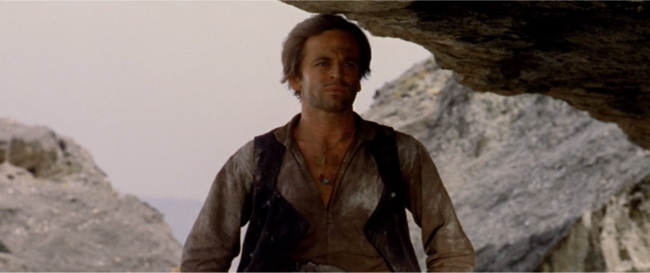
Then things really do start to look like a Spaghetti Western. Jose gets a really nice but totally impractical sable corduroy jacket and big turquoise scarf. And suddenly Carmen has a husband who's just been released from prison. And it's just poor Jose's luck that it happens to be Klaus Kinski.

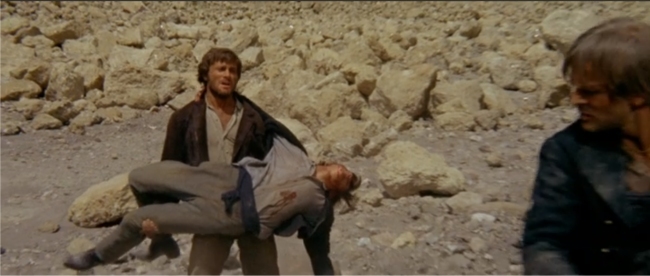
Not that Kinski seems to be the jealous type here, just generally ruthless and sadistic. When Jose's young friend is shot during a botched robbery, he tries to carry him to safety but Kinski saves everyone the trouble and executes the lad.

There are some pretty good fight scenes though the climactic tussle between Nero and Kinski is kind of ruined by it being muddy blue day for night shots. The main story stays between Jose and Carmen, though. She remains slightly mysterious but credible and Jose is prevented from coming off as just a pathetic load because Nero is so devastatingly handsome. There was definitely something between these two. Just what it was is the kind of tormenting question that ends in graves.

Wednesday, July 08, 2020

The Inevitable Head

The trouble with revolutions about destroying hierarchy is that they require leaders. 1969's Tepepa presents characters wrestling with this problem in the context of revolutionary Mexico in the early 20th century. A Spaghetti Western, or in a subgenre called "Zapata Western", it presents the terrific violence and memorable personalities associated with the Italian/Spanish productions from the 60s with an ambition to be something a bit like David Lean's epics at the time. It doesn't quite reach those levels, it's too cartoonish, and the double moral centres, in the form of a cool Englishman and a little Mexican boy, make the film insubstantial in an effort to make it less ambiguous. But Tomas Milian and Orson Welles both turn in good performances and, of course, Ennio Morricone's music is fantastic.

The irrepressible pluck against the frustrated oppressor suggested by the music is nicely complemented by Tomas Milian in the role of Tepepa, a sort of Errol Flynn-ish version of Zapata. Friend or foe, joy or misfortune are as likely to provoke a hearty laugh from this charismatic hero. But he's quite shrewd.

Real life Mexican President Madero is here played by Paco Sanz looking a lot more like Vladimir Lenin than Madero did in real life. When Tepepa helps him take over the country he's quick to notice the same fat cats end up in charge of things. For the purposes of the film, the villain and key fat cat is embodied ably by Orson Welles.

Welles plays Colonel Cascorro, as weary and cynical as Tepepa is lively and positive. But both men are of the unusual kind best suited to be leaders, men who can see the big picture and make decisions outside the confines of crowd mentality or public opinion. Cascorro keeps order with brutality sometimes, Tepepa decides life and death for reasons sometimes unclear or dubious to his followers. He kills one man, formerly loyal, for betraying him and he kills him right in front of the man's son. This is the little boy who becomes somewhat awkwardly symbolic as the movie progresses, leading to an ending in which the boy actually makes a statement on behalf of the spirit of Mexico. In case it just wasn't clear.

The other moral centre befriends the child briefly and almost adopts him. Henry Price (John Steiner) is a doctor from England, perhaps representing the foreign perspective on the political conditions in Mexico. He comes across as faintly psychotic and he's in Mexico to avenge the rape and murder of his fiancee at the hands of Tepepa. At least, that's what he's heard. But he rescues Tepepa from Cascorro at the beginning of the film for reasons he doesn't seem to understand himself.

His continuing investigation into whether this Tepepa fellow is worthy or not mirrors Tepepa's own dissatisfaction in the inevitability of human nature to produce corrupt leaders. If Tepepa turns out to be such a leader himself, does he have the capacity to see it? It's an interesting question perhaps posed a little too cartoonishly in the end.

Tepepa is available on Amazon Prime.

Friday, June 26, 2020

Beware Sartana's Brand of Generosity

Gianni Garko, the original Sartana, returns with a moustache in 1970's Have a Good Funeral, My Friend . . . Sartana Will Pay (Buon funerale amigos!... paga Sartana). Very generous of him and I can confirm he lavishly spends on coffins throughout the film taking this bit established in Yojimbo to decadent levels. Yet this film is a return to a more grounded, satisfying storytelling after the previous entry, Sartana's Here . . . Trade Your Pistol for a Coffin, drove the series' slightly coy sadism into self-parody. This one even has a sweet hint of a suggestion of romance for Sartana.

The plot isn't wildly different from previous entries--Sartana, the mysterious, preternatural gunman with gadgets is hunting people down having something to do with some kind of land swindle.

Among his enemies this time are a corrupt banker and the Chinese owner of a saloon, Lee Tse Tung (George Wang). For the latter, the film's climax turns out surprisingly to be a melee, taking Sartana out of his trick shot element. Tse Tung wields an anachronistic Japanese sword against Sartana but it leads to the cool image of Sartana wielding a katana when he naturally turns the tables.

There's less emphasis on Sartana's ability to hide his guns and escape certain death and more focus on him intimidating people with his presence. He also seems to have a soft spot for Abigail (Daniela Giordano), a young woman mixed up in the bogus land deal.

Two thirds of the way through the movie there's a particularly nice action sequence when four outlaw brothers are randomly introduced and very quickly dispatched by Sartana. They're introduced nicely, though, with music and visual composition so watching their showdown with the film's hero is really very good.

Have a Good Funeral, My Friend . . . Sartana Will Pay is available on Amazon Prime.

Sunday, May 03, 2020

His Gun is Quick, His Titles are Long

You think you're hot stuff, out there in the old west, with your pistol and your freedom. But you know what? Sartana's Here . . . Trade Your Pistol for a Coffin. It's plain sense at this point. From 1970, it's the third film to feature the preternatural Spaghetti Western hero and the only one not to feature Gianni Garko in the lead role. Uruguayan actor George Hilton is a decent enough substitute in a film that's basically a series of gags, repeated scenes where Sartana faces certain death. It is amusing seeing each new clever way he finds to pull a hidden gun from some prop or garment but the weirdness and subtle mystery of the first two films are sadly lacking.

There is a somewhat difficult to follow plot about the owner of a gold mine possibly hiring men to steal from his own shipments. Sartana is on the trail and massacres one set of bandits or outlaws after another, often in rooms where it seems Sartana is definitely surrounded and has no possible way of getting to his gun and shooting three or five guys instantly. No realistic way, maybe, but that's never stopped Sartana before . . .

There's a running gag about Sartana shooting through bread. In one of the final scenes, he conspicuously sets up three loaves of bread on a table before his enemies rush in, a sure sign he's probably not going to use the bread. In fact, his little fake outs do start to get rather predictable.

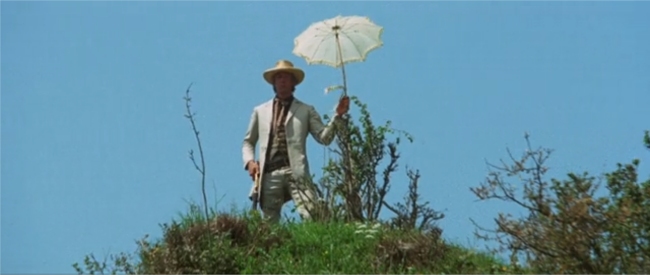
A rival/friend/bitter enemy for Sartana appears called Sabbath (Charles Southwood), of course having nothing to do with the main plot. He's a dandy dressed in white who likes to gamble, suspiciously similar to Hot Dead, the character played by Klaus Kinski in the previous film. Sabbath doesn't have quite the charm of Hot Dead but his stand-off with Sartana at the end of the film is an amusing tangle of one-upmanship and ridiculous plot twists.

Sartana's Here . . . Trade Your Pistol for a Coffin is available on Amazon Prime.

Monday, November 25, 2019

The Weight of the Hat

He wears his famous black hat and black cloak but is that all it takes to be Sartana? Decidedly not, as evidenced by 1969's I am Sartana, Your Angel of Death (Sono Sartana, il vostro becchino). The sequel to If You Meet Sartana Pray for Your Death, this tale of Sartana hunting down his imposter is less focused than its predecessor but still a lot of fun, in no small part because of a much bigger, more amusing role for Klaus Kinski.

The opening credits feature a close-up of Sartana (Gianni Garko) doing card tricks--appropriate considering how much of the movie is about tricks, some cleverer than others. Sartana has his hands on a deck of cards more than once in the film, most effectively when he manages to surreptitiously swap the deck for a gun from the man guarding him.

Despite the straight forward premise, this film works a lot like a series of vignettes as Sartana drifts into rooms and sheriff stations, appearing suddenly to get the upper hand. As in the first film, there's something more supernatural about this Spaghetti Western hero than any other. The Man with No Name, Django, and Ringo all have mystery and faintly sadistic guile, but Sartana tends more than any other to do things that are clearly impossible. My favourite in this film being when a gunman spots Sartana's hat and cloak on a rack in a barber shop. The wouldbe killer scans the shop only to look back and see Sartana's gotten the drop on him because the hat and cloak have transformed into the man himself.

Kinski, who played a petty thug named Morgan in the first film, here plays a dangerous gunman called Hot Dead. He doesn't seem to have anything to do with the bank robbers who've framed Sartana or the plot of the film in any other way. A scene of Hot Dead in a train car lazily foiling a card sharp but promising to "lose anyway" is presented without any apparent connexion to Sartana. When the two finally meet, Hot Dead maintains his intriguing tendency to show his skill before deliberately backing down. Kinki's irrepressible natural energy makes this low energy character trait fascinating.

I am Sartana, Your Angel of Death is available on Amazon Prime.

Wednesday, November 13, 2019

A Hard Mask

The premise of and creative team behind The Mandalorian, the new live action Star Wars series, seem both very safe and very risky; a story set after Return of the Jedi with familiar original trilogy aliens and atmosphere showrun by the man who effectively launched the MCU, Jon Favreau. On the other hand, it centres on an aloof character who never shows his face or gives his name and who, in the first episode, has few interactions with other characters that aren't business transactions. Mainly, the first episode works and works well but with the absence of vulnerable character moments it may not feel as though it gains quite the traction one expects from prestige television nowadays.

The show's been likened to a Spaghetti Western by critics and by members of the creative team. The Mandalorian armour was first made famous by Boba Fett in the original trilogy, a character George Lucas based on Clint Eastwood's Man with No Name in a trilogy of Spaghetti Westerns by Sergio Leone. Boba's father, Jango Fett, was named after Django, a popular character in a long series of Spaghetti Westerns before he manifested as Jamie Foxx for Quentin Tarantino. Any movie or series based on the mysterious bounty hunter would inevitably have shades of Spaghetti Western. The Mandalorian lacks the heights of weirdness and brutality that made Spaghetti Westerns so remarkable, though. There's no Franco Nero dragging a coffin through the desert or Giuliano Gemma tauntingly aiding a garrulous gang of Mexican bandits accompanied by a strange Ennio Morricone theme. Pedro Pascal successfully conveys some warmth through that helmet but he's not as eerie as Boba Fett, as amusing as Ringo, or mysterious as the Man with No Name. He may be closest to Charles Bronson's character in Once Upon a Time in the West. Unlike Boba Fett, Pascal's character, Dyn Jarren, has a clear reverence for Mandalorian culture which we can see when he has a new piece of his armour ritually forged from a lump of precious metal he collects from a client. It would be nice if this comes along with a personal code like that exhibited by western heroes.

The supporting cast is great. Werner Herzog improbably plays a man who seems like he might be a former Imperial. Nick Nolte plays a character who seems loosely based on the tavern owner from Yojimbo (a film that served as inspiration for A Fistful of Dollars). It's great casting. The presence of Carl Weathers is also a nice touch.

The first episode is directed by Dave Filoni, best known as the supervising director of Clone Wars, a show on which, coincidentally, Jon Favreau voiced a traitorous Mandalorian. Rebels, a follow-up cgi series created by Dave Filoni after Disney acquired Star Wars, demonstrated pretty decisively that whatever element made Clone Wars so great, it wasn't Dave Filoni (I suspect it was George Lucas). Filoni does an adequate job directing the first episode of The Mandalorian but he's vastly indebted to cinematographer Greig Fraser, the same cinematographer that gave Rogue One such a memorable look.

So Favreau has, in some ways, a self contradictory mission; he's made a character who can be the mystery that Boba Fett can no longer be but he needs this character to be the emotional anchor of a series. I'll certainly be watching to find out how he well he succeeds.

The Mandalorian is available on Disney+.

Monday, June 17, 2019

Who Knows What Gold Lurks in the Coffins of Men?

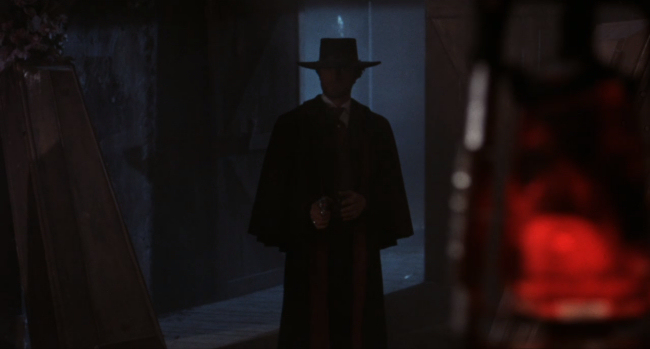
A faint sound of mechanical music, maybe a shadow on the wall, that's all the warning you'll get and If You Meet Sartana, Pray for Your Death. Or so says the title of the 1968 Spaghetti Western that introduced the popular character to audiences. Definitely closer to a superhero film than most of the best films of the genre, the first Sartana movie is like a wilder adaptation of Yojimbo than A Fistful of Dollars with The Shadow as a protagonist.

Sartana (Gianni Garko) may be more supernatural than The Shadow, though. The film begins with the first of a few instances where it clearly looks like the man in black and red is shot and killed--only to inexplicably calmly walk back into frame and gun everyone down.

But he misses Klaus Kinski, who's set up with a rifle on the hill. Kinski plays a character called Morgan and his role is small enough he's credited as making "a special appearance". He doesn't have much dialogue, allowing Kinski to play without the inevitable dubbing, and his mysterious gunman character wears a bell on one of his spurs. This ominous sound that somehow effectively communicates his prowess is overshadowed when Sartana starts using a music-playing pocket watch he took off a dead man to announce his presence.

Sometimes a guy will hear the pocket watch and look around wildly for Sartana and never see him at all. It's just a reminder that Sartana is watching, that Sartana knows, somewhere in the shadows of bright desert sun reflecting off brilliant white sand.

What does Sartana want? He says he wants gold, and that sort of seems to be the general trend of his activities as he foils bandits and a Mexican militia headed by Fernando Sancho from the Ringo movies. But it doesn't explain Sartana's sadistic psychological games, his theatricality, his tiny mechanical gun, and above all his apparent invulnerability.

The ambiguity works, though, and I found myself smiling along with him when his complicated plan involving a rope trap in a prostitute's room proves effective, or when he ominously tells a story to be overheard by Morgan and Lasky (William Berger) in a barber shop. He also likes to gamble but there's never any hint of a possibility that he could lose at it.

It's a decadent pleasure, far from the more beautiful or challenging films of the genre, but by no means bad. If You Meet Sartana, Pray for Your Death is available on Amazon Prime.

Thursday, April 25, 2019

Inexorable Vengeance

A marauding band of scalp hunters are pursued by a lone, vengeful Native American man called Navajo Joe in a 1966 Sergio Corbucci Spaghetti Western. Not a fondly remembered film--even its star, Burt Reynolds, didn't seem to like it--it's still a taut story with good performances, terrific action, and a wonderful score.

As Joe, the title character, Reynolds is almost unrecognisable. If you're looking for the mischievous moustached man, he's not here--Reynolds certainly looks odd without a moustache, his heavy brow making his face look unbalanced. With the bad makeup and really bad wig, he looks more Romulan than Navajo. But an interesting thing happens when you have a charismatic actor play a quiet, relentless man of action. Reynolds is so full of personality that some of it inevitably comes through and you get a sense of the man Joe used to be despite the film's minimal dialogue and lack of elaborate backstory.

Ennio Morricone's score is a showcase of what he did best; electric guitar and weird vocalisations along with grim, isolated piano. The vocals have a much angrier, horrific, scream-like quality than in The Good, the Bad, and the Ugly, though. It's another thing that fills the void left by the minimal story. We know Joe's wife was killed by the leader of the marauders, Duncan (Aldo Sambrell), and that's all we need to know.

The marauders are a product of a town's bounty on Indian scalps. Even the townspeople no longer recognise the need for this bounty as the gang have now taken to scalping women and children and expecting to be paid for it. When Joe comes to town with the train load of money the town thought the marauders stole, he casually demands the sheriff's badge at the point of a gun. He's got too much on his mind for their bullshit. Navajo Joe is available on Amazon Prime.

Wednesday, March 13, 2019

An Unlikely Smell

I was in the mood for a Spaghetti Western last night and didn't quite get what I wanted with 1975's Cry, Onion! (Cipolla Colt, "Onion Colt"). But that wasn't such a bad thing. A parody of Spaghetti Westerns that shows an intimate knowledge of the genre it also has a really delightful absurd streak.

The normally stoic leading man Franco Nero--the original Django himself--stars as Onion, a crazed onion farmer who comes to an oil town looking to buy land. But in doing so he stands in the way of a tycoon's ambition, the ruthless Petrus Lamb (Martin Balsam), who, when he lifted his golden clockwork prosthetic hand into frame, tipped me off as to exactly what kind of movie this was going to be.

Already there are shades of various Westerns and Spaghetti Westerns, particularly Once Upon a Time in the West where it's a railroad tycoon with MS who's trying to push out landowners. Cry, Onion! is also peppered with famous historical names in ridiculous places, including Al and his brother Dutch Capone as little kids using homemade grenades to defend the land Onion purchased. Waging a print war against Lamb is an elderly town resident, none other than Joseph Pulitzer.

Who's played by none other than Sterling Hayden, sadly dubbed over by another actor. This was three years after he was in The Godfather. I imagine by this point in his career he had his pick of roles; he is one I've always admired for a willingness to do something strange and off-beat, apparently not nursing a chip on his shoulder that no-one saw him as a handsome leading man anymore.

The Spanish actress Emma Cohen--who played the version of Big Bird on the Spanish Sesame Street--plays Pulitzer's daughter, Mary Ann, who falls in love with Onion at first sight, despite having trouble tolerating his stench. In a gratuitous parody of Spaghetti Western stylistic flourishes, the frame freezes on her face and his when they first see each other and cartoon hearts appear around their faces before their images are put together into a silly Valentine's card.

There are also jokes that are just plain absurd, as when Onion's chasing evil gunfighters in a granary, brushing aside grain to see the faces of the men to find the one he wants. He doesn't make any headway until he brushes away the grain on one man to encounter his own face. It doesn't make any sense at all, it's great.

Nero gives a zany performance oddly complemented by an English dub actor doing a Jimmy Stewart impression. Cry, Onion! is available on Amazon Prime.