

A man returns from war to find himself profoundly displaced from his family, community, and identity in 1965's The Return of Ringo (Il ritorno di Ringo). A great and fascinating film in itself, it takes on still more fascinating qualities when considered as a sequel to A Pistol for Ringo, a film released the same year with the same director and screenwriter (Duccio Tessari), the same composer (Ennio Morricone), and the same cast. But despite the fact that Giuliano Gemma plays Ringo, the hero of both films, and many of the other cast members occupy roles similar to those they occupied in the first film, many names are different, character occupations and nationalities are different, and the very tone of the film is vastly different. Instead of a near comedy, light action film, The Return of Ringo is almost operatic in its portrayal of tragedy and misfortune.
A lot of that is due to Morricone's score--although he composed the scores for both films, Morricone created something decidedly different for each one. Shots of Ringo seeing his wife, Hally (Lorella De Luca), with the leader of a family of Mexican bandits (George Martin) who now rule the town are accompanied by intense, almost screeching strings. This paired with the film's more saturated colours concentrated in a visual and thematic motif of flowers gives the impression of intense feeling that Ringo suppresses, generally only expressed by him in an involuntary tick he's picked up.

At the end of the first film, the cocky young Ringo had ridden off into the sunset after having saved the day, rescuing the family of a wealthy major from the clutches of a group of Mexican bandits. At the start of the second film, a much quieter and wearier Ringo, still played by Giuliano Gemma, returns from the American Civil War in which he'd fought on the Union side. He stops at a tavern first where he learns the town is now run by another group of Mexican bandits and that all of the young local men have been killed.

Ringo's wife is played by the same woman who played Ruby in the first film, Lorella De Luca, the daughter of the major being held captive. Now her name is Hally (the same as the false American name given to the actress De Luca to sell the film in the U.S.) and she's the daughter of a wealthy senator instead of a retired major. The actor who played the major in the first film, Antonio Casas, now plays the cowed and broken sheriff, who tells Ringo how being white now makes him an inferior race in town and beneath notice.

Before going into town, Ringo dyes his blonde hair dark brown and dresses as a field labourer. When he gets to the saloon, a sign informs him gringos and beggars aren't welcome. Inside the saloon, one of the bandits, Estaban (Fernando Sancho), immediately demands to know Ringo's race and is frustrated when Ringo evades the question. In light of to-day's politics in the U.S., the idea of Mexican bandits taking over an American town and imposing social order based on race might seem like the daydream of a Trump supporter but it's important to remember that this is an entirely Italian and Spanish production--all the actors are Italian or Spanish, mostly Spanish. Like all Spaghetti Westerns, the story is a foreign interpretation of the mythology of American cinema and the significance of race and nationality here is primarily that of plot faction. But it's also significant that Ringo fought for the Union and instead of fighting now on behalf of Caucasians, he deliberately makes his race obscure. It's the kind of distillation of the American ideal, which doesn't judge character based on race, stripped of political permutations by the simplicity of a fantasy from a foreign perspective. The Italians and Spanish wouldn't "know" why the racist bandits couldn't be Mexican. It's no more nuanced a commentary on American politics than Black Panther is on Central African politics.

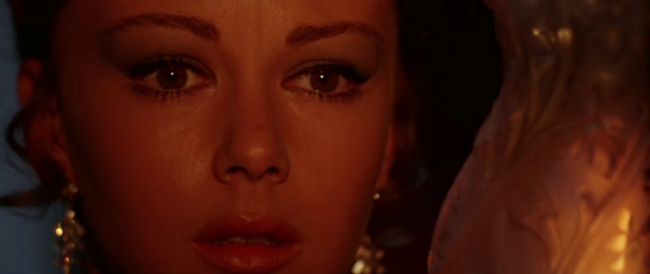
Ringo has one Mexican ally, Rosita, a singer, dancer, and fortune teller played by Nieves Navarro who played the bandits' second in command in the first film. She seems to prefer taking Ringo's side entirely because she's physically attracted to him, something the film sweetly emphasises with pretty unambiguous symbols.

There are so many shots in this movie I thought wonderful, much more than in the first film. I love this shot of Rosita reading Ringo's fortune that has their faces in the foreground and a low angle shot of a mirror giving a high angle shot of her cards:

I also love the scene where Hally visits Ringo after his phony funeral and he goes to lift her funeral veil like a bridegroom but she prevents him, lifting it herself.

This is a display of loyalty from her--confirming that she acknowledges his life--but it also again renders him impotent because she assumes the groom's task for him. Sexual subtext is all over the film, which is no surprise given how thoroughly Ringo's been cuckolded.
The leader of the bandits, who's taken Ringo's place as Hally's de facto husband and is already her sexual partner, is played by the same man who played Ruby's fiance in the first film, Spanish actor George Martin. But in the first film he was the sheriff and was presented as more of a good guy, more morally upright, than Ringo himself. Now he's a sadistic and manipulative tyrant. Not literally the same guy but occupying the same place as Ringo's romantic rival. Only in the first film, Ringo would have only selfish justifications for fighting him while in the second movie imperatives for the good of the community align with Ringo's personal and emotional needs. It's so dreamlike it almost seems like one movie is the dream of the other. But which is which? Either way, they're excellent films, particularly the second, and they're both available free to Amazon Prime subscribers.


