Showing posts with label marilyn monroe. Show all posts

Friday, July 28, 2023

Marilyn's Shadow

While I think vulnerability in artists and characters is good, and the willingness to be vulnerable can be admirable, I dislike the fetishisation of vulnerability. Into this category falls 2022's Blonde, a movie that revels in the misery of Marilyn Monroe's life, starting with the most pessimistic interpretation of the motives of people around her and then imagining things were even worse. In this film, based on a book by Joyce Carol Oates, Marilyn Monroe becomes the Sufferer and director Andrew Dominik presents one minimalist scene after another in which Marilyn, in a dark room or carefully reconstructed publicity photo or movie scene, is compelled to shed tears or is duped into smiling.

Marilyn Monroe, as a subject, is a bit like Alice in Wonderland. No matter how many films have been made or books written about or inspired by the original, there will always be more. Part of the reason is that there's a distinct feeling that every version, no matter how good, never quite scratches the itch. Marilyn Monroe and Alice in Wonderland both leave the audience with the feeling that there's more under the surface, that there are tantalising avenues to explore, but access to these paths are forever blocked. Not necessarily because there are secrets that can never be uncovered, but because the original subject so successfully suggests the beginnings of ideas and stories.

I imagine Joyce Carol Oates and Andrew Dominik researched Marilyn and were captivated by the idea of how much suffering the woman probably endured behind the scenes. Omitted entirely from the film are Marilyn's first husband, her tenacious struggle to become an actress, and her final completed, greatest film, The Misfits. Instead we meet a persistently passive Norma Jean, who can do little more than shed tears as her mother, overcome by madness, nearly murders her. A passive Marilyn is confused as a studio executive bends her over for anal sex in exchange for her big break. A passive Marilyn feebly discusses the complexity of her character in Don't Bother to Knock. A passive Marilyn drifts into a sexual relationship with the sons of Charlie Chaplin and Edward G. Robinson.

The only really sympathetic male character is Arthur Miller, played with real warmth by Adrien Brody. And yet, while the film pores dully over slow motion, recreated shots of The Seven Year Itch and Gentlemen Prefer Blondes to show how Marilyn was exploited by a chorus of demoniac, slobbering men, Blonde doesn't even mention the film Miller wrote for her, arguably her greatest triumph as an actress, The Misfits. Blonde is not interested in what Marilyn accomplished or if she even had any real talent or positive contribution to the cultural landscape. It's little more than an excuse for the filmmakers to experience the simultaneous pleasure of delighting in a beautiful woman's suffering while caricaturing men--some of whom were probably truly responsible for that suffering, and others who were probably truly not.

Ana de Armas certainly bears an uncanny resemblance to Marilyn, though her nose and jawline are different, and she holds nothing back in the role. It's really a brave performance, if only the material were more worthwhile.

Blonde is available on Netflix.

X Sonnet #1722

Where apple dolphins play, the dinner cooked.
Around the party paper, people sang.
A joyous noise compels a nosy look.
Combustive kites propel a lofty bang.
With stable sets of colours, palettes melt.
Repeated pictures slowly soak the years.
Reduction rendered man below the belt.
Impressive scenes could lack a pool of tears.
Increasing names endorse the smokey meal.
Upon the seven seas a secret sucked.
Retreated houses ask a month to deal.
Another wind before the mill was ducked.
With dancing kappa, ponds were conquered first.
The world beyond endures persistent thirst.

Saturday, March 19, 2022

All Too Fitting

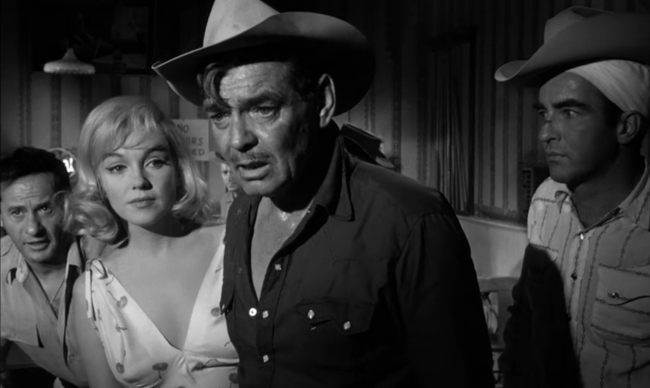
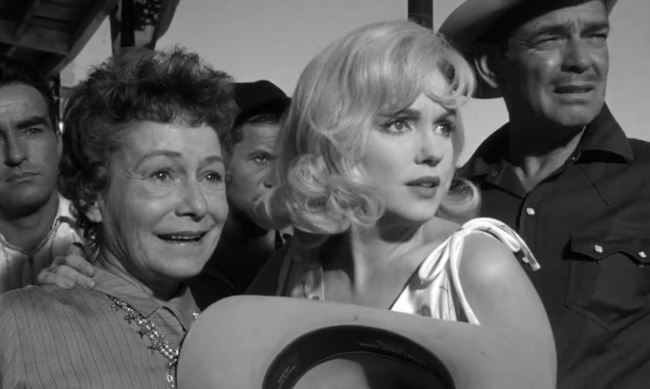
Want to see perfection? It's available for twelve more days on Amazon Prime. Now streaming is 1961's The Misfits, one of the most perfect movies ever made. Marilyn Monroe stars in a movie written by her husband, the great playwright Arthur Miller. And it's kind of a movie about her as well as more generally about people adrift in a world that has no place for them.

It's funny to say that about Monroe or her character, Roslyn. If anyone has a place in this world, surely it's Marilyn Monroe whose image even to-day, even here in Japan, is instantly recognisable. But Arthur Miller and director John Huston's portrait of a woman increasingly desperate to make connexions with men even as she's surrounded by men who adore her is keen as a razor.

Somewhere between the fantasy she can't live up to and her own need for affection is a place of complete psychological isolation. One suspects Monroe knew a lot of guys like Eli Wallach's character, Guido, whose fervour is all about his needs. "Give me a reason," he says, like the Portishead lyric, and that's when she realises the former bomber could "blow up the world" and all he'd be sorry for was himself. How far would Marilyn have to get with a guy before she realised all of his demonstrations of love were entirely selfish? It would be hard enough for most people in her shoes, it was probably twenty times harder in a Hollywood filled with narcissists.

Clark Gable's character, Gay, is the best guy for her, the dream man that probably never existed. "How do you just live?" she asks him when he tells her how simple his life is as a cowboy. In the climax we find his freedom does come at a price his conscience is finally no longer willing to pay. But he'd probably always have a certain equanimity about him, a quality that allows him to tell Roslyn she's so beautiful, "It's kind of an honour," just to sit next to her. But not greedily clutch at her the way Guido does or pathetically the way Perce, Montgomery Clift's character, does.

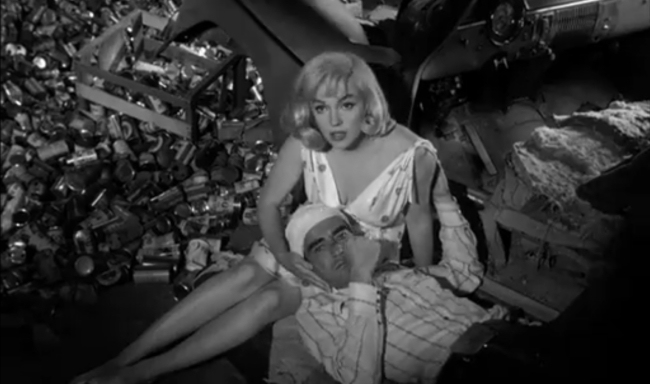
He's another lost soul perfectly cast. But he's looking for a mother, that's clear from his introductory scene where tries to make his real mother proud of his rodeo achievement in a pathetic phone call. He's not as independent as Gay but both of them want something at that dangerous rodeo that Roslyn can't understand. She screams in despair every time Perce falls off the horse. She's always trying to patch up wounds in others that may not even exist, much to Gay's evident irritation. And finally it seems obvious that her response to her own psychological pain is to project it on others rather than try to heal it in herself. Maybe that wasn't even possible.

They keep making biopics about Marilyn Monroe but they needn't bother. Nothing's ever going to top The Misfits.

Wednesday, June 12, 2019

The River is Beautiful but Difficult

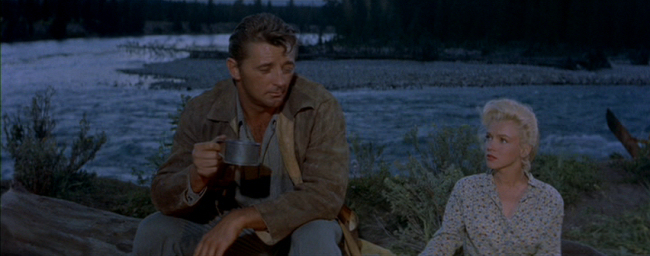
Maybe the idea of an Otto Preminger movie starring Robert Mitchum and Marilyn Monroe put my expectations too high the first time I watched 1954's River of No Return. I find I like it a lot more now--those beautiful location shots in Calgary, Robert Mitchum's performance, Marilyn Monroe's beauty, and the story about necessity and relative morality. It doesn't compare well with Bicycle Thieves, the Italian Neorealist film that influenced it, but it's not bad.

As much as I love Robert Mitchum, and as much as I love him in this movie, he's a key part of what makes Bicycle Thieves the better film. Even though Lamberto Maggiorani wasn't a professional actor, the anxiety that naturally came through his stony face established the pain and desperation as he was forced to make increasingly bad moral choices while his son looked on. Mitchum's version, Matt Calder, always seems cool and satisfied with his own choices, something Mitchum's natural, gentle melancholy makes great to watch but which makes for a less interesting film.

Instead of a father and son whose bicycle is stolen, upon which their livelihood depends, Robert Mitchum and Tommy Rettig play a father and son whose horse and rifle are stolen. They're farmers in harsh, if gorgeous, territory and Matt astutely observes they'll never survive without the horse to plough the fields and without the rifle to protect them from Indians. The 1950s into the 60s had several westerns that began to cast Native Americans in a more sympathetic light; this wasn't one them. But the threat they present to the protagonists is certainly credible.

Marilyn Monroe plays Kay, a dance hall performer who'd befriended Rettig's character, Mark, while Matt was in prison. I don't think Monroe was a bad actress--she gives one of the greatest performances of all time in The Misfits--but in River of No Return she was the victim of bad advice from an elocution coach. The coach infuriated Preminger but Monroe insisted she remain with her on set. An insistence on perfectly enunciating every single word results in a stilted performance as different from her strikingly natural turn in The Misfits as could be. Her musical numbers aren't bad, though, and, of course, she's always easy on the eyes, even if her hair and makeup really aren't appropriate for the scenario.

It's her boyfriend, Weston (Rory Calhoun), who steals Matt and Mark's horse and rifle after Mark helped the couple when they were on a raft, caught in the rapids of the nearby river. He leaves her with them when she refuses to abandon Mark but the moral dialogue of the film mainly consists of Kay defending Weston as a desperate victim of circumstances who needs forgiveness more than punishment. In this, the film almost seems to be a rebuke of Bicycle Thieves, seemingly saying that it's only a foolish, soft-hearted woman who forgives a horse thief. Matters are complicated a little when we find out why Matt was in prison and, like the son in Bicycle Thieves, Mark is forced to assess his father's worth. But Matt, for the most part, never does anything really questionable--his crime was killing a man in defence of another--and Mitchum's performance is perfectly appropriate for the screenplay.

The only really challenging scene is when Matt starts roughly embracing Kay, forcing her to the ground as she struggles, though this follows from a dialogue in which she offered her body in exchange for Weston's life. Later it's implied Matt was trying to make a point, that Kay really didn't understand what she was offering, but the violence of the scene is by no means normal in a 50s Western. Maybe this was the point where Preminger and screenwriter Fenton wanted to show Matt doing something truly wrong but the motivations come across as too muddled.

But it's a beautiful film. The locations are great and I loved the raft scenes created without process shots, where you can actually see the actors or the stunt people are on a raft in the river, even if the rapids aren't quite as rapid as they need to be to imply peril.