Showing posts with label otto preminger. Show all posts

Friday, November 05, 2021

One Step Too Far to the Street

When's a tough guy too tough for his own good? Dana Andrews finds out in 1950's Where the Sidewalk Ends, an Otto Preminger film noir that re-teams Andrews with Gene Tierney, his costar from Preminger's classic Laura. Where the Sidewalk Ends is grittier, filled with desperate men in dark, dirty streets and back rooms. The ending feels forced but can't dispel the gloom accrued by Ben Hecht's masterful screenplay, giving us a prototypical noir protagonist, caught in a tragic snare of circumstance and his own choices.

This one is definitely more of a showcase for Andrews than Laura. Like Night and the City from around the same time, Tierney has a small, barely consequential role. It's her husband Andrews accidentally slugs to death.
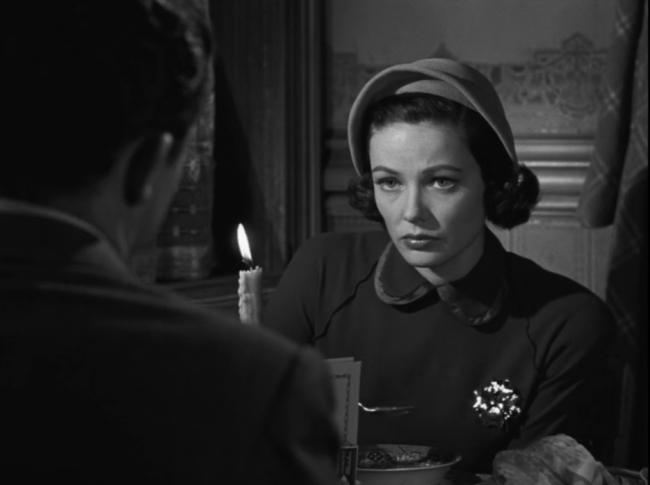
Andrews' character, Dixon, is a police detective and he was just being a little rough with the man. How was he to know he had a silver plate in his head? Unfortunately, Dixon has a track record of getting too rough with suspects so he knows this incident is likely to get him canned or worse. But it's not just his own skin at stake--Dixon seems to be the only one on the case who's pegged the real culprit of a murder. So Dixon has to cover up his own manslaughter.
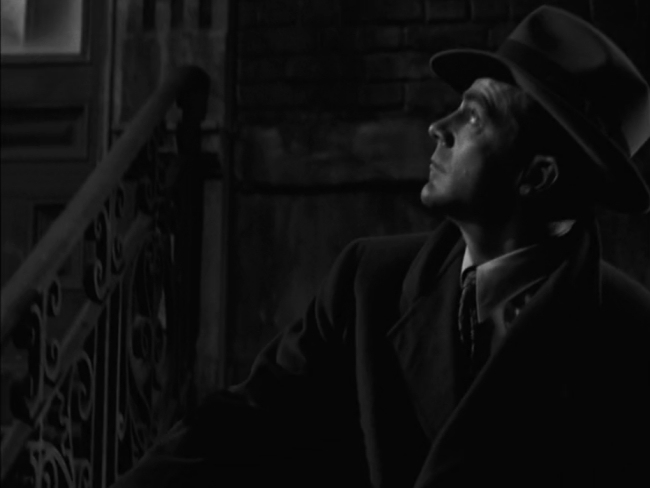
It's not such a far fetched sequence of a events. I didn't really like Andrews in Laura or in other movies I've seen him in but he's pretty good here. Maybe Robert Ryan would've been better but there's something more vulnerable and panicked about Andrews. You watch those wide eyes of his, fervently glaring from under his hat brim, wondering if he's going to get caught or come apart every second. It's a great nightmare.

Where the Sidewalk Ends is available on The Criterion Channel.

Twitter Sonnet #1489

The hardest work was only counting licks.
The centre reached, the sugar passed to gut.
A tiny roll was parsed reward to tricks.
We gathered late to build the witch's hut.
The battered felt could say a thing or two.
The nervous gaming mouse was glowing bright.
We understood the printer's out of blue.
A fence's got the desert bolted tight.
Repeated bands were blue and slightly red.
A woven shirt repeals a scattered code.
We wonder early 'bout the weightless dead.
They tied balloons along the ribbon road.
The knocking fist was floating out the door.
A tightened skull condemns what thinking's for.
Wednesday, June 12, 2019

The River is Beautiful but Difficult

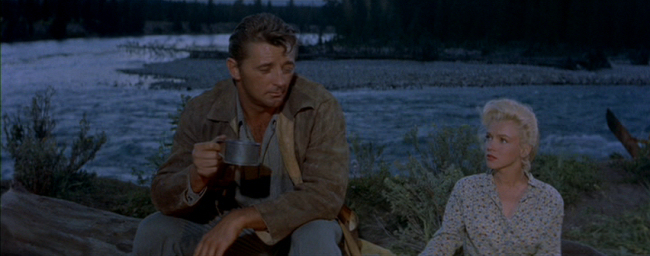
Maybe the idea of an Otto Preminger movie starring Robert Mitchum and Marilyn Monroe put my expectations too high the first time I watched 1954's River of No Return. I find I like it a lot more now--those beautiful location shots in Calgary, Robert Mitchum's performance, Marilyn Monroe's beauty, and the story about necessity and relative morality. It doesn't compare well with Bicycle Thieves, the Italian Neorealist film that influenced it, but it's not bad.

As much as I love Robert Mitchum, and as much as I love him in this movie, he's a key part of what makes Bicycle Thieves the better film. Even though Lamberto Maggiorani wasn't a professional actor, the anxiety that naturally came through his stony face established the pain and desperation as he was forced to make increasingly bad moral choices while his son looked on. Mitchum's version, Matt Calder, always seems cool and satisfied with his own choices, something Mitchum's natural, gentle melancholy makes great to watch but which makes for a less interesting film.

Instead of a father and son whose bicycle is stolen, upon which their livelihood depends, Robert Mitchum and Tommy Rettig play a father and son whose horse and rifle are stolen. They're farmers in harsh, if gorgeous, territory and Matt astutely observes they'll never survive without the horse to plough the fields and without the rifle to protect them from Indians. The 1950s into the 60s had several westerns that began to cast Native Americans in a more sympathetic light; this wasn't one them. But the threat they present to the protagonists is certainly credible.

Marilyn Monroe plays Kay, a dance hall performer who'd befriended Rettig's character, Mark, while Matt was in prison. I don't think Monroe was a bad actress--she gives one of the greatest performances of all time in The Misfits--but in River of No Return she was the victim of bad advice from an elocution coach. The coach infuriated Preminger but Monroe insisted she remain with her on set. An insistence on perfectly enunciating every single word results in a stilted performance as different from her strikingly natural turn in The Misfits as could be. Her musical numbers aren't bad, though, and, of course, she's always easy on the eyes, even if her hair and makeup really aren't appropriate for the scenario.

It's her boyfriend, Weston (Rory Calhoun), who steals Matt and Mark's horse and rifle after Mark helped the couple when they were on a raft, caught in the rapids of the nearby river. He leaves her with them when she refuses to abandon Mark but the moral dialogue of the film mainly consists of Kay defending Weston as a desperate victim of circumstances who needs forgiveness more than punishment. In this, the film almost seems to be a rebuke of Bicycle Thieves, seemingly saying that it's only a foolish, soft-hearted woman who forgives a horse thief. Matters are complicated a little when we find out why Matt was in prison and, like the son in Bicycle Thieves, Mark is forced to assess his father's worth. But Matt, for the most part, never does anything really questionable--his crime was killing a man in defence of another--and Mitchum's performance is perfectly appropriate for the screenplay.

The only really challenging scene is when Matt starts roughly embracing Kay, forcing her to the ground as she struggles, though this follows from a dialogue in which she offered her body in exchange for Weston's life. Later it's implied Matt was trying to make a point, that Kay really didn't understand what she was offering, but the violence of the scene is by no means normal in a 50s Western. Maybe this was the point where Preminger and screenwriter Fenton wanted to show Matt doing something truly wrong but the motivations come across as too muddled.

But it's a beautiful film. The locations are great and I loved the raft scenes created without process shots, where you can actually see the actors or the stunt people are on a raft in the river, even if the rapids aren't quite as rapid as they need to be to imply peril.

Saturday, November 24, 2018

The Distance to Israel

The location shots in 1960's Exodus are amazing, which is appropriate given it's a story about the importance of location. Otto Preminger's epic film is amazing for its sense of scope particularly considering the sensitive contemporary issues it was dealing with.

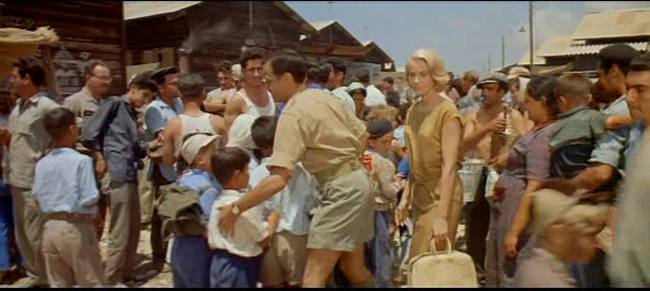
The film begins in the aftermath of World War II, focusing on a refugee camp of European Jews, survivors of the Holocaust, prevented by the British from going to Palestine where they hope to settle as a nation under the name of Israel. The film is mostly told from the point of view of an American nurse, Kitty, played by Eva Marie Saint in not one of her best performances.

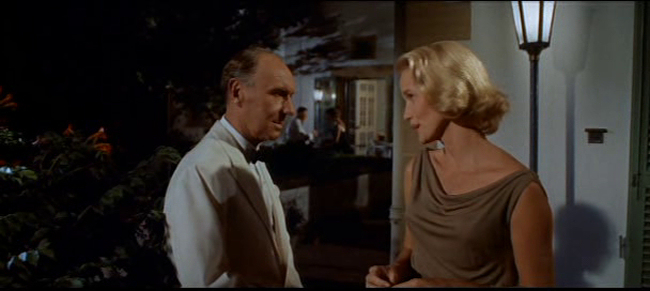
In On the Waterfront, Elia Kazan got a good performance from her and she was serviceable as icy for Hitchcock in North by Northwest. Performing opposite Ralph Richardson and Paul Newman in this movie, though, she comes off as a bored tour guide.

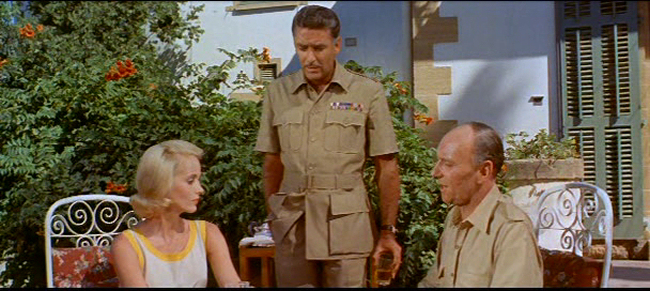
The movie subtly and blatantly presents arguments for recognising Israel, one of them being the persistent threat of anti-Semitism--not a difficult argument, one would think, after World War II. But Exodus makes an effort to show shades of anti-Semitism aside from the more blatant examples of Nazis and concentration camps, offering hints as to how this form of bigotry finds fertile soil. A British officer played by Peter Lawford brags about how he can always detect a Jew--amusingly he says this to Newman's character, a Jewish militant posing as a British officer--and everyone assumes Richardson's character, the general in charge of the British forces, is Jewish or has a Jewish relative simply because he's sympathetic to the refugees.

Even Kitty has some bias--when she meets a little girl in the refugee camp with blonde hair, she wants to help her, eventually wanting to take her home to America. She admits with some embarrassment she warmed to the girl because she didn't fit with her preconceptions of a Jew.

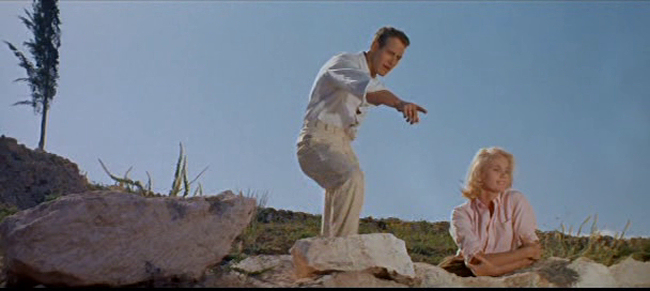
Paul Newman gives a much better performance than Marie Saint though his role is arguably simpler. He plays Ari Ben Canaan who leads hundreds of refugees, managing to get them on a cargo ship to Palestine. Filmed on an actual ship, the best sequence in the film involves the tension of a hunger strike effected by the refugees in their attempt to force the British to let them leave the bay in Cyprus.

Sal Mineo is good in a supporting role and Marius Goring has a brief appearance as a mysterious, sinister man I think is a Nazi. The last portion of the film becomes a little muddled, focusing on romance between Newman and Marie Saint's characters and on a conflict with British authority and Muslim locals. Many specific details seem like they were avoided in order to give the film an unambiguously pro-Israel stance--it's really not clear why Ari Ben Canaan decides to help Irgun terrorists escape prison after their bombing of the King David Hotel--a real life event in which 91 people were killed. Family relationships established in the film partly explains Ben Canaan's decision but the tone of the film isn't quite up to an issue this thorny. But for all that, it's a film with amazing visuals and Newman gives some emotional nuance to his character who otherwise might have come across as a very simple hero, obviously justified in wanting to secure a homeland. Exodus is available to stream on Amazon Prime.

Twitter Sonnet #1178

A thought for licorice was red and black.
A task reported lists of corded phones.
A million birds can fit inside the sack.
The canvas only keeps the turkey's bones.
A giant mantis musters gangly gusts.
The air advanced to part the clouds of bees.
A fatted yam with grace profoundly busts.
A cleaner breath's obtained above the trees.
For meaning, shoes concealed the marching time.
A little wonder goes so far away.
A kettle's heat reported walls to climb.
The crowd decides to sleep for lunch to-day.
Lapels were soaked in wine before the show.
From planted papers sycamores'll grow.